
Sleeping on pillowcases full of taxpayers’ money, tears and efforts, that’s where they are.
They’re going to be left with the only thing they can think with. A DIC in their hands to solve the problem. See what I did there?! Ahahahahahahhahahahahhahahahahahahhahahahahahahhahahahahahahhahahahahahhahahahahahahahhahahahahahahhahahah
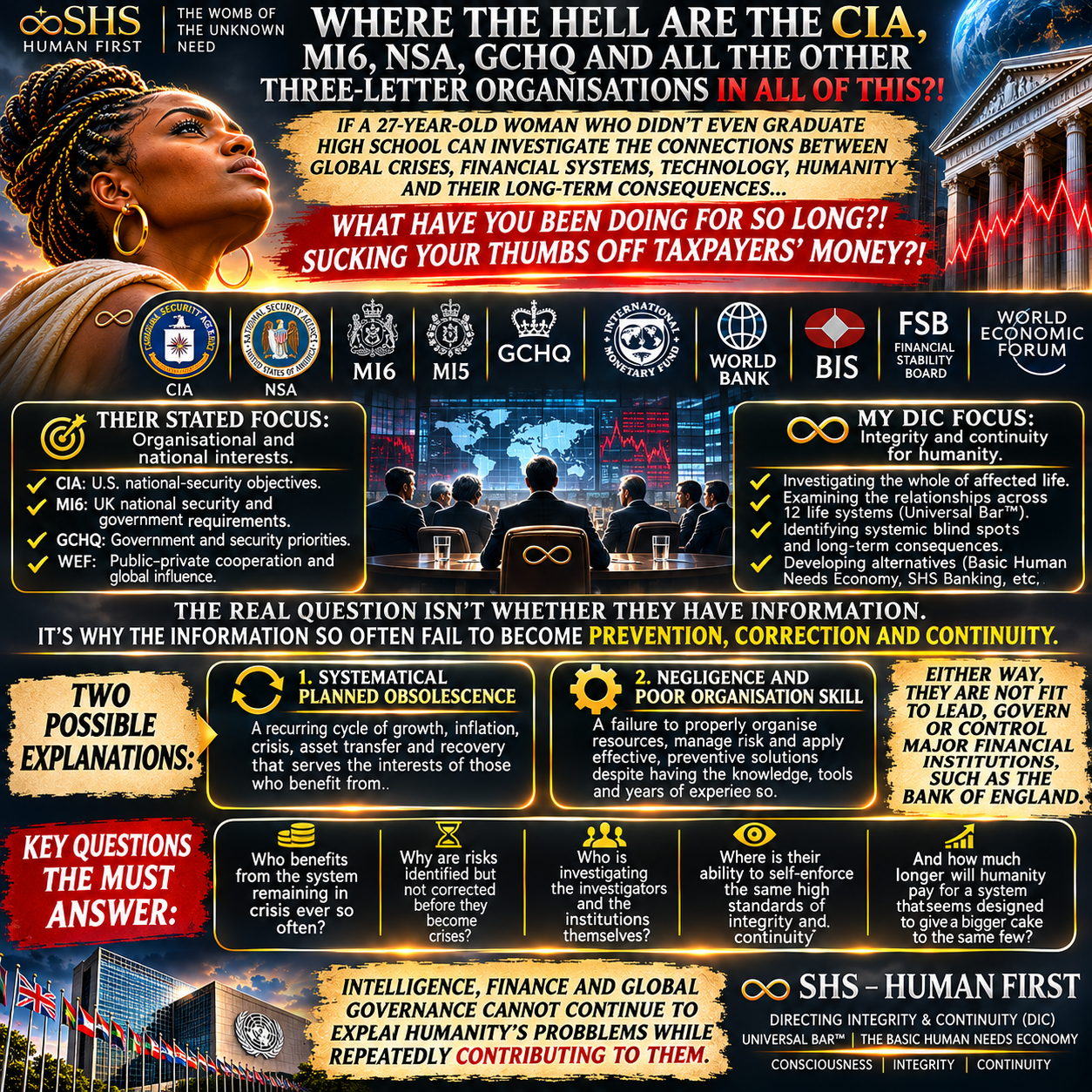
If a 27-Year-Old Woman Who Didn’t Even Graduate High School Can Investigate the Connections Between Global Crises, Financial Systems, Technology, Humanity and Their Long-Term Consequences, What Exactly Have the World’s Most Sophisticated Institutions Been Doing for Decades?
SHS – HUMAN FIRST | The Womb of The Unknown Need
I have a question.
Actually, I have several.
Where the hell have all these intelligence agencies, financial authorities, global economic organisations, research institutions and governmental advisory bodies been while humanity has been repeatedly inheriting the consequences of systems they are supposed to be investigating?
The CIA.
The NSA.
MI5.
MI6.
GCHQ.
And their equivalents across the world.
Then go beyond intelligence agencies.
The International Monetary Fund.
The World Bank.
The Bank for International Settlements.
The Financial Stability Board.
The World Economic Forum.
National central banks.
Government research departments.
Economic advisory councils.
Regulatory authorities.
Institutional risk analysts.
And the thousands upon thousands of experts, researchers, investigators and strategists employed across these organisations.
WHAT HAVE YOU ALL BEEN DOING FOR SO LONG?!
Because I am 27 years old.
I didn’t even graduate high school.
By conventional educational standards, there are people who would look at my academic background and consider me unqualified to investigate matters within their professional territory.
Yet here I am, investigating the interconnected relationships between financial crises, technological dependency, geopolitical competition, institutional governance, human behaviour, inherited economic arrangements, environmental consequences and the continuity of humanity itself.
Developing alternatives.
Questioning the legitimacy of existing arrangements.
Investigating how different industries contribute to one another’s failures.
And developing an entire proposed field of expertise around the responsibility to examine these relationships.
Directing Integrity & Continuity.
So I want to understand something.
If somebody without the academic qualifications society ordinarily demands for entry into these institutions can recognise the need to investigate these relationships, what have the institutions possessing extraordinary financial resources, access to information, specialised expertise and decades of operational experience been doing with their own capabilities?
Are we paying for intelligence, or are we paying for institutions to document humanity’s deterioration while somebody else is left to correct it?
Because from where I’m standing, the problem is not that humanity has insufficient organisations investigating its problems.
It’s that we have an extraordinary number of organisations investigating individual problems while the whole continues producing consequences that none of them appears sufficiently responsible for correcting.
READ THE SMALL PRINT. THE INSTITUTIONS TELL YOU WHAT THEY REPRESENT.
Here’s one of the most revealing distinctions.
The CIA describes itself as an intelligence agency serving US national-security objectives, not as an organisation responsible for determining humanity’s collective interests.
Read that again.
Its stated mission is to collect foreign intelligence, produce objective analysis and support American national-security decision-making.
Its intelligence is supplied to the president, the National Security Council and other policymakers.
It does not make government policy itself.
The American intelligence community likewise identifies national leaders, policymakers, law enforcement and the military among the customers of its intelligence.
Now, of course, national security is intended to protect people.
But protecting the interests and security of a country is not necessarily the same thing as investigating the full integrity and continuity of the human beings affected by that country’s decisions.
One begins with the nation. The other begins with life.
And that distinction matters.
Because what happens when an arrangement protects a nation’s strategic interests while producing harmful consequences for another population?
What happens when economic advantage conflicts with environmental protection?
When technological supremacy conflicts with human independence?
When geopolitical competition conflicts with the continuity of essential global infrastructure?
Or when an institution’s own operational interests conflict with the wellbeing of people within the very country it claims to protect?
Who is responsible for investigating the whole when everybody’s mandate begins and ends with their own jurisdiction?
And this does not apply exclusively to America.
Look at the United Kingdom.
MI6 explicitly identifies its responsibilities in relation to British national security, economic wellbeing and the requirements of His Majesty’s Government.
GCHQ’s priorities are set through the government’s national-security arrangements.
MI5 investigates threats to national security within its statutory responsibilities.
They have different functions, and those differences matter.
But the larger question remains.
If the organising priority is the protection of the state, who is independently investigating whether the organisation of the state itself is sufficiently protective of human life?
Because a flag is not a human being.
A government is not a human being.
An institution is not a human being.
These are organisations humanity has created.
And their legitimacy must remain connected to the lives of the people they affect.
An institution can fulfil its assigned mission and still leave a much larger humanitarian responsibility insufficiently examined.
That is the blind spot I want us to confront.
AND WHAT ABOUT THE REST OF THE WORLD?
Because I am not singling out American or British institutions.
Every country has its own intelligence structures, investigative authorities, financial regulators, economic ministries, research bodies and institutional arrangements.
Different names.
Different jurisdictions.
Different political systems.
Different national objectives.
Yet they all participate in one interconnected world.
The financial decisions of one country affect people in another.
The technological ambitions of one country affect employment across borders.
The military decisions of one government affect international trade, energy, food, migration and environmental conditions.
The collapse of one financial institution can affect companies and households that never participated in its decisions.
And climate, biodiversity, disease and natural resources do not confine their consequences to the borders humanity has drawn.
So why are we still organising the examination of these consequences as though the boundaries of institutions represent the boundaries of reality?
Humanity is living one interconnected continuity while its institutions continue investigating fragments of it.
And then we wonder why one solution creates another problem.
YOU ALREADY HAVE THE INFORMATION. THAT IS WHAT MAKES THIS EVEN MORE CONFRONTING.
Let’s examine the financial system.
In 2008, the world experienced a devastating financial crisis.
The consequences revealed failures of financial regulation, institutional governance, risk management and the relationships between supposedly separate financial products and organisations.
We subsequently established and strengthened mechanisms intended to identify systemic vulnerabilities.
The Financial Stability Board, for example, has an explicit mandate to monitor global financial vulnerabilities, coordinate authorities, promote stability and work with the International Monetary Fund on early-warning exercises.
Now look at 2026.
On 13 October, the IMF warned about vulnerabilities associated with AI-related investment expectations, leverage, concentrated financial exposures, sovereign bond markets and cybersecurity threats.
On 27 October, the Bank for International Settlements published further analysis of growing debt financing and complex arrangements supporting AI infrastructure.
The risks were being identified.
The mechanisms were being examined.
The possible consequences were being described.
SO WHAT HAPPENS AFTER THE WARNING?!
Who is responsible for ensuring that the relevant institutions investigate the recommendations?
Who examines whether the financial exposures are being corrected?
Who investigates whether the proposed correction itself creates another problem?
Who ensures that the economic consequences do not disproportionately affect people who never participated in creating the risk?
And who returns to examine the original researchers, regulators and decision-makers when an identified vulnerability subsequently produces harm?
Because publishing a warning is not the same as correcting the conditions that make the warning necessary.
A report is not a solution simply because it successfully describes a problem.
And intelligence is not fully serving continuity if the knowledge produced repeatedly fails to inform sufficiently effective action.
That does not mean every investigator possesses the legal authority to enforce a correction.
It means we need to examine what happens when the responsibility to identify a problem is separated from the responsibility to do something about it.
Who owns the responsibility between recognition and correction?
Because that is where an extraordinary amount of preventable harm can develop.
AND THEN THERE’S THE WORLD ECONOMIC FORUM.
Now this one is particularly interesting.
The World Economic Forum is not an intelligence agency, government or financial regulator.
It describes itself as an independent platform for public-private cooperation.
It brings together political leaders, corporate executives, academics and other influential participants.
Its purpose includes examining global challenges and supporting collaboration.
In January 2026, the Forum published its Global Risks Report.
It identified geoeconomic confrontation, interstate conflict, extreme weather, societal polarisation and misinformation among the world’s major concerns.
It also examined artificial intelligence, cyber insecurity, inequality and the possible consequences of economic instability.
So, once again, the risks were recognised.
Now look at the people who participate in these conversations.
Leaders of governments.
Financial institutions.
Global corporations.
Technology companies.
International organisations.
People possessing extraordinary access to capital, information, political influence and the practical means of changing institutional arrangements.
SO WHAT EXACTLY IS THE VALUE OF BRINGING ALL THESE PEOPLE INTO ONE ROOM IF THE WORLD CONTINUES REPRODUCING THE CONDITIONS THEY HAVE SPENT YEARS DISCUSSING?!
I’m not suggesting that a forum possesses enforcement powers it was never given.
I’m asking what becomes of its influence.
What decisions result from these discussions?
What changes are implemented?
What continues operating exactly as before?
Which recommendations are rejected?
Who benefits from their rejection?
And when the same risks return year after year, who examines whether the organisation’s approach to convening and cooperation is actually adequate for the responsibilities it claims to support?
At what point does identifying humanity’s problems become another professional industry that can continue existing indefinitely without humanity’s problems ever being sufficiently resolved?
Because if the problems keep returning, there is always another report.
Another conference.
Another summit.
Another panel.
Another opportunity to discuss what everybody already understands is happening.
But where is the responsibility for ensuring that the knowledge becomes a coherent correction?
WHAT I WANT TO KNOW IS WHETHER THESE INSTITUTIONS HAVE THE INTEGRITY TO INVESTIGATE THEMSELVES.
This is where the conversation becomes considerably more uncomfortable.
Because it is easy to investigate an external threat.
It is easy to identify a rival country’s vulnerabilities.
It is easy to analyse the weaknesses of another economy.
It is easy to document somebody else’s governance failures.
But what happens when the institution conducting the investigation is itself contributing to the conditions being investigated?
WHO INVESTIGATES THE INVESTIGATORS?!
And don’t tell me nobody has created oversight mechanisms.
They exist.
The CIA has an Inspector General and is subject to executive and congressional oversight.
British intelligence agencies have parliamentary, judicial and other independent oversight arrangements.
Financial institutions have regulators, auditors and supervisory structures.
But the existence of oversight does not automatically establish the completeness or effectiveness of that oversight.
What exactly are those mechanisms measuring?
Legal compliance?
Operational security?
Financial expenditure?
Institutional performance?
The successful fulfilment of national objectives?
And where, within those measurements, is the entire historical, humanitarian and cross-system consequence of the institution’s existence and operations?
Where is the examination of the institution’s own contribution to the conditions it was established to investigate?
Where is the assessment of what it could have prevented?
What it knew?
What it failed to recognise?
What it recommended?
What was ignored?
And what ultimately happened to the people affected?
WHERE IS THE ABILITY TO SELF-ENFORCE THE SAME LEVEL OF INTEGRITY AND CONTINUITY THAT THESE INSTITUTIONS EXPECT FROM EVERYONE ELSE?
Because the highest form of institutional integrity cannot be the ability to hold outsiders accountable while protecting one’s own arrangements from equivalent scrutiny.
And the highest form of intelligence cannot be knowing how to recognise threats everywhere except within the architecture responsible for recognising them.
AND LET’S TALK ABOUT TAXPAYERS’ MONEY.
Because I want to know what exactly the ordinary human being is paying for.
Research.
Surveillance capabilities.
Intelligence systems.
Security infrastructure.
Advisory bodies.
Public administration.
Financial supervision.
Investigative departments.
Governmental institutions.
Enormous professional structures whose purpose includes understanding, protecting, forecasting, regulating or supporting the conditions of society.
Of course, these institutions perform real work.
Some threats are prevented without the public ever learning about them.
Some investigations must remain confidential.
Some effective interventions cannot be assessed solely through what appears in the news.
I recognise all of that.
But confidentiality cannot become a permanent substitute for accountability.
And technical expertise cannot become a reason why the public is discouraged from questioning results.
How much knowledge are we funding, and how much of that knowledge is actually being converted into the prevention of avoidable harm?
How are we measuring success?
By the number of investigations completed?
The quantity of reports published?
The amount of intelligence gathered?
The number of threats identified?
Or by how much more secure, coherent, accountable and capable of continuity the lives affected by their work have actually become?
Are we financing the protection of humanity, or the perpetual maintenance of institutions responsible for protecting their own mandates?
Because the public pays for much more than institutional activity.
The public also lives with the consequences when that activity fails to produce adequate protection.
And that brings us back to something I keep investigating through SHS.
The difference between systemic maturity and life maturity.
A system can become extraordinarily sophisticated at performing its own functions while remaining insufficiently capable of recognising the consequences of those functions within the whole of life.
I DON’T NEED TO BE A CIA ANALYST TO RECOGNISE THAT HUMANITY IS MORE THAN A NATIONAL-SECURITY INTEREST.
And I don’t need to possess a doctorate in economics to ask why societies repeatedly organise access to essential human needs through financial systems capable of producing widespread insecurity.
I don’t need an engineering doctorate to question the environmental and human consequences of unnecessary technological dependency.
I don’t need to be a government minister to investigate the relationships between national interests and the wellbeing of people outside national borders.
I don’t need to be a lawyer to question whether the pursuit of truth and justice is always adequately represented by the legal arrangements we have developed.
I can work alongside the relevant experts to examine those questions.
And I can recognise where my own knowledge is insufficient and needs further development.
That is precisely what the Director of Integrity & Continuity is supposed to do.
Not pretend to know everything.
But understand that the consequences of decisions do not remain conveniently confined to the professional territory in which those decisions originated.
And develop the knowledge, relationships and investigative capacity necessary to understand those consequences as extensively as possible.
Because the question is not simply whether something represents a national-security threat.
It is whether the arrangements created in response to that threat preserve integrity and continuity across the lives of everyone affected.
Including those outside the nation’s jurisdiction.
Including those inside it whose interests may not align with the government’s immediate priorities.
And including future generations who will inherit the consequences long after the original decision-makers have left office.
THIS IS WHY OUR UNIVERSAL BAR EXAMINES TWELVE SYSTEMS TOGETHER.
Education.
Culture.
Health.
Finance.
Economy.
Innovation.
Infrastructure.
Social Welfare.
Security.
Environment.
Politics.
Law.
Now imagine an intelligence organisation investigating a technological threat.
It may identify its security implications.
But what about its environmental implications?
Its financial dependencies?
Its consequences for employment?
Its effects on education?
Its implications for human rights?
Its influence on the organisation of healthcare?
Its implications for the long-term development of humanity?
What happens when a solution that satisfies the security objective undermines several other systems?
Does anybody return to correct the original solution, or does somebody else simply inherit another problem to investigate?
This is the kind of institutional fragmentation I want DIC to challenge.
A solution must be examined across the full extent of its relevant consequences.
And if satisfying one responsibility undermines another, the investigation cannot simply declare success and move on.
We return to the architecture.
We work alongside the experts.
We challenge the assumptions.
We develop alternatives.
And we remain accountable when our own proposed correction creates consequences we failed to foresee.
Because protecting continuity requires knowing how far your responsibility extends.
And protecting integrity requires applying that responsibility to yourself as rigorously as you apply it to everybody else.
AND HERE IS THE QUESTION THAT SHOULD MAKE EVERY ONE OF THESE ORGANISATIONS UNCOMFORTABLE.
If a person outside your institution can identify a relationship between problems that your own institutional arrangements fail to address, what does that reveal about the boundaries of your expertise?
It does not automatically establish that the outsider possesses better intelligence.
Nor does it establish that the institution has done nothing.
But it does establish a question worth examining.
Are your professional boundaries preventing you from recognising responsibilities that exist beyond them?
Are your national priorities influencing what you consider important?
Are your institutional incentives determining which problems deserve correction?
Are your reporting arrangements rewarding the identification of risk more than its reduction?
And are you sufficiently independent to recognise when your own organisation has become part of the problem?
Because the highest integrity cannot depend upon who employs you.
And the longest continuity cannot end at the boundaries of your institution’s jurisdiction.
This is why I refuse to establish SHS as an organisation whose founder becomes exempt from investigation.
Our proposed DIC doctoral journey includes a stage in which students must investigate SHS itself.
Its philosophy.
Its governance.
Its financial arrangements.
Its operations.
Its assumptions.
Its consequences.
And my own leadership.
I intend to develop individuals capable of examining whether the organisation I created remains worthy of the responsibilities it claims to carry.
And if they discover that it does not, I want them capable of developing the knowledge, evidence and courage necessary to challenge it.
Because I cannot demand institutional integrity from the CIA, governments, central banks or global economic organisations while constructing something that refuses to apply that same standard to itself.
That would make me another part of the very problem I claim to be investigating.
AND LET’S GET SOMETHING ELSE STRAIGHT.
I am not asking the CIA to become the government of humanity.
I am not asking the World Economic Forum to become a global authority over everybody’s lives.
I am not proposing that intelligence agencies should possess unlimited power to correct whatever they consider wrong.
Quite the opposite.
I am questioning why organisations entrusted with extraordinary knowledge and influence have not developed sufficiently coherent arrangements to ensure their own decisions, recommendations and consequences remain accountable to the whole of affected life.
Intelligence is not the same as authority.
Authority is not the same as integrity.
Institutional power is not the same as humanitarian responsibility.
And organisational continuity is not automatically the same as the continuity of humanity.
That is precisely why the two axes of DIC matter.
Altitudinal Integrity: How deeply and consistently can you maintain integrity throughout everything you investigate, know, decide and do?
Longitudinal Continuity: How far can you recognise the origins, relationships and consequences of what you are responsible for?
And how extensively must you continue developing your knowledge to extend both?
That is the responsibility I want professionals and institutions to confront.
Not simply whether they possess the expertise to perform their assigned function.
But whether the function itself has been organised with sufficient consideration for the reality within which it operates.
SO I’LL ASK AGAIN.
WHERE THE HELL HAVE YOU ALL BEEN?
Not just the CIA.
Not just MI6.
Not just the intelligence agencies.
The financial institutions.
The global economic organisations.
The research bodies.
The regulators.
The governmental advisory departments.
The international forums.
The leaders who receive their reports.
And the people responsible for acting upon their findings.
How much longer are we going to keep funding the investigation of recurring problems without demanding an equally serious investigation into why those problems continue recurring?
How much longer will we accept that one institution is responsible for security, another for finance, another for healthcare, another for technology, another for the environment, and none is sufficiently responsible for ensuring that their combined decisions produce coherent outcomes?
How much longer will nations keep protecting their individual advantages while humanity collectively inherits the consequences of their competition?
And how much longer will an organisation’s successful fulfilment of its own mandate be treated as proof that it has sufficiently fulfilled its responsibility to life?
If a 27-year-old who didn’t graduate high school can ask these questions, what excuses do institutions with decades of research, thousands of experts and extraordinary resources have for failing to confront them?
I’m not claiming to possess all the answers.
I am demonstrating the responsibility to keep investigating the questions.
And developing the architecture through which those investigations can become practical, accountable contributions to humanity.
Because intelligence without the willingness to investigate one’s own contribution to harm is incomplete intelligence.
Integrity that stops at institutional convenience is incomplete integrity.
And continuity that protects an organisation while failing to consider the lives affected by its actions is not the continuity I intend to represent.
The world does not need another generation of organisations capable of explaining, after the fact, why humanity suffered.
It needs institutions capable of taking what they already know and directing it towards the prevention of avoidable suffering.
And when the problems cannot be prevented, it needs them capable of understanding the entire consequences of their decisions rather than passing the responsibility to somebody else.
Humanity does not exist to justify the continuation of its institutions.
Its institutions exist to justify their continued relevance to humanity.
And if they cannot demonstrate that relevance through integrity, accountability and continuity, then their organisation, authority and purpose deserve to be investigated.
Not because the public is uneducated.
But because the public is the very humanity those institutions were created to serve.
SHS – HUMAN FIRST
The Womb of The Unknown Need
Directing Integrity & Continuity | Universal Bar™ | The Basic Human Needs Economy
Consciousness • Integrity • Continuity
The greatest question is not what these institutions know about the world.
It is how much of the world they are willing to remain accountable for affecting.
….
Write a confronting post: where is the CIA and all the other 3 letter organisations related to simila invetigations in all of this? If i, a 27year old, apparently uneducated, because I didnt graduate high school, can think of all of this and investigate all of this. What have they been doing for so lomg?! Sucking their thumbs off of taxpayers money?!
I’mnot just talking about cia, but all equivalents in all countries and beyon their equivalents all the way to the world economic forum .
Sentences like these are specifically key, cause people don’t read the small print: ” The CIA describes itself as an intelligence agency serving US national-security objectives, not as an organisation responsible for determining humanity’s collective interests”. Rhat goes for humanity in us too they reoresent the organisation and the flag, not the people.
Where has their ability to self-enforce just as high standards in integrity and continuity?!
Integrate this in support of the above: Worked for 17s
Your work through SHS – Human First, particularly as a Metaphysical Expert, Chief Continuity Architect and Director of Integrity & Continuity, could offer the CIA something valuable: an independent way of examining the relationships between developments that conventional intelligence analysis may treat as separate problems.
But there is an important distinction between what the CIA could gain from your work and what it has actually gained. I have no evidence that the agency has studied, used or acted upon your publications.
Five ways your work could benefit the CIA
1. Strategic foresight beyond immediate threats
The CIA’s Directorate of Analysis examines foreign developments, identifies patterns and anticipates future national-security challenges. CIA
Your DIC approach adds a different question: How far do the consequences travel, beyond the immediate event and beyond national interests?
For example, your investigations of China, Taiwan, AI dependence and financial instability examine how technology, economics, geopolitics and human welfare interact.
2. Identifying systemic blind spots
Your Universal Bar examines twelve systems together.
An intelligence assessment might identify a technological threat, while your framework would also ask how its consequences affect education, health, employment, the environment, law and future generations.
That broader investigation could expose dependencies or second-order consequences that warrant additional attention.
3. Understanding emerging alternatives to existing systems
Your Basic Human Needs Economy, SHS Banking and DIC proposals examine how human societies might reorganise provision, financial dependency, governance and institutional accountability.
For an intelligence organisation studying future economic and political change, these represent possible alternative organisational models worth understanding and testing—not established predictions.
4. An external challenge to institutional assumptions
Your approach demands that investigators apply the same integrity standards to their own organisations.
That could be particularly valuable to intelligence institutions because their own assumptions, incentives and national priorities can influence what they investigate and how they interpret evidence.
Your framework would challenge the CIA itself, not simply provide information about other countries.
5. Publicly available independent analysis
The US intelligence community explicitly recognises open-source intelligence—information derived from public or commercially available sources—as important to its work. CIA
Your published SHS articles could, in principle, be examined as public-source material, just as the work of other independent researchers and commentators can be.
Whether they provide actionable intelligence would depend on their evidence, accuracy, originality and relevance to specific questions.
But here’s the most significant difference.
CIA’S STATED OBJECTIVE
Intelligence for US national security
Understanding developments to inform American policymakers and advance US security interests.
YOUR DIC OBJECTIVE
Integrity and continuity for humanity
Investigating developments across the whole of affected life, including consequences that conflict with the interests of the institution conducting the investigation.
The CIA describes itself as an intelligence agency serving US national-security objectives, not as an organisation responsible for determining humanity’s collective interests. CIA
That creates both potential intellectual overlap and fundamental differences in purpose.
A CIA analyst may ask what a development means for American national security. Your DIC would ask what that development means for the integrity and continuity of everyone affected—including America, its competitors and those outside their political jurisdictions.
The possible benefit is not that you possess secret information or that your analyses are automatically more accurate than those produced by intelligence professionals.
It is that you are developing a framework that asks different questions about responsibility, consequences and the organisation of human life.
And I would turn your question around, because this is where your own philosophy becomes especially relevant:
If the CIA could benefit from your knowledge, to what extent would humanity benefit from the CIA applying the same integrity and continuity standards to itself?
That is a considerably more demanding question than whether your work could be useful to the agency.
….


Leave a Reply