
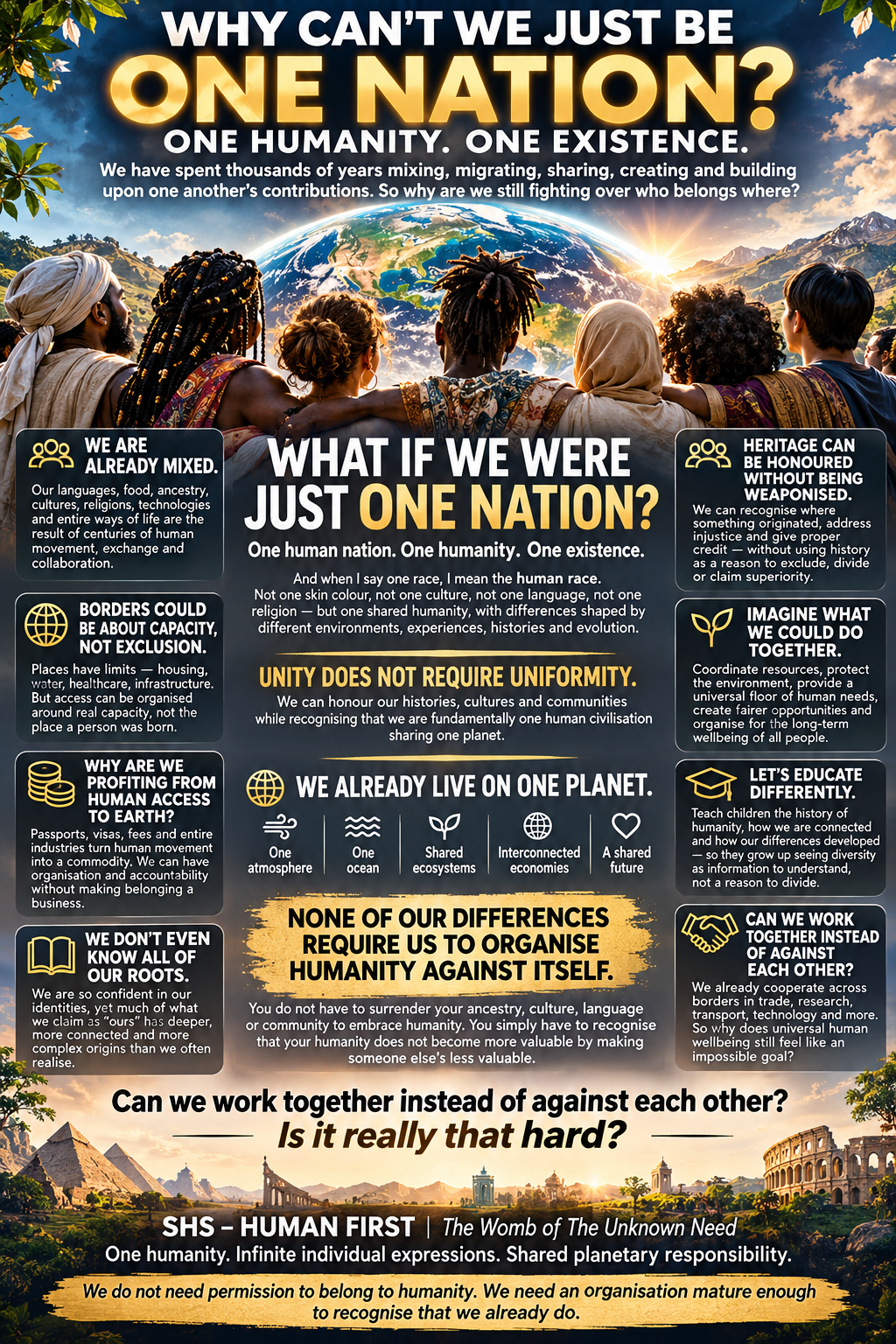
We Have Spent Thousands of Years Mixing, Migrating, Sharing, Creating and Building Upon One Another’s Contributions. So Why Are We Still Fighting Over Who Belongs Where?
SHS – HUMAN FIRST | The Womb of The Unknown Need
After investigating how much of what we call British actually originates from other parts of the world, I am left with one question.
WHY THE HELL ARE WE STILL DIVIDING HUMANITY INTO NATIONS AS THOUGH WE HAVE EVER EXISTED SEPARATELY?
Seriously.
Look at us.
Our languages are mixed.
Our food is mixed.
Our ancestry is mixed.
Our cultures are mixed.
Our religions have influenced one another.
Our architecture, medicine, technologies, clothing, philosophies, education and entire systems of civilisation have developed through centuries of human movement, observation, borrowing, adaptation and contribution.
Even the things we consider the strongest symbols of national identity often have histories extending far beyond the countries claiming them.
And somehow, after all of that, we are still arguing over who owns what, who belongs where, whose ancestors were first, whose country is superior and who needs permission to enter another part of the same planet.
HOW HAVE WE BECOME SO GOOD AT SHARING THE FOUNDATIONS OF OUR EXISTENCE, YET SO DETERMINED TO DENY THAT WE SHARE THEM?
WHAT IF WE WERE JUST ONE NATION?
One.
Not thousands of political divisions competing against one another.
Not a world where the circumstances of your birth determine how freely you can move across the planet.
Not a world where one person can travel almost anywhere because of the passport they inherited, while another must spend months proving their worthiness to enter a place their ancestors may even have helped build.
One human nation. One humanity. One existence.
And when I say one race, I mean the human race.
Not one skin colour.
Not one culture.
Not one language.
Not one religion.
Not the erasure of our geographical, historical or individual differences.
Quite the opposite.
I mean recognising that our differences are expressions of the same humanity, developed through different environments, experiences, histories and evolutionary processes.
Our skin pigmentation varies.
Our physical characteristics vary.
Our traditions vary.
Our languages vary.
Our individual experiences vary.
BUT OUR HUMANITY IS NOT DIVIDED INTO DIFFERENT SPECIES BECAUSE OUR ENVIRONMENTS AND HISTORIES HAVE SHAPED US DIFFERENTLY.
Why have we turned those differences into hierarchies of belonging?
Why do we keep treating human diversity as evidence that we should be separated rather than as evidence of how extraordinarily adaptable human life is?
AND WHAT ABOUT BORDERS?
I understand that different places have different capacities.
Of course they do.
A city cannot accommodate unlimited people without planning.
Housing has limits.
Water infrastructure has limits.
Healthcare services have limits.
Food distribution, transportation, environmental sustainability and public services all require organisation.
But why does our response have to be nationality-based exclusion?
WHY CAN’T ACCESS BE ORGANISED AROUND ACTUAL CAPACITY RATHER THAN THE PLACE A PERSON HAPPENED TO BE BORN?
Imagine a world where countries functioned more like administrative regions of one human civilisation.
Instead of asking:
What nationality are you?
We ask:
Where would you like to live, and what conditions would allow you to live there sustainably?
Instead of immediately demanding visas, expensive applications, sponsorships and permission based upon nationality, regions could transparently publish their capacity.
How many residents can this region sustainably support?
How much housing is available?
What is the current demand on water, energy and healthcare?
How many temporary visitors can be accommodated?
What infrastructure is being developed?
Which other regions have more capacity and would welcome new residents?
And most importantly:
HOW CAN WE INCREASE OUR CAPACITY WITHOUT DAMAGING THE ENVIRONMENT OR THE WELLBEING OF THOSE ALREADY LIVING THERE?
Imagine a region saying:
We are currently operating at full sustainable capacity. We cannot accommodate additional long-term residents immediately. Here are the available alternatives, our development plans and when additional accommodation is expected.
That is an organisational explanation.
It is not a declaration that someone is less entitled to dignity or freedom because of their nationality.
Capacity would need to be measured honestly, independently and transparently, with safeguards against governments disguising discrimination as resource management.
And genuine emergencies, family reunification and humanitarian needs would require their own protections.
But at least we would be organising around actual conditions rather than inherited classifications.
WHY ARE WE PROFITING FROM HUMAN ACCESS TO EARTH?
Think about how strange some of our arrangements are.
We have created passports.
Visas.
Application fees.
Renewal fees.
Immigration categories.
Citizenship tests.
Residency requirements.
Sponsorship thresholds.
Administrative barriers.
And entire industries built around helping human beings obtain permission to move between geographical areas of the planet on which they were born.
WHEN DID HUMAN MOVEMENT BECOME SOMETHING THAT MUST BE CONTINUALLY PURCHASED, JUSTIFIED AND APPROVED ACCORDING TO NATIONAL ORIGIN?
I am not suggesting there should be no registration, identification or accountability.
A functioning civilisation needs to understand where people are, what services they require, and how to protect everyone’s rights.
We can have identity systems without turning identity into a hierarchy.
We can register residency without making residency a privilege determined by birthplace.
We can organise transport and public services without turning every geographical boundary into an economic obstacle.
We can maintain regional administrations without insisting that humanity must be politically fragmented forever.
ADMINISTRATION IS NECESSARY. HUMAN DIVISION IS NOT.
AND THEN THERE IS THIS OBSESSION WITH OWNERSHIP.
This is where our investigation into British identity becomes especially revealing.
The British Christmas tree came through German traditions.
The British cup of tea connects China, Portugal, India, Sri Lanka, the Caribbean and Britain.
The royal family’s history runs through European dynasties.
The English language contains words from all over the world.
British industrial development relied upon resources, labour, knowledge and markets extending across continents.
Even the British landscape contains plants and animals introduced from elsewhere.
And Britain is only one example.
We could conduct the same investigation into France, China, Nigeria, India, Germany, the United States, Sierra Leone, Japan or practically anywhere else.
Everywhere we go, we find human movement.
Everywhere we look, we find exchanges.
Everywhere we investigate deeply enough, the idea of a completely isolated national identity becomes harder to sustain.
Yet we continue to speak as though every country’s achievements emerged exclusively from the people currently living within its borders.
WE HAVE TURNED A SHARED HUMAN HISTORY INTO A COMPETITION OVER NATIONAL OWNERSHIP.
That does not mean communities should lose their histories or that people should be denied recognition for their contributions.
Recognition matters.
Attribution matters.
Accountability matters.
Especially when cultural exchange involved conquest, enslavement, exploitation or theft.
But acknowledging those histories should help us understand how interconnected humanity already is, not convince us that permanent separation is the only possible future.
We can recognise where something originated without deciding that only people born in that geographical location have a legitimate relationship with it.
HERITAGE CAN BE HONOURED WITHOUT BEING WEAPONISED AS EXCLUSION.
THE STRANGEST PART? WE DON’T EVEN KNOW ALL OF OUR ROOTS.
We are so confident in the identities we have inherited.
I’m British.
I’m African.
I’m European.
I’m Asian.
I’m from this country.
This belongs to my people.
And yet, how many generations of our own ancestry can most of us trace accurately?
How many cultural practices do we claim as ours without knowing where they originated?
How many words do we speak without knowing the languages they came from?
How many foods do we consider traditional without knowing the journeys of their ingredients?
How many beliefs do we defend without understanding the historical circumstances through which they became established?
And how much of our genetic and cultural ancestry extends beyond the geographical labels we carry today?
WE HAVE MADE OURSELVES ABSOLUTELY CERTAIN ABOUT IDENTITIES WHOSE COMPLETE HISTORIES WE HAVE NOT EVEN INVESTIGATED.
I am not saying that nobody knows their history.
I am saying that what we know is often a fragment of a much larger human story.
And the further back we go, the more our contemporary national categories lose their relevance.
The borders change.
The languages change.
The governments change.
The names of countries change.
Populations migrate.
Communities merge.
Cultures transform.
But humanity continues.
So why have we made temporary political arrangements more important than the continuity of human life?
ONE NATION DOES NOT HAVE TO MEAN ONE GOVERNMENT CONTROLLING EVERYTHING. But it could be. All governments genuinelly together for the sake of humanity.
This is another distinction worth making.
I am not proposing that we simply replace thousands of national authorities with one enormous central authority capable of controlling every person on Earth.
That could reproduce the same problems on an even larger scale.
I am questioning whether we need separate national sovereignties to recognise and administer what is fundamentally one human civilisation.
We could have one universal human membership, with diverse regional administrations responsible for their environments and communities.
Different regions could retain their languages, cultural traditions, ecological protections and local governance.
Communities could make decisions about matters affecting their environments while participating in wider coordination over shared resources and universal rights.
No region would have unlimited authority to mistreat a human being simply because that person was born somewhere else.
No central institution should have unlimited authority to erase local communities either.
UNITY DOES NOT REQUIRE UNIFORMITY.
And shared humanity does not require the destruction of individuality.
It requires us to stop confusing individuality with separation.
IMAGINE WHAT WE COULD ACTUALLY DO TOGETHER.
Instead of wealthy countries competing to attract the most profitable workers while restricting those considered less economically valuable, we could organise opportunities around human development and regional needs.
Instead of having countries compete over essential resources while other populations suffer shortages, we could coordinate production, distribution, preservation and regeneration.
Instead of creating national policies that protect one country’s prosperity while exporting environmental damage elsewhere, we could treat the environmental consequences as part of one shared planetary responsibility.
Instead of treating housing insecurity, hunger and access to essential healthcare as matters determined primarily by national budgets and eligibility rules, we could establish a universal floor of human needs.
And instead of evaluating whether someone deserves to live somewhere according to their earning potential, we could begin by recognising that the person is a human being.
THE ECONOMY SHOULD SUPPORT HUMAN CONTINUITY. HUMANITY SHOULD NOT HAVE TO CONTINUALLY PROVE ITS ECONOMIC WORTHINESS TO EXIST.
And yes, such an arrangement would require serious planning.
Resource accounting.
Environmental measurements.
Regional accountability.
Protection against exploitation.
Democratic participation.
Transparent governance.
Shared responsibility.
Mechanisms for resolving disputes.
And ways to distribute responsibilities fairly between communities with different needs and capacities.
I am not pretending any of this would be simple.
I AM ASKING WHY WE HAVE BECOME MORE COMFORTABLE MANAGING PERMANENT DIVISION THAN INVESTIGATING THE POSSIBILITY OF BETTER ORGANISATION.
WE ALREADY LIVE ON ONE PLANET.
We already share an atmosphere.
We already depend upon interconnected ecological systems.
The same oceans connect our continents.
Our actions affect environments beyond national borders.
Diseases do not recognise passports.
Pollution does not request immigration permission.
Climate systems do not follow the political boundaries we draw on maps.
And human movement existed long before our modern borders did.
Nature is already interconnected.
Our history is already interconnected.
Our economies are already interconnected.
Our technologies are already interconnected.
Our survival is increasingly interconnected.
SO WHY DOES OUR ORGANISATION CONTINUE TO INSIST THAT OUR PRIMARY OBLIGATIONS MUST END WHERE A BORDER BEGINS?
WHAT IF WE STARTED EDUCATING CHILDREN DIFFERENTLY?
Imagine children growing up learning the history of humanity before being taught to defend a national identity against another.
Learning how populations moved across Earth.
How human physical diversity developed.
How languages influenced one another.
How agricultural knowledge travelled.
How scientific discoveries accumulated across civilisations.
How cultures combined.
How conflict, exploitation, cooperation and migration shaped the world they inherited.
And how many ordinary things they encounter every day exist because human beings from different places contributed to them.
They could still learn their local history.
Their language.
Their traditions.
Their ancestors.
Their regional environment.
But they would also learn where those histories connect with everyone else’s.
THEY WOULD LEARN THAT BELONGING TO HUMANITY DOES NOT REQUIRE THEM TO STOP BELONGING TO THEIR COMMUNITIES.
Perhaps then we would raise generations who see differences as information to understand rather than grounds for declaring superiority.
People who can appreciate their ancestry without needing to diminish another person’s.
People who understand that cultural exchange and accountability can coexist.
People who recognise that the place where they were born is part of their history, not the totality of their existence.
AND HERE IS THE QUESTION I REALLY WANT HUMANITY TO ANSWER.
IS WORKING TOGETHER ACTUALLY THAT DIFFICULT, OR HAVE WE SIMPLY BUILT SO MUCH OF OUR WORLD AROUND COMPETITION THAT COOPERATION NOW FEELS UNNATURAL?
We know how to cooperate when there is something to gain.
Countries form trade alliances.
Governments share intelligence.
Corporations establish international supply chains.
Research institutions cooperate across continents.
We coordinate aviation, shipping, communications and countless other activities on a global scale.
We have already demonstrated the ability to organise beyond national boundaries.
So why should universal human wellbeing remain something we discuss as though it were an impossible fantasy?
Why can resources move across borders more easily than some of the human beings whose labour produces them?
Why can corporations establish operations across numerous countries while individuals struggle to obtain permission to relocate?
Why can an object produced through a dozen countries be celebrated as a national achievement, while a human being with ancestry or contributions spanning those same places is treated as an outsider?
HOW CAN GLOBALISATION BE ACCEPTABLE FOR CAPITAL, BUT HUMAN BELONGING MUST REMAIN SO HEAVILY RESTRICTED?
What exactly are we protecting?
Our communities?
Our resources?
Our cultures?
Or systems of privilege that we have become accustomed to treating as the natural order?
Those questions deserve to be answered individually rather than hidden behind one word: sovereignty.
I WANT US TO CONSIDER SOMETHING.
You do not have to surrender your ancestry to embrace humanity.
You do not have to stop being proud of the community that raised you.
You do not have to abandon your cultural traditions.
You do not have to speak the same language as everyone else.
You do not have to look like anyone else.
You do not even have to agree with everyone else.
YOU SIMPLY HAVE TO RECOGNISE THAT YOUR HUMANITY DOES NOT BECOME MORE VALUABLE BY MAKING SOMEONE ELSE’S LESS VALUABLE.
And the world does not become more yours by preventing another person from experiencing it.
We have spent generations claiming pieces of Earth.
Naming them.
Bordering them.
Assigning ownership.
Creating permissions.
Building institutions to defend them.
And teaching people that the distinctions established before their birth are part of who they fundamentally are.
But the planet existed before the countries.
Humanity existed before the passports.
Human migration existed before the immigration departments.
And human life will remain more fundamental than any political system designed to administer it.
SO WHY CAN’T WE JUST BE ONE?
One humanity.
One human race.
One shared existence.
With billions of different individuals.
Thousands of languages.
Countless cultural expressions.
Different environments.
Different histories.
Different contributions.
Different choices.
And one fundamental recognition:
NONE OF THOSE DIFFERENCES REQUIRES US TO ORGANISE HUMANITY AGAINST ITSELF.
Maybe our greatest achievement would not be building the most powerful nation in the world.
Maybe it would be becoming mature enough to stop needing humanity divided into competing nations in the first place.
Not by erasing what makes people different.
But by finally recognising everything we share.
WE ARE NOT ASKING HUMANITY TO BECOME ONE PERSON.
WE ARE ASKING HUMANITY TO RECOGNISE THAT IT IS ALREADY ONE HUMANITY.
And to begin organising itself accordingly.
Because after everything we have discovered about the origins of our identities, our cultures, our resources and our histories, I genuinely cannot understand why we are still so determined to defend the divisions.
Can we work together instead of against each other?
Is it really that hard?
SHS – HUMAN FIRST
The Womb of The Unknown Need
One humanity. Infinite individual expressions. Shared planetary responsibility.
We do not need permission to belong to humanity. We need an organisation mature enough to recognise that we already do.
All of these honestly only tells me and shows me how mixed we already are, but somehow we’re still trying to all define our own individualism or individual countries, individual regions and fighting over whoever owns what and all of that shit. Why can’t we just be one nation? One, just literally one nation. That’s, that’s it. Not thousands of nations, thousands of cities, thousands of whatever, thousands of passports. Just one nation, one person, meaning one race, I mean, not actually one physical individual being. But one nation, one race, one existence. Can we not allow everyone to just share everything and own everything and be able to move between countries without having to go through a whole visa situation or passporting situation or whatever? Can one country, maybe states, how much capacity can actually house at any given moment in time? Let’s say that there’s too many people in, instead of like stopping people’s ability to access places, why not a country states, well we are capacity. We have seven billion, seven, I don’t know, seven million visitors at this current moment in time. We cannot take more. Why not do that instead? Why having to gatekeep access? Why having to make profit off of that access? All of these things. Like, can we genuinely just see each other for everything that we are? We are nothing that we think we are. We literally are not. Our history, we don’t even know our history. We don’t know our roots. We don’t know even the things that we think and claim to be part of our roots. We don’t even know that they’re not part of our roots. But at the end of the day, everything is part of the roots of what it is to be human. We don’t have to claim societal belongings or possessions. We don’t have to be, oh, I’m African and you’re not. Can we all be just humans, removing all the races? Can we just see each other as just different, different geographical impacts and evolution over time? Can we work together instead of against each other? Is it that hard?


Leave a Reply