

The Soil of Human Consciousness, the Mycelium of Civilisation, and Why the Magic We Dream Of Must First Be Rooted in the Systems We Live Within.
SHS – HUMAN FIRST | From Disciplinary Education to the Conscious Development of Humanity
There is something profoundly revealing about the way we organise education.
We take children who arrive in the world naturally curious, imaginative, observant, energetic, and eager to investigate everything around them.
And then we begin preparing them for the world we have already constructed.
We teach them what they must know to function within it.
How to behave.
How to qualify.
How to compete.
How to work.
How to become employable.
And, eventually, how to sustain themselves financially within the very arrangements they spent their childhood preparing to enter.
Now, education has undoubtedly given humanity extraordinary opportunities. Literacy, scientific understanding, historical knowledge, critical thinking, and access to accumulated human discoveries are invaluable.
But I have a question.
At what point did preparing a child to function within society become more important than preparing society to accommodate the full development of the child?
Because those are two entirely different projects.
One produces people who can operate within what already exists.
The other investigates what must exist for human beings to develop more fully.
And it is the second that interests me.
Not simply because I believe education can be improved.
But because the civilisation I envision is far more extraordinary than the one we currently educate children to survive.
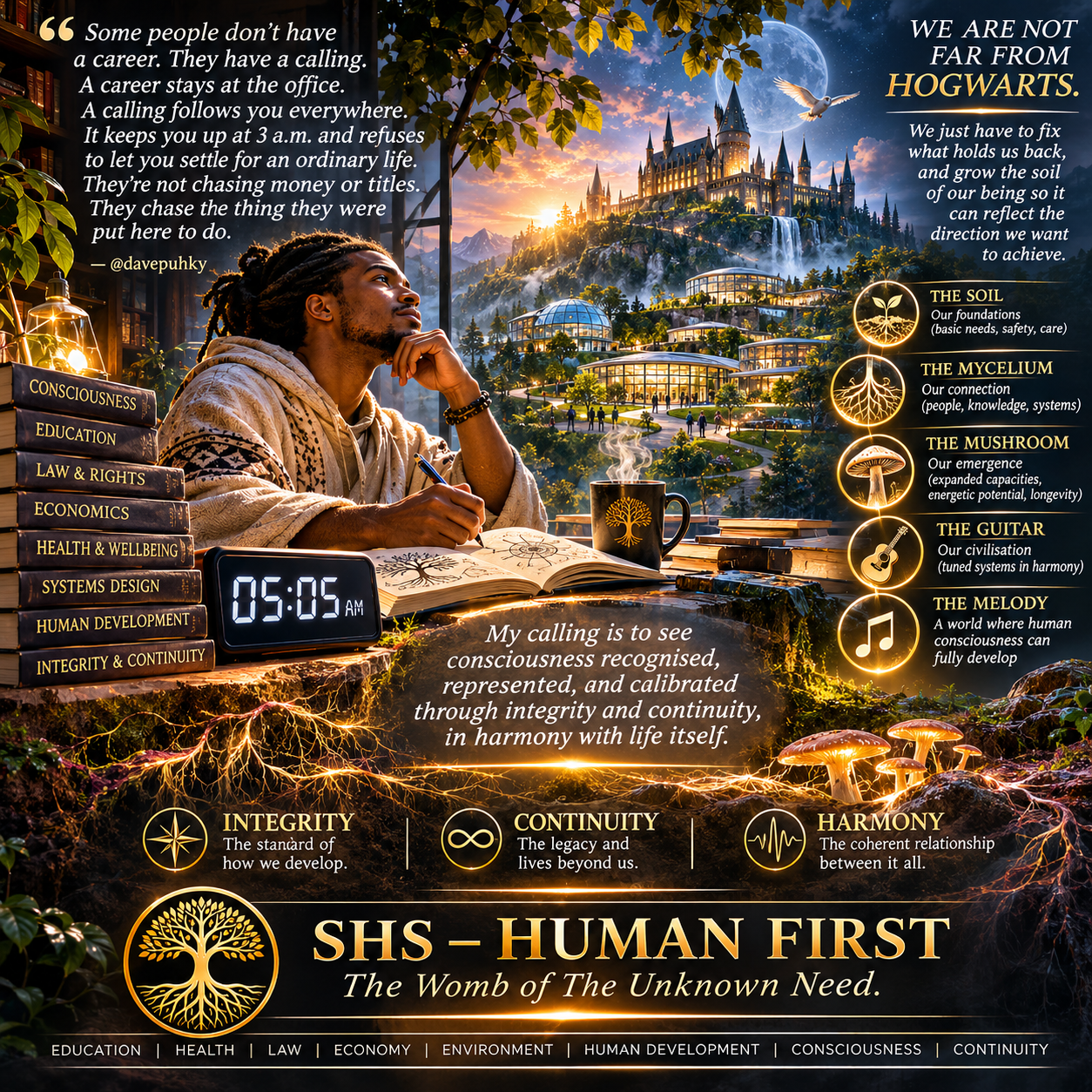
We are not far from Hogwarts.
At least, not in the sense of creating a world where exploration, discovery, extraordinary human potential, and the mysteries of existence become normal parts of education.
But we are considerably further from developing the foundations that would allow such a world to flourish.
And that is what I want us to understand.
1. YOU CANNOT GROW A MAGICAL FOREST IN SOIL YOU HAVE NEVER LEARNED TO NOURISH.
Imagine wanting to grow the most extraordinary forest.
Trees unlike anything you have seen.
Flowers with extraordinary colours.
Mushrooms emerging from networks that extend far beyond what your eyes can observe.
A living ecosystem whose relationships produce outcomes that no individual organism could accomplish alone.
Now imagine that, instead of investigating the soil, water, nutrients, climate, and interdependencies necessary to sustain that forest, you simply demand that the trees grow.
You admire the flowers.
You celebrate the mushrooms.
You imagine what the forest could become.
But you refuse to investigate the ground beneath it.
How exactly do you expect the forest to flourish?
This is how I see much of humanity’s relationship with consciousness and spirituality today.
We want the extraordinary.
We want energetic development.
We want greater awareness.
We want profound spiritual experiences.
Some dream of telekinesis, extraordinary longevity, or even immortality.
We want to explore dimensions of existence that our current understanding cannot fully explain.
But what about the soil?
What about the conditions under which we are expected to develop?
What about the economic systems consuming our time?
The legal systems determining which expressions of human life receive protection?
The educational systems deciding what children are encouraged to investigate?
The social systems dictating what is considered respectable?
The institutions that decide what counts as a legitimate human contribution?
Why do we keep searching for extraordinary flowers while neglecting the soil from which human development must grow?
Because consciousness does not exist in isolation from the conditions under which we live.
Our physical wellbeing matters.
Our environments matter.
Our relationships matter.
Our opportunities matter.
Our freedom to explore matters.
And the systems that organise these conditions matter.
If we want a world that reflects a more expansive understanding of humanity, then the organisation of our lives must begin reflecting that direction.
Otherwise, we are attempting to grow a future our foundations have not been prepared to sustain.
2. HOGWARTS WAS NEVER JUST ABOUT MAGIC. IT WAS ABOUT AN ENVIRONMENT THAT RECOGNISED THE POSSIBILITY OF IT.
Think about .
Of course, it is fictional.
And I am not suggesting that its supernatural abilities have been established as real human capabilities.
But look beyond the spells.
Beyond the wands.
Beyond the spectacle.
What makes the idea of Hogwarts so attractive?
It is an entire educational environment organised around the assumption that the students have more to discover about themselves and their world.
There are spaces for investigation.
Teachers dedicated to different fields of study.
Practical experiences.
Libraries.
Traditions.
Experiments.
Mentorship.
Communities.
And a wider society, however imperfect, in which the subjects taught at the school have recognised significance.
That last part is crucial.
The children are not expected to spend their entire childhood learning something that the adult world will later require them to hide in order to be respected.
Their education has a place within the society they are preparing to enter.
Now bring that idea back to our own civilisation.
Imagine children having access to education that explores the full range of demonstrable human capacities alongside the unresolved questions of consciousness and existence.
The body.
The mind.
The senses.
Emotions.
Nature.
Philosophy.
Scientific investigation.
Meditation.
Concentration.
Relationships.
Energy in its scientifically established forms, alongside careful inquiry into the experiences people describe as energetic or spiritual.
What if human development were treated not as an extracurricular privilege but as a central purpose of education?
What if children were supported in discovering their capacities without having to surrender their curiosity to the demands of future employability?
And what if the world they entered as adults had been organised to support that continued development?
That is the real magic I want us to investigate.
Not merely whether somebody can perform something extraordinary.
But whether we can build an extraordinary civilisation around the development of ordinary human beings.
3. WE ARE SUPPOSED TO BE THE MYCELIUM OF CONSCIOUSNESS.
Let me introduce an image.
A forest may appear to be composed of individual trees, plants, mushrooms, insects, animals, and countless other organisms.
But beneath the visible landscape, fungal mycelium forms intricate networks of branching filaments.
These networks interact with their surroundings, and many fungi form relationships with plants through which nutrients and other resources can be exchanged.
The forest is not simply a collection of isolated things.
It is an ecosystem of relationships.
Now, imagine humanity as the mycelium of consciousness across the visible world.
Each human being is individually alive.
Each has their own experiences.
Their own perceptions.
Their own histories.
Their own abilities.
Their own development.
Yet we also exist in continuous relationship.
We exchange knowledge.
We influence one another.
We transmit culture.
We inherit discoveries.
We contribute to institutions.
We construct collective realities that no individual could maintain alone.
Our lives are connected in ways that extend beyond any one person’s immediate awareness.
And what happens when those connections are poorly organised?
Knowledge becomes isolated.
Human experiences are divided into competing categories.
Industries stop understanding one another.
Education separates disciplines that belong in conversation.
Spirituality becomes disconnected from practical life.
Science becomes disconnected from some of the communities whose experiences might generate legitimate research questions.
Law becomes disconnected from the diversity of human needs it is supposed to protect.
And the individual is forced to move between these fragmented realities, adjusting their identity according to whichever institution they happen to be standing in front of.
Now imagine the opposite.
Imagine those relationships becoming better connected.
Not through enforced agreement.
Not by surrendering individual autonomy.
But through an organisation of life capable of recognising the connections between its different expressions.
That is the mycelium I want us to develop.
A civilisation in which knowledge, care, consciousness, institutions, and human development are connected rather than constantly competing for recognition.
And what about the mushroom?
To me, the mushroom emerging beyond the visible network becomes a metaphor for the extraordinary possibilities we hope humanity may eventually understand.
The ethereal.
The energetic.
The presently unexplained.
Even our aspirations concerning radically extended life.
These are possibilities and questions, not established promises of supernatural powers or immortality.
But the metaphor is meaningful.
We are fascinated by what might emerge above the soil, while forgetting that the strength of what emerges depends upon the conditions and connections beneath it.
We want the mushroom.
I want us to nourish the mycelium.
4. IF YOU WANT MAGIC, FIRST LEARN HOW TO ROOT ITS UNDERSTANDING IN WHAT IS KNOWN.
This is where I believe spirituality and scientific integrity should meet.
I do not want humanity to abandon its imagination.
Quite the opposite.
Imagination allows us to investigate possibilities beyond what is already familiar.
But there is an enormous difference between imagining something and demonstrating how it works.
If somebody claims to move an object without physical contact through conscious intention, that is a question worth examining carefully.
What actually moved the object?
What conditions were present?
Can alternative explanations be excluded?
Can the effect be reproduced under controlled conditions?
Can independent investigators verify it?
If not, the investigation remains open rather than the claim becoming established knowledge.
And that is perfectly acceptable.
We do not dishonour the unknown by refusing to pretend that we already understand it.
We dishonour investigation when we confuse curiosity with certainty.
If we want to investigate what appears magical, we should become exceptionally good at understanding what is already known.
Physics.
Biology.
Psychology.
Neuroscience.
Ecology.
Human development.
Perception.
The relationships between bodies and environments.
The mechanisms through which information and energy move in the physical world.
These disciplines do not eliminate wonder.
They give wonder somewhere to begin.
A child who learns how electricity works has not lost the wonder of lightning.
A child who understands astronomy has not lost the beauty of the stars.
A child who studies the nervous system has not exhausted the mystery of conscious experience.
Understanding is not the enemy of magic. It is what allows us to distinguish the genuinely extraordinary from what we have simply not yet learned to explain.
And if we ever discover new demonstrable human capacities, then those discoveries will need foundations robust enough to support further investigation, education, ethical use, and transmission across generations.
That is how we move from isolated claims towards shared knowledge.
From spectacle towards understanding.
From possibility towards responsible development.
5. OUR CIVILISATION IS AN UNTUNED GUITAR.
Now, here is another way I see it.
Imagine an extraordinary guitar.
Beautifully constructed.
Capable of producing an enormous range of sounds.
An instrument through which a human being could communicate emotions that ordinary language struggles to express.
But the strings are out of tune.
One is too tight.
Another is too loose.
One produces a note that conflicts with the next.
And each time someone attempts to play, the result is a distorted arrangement of sounds that could have produced something beautiful.
Would you conclude that the guitar is incapable of music?
Of course not.
You would recognise that the instrument needs to be tuned.
That is how I see our present organisation of civilisation.
We have systems of education that do not always align with our understanding of human development.
Economic arrangements that can undermine the wellbeing they are supposed to support.
Healthcare systems frequently required to respond to harm that better prevention might have reduced.
Legal frameworks that can recognise some aspects of personhood while struggling with emerging forms of human experience.
Institutions that operate in silos despite serving the same human lives.
And cultures that praise individual freedom while pressuring people to conform to narrow expectations of acceptable behaviour.
These are the strings.
Education.
Health.
Economy.
Law.
Culture.
Environment.
Social welfare.
Science and innovation.
Governance.
Infrastructure.
Security.
Finance.
Each has a contribution to make.
But when they are not coherently organised around the human being, they can produce contradictions that people are forced to live through.
One institution tells you to protect your mental health.
Another structures your working life around relentless pressure.
One celebrates creativity.
Another demands that every creative contribution justify itself financially.
One acknowledges freedom of belief.
Another social environment treats the expression of unfamiliar beliefs as grounds for exclusion or professional disrespect.
The problem is not necessarily that humanity lacks the capacity to create beautiful music.
The problem is that we are trying to play through an instrument whose strings have not been brought into harmony.
And how do you tune a guitar?
You don’t simply shout at it to sound better.
You examine each string.
You identify the relationship between its present condition and the note it is meant to produce.
You adjust.
You listen.
You compare.
You correct.
And you continue until the instrument can produce a coherent sound.
That is what systemic calibration means to me.
Not destroying everything indiscriminately.
Not preserving everything because it already exists.
But identifying what each system is supposed to contribute to life, examining where it fails, and adjusting its relationships with the others.
Because the melody of civilisation is not produced by one institution playing perfectly while the others remain out of tune.
It emerges through their relationships.
And imagine what becomes possible when we finally begin tuning the instrument around humanity rather than expecting humanity to continually adapt to its discord.
6. THE SPIRITUAL WORLD HAS EVERYTHING TO GAIN FROM SYSTEMIC RECOGNITION.
This is where I want to challenge spiritual communities.
You speak about awakening.
You speak about consciousness.
You speak about manifestation.
You speak about collective energies and transforming reality.
But what about the reality that determines whether you can afford to eat tomorrow?
What about the laws that protect or restrict your activities?
What about the institutions that determine whether your contribution receives recognition?
What about the economic system that requires you to commercialise your practices to sustain yourself?
How can we speak endlessly about transcending the material world while refusing to examine the structures that govern our material lives?
I am not saying everyone must become a legal expert or an economic architect.
But I am asking us to recognise that spiritual development and systemic transformation are not necessarily opposing ambitions.
They can support one another.
A spiritual practitioner who does not have to worry constantly about housing may have more freedom to practise.
A researcher with secure resources may investigate more thoroughly.
A child whose needs are covered can explore without the same pressures of economic survival.
A community with legally protected freedom of belief can practise without having to conceal its identity simply to avoid unjust treatment.
And an educational institution that makes room for philosophy, meditation, emotional development, and serious inquiry can recognise more of the human experience.
The more our systems protect the conditions of human development, the less spiritual exploration has to exist as an escape from everyday life.
That is the bridge.
Not requiring spiritual practice to become a commercial product in order to survive.
Not compelling institutions to endorse every spiritual claim.
But making space for the human being to explore their existence without unnecessarily sacrificing security, dignity, or opportunity.
7. WHY MUST THE HUMAN BEING BECOME A DIFFERENT PERSON IN EVERY INSTITUTION?
Consider how we move through modern society.
At work, you must be professional.
In education, you must be academically appropriate.
In religious or spiritual communities, you may be expected to express particular beliefs.
In medical settings, you become a patient.
In legal proceedings, you become a claimant, defendant, witness, or subject of regulation.
In the economy, you become a consumer, worker, taxpayer, investor, or debtor.
And in each environment, different aspects of your existence become relevant while others may be ignored.
Some role distinctions are necessary.
A medical consultation and a spiritual ceremony do not require identical procedures.
A scientific investigation and a personal account of mystical experience do not operate under the same standards of evidence.
But why should these distinctions require us to deny the wholeness of the human being?
We can distinguish between aspects of human life without fragmenting the person living them.
You should not have to conceal your spirituality merely to be treated with dignity in a workplace.
You should not have to abandon scientific reasoning in order to participate in a spiritual community.
You should not have to relinquish your cultural identity to receive fair treatment in an institution.
You should not have to reduce every interest to its economic value before society considers it worth pursuing.
And you should not have to travel halfway around the world simply to find a community willing to recognise an aspect of your humanity that is otherwise treated with suspicion.
People may already possess legal protections for belief, expression, and association, but formal rights do not always translate into practical inclusion.
This is why legal recognition matters.
Not because law should declare every spiritual proposition true.
But because law can protect the freedom to investigate, believe, practise, associate, research, and express one’s identity within appropriate limits that protect others.
The legal system does not need to certify your entire worldview to recognise your humanity.
And that distinction is fundamental.
We need institutions capable of protecting the whole person without abandoning the different standards through which particular claims and activities must be evaluated.
Because an integrated human life does not require every institution to perform the same function.
It requires those institutions not to contradict the fundamental dignity of the person they are supposed to serve.
8. THE REAL PURPOSE OF SHS EDUCATION: THE CHILD MUST NOT HAVE TO WAIT FOR ADULTHOOD TO BEGIN DISCOVERING THEMSELVES.
This is why I have been developing COMPYE and the broader educational architecture of SHS – Human First.
Not to create children who all think alike.
Not to manufacture spiritual practitioners.
Not to tell a child what their consciousness must become.
And certainly not to replace scientific education with unverified promises of extraordinary powers.
But to create an environment where the different dimensions of human development can be explored without being unnecessarily separated.
Imagine a child learning biology while also learning to observe their own body.
Learning ecology while understanding the interdependencies of the environment.
Learning music while exploring rhythm, emotion, mathematics, and the physical properties of sound.
Learning meditation while examining attention, perception, and emotional regulation.
Learning history while investigating how human beings developed the institutions that govern our present lives.
Learning law while understanding rights, responsibilities, autonomy, and consent.
Learning to question extraordinary claims without feeling that curiosity itself is forbidden.
And learning that their contributions to life need not be measured exclusively by how much money they will someday earn.
That is what I want education to cultivate.
Not merely employable individuals.
But human beings capable of understanding themselves, their environments, their relationships, and the consequences of their contributions.
And if children grow into adults who wish to investigate extraordinary claims, altered states, longevity, new scientific discoveries, or the mysteries of consciousness, they should have the intellectual foundations necessary to do so responsibly.
They should understand the distinction between observation and interpretation.
Between belief and evidence.
Between imagination and demonstration.
Between possibility and established reality.
Because the more ambitious our explorations become, the stronger our foundations must be.
You cannot prepare children for an extraordinary future by depriving them of the tools needed to understand reality.
You prepare them by giving them those tools and the freedom to keep discovering.
9. WE WANT IMMORTALITY, BUT WE HAVE NOT YET LEARNED TO PROTECT CONTINUITY.
Now consider one of humanity’s most extraordinary aspirations.
Immortality.
Across religions, mythologies, philosophies, and contemporary scientific conversations about longevity, human beings have repeatedly questioned whether life can be extended beyond the limits we presently recognise.
It is a fascinating question.
But biological immortality for human beings has not been demonstrated, and spiritual claims about surviving bodily death remain matters of belief and philosophical investigation rather than established scientific fact.
So let us examine what we can already address.
Why are we so fascinated by the possibility of never dying while remaining so careless about what we allow to die around us?
Knowledge disappears.
Communities lose resources.
Institutions abandon their original purposes.
Generations repeat preventable mistakes.
Human beings dedicate their lives to discoveries that are never properly preserved or transmitted.
And societies sacrifice the wellbeing of living people while celebrating speculative visions of future human transcendence.
What would it mean to begin with continuity?
To preserve what is valuable.
To protect life where we can.
To improve healthcare.
To investigate ageing responsibly.
To sustain environments.
To transmit useful knowledge.
To create conditions in which future generations inherit more possibilities rather than merely more obligations.
This is where the pursuit of immortality meets something already within our capacity to develop.
Before we establish whether consciousness can continue beyond bodily death, we can investigate how the consequences of a conscious life continue beyond the individual who lived it.
Through care.
Through knowledge.
Through relationships.
Through institutions.
Through discoveries.
Through the conditions we leave for those who come after us.
This is not the same as literal immortality.
But it is a dimension of continuity that we can already influence.
And why would a civilisation aspiring towards extraordinary forms of existence neglect the continuity of life it already knows how to protect?
10. RAISING THE FREQUENCY OF CIVILISATION BEGINS WITH CORRECTING ITS DISCORD.
When I speak about harmonics and frequency, I want people to understand the image I am offering.
A guitar does not become beautiful music simply because we desire harmony.
Its strings must be physically adjusted.
Their frequencies can be measured.
Their relationships can be examined.
And their combined sound depends on how they are played.
Likewise, societal harmony cannot be produced simply by declaring that everyone should vibrate at a higher frequency.
In the literal scientific sense, there is no established mechanism by which improving laws or economic arrangements raises a collective spiritual vibration and thereby produces supernatural abilities.
But as a metaphor for organising life, the instrument is powerful.
If we want a society characterised by greater care, understanding, freedom, and cooperation, we must investigate what conditions produce or obstruct those experiences.
How much of our daily life is organised around fear?
How much around competition?
How much around exhaustion?
How much around the expectation that human beings must continuously prove their economic usefulness?
And how much around genuine opportunities to develop?
What happens when we improve access to food, housing, education, healthcare, safety, time, and supportive relationships?
What happens when institutions cooperate rather than repeatedly shifting responsibility between one another?
What happens when people have more freedom to pursue meaningful interests?
These are questions we can investigate through real-world outcomes.
If we want a different melody, we must change how the instrument is tuned and played.
And as the practical conditions improve, more human beings may gain the freedom to explore the experiences they associate with higher consciousness.
Not because every aspiration becomes scientifically true through collective desire.
But because the barriers preventing people from investigating, learning, practising, and developing become smaller.
That is a transformation worth pursuing even before any extraordinary claim is established.
11. THE GREAT DIVIDE IS NOT BETWEEN SCIENCE AND SPIRITUALITY. IT IS BETWEEN FRAGMENTATION AND INTEGRATION.
Imagine a conversation involving a spiritual practitioner, a neuroscientist, a lawyer, an educator, a philosopher, a physician, and a child.
The practitioner describes an unusual experience.
The neuroscientist investigates possible mechanisms.
The physician examines physiological implications.
The lawyer considers autonomy, consent, and protection.
The educator asks how curiosity about such experiences could be supported responsibly.
The philosopher questions what the experience means.
And the child asks a question none of the adults thought to consider.
Now imagine that none of them treats the others as automatically irrelevant.
They do not have to agree.
They do not even have to reach the same conclusions.
But they recognise that their different approaches may contribute to a fuller investigation.
That is what integration looks like.
Not collapsing every field into spirituality.
Not demanding that science abandon its methods.
Not forcing legal institutions to validate unproven claims.
But making it possible for different fields to contribute without the human being disappearing between them.
Because the body examined by the doctor belongs to the same individual whose rights the lawyer considers.
The same individual whose development the teacher supports.
The same individual whose consciousness the philosopher investigates.
And the same individual who may describe spiritual experiences.
Why should we organise these investigations as though they concern entirely separate beings?
Humanity is one interconnected subject approached through many different lenses.
And our systems should become increasingly capable of recognising that wholeness.
12. THE MAGICAL CIVILISATION WILL NOT BEGIN WITH A WAND. IT WILL BEGIN WITH A FOUNDATION.
Perhaps one day we will discover extraordinary things about consciousness that our present scientific understanding does not yet accommodate.
Perhaps we will develop technologies and knowledge that make aspects of today’s fantasy resemble tomorrow’s ordinary reality.
And perhaps some ideas will remain fictional.
That is the nature of honest investigation.
We do not know everything in advance.
But there is one thing we can already begin building.
A society that gives human beings more freedom to explore.
A society where children are not educated merely to survive an inherited economic order.
A society where the spiritual practitioner does not need to become a commercial brand simply to secure basic needs.
Where a researcher can investigate unconventional questions without abandoning scientific integrity.
Where a person can express their beliefs without being denied fundamental dignity.
Where scientific discoveries can inform humane institutions.
Where economic organisation serves development rather than continually displacing it.
Where law recognises the diversity of human lives without confusing personal conviction with proven fact.
And where the contributions of different generations are preserved and developed rather than continually lost.
That would already be a civilisation far more magical than the arrangements we currently accept as inevitable.
Not because everyone would suddenly acquire supernatural abilities.
But because far more people would have the opportunity to discover capacities, interests, relationships, and forms of contribution that present conditions may prevent them from exploring.
And from that foundation, who knows what we might learn?
13. WE CANNOT KEEP ASKING CONSCIOUSNESS TO FLOURISH IN A WORLD ORGANISED TO CONSTRAIN IT.
This is ultimately my challenge to both the systemically minded and the spiritually minded.
To those who understand institutions:
Your understanding of law, economics, governance, science, and education is not the endpoint.
These structures exist to organise human life.
And the question must always return to whether they adequately protect and support the human beings they govern.
To those who pursue spirituality:
Your exploration of consciousness need not remain disconnected from the systems through which everyday life is organised.
If you want more people to experience the freedom you seek, the conditions that make that freedom possible matter.
Study them.
Question them.
Participate in improving them.
Because neither side can fully serve humanity while treating the other as irrelevant.
The spiritual world benefits from systemic transformation because it creates room for more human exploration.
The systemic world benefits from taking human consciousness seriously because it is reminded that people are more than the roles institutions assign to them.
And humanity benefits when the distance between these two worlds becomes smaller.
Not through coercion.
Not through imposed beliefs.
But through a more conscious organisation of life.
MY FINAL THOUGHT: THE FOREST, THE MYCELIUM, THE MUSHROOM, AND THE MUSIC.
I want to return to the beginning.
The soil.
Because everything I am describing comes back to the conditions from which we develop.
We dream of the mushroom.
The extraordinary experience.
The seemingly impossible ability.
The mystery beyond our present understanding.
But I am looking at the mycelium.
The connections.
The relationships.
The educational foundations.
The legal recognition.
The economic support.
The continuity of knowledge.
The systems that determine whether humanity can explore its possibilities collectively.
And beneath all of that, I am looking at the soil.
The basic needs of life.
The body.
The environment.
The safety and stability that make development possible.
Because a forest does not become extraordinary by neglecting its foundations.
And neither does a civilisation.
Then I look at our guitar.
Twelve strings, if you will, representing the different systems through which we organise collective life.
Each capable of contributing something essential.
Each requiring attention.
Each needing to be understood in relation to the others.
And I imagine what happens when we stop forcing human beings to accommodate the discord and instead begin tuning our systems towards their wellbeing.
Perhaps the first melody will be simple.
Children growing up with their needs secured.
Families no longer organised predominantly around survival pressures.
Teachers able to support curiosity rather than merely assess compliance.
Spiritual practitioners free to explore without making every discovery a commodity.
Researchers supported in investigating the unknown.
Human beings moving between institutions without having to deny essential aspects of themselves.
And communities able to develop together rather than remaining divided into isolated bubbles of expertise.
Then perhaps the music becomes more complex.
New discoveries.
New forms of education.
Greater cooperation.
Deeper understanding of consciousness.
Scientific and philosophical questions that today’s children may be better equipped to investigate than we are.
And, possibly, developments we cannot presently imagine.
But we cannot guarantee those discoveries in advance.
What we can do is create the conditions in which humanity becomes more capable of investigating them.
I do not want a civilisation that promises magic while neglecting life.
I want a civilisation so committed to life that the opportunities it creates for human development would seem magical compared with what we have accepted today.
That is the distinction.
That is the direction.
And that is why I say we are not far from Hogwarts.
Not because we have already demonstrated the supernatural world of fiction.
But because we possess the capacity to build educational environments where wonder, investigation, nature, human development, and the unknown are taken seriously.
What holds us back is not simply a lack of extraordinary abilities.
It is our failure to organise the abilities we already have around the full development of the human being.
We want the mushroom without nourishing the mycelium.
We want the melody without tuning the instrument.
We want the extraordinary without establishing the ordinary conditions necessary to explore it.
And then we wonder why the future remains confined to our imagination.
So let us begin with the soil.
Let us connect the mycelium.
Let us tune the instrument.
Let us educate the child.
Let us reform the institutions.
Let us make room for the unknown without abandoning what we already know.
And let us build a civilisation that does not require human beings to shrink themselves in order to belong.
Because the future I am working towards is not one in which magic replaces reality.
It is one in which our understanding and organisation of reality become expansive enough to give humanity the freedom to explore what once seemed magical.
And the most extraordinary part?
We do not need to wait for the discovery of a supernatural power to begin.
We can begin by changing how we care for one another.
How we educate.
How we govern.
How we share.
How we investigate.
How we protect continuity.
And how we recognise the human being across every system we create.
The magic I want humanity to experience begins with a civilisation that finally learns how to serve life in its wholeness.
SHS – HUMAN FIRST
The Womb of The Unknown Need.
The soil is our foundation. The mycelium is our connection. The mushroom is our aspiration. The melody is our civilisation. And consciousness is what we are learning to understand through it all.
We are not building Hogwarts by pretending magic is already here. We are building the foundations of a world where humanity finally has the freedom to investigate how extraordinary life can become.
….
Write about this as where society currently is, but the depth to where we’re headed is so much more magical. We are not far from hogwarts, we just have to fix what holds us back and be able to get ourselves to a place where the soil of our being reflects the direction we want to achieve. If we want magic we must first have its understandings rooted in what is known, without roots it cannot be grounded across the wholeness of our being. If we don’t connect each other we forget to connect consciousness, as we’re supposed to be the mycelium of consciousness above the ground and the mushroom would be ethereal, as in energetical superpowers and things liek immortality. We want those things but are unwilling to have their tips recognised in the very systems that govern our lives and have the ability to help the field and its harmonics to frequence and vibrate at a higher frequency, allowing more higher experiences. Its like the system is the unaccorded guitar, it sounds terribly, but the moment you spend time with each chord and bring it up to speed, then you can create the beautiful melodies we know guitars to be able to play..
The spiritual real benefits the most from having consciousness recognised in the system, because it bridges the gap between them and the very thing that coerces them to act against their own believes, like moneymaking. It benefits everyone to have our humanity recognised in the legal systems, because without it we’l forever be stretched across and have to hide, travel or deny parts of ourselves in order to appease the persona that society requires us to be in order to function in it and be respected across the board of industries, bubbles and silos.


Leave a Reply