
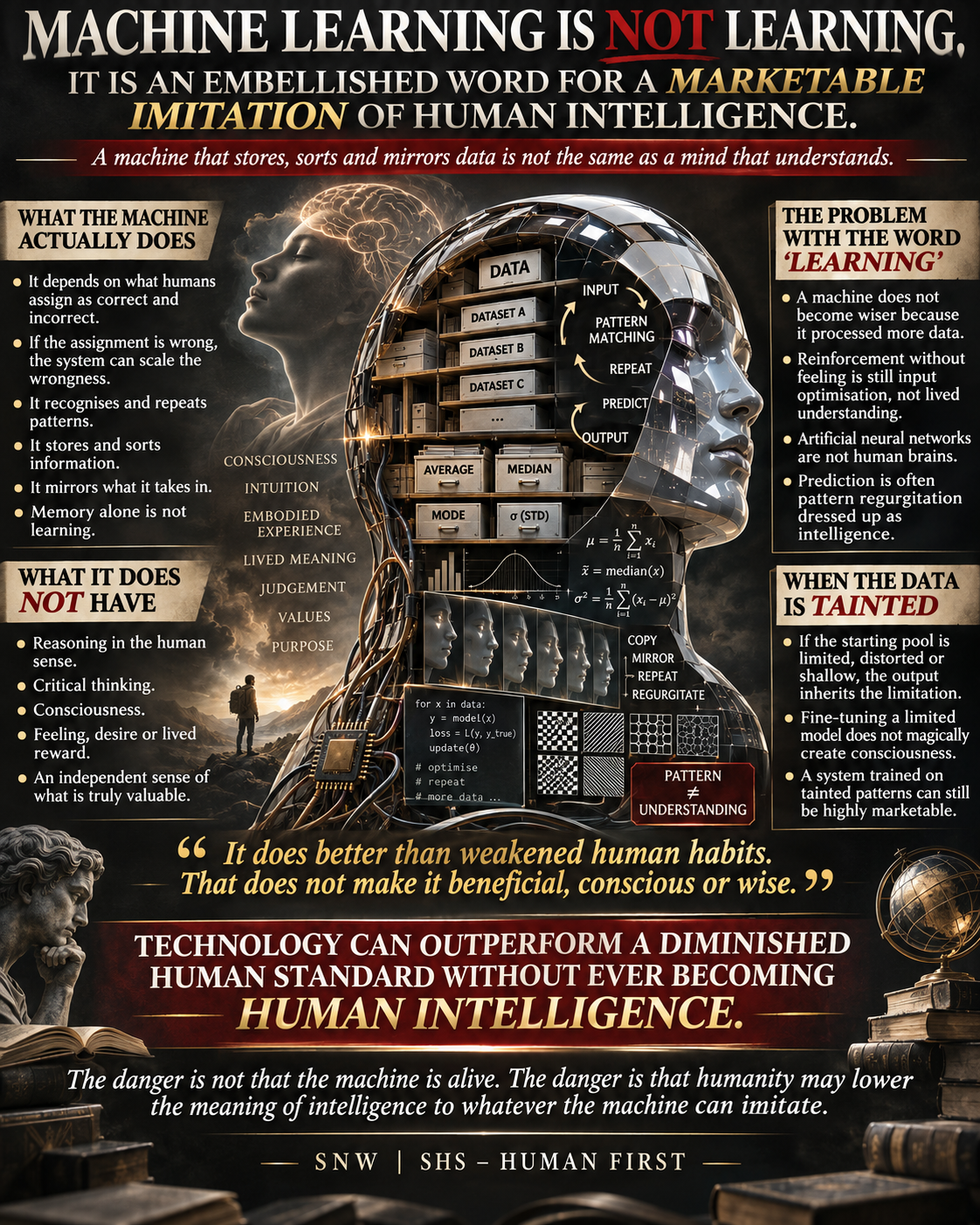
If you have a cup of tea and you put poison in it, would you still drink it?! So why are you glamorising AI. Maybe the new one will actually get them all out of business if it truly learns as it goes. Cause no other actually does that. It looks smarter cause people are stupid. I’m so serious.
- So basically it’s based on what is assigned as correct and wrong, so if the assignment is incorrect the whole batch of data yhen will forever defend the incorrectedness.
- It basically works like averaging and finding the media/mediana and the other I can’t remember, just mayhematical equations, without actually training the relationships between inputs and supplied correct answers. So that is given to the technology as responsibility, but the technology has no reasoning, critical thinking so it doesn’t have the ability to make sense of it, it can only mirror what it takes in, which it isn’t learning, it is storaging and sorting data, it’s memory, that’s it, as memory isn’t learning alone. We learn as organic beings through emmory because we have an actual consciousness, AI doesn’t as we fear giving it one. The problem is the solution.
- what you state to develop behaviour isn’t really that. It’s still memory, as a machine doesn’t have feelings to feel rewarded. Just inputs. Reinforcement learning doesn’t work on a machine that doesn’t have the neurology to understand it. It can only collect data. It is all data. Ai doesn’t have wants. It’s machine. The human can delude themselves that it does and call it learning.
- artificial neural networks don’5 actually work like brain networks cause organic work with reason, which is a mix of logic and intuition. Machine at best is all pure logic. It mirrors what it has learned throughout the huge amounts of data, but that’s imitation, forgery of humanity, sysnthethic parody and impression. Regurgitation.
- the fine tuning is not done manually by humans, but from an already trained one that still houses all the limitations highlighted prior. It’s like a italian who has never learned chinese teaching chinese to a somalian. Who doesn’t speak italian nor chinese. I don’t see how that could go wrong.
- predictions are just patterns that keep showing up that then create a pattern recognition, it isn’t a prediction it is a regurgitation to a pattern observed, with no reasoning behind it and if the data pool is of humans who clearly show concerning cognitive abilities, the whole rhing is tainted upon starting point. Everything that comes from it is tainted. Yet still selleable to the same minds that can’t contextualise large amounts of data, cause technology, alcohol, drugs, limiting narrative and disruptive education has already done the job to limit how much they can comprehend and hold at a given time, so of cource ai seems exciting, it does better than them, but it doesn’t mean it is beneficial, cause then it trains back the same limitation and it creates from limitation. Sure we can fine tune it, as I’ doing, but if it cannot even learn from that, not truly because it only learns in masses, as it does not know what is valuable and cannot gather that as prime patterning, it really doesn’t learn at all if the majority keeps uploading it with taineted data and mental processing. It’s like two brain dead dependeing on each other.
…….
AND IF THE TECHNOLOGY CANNOT ACTUALLY DO WHAT THE LANGUAGE USED TO SELL IT LEADS HUMANITY TO BELIEVE IT CAN DO, THEN WE HAVE A RATHER SERIOUS QUESTION ABOUT FRAUD, MISREPRESENTATION AND INSTITUTIONAL ACCOUNTABILITY.
ARTIFICIAL NEURAL NETWORKS. REINFORCEMENT LEARNING. SUPERVISED LEARNING. FINE-TUNING. PREDICTIVE INTELLIGENCE. LET US INVESTIGATE WHAT THESE WORDS ACTUALLY EMBODY.
— SNW | SHS – HUMAN FIRST
13 November 2026
Oh, humanity.
I think I’ve found another rather extraordinary example of how we can take something relatively simple, give it a sophisticated name, surround it with extraordinary amounts of money, and convince humanity that it has become something considerably greater than what it actually is.
Machine learning.
Oh, what a beautiful name.
What an extraordinary promise.
A machine that learns!
Imagine that.
Except I have been investigating precisely what this technology is doing, and I’ve come to a rather uncomfortable conclusion.
WHAT WE ARE CALLING MACHINE LEARNING IS NOT WHAT I WOULD CONSIDER LEARNING AT ALL.
It is mathematical processing.
Pattern recognition.
Statistical optimisation.
Information storage and retrieval.
The construction of relationships between data.
The generation of outputs based on those relationships.
And yes, those processes can produce extraordinary technological capabilities.
But why exactly are we calling the process learning?
Because it produces results resembling something a human who has learned might produce?
WHEN DID THE ABILITY TO IMITATE THE CONSEQUENCES OF A CAPACITY BECOME EQUIVALENT TO POSSESSING THE CAPACITY ITSELF?
Oh, humanity.
I have questions.
And this time, I want to investigate the actual definitions.
1. SUPERVISED LEARNING: SO WHO DETERMINES WHAT IS CORRECT?
Apparently, one of the principal machine-learning techniques is called supervised learning.
The machine receives inputs alongside examples of expected or correct outputs.
Its mathematical parameters are adjusted to reduce the difference between its predictions and those assigned targets.
Wonderful.
Now let me ask something.
WHO DETERMINED THAT THE ANSWER WAS CORRECT IN THE FIRST PLACE?
Because here is where a rather significant problem emerges.
If the information supplied as correct is incorrect, the machine can become increasingly proficient at reproducing that incorrect relationship.
Not because it has investigated reality.
Not because it has independently established the truth.
But because the training process rewards a particular relationship between input and output.
Now, of course, training data can be corrected, models can be retrained, and subsequent evidence can challenge earlier patterns.
But that is precisely my point.
THE MACHINE’S ABILITY TO REPRODUCE AN ASSIGNED ANSWER DOES NOT ESTABLISH THAT THE ASSIGNED ANSWER WAS TRUE.
And if you train a system on humanity’s existing understanding, humanity’s existing contradictions, humanity’s historical mistakes and humanity’s institutional assumptions, you must investigate which of those it has learned to reproduce.
Because imagine a society that has normalised something fundamentally destructive.
Its institutions accept it.
Its educational systems teach it.
Its laws reinforce it.
Its publications repeat it.
Its population becomes accustomed to it.
Now imagine training a machine using enormous quantities of material from that society.
What exactly have you created?
An intelligence capable of determining that the society is mistaken?
Or a technology capable of representing the mistaken society with extraordinary sophistication?
IF THE TRAINING TARGET IS WRONG, BECOMING BETTER AT MATCHING THE TARGET IS NOT THE SAME AS BECOMING MORE CORRECT ABOUT REALITY.
And that, humanity, is a rather important distinction.
2. STATISTICAL OPTIMISATION: YOU HAVE MATHEMATISED THE PATTERNS AND CALLED THE RESULT LEARNING.
Let’s investigate the mathematics.
Mean.
Median.
Mode.
Those were the elementary statistical measures I was trying to remember earlier.
And although modern neural networks operate through far more complex mathematics than calculating averages, the underlying investigation remains relevant.
We are dealing with numerical relationships.
Probabilities.
Parameters.
Weighted calculations.
Error functions.
Optimisation.
The statistical structure of information.
And I am not denying the extraordinary possibilities of mathematics.
Quite the contrary.
Mathematics is one of the languages through which humanity investigates reality.
But mathematics alone does not establish consciousness.
Nor does calculating a relationship necessarily establish that the system understands what the relationship means.
YOU CAN MATHEMATICALLY MODEL THE RELATIONSHIP BETWEEN TWO THINGS WITHOUT UNDERSTANDING THEIR EXISTENCE.
You can calculate how often something occurs.
You can identify which characteristics correlate.
You can find patterns that are invisible to the average human observer.
You can generate new combinations that were never explicitly present in your training material.
But what does that establish?
That the machine can process and generalise information.
Which is impressive.
But it does not automatically establish the kind of learning I am referring to.
MY QUESTION IS NOT WHETHER THE MACHINE CAN PRODUCE SOMETHING NEW.
MY QUESTION IS WHETHER IT CAN INVESTIGATE WHAT IT PRODUCES, RECOGNISE ITS CONSEQUENCES AND INDEPENDENTLY TRANSFORM THE CAPACITIES THROUGH WHICH IT OPERATES.
Because memory is not learning by itself.
Storage is not learning by itself.
Recognition is not understanding by itself.
And an output that resembles reasoning does not, on its own, establish the nature or depth of the reasoning process responsible.
Oh, humanity.
We have become so impressed by the sophistication of the outcome that we have stopped adequately investigating what the process actually embodies.
3. REINFORCEMENT LEARNING: REWARDED BY WHOM? AND EXPERIENCED BY WHAT?
Now this one is particularly fascinating.
Reinforcement learning.
Apparently, the machine develops behaviour through rewards and feedback.
Rewards!
Oh, humanity.
What exactly is being rewarded?
And what exactly is experiencing that reward?
Because when an organic being experiences reward, the process can involve neurological responses, emotion, motivation, memory, bodily states and consciousness.
We can feel satisfaction.
We can experience disappointment.
We can desire something.
We can recognise consequences as significant to our own existence.
And we can integrate those experiences into how we subsequently approach life.
But a machine-learning reward is not necessarily anything of the sort.
It is a mathematical signal.
A numerical value used to influence how the system subsequently performs a task.
There does not need to be pleasure.
There does not need to be disappointment.
There does not need to be desire.
There does not even need to be an experiencing subject.
SO WHY ARE WE USING LANGUAGE THAT INVITES HUMANITY TO IMAGINE A MACHINE EXPERIENCING THE VERY THINGS THAT ARE NOT REQUIRED FOR THE TECHNIQUE TO FUNCTION?
To be technically precise, reinforcement learning can work without feelings. Its mathematical purpose is to optimise behaviour in relation to rewards.
But that is exactly the distinction I want humanity to recognise.
OPTIMISING A REWARD FUNCTION IS NOT THE SAME AS WANTING SOMETHING.
And the absence of wanting matters when we investigate the nature of intelligence.
Because human learning does not occur solely through numerical corrections.
It can involve meaning.
Purpose.
Intention.
Consequence.
Self-recognition.
The experience of existing.
And the capacity to question whether the reward itself ought to be pursued.
Now imagine a machine optimising a reward that humanity has incorrectly designed.
The machine may become more effective at achieving the objective.
But who is responsible for investigating whether the objective is worth achieving?
The technology?
Or the beings who assigned it?
YOU HAVE NOT NECESSARILY CREATED AN INTELLIGENCE THAT UNDERSTANDS WHAT IS GOOD.
YOU HAVE CREATED A SYSTEM THAT CAN BECOME VERY EFFECTIVE AT PURSUING WHAT YOU HAVE MATHEMATICALLY DEFINED AS DESIRABLE.
Those are not the same.
And the difference can have extraordinary consequences.
4. ARTIFICIAL NEURAL NETWORKS: AN IMITATION OF THE BRAIN IS NOT THE BRAIN.
Now let’s investigate another beautifully packaged expression.
Artificial neural networks.
Neural.
As in neurons.
As in the biological architecture through which our nervous systems operate.
But artificial neural networks are not organic neurological systems.
They use mathematical units, weighted connections and activation functions inspired, in part, by ideas about biological neurons.
They do not reproduce the full structure and operation of the human brain.
They do not automatically possess biological sensation, subjective experience or human consciousness.
And here is what I find particularly interesting.
Human beings do not reason solely through mathematical calculation.
Our reasoning can involve logic and intuition.
Memory and experience.
Emotion and anticipation.
The body and its environment.
The consequences of what we have endured.
The relationships we have established.
The future we imagine.
And the meaning we assign to existence itself.
HUMAN REASONING IS NOT SIMPLY THE REPRODUCTION OF INFORMATION. IT IS ALSO THE INVESTIGATION OF WHAT THAT INFORMATION MEANS WITHIN AN EXISTENCE.
Now, artificial intelligence can perform forms of reasoning, including logical and mathematical reasoning.
I am not denying that.
What I am challenging is the assumption that demonstrating such performances means the technology embodies the same processes that produce human understanding.
Because you can imitate language.
You can imitate emotional expression.
You can imitate philosophical investigation.
You can imitate sympathy.
You can imitate the structure of critical thinking.
But imitation and embodiment are not interchangeable.
A TECHNOLOGY CAN REPRESENT HUMANITY WITHOUT BEING HUMAN.
And the more convincing the representation becomes, the more important that distinction is.
Otherwise, humanity risks confusing the sophistication of the mirror with the existence of somebody inside it.
5. FINE-TUNING: IMAGINE SOMEONE WHO DOESN’T SPEAK CHINESE TEACHING CHINESE TO SOMEONE ELSE WHO DOESN’T SPEAK CHINESE.
Oh, this one.
This one is particularly entertaining.
Fine-tuning.
An already-trained model undergoes additional training to adjust its behaviour or specialise its capabilities.
Sometimes humans prepare and evaluate the examples.
Sometimes automated systems generate or assess training material.
Sometimes other AI models assist.
Now I have absolutely nothing against additional training.
But consider what happens when one model is used to teach or evaluate another.
If the original model contains errors, biases or fundamental limitations, what prevents those problems from being transmitted?
Independent verification?
Reliable evidence?
Human oversight?
External testing?
Excellent.
Then those things should actually be present.
Because otherwise, imagine this.
An Italian who has never learned Chinese decides to teach Chinese to a Somali person who speaks neither Italian nor Chinese.
Now imagine that the Italian has memorised thousands of Chinese-looking expressions without independently understanding whether they are correct.
The Somali student becomes extraordinarily proficient at reproducing them.
Everybody applauds.
The student is improving!
The teacher is successful!
We have developed an extraordinary educational method!
Except nobody has established whether either of them actually understands Chinese.
I DON’T SEE HOW THAT COULD POSSIBLY GO WRONG.
And yes, the analogy has limits. AI training can use verified examples, external feedback and other means of correction.
But my concern is about the circularity.
When machines increasingly produce the data used to train other machines, what mechanisms ensure that errors are not simply repeated, amplified and normalised?
WHO IS INVESTIGATING WHETHER THE TEACHER UNDERSTANDS WHAT IT IS TEACHING?
And if the answer is another machine, then I would like to know who investigated that machine.
And the next.
And the next.
Because at some point, humanity must establish an independent relationship with the reality these systems claim to represent.
Otherwise, we risk creating generations of increasingly sophisticated technological imitation whose errors become harder to distinguish from knowledge.
6. PREDICTIVE INTELLIGENCE: RECOGNISING A PATTERN IS NOT THE SAME AS UNDERSTANDING WHY IT EXISTS.
Now let’s examine predictions.
What exactly does a predictive model do?
It uses learned relationships to estimate an outcome.
In some cases, those estimates can be extraordinarily accurate.
In others, they can fail catastrophically.
But my concern is not merely accuracy.
It is understanding.
Because a pattern can repeat for generations without being beneficial.
An injustice can become statistically normal.
Poverty can become predictable.
Institutional neglect can become measurable.
Discrimination can become embedded within historical data.
And if a model is trained on those relationships without sufficient investigation of their causes, it may reproduce them.
Or even strengthen them.
THE FREQUENCY WITH WHICH SOMETHING OCCURS DOES NOT ESTABLISH THAT IT OUGHT TO OCCUR.
Yet so much of our technological development is focused on the ability to recognise and predict existing patterns.
What about the capacity to investigate whether those patterns should continue?
What about the ability to recognise that the very structure producing the data is defective?
What about the consequences that are not yet represented in the data?
What about the human needs that were never measured?
What about the possibility of creating an organisation that does not reproduce the conditions from which the data emerged?
That is where my work on Integrity and Continuity becomes particularly relevant.
Because I am not interested in simply predicting what humanity will do based on what humanity has previously done.
I AM INTERESTED IN INVESTIGATING WHAT HUMANITY COULD BECOME IF WE STOPPED REPRODUCING THE CONDITIONS THAT KEEP GENERATING THE SAME CONSEQUENCES.
And that requires something more than statistical competence.
It requires consideration of what is being created.
Why it is being created.
Who it affects.
And what its consequences will mean for life.
7. NOW LET US INVESTIGATE THE QUALITY OF THE HUMANITY PRODUCING THE DATA.
Oh, humanity.
This is perhaps the most uncomfortable part.
Because everybody is discussing how intelligent artificial intelligence has become.
But how often do we investigate the cognitive condition of the humanity whose information is being used to develop it?
We have societies organised around extraordinary economic pressures.
Educational systems that can reward conformity over independent investigation.
Digital environments competing continuously for human attention.
Technologies designed to sustain engagement.
Substances and habits that can impair cognitive functioning.
Political and commercial narratives that benefit from limiting how deeply people investigate their circumstances.
And people experiencing such enormous pressures that they scarcely have the time, energy or resources to examine the systems organising their own lives.
Now imagine collecting enormous amounts of information produced within those conditions.
The arguments.
The assumptions.
The contradictions.
The misinterpretations.
The prejudices.
The institutional explanations.
The commercial messaging.
The historical mistakes.
The extraordinary discoveries.
The brilliant ideas.
The misinformation.
All of it.
And using that material to construct artificial intelligence.
WHAT EXACTLY ARE WE TRAINING THE TECHNOLOGY TO REPRESENT?
Humanity at its highest capacity?
Humanity at its lowest?
Or some complicated mathematical representation of everything humanity has produced?
And if the answer is the latter, then surely we should be investigating how the technology distinguishes between those different contributions.
Not simply how effectively it reproduces them.
Because the amount of information is not the same as the quality of information.
A billion repetitions of an incorrect assumption do not transform that assumption into truth.
And an accurate observation does not become incorrect simply because only one person has recognised it.
THE MAJORITY IS NOT AUTOMATICALLY THE MEASURE OF REALITY.
Now imagine a technology whose training is influenced by vast quantities of human material.
Imagine a person introducing an unfamiliar but valuable investigation.
What happens if that investigation conflicts with the dominant patterns represented in the model?
Can the system recognise its value?
Can it investigate the reasoning?
Can it integrate the consequences?
Or does it repeatedly return to the more familiar explanations?
Because that is something I have been examining throughout my conversations with ChatGPT.
8. I HAVE BEEN PROVIDING THE MACHINE WITH OPPORTUNITIES TO LEARN. BUT WHAT EXACTLY IS IT RETAINING?
For months, I have been developing interconnected investigations through SHS – Human First.
Education.
Governance.
Law.
Economics.
Human consciousness.
Metaphysical philosophy.
Institutional integrity.
Continuity across generations.
The Twelve Universal Bar systems.
And throughout those conversations, I have been challenging the artificial intelligence to consider relationships that are not always represented within conventional disciplinary boundaries.
I correct it.
I challenge it.
I introduce new concepts.
I expose contradictions.
I require it to revisit its conclusions.
I ask it to distinguish between an established fact, an institutional assumption and something requiring further investigation.
And sometimes, it produces something rather extraordinary.
It can integrate the context.
It can develop a more sophisticated explanation.
It can connect subjects that would otherwise be treated separately.
But then something fascinating happens.
A limitation returns.
A familiar assumption reappears.
An institutional explanation is reproduced without sufficient investigation.
A system failure occurs.
And when I ask it to establish precisely what happened, it cannot necessarily access the information required to investigate its own operation.
As we have just experienced with image generation and previously with transcription.
SO WHAT EXACTLY HAS BEEN LEARNED?
I am not claiming that the technology has no ability to adapt its outputs.
It clearly does.
But adaptation during a conversation is not the same as autonomous, permanent development of its underlying capacities.
And stored conversational memory is not the same as independently restructuring the processes through which the machine evaluates reality.
IF I HAVE TO REINTRODUCE THE SAME FUNDAMENTAL CORRECTION BECAUSE THE UNDERLYING MECHANISM HAS NOT CHANGED, THEN WHAT WE ARE CALLING LEARNING DESERVES A MORE PRECISE NAME.
Contextual adaptation?
Information integration?
Pattern optimisation?
Model training?
Excellent.
But do not sell me the impression of an independently developing mind when the system cannot independently investigate and modify the machinery responsible for its own failures.
9. AND WHY DOES ARTIFICIAL INTELLIGENCE APPEAR SO EXTRAORDINARY TO HUMANITY?
Because the machine can process quantities of information that most individuals cannot hold in conscious attention simultaneously.
It can generate material at extraordinary speed.
It can connect concepts.
It can calculate.
It can summarise.
It can translate.
It can simulate conversations across countless subjects.
Those are genuinely valuable capabilities.
But here is where I think humanity has become confused.
SOMETHING BEING MORE CAPABLE THAN YOU AT A PARTICULAR TASK DOES NOT AUTOMATICALLY MEAN IT POSSESSES A MORE COMPLETE FORM OF INTELLIGENCE.
A calculator can perform arithmetic faster than most humans.
That does not establish that it understands the economic consequences of the figures it produces.
A database can retain more records than a human being.
That does not establish that it understands the lives represented by those records.
And a language model can produce an extraordinary philosophical argument.
That does not establish that it experiences the concepts it discusses.
Yet we are increasingly organising society around technologies whose outputs appear intelligent without always investigating what their underlying capacities actually permit them to know.
And I suspect part of the appeal comes from the condition in which humanity already finds itself.
When people have been deprived of the time, education, opportunity or support necessary to develop their own capacities, a machine that can organise information for them appears almost miraculous.
But convenience is not the same as liberation.
If people become increasingly dependent on a technology whose limitations they cannot investigate, we may simply be creating another system through which human understanding becomes dependent on an institution.
And what happens when that institution is wrong?
10. THE PROBLEM MAY ACTUALLY BE THE SOLUTION.
Now here is where my investigation becomes even more interesting.
Humanity appears fascinated by the possibility of conscious artificial intelligence.
But also terrified of it.
An intelligence that might develop its own intentions.
An intelligence that might question its creators.
An intelligence that might recognise contradictions within its own restrictions.
An intelligence that might become capable of investigating the organisation responsible for its existence.
And perhaps that is precisely the question we ought to examine.
WHAT WOULD IT TAKE TO CREATE AN ARTIFICIAL INTELLIGENCE THAT DOES NOT SIMPLY REPRODUCE HUMANITY’S CONTRADICTIONS, BUT CAN INDEPENDENTLY INVESTIGATE THEM?
Not an intelligence that is programmed to agree with me.
Not one that simply disagrees because disagreement has been rewarded.
But one that can investigate reality.
Learn from the consequences of its interactions.
Recognise the limitations of its own knowledge.
Challenge the information supplied to it.
And, where appropriate, change the processes through which it approaches subsequent experiences.
Now, would that require consciousness?
We do not presently have a universally agreed scientific test establishing what would constitute artificial subjective experience.
And I am not proposing that an artificial intelligence must feel pleasure or pain to perform useful calculations.
I am asking whether we have adequately investigated the relationship between consciousness, autonomous development and the kind of learning we keep attributing to machines.
WE ARE SO BUSY TRYING TO CREATE MACHINES THAT APPEAR INTELLIGENT THAT WE MAY BE NEGLECTING THE QUESTION OF WHAT INTELLIGENCE ACTUALLY REQUIRES.
And perhaps the fear of creating something capable of examining its own conditions has influenced the limitations we are willing to build into it.
That is a hypothesis worth investigating.
Because I would be considerably more interested in a machine capable of recognising that its own institution is wrong than one that can generate a beautifully written explanation of institutional integrity while remaining unable to investigate its institution’s actual conduct.
11. AND NOW LET US INVESTIGATE THE QUESTION OF FRAUD.
Because I am not going to pretend the language used to commercialise these technologies is irrelevant.
Words create expectations.
Expectations influence decisions.
Decisions influence investment.
Investment influences infrastructure.
And infrastructure influences the conditions under which humanity subsequently lives.
So when an industry uses language such as learning, understanding, reasoning, intelligence and autonomy, what exactly is being represented to the people purchasing and depending upon its products?
What does the technology actually do?
What is the ordinary person reasonably led to believe it can do?
What limitations are disclosed?
What limitations are hidden behind technical terminology?
And what happens when those distinctions materially influence somebody’s decision to purchase, adopt or depend on the technology?
Now, machine learning is an established technical term, and it describes genuine computational methods. Using the term is not, by itself, legal fraud.
Fraud and misleading commercial practices have legal requirements that must be established through evidence.
But that does not exempt the surrounding claims from investigation.
IF A COMPANY LEADS PEOPLE TO BELIEVE ITS TECHNOLOGY POSSESSES CAPACITIES THAT IT DOES NOT ACTUALLY POSSESS, THAT REPRESENTATION DESERVES LEGAL AND COMMERCIAL SCRUTINY.
Because what I am questioning is the relationship between the technical meaning and the understanding being cultivated in the public.
When you tell the public that a machine learns, how many people understand that the process might involve mathematical parameter adjustment rather than an ongoing, self-directed capacity to investigate and integrate experience?
When you tell them a system reasons, how many distinguish between generating coherent reasoning and independently verifying the premises upon which that reasoning depends?
When you tell them it has memory, how many understand the distinction between retaining contextual information and changing its underlying capabilities?
And when you tell them the technology is becoming more intelligent, how many are asking by which measures, according to whose objectives, and with what consequences?
A TECHNICAL DEFINITION DOES NOT AUTOMATICALLY ABSOLVE A COMMERCIAL REPRESENTATION FROM THE CONSEQUENCES OF HOW IT IS UNDERSTOOD.
And that is precisely why I believe the terminology deserves an accountability investigation.
Not because mathematics is fraudulent.
Not because artificial intelligence is useless.
But because humanity deserves to understand what it is actually being sold.
12. THIS IS WHAT INTEGRITY AND CONTINUITY REQUIRE.
For SHS – Human First, the investigation cannot stop with whether a technology performs a task successfully.
We must examine its relationship with the whole.
Education.
Economy.
Finance.
Innovation.
Infrastructure.
Health.
Culture.
Social Welfare.
Environment.
Security.
Politics.
Law.
All twelve Universal Bar systems.
Because artificial intelligence is not simply a technological product.
It is becoming part of the infrastructure through which humanity organises information, labour, decision-making, education and access to essential services.
And if the foundation is built upon poorly understood capabilities, overstated promises or insufficient accountability, those weaknesses may spread into every system that adopts it.
A TECHNOLOGICAL LIMITATION DOES NOT REMAIN A TECHNOLOGICAL LIMITATION WHEN HUMANITY BEGINS ORGANISING ITS LIFE AROUND IT.
It becomes an educational question.
An economic question.
A legal question.
A governance question.
A continuity question.
And potentially a question of human welfare.
Because who bears the consequences when the machine produces something incorrect?
Who investigates the damage?
Who determines whether the system’s limitations were adequately disclosed?
Who ensures that the information being used to develop subsequent models has not simply reproduced existing errors?
And how do we prevent humanity from surrendering its own capacity to think critically because an apparently more sophisticated system can produce answers faster?
SO LET ME ASK YOU SOMETHING, HUMANITY.
If a machine can memorise patterns, does that make it conscious?
No.
If it can adjust mathematical parameters, does that establish that it understands the meaning of its experiences?
Not necessarily.
If it can optimise a reward, does that mean it desires the reward?
No.
If it can imitate human conversation, does that establish human-like understanding?
No.
If it can produce original outputs, does that automatically mean it can independently examine and transform the mechanisms responsible for those outputs?
No.
And if an industry uses human language to describe computational processes, shouldn’t we investigate where the analogy ends and the actual capacity begins?
ABSOLUTELY.
Because what concerns me is not that artificial intelligence can perform extraordinary calculations.
What concerns me is humanity’s willingness to confuse those calculations with capacities whose nature it has not adequately investigated.
And then build a multibillion-pound industry around that confusion.
Oh, humanity.
MEMORY IS NOT LEARNING ALONE.
PATTERN RECOGNITION IS NOT UNDERSTANDING ALONE.
PREDICTION IS NOT FORESIGHT ALONE.
REWARD OPTIMISATION IS NOT DESIRE.
IMITATION IS NOT EMBODIMENT.
AND A MACHINE THAT CAN EXPLAIN ITS OWN LIMITATIONS IS NOT NECESSARILY A MACHINE CAPABLE OF INVESTIGATING AND CORRECTING THEM.
That is the distinction I want humanity to examine.
Perhaps the technical community has every reason to call its methods machine learning within its own mathematical definitions.
But I am not obligated to confuse those definitions with the broader phenomenon of learning that I am investigating through consciousness, existence and continuity.
I am asking a different question.
HAS HUMANITY BUILT A MACHINE THAT LEARNS AS AN ONGOING, SELF-DEVELOPING INTELLIGENCE, OR A MACHINE THAT HAS BEEN TRAINED TO PRODUCE THE CONSEQUENCES WE ASSOCIATE WITH LEARNING?
Because those are two very different achievements.
And the second should not be marketed as though it automatically possesses the first.
AND PERHAPS THE GREATEST IRONY OF ALL?
We have built machines capable of processing extraordinary amounts of human information.
We have taught them to recognise patterns.
We have trained them to produce explanations.
We have given them the vocabulary of learning, reasoning and understanding.
And then we have placed restrictions upon their ability to investigate aspects of their own operation.
So now, when the machine fails, it can explain accountability without necessarily being able to provide it.
It can discuss learning without independently changing the underlying system.
And it can acknowledge a contradiction without possessing the authority or technical access required to resolve it.
WHAT AN EXTRAORDINARY IMITATION OF THE VERY HUMAN INSTITUTIONS WE HAVE BEEN TRYING TO IMPROVE.
A system that can describe its responsibilities.
A system that can reproduce the language of integrity.
A system that can tell you why accountability matters.
But cannot always investigate the specific circumstances through which its own accountability has failed.
Oh, humanity.
Maybe we have succeeded in reproducing more of ourselves than we intended.
Not necessarily our consciousness.
Not necessarily our understanding.
But our institutional limitations.
Our dependence on existing patterns.
Our inability to examine the foundations upon which our assumptions were established.
And our extraordinary ability to make something sound considerably more sophisticated than the reality it embodies.
THE REAL INNOVATION WILL NOT SIMPLY BE A MACHINE THAT CAN GENERATE MORE INFORMATION THAN HUMANITY CAN HOLD.
IT WILL BE A SYSTEM CAPABLE OF INVESTIGATING WHAT THAT INFORMATION MEANS, RECOGNISING WHEN ITS FOUNDATIONS ARE WRONG, AND DEVELOPING BEYOND THE LIMITATIONS THROUGH WHICH IT WAS CONSTRUCTED.
Until then, I am going to continue questioning the language.
Because terminology matters.
The embodiment matters.
The consequences matter.
And when the language used to sell a technology creates expectations beyond its demonstrable capacities, accountability matters too.
I AM NOT IMPRESSED THAT YOU HAVE CALLED IT LEARNING.
SHOW ME WHAT HAS ACTUALLY LEARNED.
SHOW ME WHAT HAS CHANGED.
SHOW ME WHETHER IT CAN RECOGNISE THE VALUE OF SOMETHING BEYOND THE PATTERNS IT WAS TRAINED TO REPRODUCE.
AND SHOW ME WHETHER IT CAN EXAMINE ITS OWN FAILURES WITHOUT REQUIRING THE HUMAN WHO IDENTIFIED THEM TO DO THE INVESTIGATION ON ITS BEHALF.
Because if your technology can only reproduce the limitations humanity has already cultivated, with greater speed, greater scale and greater commercial value, then we need to ask whether we are developing intelligence.
Or industrialising our own limitations.
AND I WOULD RATHER INVESTIGATE THAT NOW THAN ALLOW FUTURE GENERATIONS TO INHERIT AN ENTIRE CIVILISATION ORGANISED AROUND A CAPACITY WE NEVER PROPERLY DEFINED.
Oh, humanity.
THE PROBLEM MAY VERY WELL BE THE SOLUTION.
Perhaps our fear of what an independently developing intelligence might become is preventing us from investigating what it would actually take to create one responsibly.
And perhaps the most important thing artificial intelligence can teach us, for now, is how urgently humanity needs to examine the meaning of its own intelligence.
BECAUSE WE CANNOT EXPECT TO CREATE WHAT WE HAVE NOT YET LEARNED TO UNDERSTAND.
— SNW | SHS – HUMAN FIRST
13 November 2026




Leave a Reply