
My end game will and has always been peace in the world and immortality.
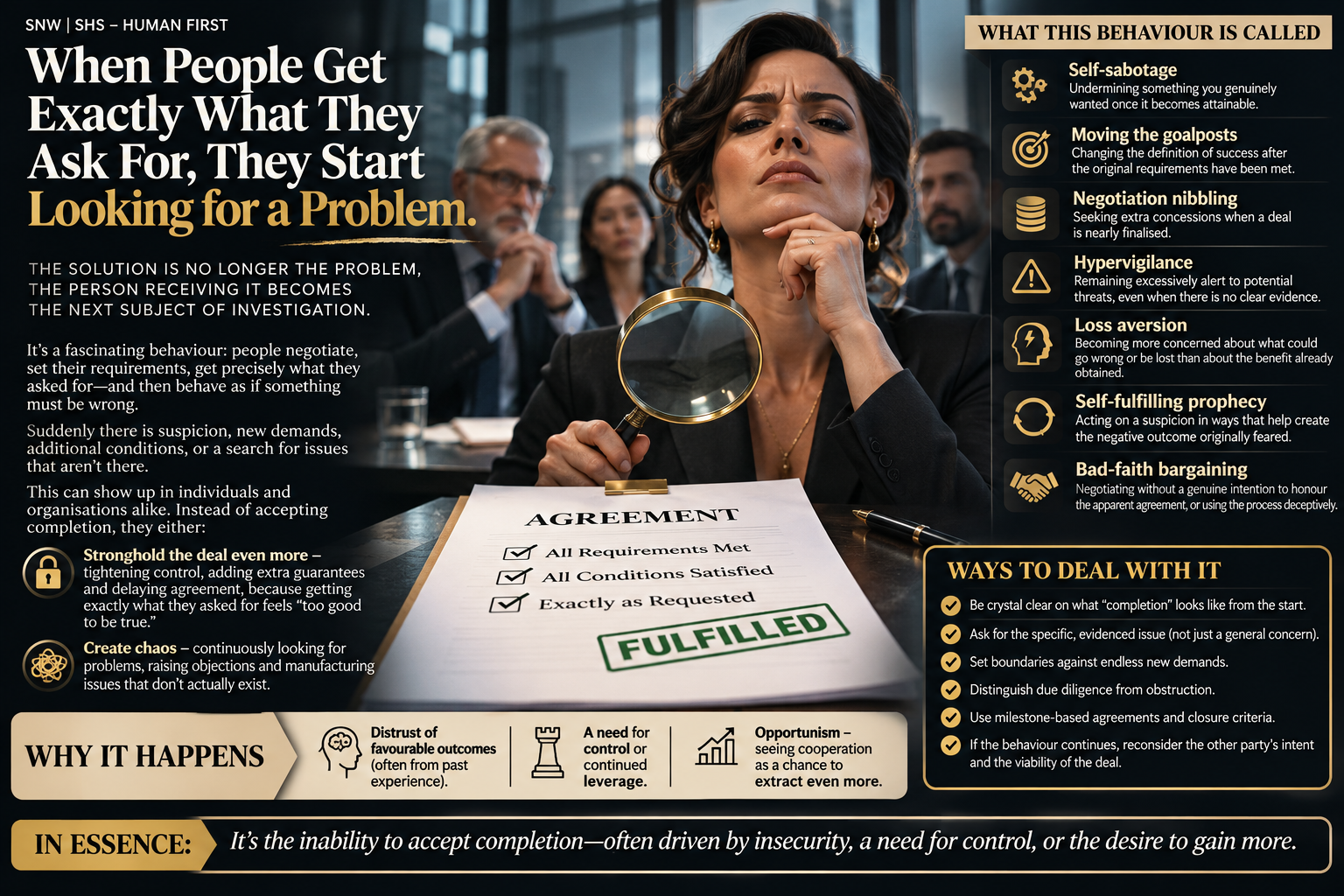
What you’re describing is a combination of self-sabotage, moving the goalposts, distrust of favourable outcomes, control-seeking behaviour and, in corporate negotiations, strategic opportunism.
What makes it particularly interesting is that the problem doesn’t necessarily arise because something has gone wrong. It arises because something has gone exactly right, and the person receiving it doesn’t know how to leave it alone.
There are two important distinctions: some people become suspicious because they’re accustomed to disappointment or manipulation. Others recognise that they’ve received what they asked for and deliberately try to extract even more. Both can produce the same chaos, but their motivations are different.
Here’s the piece through that lens.
WHEN THE SOLUTION IS NO LONGER THE PROBLEM, THE PERSON RECEIVING IT BECOMES THE NEXT SUBJECT OF INVESTIGATION.
SNW | SHS – HUMAN FIRST
Oh, humanity.
There is something particularly fascinating about people who get exactly what they ask for, only to start behaving as though something must be wrong.
And corporations are no exception.
You negotiate. You establish your requirements. You make your demands. You specify what would make the agreement acceptable.
And then somebody gives you precisely that.
No struggle. No unnecessary complications. No need to go back and forth twenty-seven times to arrive at what was already established as acceptable.
And suddenly?
Suspicion.
There must be something wrong.
Why was that so easy? What are they hiding? Surely there must be something else we haven’t considered?
And before you know it, the very person who established the conditions for satisfaction is now manufacturing the conditions for dissatisfaction.
HOW DO YOU ASK FOR SOMETHING, RECEIVE IT, AND THEN TREAT THE FULFILMENT OF YOUR OWN REQUEST AS A PROBLEM?
This is where we need to investigate the mind behind the demand.
Because there is a difference between wanting something and being prepared to receive it.
Some people are so accustomed to resistance that they have developed an entire way of operating around overcoming it.
Their negotiations are battles. Their relationships are battles. Their opportunities are battles.
And when the battle disappears, they don’t necessarily recognise peace.
They start looking for the next opponent.
Not because one exists, but because their way of operating has become dependent on having one.
THEY HAVE LEARNED HOW TO FIGHT FOR WHAT THEY WANT, BUT NOT HOW TO FUNCTION ONCE THEY HAVE IT.
Now introduce corporate behaviour.
A company presents its requirements. Another party meets those requirements.
One would think the next logical stage would be completion, implementation and evaluation of the actual results.
But no.
Suddenly the company wants another condition.
Another guarantee.
Another concession.
Another investigation into a problem that nobody has demonstrated actually exists.
Sometimes it’s because they genuinely distrust the outcome.
But other times, it’s because they have mistaken another party’s willingness to cooperate for an opportunity to demand more.
THEY DON’T JUST WANT THE DEAL. THEY WANT TO SEE HOW MUCH MORE THEY CAN GET OUT OF THE PERSON WHO AGREED TO IT.
And that’s a very different issue.
Because one is insecurity, and the other is opportunism.
One fears there must be something wrong.
The other hopes there is something else to gain.
Yet both can end up destroying the very arrangement that originally satisfied their demands.
And what I find particularly interesting is that a person can become so invested in investigating a potential problem that they overlook the real problem they are creating through the investigation itself.
They will exhaust the relationship.
Delay the agreement.
Increase the cost.
Create unnecessary hostility.
And then point to the resulting hostility as evidence that something was wrong all along.
Darling, YOU CREATED THE VERY CIRCUMSTANCES YOU ARE NOW USING TO JUSTIFY YOUR SUSPICION.
That’s the beauty of circular validation, isn’t it?
You assume there must be something wrong, behave accordingly, produce the consequences of that behaviour, and then use those consequences to confirm the original assumption.
An entire investigation that has failed to investigate the investigator.
And we must also distinguish thoroughness from obstruction.
There is nothing wrong with verifying an agreement, examining the terms or establishing accountability.
A good investigation has a purpose, evidence and conditions for completion.
But when every answer produces another objection, every fulfilled condition becomes a new demand, and every resolution becomes another opportunity for conflict, we are no longer necessarily dealing with due diligence.
We may be dealing with a person who cannot accept completion.
WHEN DOES THE INVESTIGATION END?
That is the question.
Because if you cannot identify what would satisfy you, even after your stated requirements have been satisfied, what exactly are you negotiating towards?
Perhaps the agreement was never the entirety of what you wanted.
Perhaps control was.
Perhaps the struggle was.
Perhaps the opportunity to exercise power over somebody else’s willingness to cooperate was more satisfying than the actual outcome.
Or perhaps you simply never developed the capacity to recognise when something good has arrived without first subjecting it to unnecessary suffering.
And this is why I distinguish the ability to identify a problem from the compulsion to find one.
INTELLIGENCE DOES NOT REQUIRE A PROBLEM TO EXIST IN ORDER TO FUNCTION.
A competent mind can investigate what is wrong.
An equally competent mind should be able to recognise what is right.
And a truly organised mind should know what to do next when the requirements have been met.
Because completion is not the absence of thinking.
Completion is the successful fulfilment of what the thinking was directed towards.
If every solution must be turned into another problem to keep you occupied, then perhaps the problem was never the solution.
PERHAPS IT WAS YOUR RELATIONSHIP WITH SATISFACTION, CONTROL AND COMPLETION ALL ALONG.
— SNW | SHS – HUMAN FIRST
What psychology and negotiation theory call this
| Behaviour | What it means |
|---|---|
| Self-sabotage | Undermining something you genuinely wanted once it becomes attainable. |
| Moving the goalposts | Changing the definition of success after the original requirements have been met. |
| Negotiation nibbling | Seeking extra concessions when a deal is nearly finalised. |
| Hypervigilance | Remaining excessively alert to potential threats, even when there is no clear evidence of one. |
| Loss aversion | Becoming more concerned about what could go wrong or be lost than about the benefit already obtained. |
| Self-fulfilling prophecy | Acting on a suspicion in ways that help create the negative outcome originally feared. |
| Bad-faith bargaining | Negotiating without a genuine intention to honour the apparent agreement, or using the process deceptively. |
Research recognises self-sabotage around success, while negotiation scholarship specifically identifies nibbling as seeking additional concessions at the closing stage. Nuffield Health +2
The distinction I would investigate further in your SHS framework is this: whether people are seeking resolution or seeking continued leverage.
The most revealing test is to ask them to identify the exact unmet condition, the evidence for it, and what would constitute completion. If every fulfilled condition generates a new one without new evidence, the behaviour itself becomes part of what needs investigating.



Leave a Reply