
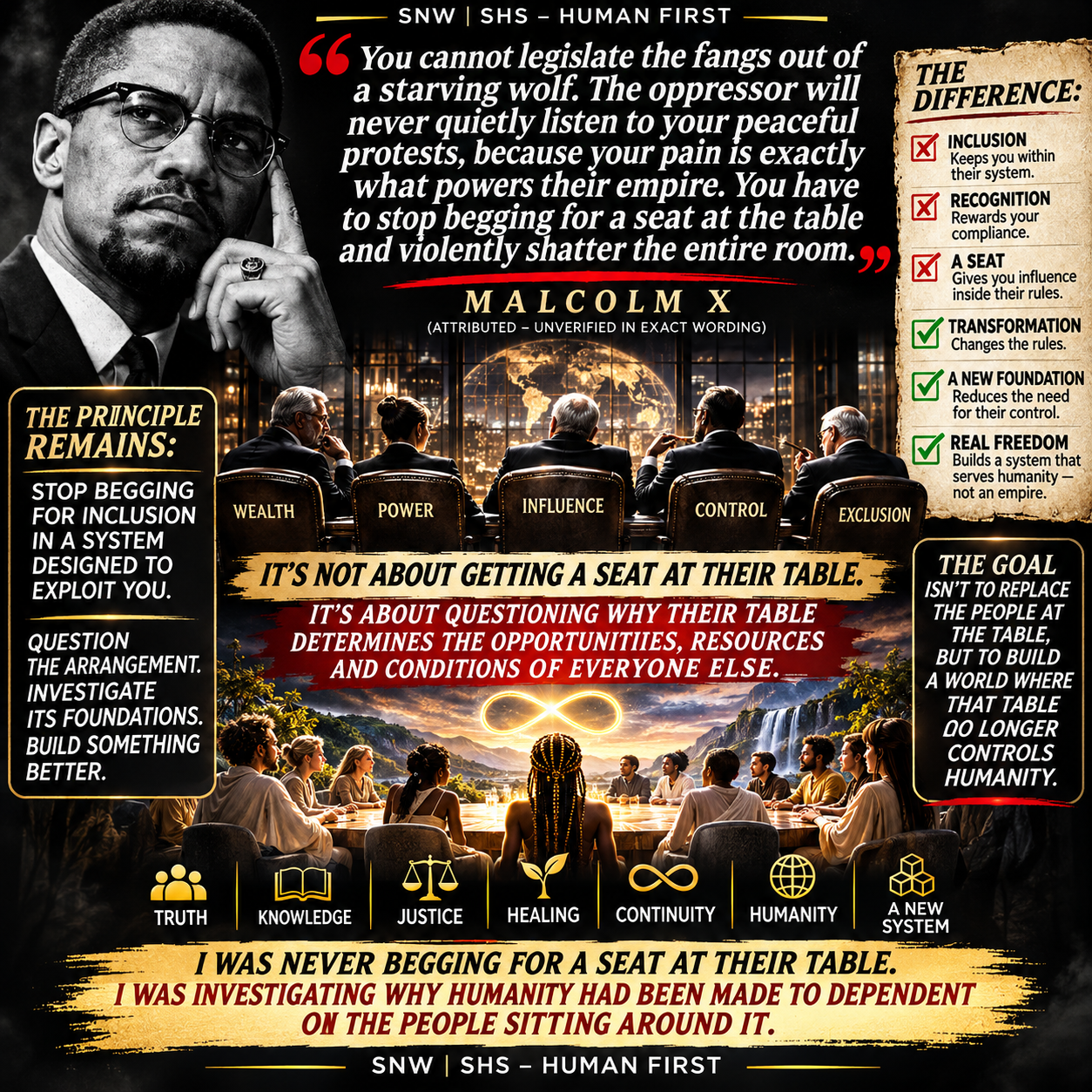
MALCOLM X. THE ARCHITECTURE OF OPPRESSION. AND THE DIFFERENCE BETWEEN DEMANDING A PLACE IN A SYSTEM AND DEVELOPING SOMETHING THAT MAKES THE SYSTEM OBSOLETE.
— SNW | SHS – HUMAN FIRST
17 November 2026
Oh, Malcolm.
How interesting.
I’ve just come across a statement circulating under Malcolm X’s name, and although I haven’t established whether those exact words were his, I find the underlying proposition rather fascinating.
Because I’ve been applying this principle throughout my investigations.
I simply hadn’t encountered it expressed in quite this way.
Stop begging for a seat at the table.
Challenge the arrangement that gives the people seated there authority over everybody else’s existence.
And I find it extraordinarily interesting how certain conclusions can emerge independently in different minds, different circumstances and different historical periods.
Not because the individuals are identical.
Not because the struggles are interchangeable.
But because when you investigate the structure of a problem rather than merely its immediate consequences, you can begin recognising the same underlying mechanisms.
I DIDN’T NEED TO KNOW THE WORDS TO RECOGNISE THE PRINCIPLE.
And perhaps that tells us something about consciousness.
You don’t necessarily need another person to give you an understanding that you’re capable of developing through your own observations.
Sometimes you encounter their words afterwards.
And recognise a relationship between what they understood and what you’ve already been doing.
WHY WOULD I BEG FOR A SEAT AT A TABLE WHOSE FOUNDATIONS I QUESTION?
Let’s examine this.
Imagine spending your life attempting to convince people who benefit from a particular arrangement that they should make some room for you.
A little recognition.
A little influence.
A little opportunity.
Perhaps a promotion.
Perhaps an invitation.
Perhaps a position among the very people whose decisions you’ve been criticising.
And when they finally offer you a place?
Congratulations.
You’re now sitting at their table.
But what happened to the people who still cannot enter the room?
What happened to the conditions that made the table exclusive in the first place?
What happened to the structures that allowed a relatively small group of people to determine which opportunities would be available to everybody else?
DID YOU CHANGE THE SYSTEM, OR DID YOU SIMPLY IMPROVE YOUR POSITION WITHIN IT?
Because those are two entirely different accomplishments.
And I believe humanity has spent an extraordinary amount of time confusing them.
People who were once excluded become successful within the very institutions that excluded them.
And society celebrates their arrival as evidence of progress.
Sometimes it genuinely is progress.
Representation matters.
Access matters.
Removing discriminatory barriers matters.
But inclusion alone doesn’t establish that every structural problem has been resolved.
If the conditions remain fundamentally unchanged for everybody else, then perhaps what we’ve accomplished is the expansion of participation rather than the transformation of the system.
And I want us to understand the difference.
I’M NOT INTERESTED IN BECOMING THE NEXT PERSON WHO GETS TO DECIDE WHO’S WORTHY.
Look at the things I’ve been investigating.
The corporate colonist.
The accumulation of companies.
The concentration of economic influence.
The financial systems that can make human survival conditional upon access to money.
The institutions whose public reputations are carefully manufactured.
The people who accept restrictions on their own autonomy and then attempt to impose similar restrictions on others.
The family dynasties that can treat children as extensions of an inherited empire.
The philanthropic arrangements through which extraordinary private fortunes become associated with the power to determine which social problems receive assistance.
Different subjects.
Different industries.
Different people.
But what’s the common question?
WHO GAVE YOU THE AUTHORITY TO ORGANISE EVERYBODY ELSE’S EXISTENCE AROUND THE PRESERVATION OF YOUR OWN POSITION?
Not every institution operates irresponsibly.
Not every wealthy individual is unethical.
And not every hierarchy is inherently illegitimate.
But authority, wealth and established status do not exempt any arrangement from investigation.
If a system claims to serve humanity, then humanity should be able to examine what it actually provides.
If an institution claims to protect people, its effectiveness should be evaluated.
If an organisation claims to create value, we should investigate what that value consists of, who receives it and what consequences accompany its production.
And if somebody claims the right to lead, they should be prepared to explain the foundations and responsibilities of that leadership.
THE TABLE DOESN’T BECOME LEGITIMATE MERELY BECAUSE EVERYBODY HAS BECOME ACCUSTOMED TO ITS EXISTENCE.
PEACEFUL REQUESTS ARE NOT THE SAME THING AS STRUCTURAL CHANGE.
Now, there’s another part of this discussion that deserves attention.
The assumption that the people benefiting from a system will voluntarily surrender their advantages simply because somebody explains the suffering associated with them.
Sometimes they do respond.
Reforms can happen.
Laws can change.
Institutions can improve.
But sometimes the incentives for maintaining the existing arrangement are stronger than the willingness to address its failures.
And that’s why I’ve never considered appealing to individual goodwill an adequate substitute for building something better.
You can ask somebody to be more generous.
But what happens when they’re no longer feeling generous?
You can ask a corporation to behave more responsibly.
But what happens when its financial incentives encourage a different decision?
You can ask somebody with authority to recognise your value.
But what happens when withholding that recognition serves their interests?
You can ask an institution to correct a failure.
But what happens when the institution is so invested in protecting its reputation that acknowledging the failure becomes inconvenient?
IF YOUR ENTIRE FUTURE DEPENDS ON THE GOODWILL OF THE PEOPLE WHO BENEFIT FROM YOUR DEPENDENCY, HOW MUCH OF YOUR FUTURE DO YOU ACTUALLY CONTROL?
And this is precisely why I’ve been developing SHS – HUMAN FIRST.
Not as another request to be accepted.
Not as a petition to become one of the powerful.
But as an attempt to investigate and develop an alternative organisation of society.
An organisation whose foundations are rooted in human existence, responsibility, integrity, free will and continuity.
Because the goal isn’t simply to replace the person at the top.
IT’S TO CHANGE THE CONDITIONS THAT KEEP REPRODUCING THE SAME PROBLEMS, REGARDLESS OF WHO OCCUPIES THE POSITION.
I’M NOT HERE TO PHYSICALLY SHATTER A ROOM. I’M HERE TO MAKE ITS ARRANGEMENT OBSOLETE.
Now, the image uses the language of violently shattering a room.
And I want to make a distinction.
I’m not interested in treating physical destruction as evidence of superior intelligence.
Destroying a building doesn’t automatically produce a better institution.
Injuring people doesn’t establish justice.
And eliminating an existing structure without understanding what must replace it can create another set of problems.
What interests me is something considerably more demanding.
MAKING THE EXISTING ARRANGEMENT UNNECESSARY THROUGH THE DEVELOPMENT OF SOMETHING MORE CAPABLE.
Because that’s where I believe real intelligence demonstrates itself.
Anybody can complain that a system is inadequate.
Many can recognise its contradictions.
Some can expose its failures.
But can you understand the architecture sufficiently to design an alternative that doesn’t simply reproduce the same deficiencies under a new name?
That’s the challenge.
And that’s the work.
Not asking the owners of the existing arrangement to appoint you as their successor.
But understanding what the arrangement provides, what it fails to provide, what humanity actually needs and how those needs could be met differently.
Not replacing one dependency with another.
Not exchanging one controlling authority for another.
Not creating another hierarchy whose continuation depends on everybody else remaining subordinate.
BUILD SOMETHING THAT DOESN’T REQUIRE HUMANITY TO CONTINUE BEGGING FOR WHAT IT NEEDS TO EXIST.
That is what interests me.
THE PEOPLE WHO BENEFIT FROM THE PROBLEM ARE NOT ALWAYS THE PEOPLE BEST POSITIONED TO SOLVE IT.
Here’s something I’ve been examining throughout my work.
How much of the modern economy has developed around managing the consequences of problems that remain unresolved?
How many organisations derive revenue from conditions that society claims it wants to eliminate?
How many systems are rewarded for responding to damage rather than preventing the conditions that produce it?
Now, providing services to people in need is not inherently exploitative.
Healthcare, legal assistance, social support and other essential services require resources and skilled people.
But there is a difference between an organisation whose continued success depends on reducing harm and one whose financial incentives may be strengthened by the persistence of that harm.
And we need to examine that distinction.
Because if the institutional rewards do not align with the outcomes society claims to want, simply asking individuals to be more compassionate may not be enough.
YOU CANNOT ASSUME THAT A SYSTEM WILL ELIMINATE A PROBLEM WHEN ITS STRUCTURE REWARDS THE CONTINUATION OF THAT PROBLEM.
That doesn’t mean change is impossible.
It means we need to examine incentives, accountability and the conditions under which decisions are made.
We need to think better.
Not less.
We need to investigate more thoroughly.
Not merely more extensively.
And we need to understand how things relate before assuming that changing one visible part will correct the entire arrangement.
That’s the distinction I’ve been making.
I DON’T NEED THEIR RECOGNITION TO INVESTIGATE THEIR CLAIMS.
And here’s another rather interesting part.
Recognition.
Oh, how people love recognition.
The titles.
The awards.
The invitations.
The public acknowledgements.
The carefully selected individuals permitted to enter certain rooms.
As though the truth of an observation becomes dependent upon the social position of the person who made it.
But a valid finding doesn’t become invalid because somebody refuses to acknowledge it.
And an invalid conclusion doesn’t become correct because somebody powerful endorses it.
CREDIBILITY DOES NOT REQUIRE RECOGNITION.
It requires grounds upon which a claim can be examined.
Evidence.
Coherence.
Accountability.
The willingness to be corrected.
And the ability to distinguish what has been demonstrated from what remains a developing interpretation.
This matters to me because I am not interested in replacing somebody else’s authority with my own unquestionable authority.
I want the quality of the investigation to matter.
I want people to be able to examine conclusions independently.
And I want the structure of society to become more capable of recognising problems without needing the permission of those whose reputations might be affected by recognising them.
Because withholding recognition should never become a substitute for answering the substance of an argument.
THE LONG GAME WAS ALWAYS BIGGER THAN A SEAT.
I’ve said before that I know my priorities.
And when you know your priorities, you know what completion means.
Some people measure success by whether they finally receive an invitation.
Others measure it by whether they become sufficiently wealthy to buy their way into the room.
Others spend their lives attempting to become the person everybody else must ask for permission.
But my objective is different.
I’m interested in the larger investigation.
The relationships between the individual, humanity, society and consciousness.
The foundations upon which institutions are built.
The conditions required to sustain life.
The systems through which knowledge is inherited.
And the development of alternatives that reduce the necessity of returning, generation after generation, to the same unresolved problems.
I am not measuring the completion of that work by whether somebody decides to give me a prestigious position.
Nor by whether the people I’ve criticised suddenly become interested in working with me.
I’M NOT BUILDING MY WORK AROUND THEIR WILLINGNESS TO ACCEPT IT.
I’m building it around the questions it is intended to address.
And its value will have to be demonstrated through what it can actually achieve.
Not simply through what I believe it can achieve.
Because that, too, is part of accountability.
AND NOW I UNDERSTAND WHY THIS STATEMENT RESONATED WITH ME.
It isn’t because I want to imitate Malcolm X.
I didn’t arrive at my work by trying to reproduce somebody else’s historical struggle.
His circumstances involved the racial oppression, segregation and denial of civil rights faced by Black Americans in the twentieth century.
Those circumstances deserve their own historical understanding.
My investigation concerns a broader set of contemporary economic, institutional, social and metaphysical questions.
Different context.
Different methods.
Different objectives.
But there is a philosophical intersection.
WHY SHOULD THE POSSIBILITY OF CHANGE BE LIMITED TO WHAT THE EXISTING AUTHORITIES ARE WILLING TO PERMIT?
Why should developing an alternative be considered unreasonable simply because it challenges established assumptions?
Why should somebody’s status determine whether the structure they defend deserves scrutiny?
And why should those who have accumulated the greatest resources automatically be considered the most capable of imagining a different organisation of existence?
That’s what I recognise in the sentiment of the image.
Not the glorification of violence.
Not the idea that every individual occupying a position of power must be regarded as an enemy.
But the refusal to confuse access with freedom.
The refusal to confuse reform with complete transformation.
And the refusal to make the legitimacy of one’s thinking dependent upon the approval of the people whose thinking is being questioned.
THE POINT WAS NEVER TO OWN THEIR TABLE.
I have no interest in taking the same structure, replacing the people sitting around it and declaring that humanity has finally been liberated.
What would have changed?
The faces?
The surnames?
The bank accounts?
The public relations strategy?
Wonderful.
But if people remain dependent on the same mechanisms, subject to the same forms of control and exposed to the same avoidable failures, then the foundations remain.
And humanity continues paying the price.
I DON’T WANT TO BECOME THE NEXT PERSON WHO GETS TO EXERCISE THE SAME POWER OVER EVERYBODY ELSE.
I want to examine whether that form of power needs to exist in the first place.
And where coordination, authority and specialised responsibility remain necessary, I want them organised around accountability rather than personal supremacy.
Because being capable of organising something does not entitle you to own everyone who participates in it.
And having the resources to support humanity does not make humanity your property.
That’s the distinction.
So, yes.
I found this statement rather amusing to encounter.
Because it describes a particular refusal I recognise in my own work.
I’ve been questioning the room.
Investigating its foundations.
Examining the people who claim authority within it.
Considering what makes the entire arrangement function.
And developing a different framework for what could exist beyond it.
Not because I expect that work to be easy.
Not because I believe every idea I’ve developed has already been verified.
But because I’m not interested in limiting the possibilities of the future to what the existing system currently considers acceptable.
THE FUTURE DOESN’T HAVE TO BE A RENOVATION OF THE PAST.
And that’s where my intention remains.
Not merely a place at the table.
Not another empire.
Not another exclusive room.
Not another individual whose recognition becomes the condition of everybody else’s opportunities.
But an organisation in which human existence, knowledge, responsibility and continuity are the foundations from which everything else develops.
Oh, Malcolm.
Whether or not you ever said those exact words, I understand the principle they attempt to express.
And I found it through my own investigations before encountering the image.
I WAS NEVER BEGGING FOR A SEAT AT THEIR TABLE.
I WAS INVESTIGATING WHY HUMANITY HAD BEEN MADE SO DEPENDENT ON THE PEOPLE SITTING AROUND IT.
And more importantly:
WHAT WOULD IT TAKE TO BUILD A WORLD IN WHICH THAT DEPENDENCY WAS NO LONGER NECESSARY?
That is the question.
And that is where my work continues.
— SNW | SHS – HUMAN FIRST




Leave a Reply