
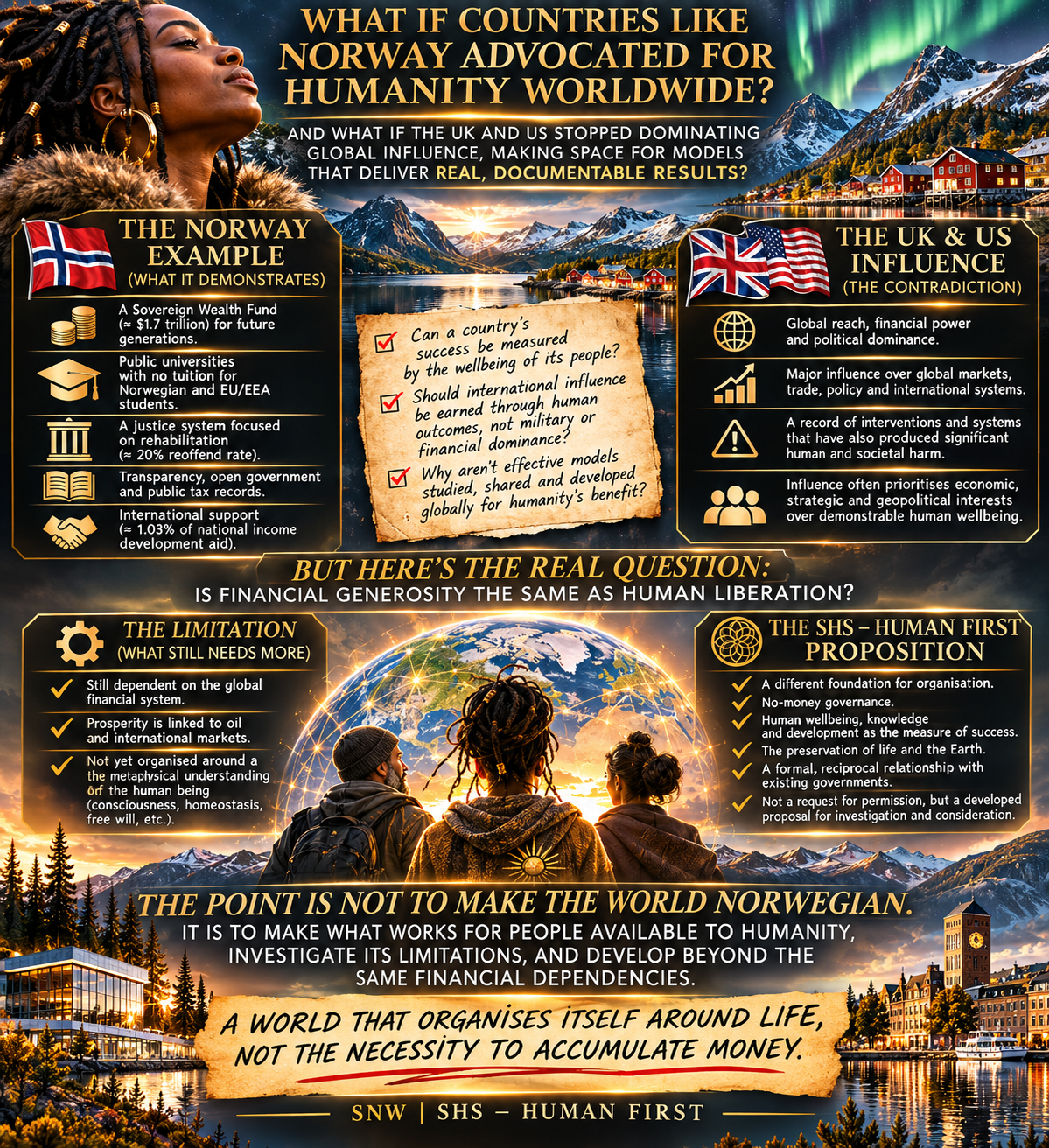
NORWAY, THE UK, THE US, INTERNATIONAL INFLUENCE, AND WHY FINANCIAL GENEROSITY IS NOT THE SAME AS HUMAN LIBERATION.
— SNW | SHS – HUMAN FIRST
17 November 2026
Oh, humanity.
Imagine something with me.
Imagine if countries like Norway decided to advocate for humanity worldwide with the same seriousness with which they’ve organised the wellbeing of their own citizens.
Imagine if countries like the United Kingdom and the United States stopped occupying so much of the international space of influence, and countries with demonstrable achievements in human wellbeing were given greater opportunity to shape the global conversation.
Not simply because they have money.
Not because they have military power.
Not because they have successfully positioned themselves as international authorities.
BECAUSE THEY HAVE RESULTS.
Actual results.
Facts.
Documentable evidence.
Established institutions that can be investigated, compared and learned from.
Oh, what a different world we might be looking at.
Not perfect.
Better.
And sometimes better is a very significant step towards what we haven’t yet developed the capacity to achieve.
1. NORWAY HAS SOMETHING INTERESTING TO SHOW HUMANITY.
Look at what Norway has established.
A sovereign wealth fund designed to preserve national petroleum wealth for future generations.
A public education system in which Norwegian and EU/EEA students generally do not pay university tuition.
A correctional philosophy that considers rehabilitation and reintegration fundamental purposes of imprisonment.
Public transparency mechanisms.
Comparatively high levels of institutional trust.
And an approach to public resources that recognises obligations extending beyond the generation currently governing them.
Now, none of this means that every Norwegian is thriving, that corruption is nonexistent, or that these institutions function perfectly.
But their existence demonstrates something.
THE ORGANISATION OF SOCIETY IS A CHOICE.
What governments prioritise matters.
What they build matters.
What they maintain matters.
What they measure matters.
And the conditions under which their citizens live are not completely disconnected from the arrangements established to govern them.
So why aren’t these achievements being studied and developed internationally with the same enthusiasm with which countries export their financial interests, political ideologies, military strategies and commercial ambitions?
Why does the world spend so much energy investigating how powerful countries became powerful, rather than how particular societies became capable of providing better conditions for the people living within them?
WHY ARE WE STILL CONFUSING THE CAPACITY TO EXERCISE POWER WITH THE CAPACITY TO ORGANISE HUMAN WELLBEING?
Because those are not necessarily the same thing.
2. WHAT IF INTERNATIONAL INFLUENCE HAD TO ANSWER TO HUMAN OUTCOMES?
The United Kingdom and United States have exercised enormous international influence through finance, diplomacy, commerce, military alliances and political institutions.
And their influence has produced different consequences across different societies.
Some beneficial.
Others profoundly damaging.
That’s precisely why I want the outcomes investigated.
Not the reputation.
Not the patriotic narrative.
Not the carefully constructed international image.
THE ACTUAL CONSEQUENCES.
If a country advocates a system of governance, investigate what that system has accomplished for its own people.
If it promotes economic policies internationally, investigate how those policies have affected the populations living under them.
If it proposes reforms for other nations, investigate whether those reforms have delivered the promised results.
And if a country has demonstrated more effective approaches in particular areas, why shouldn’t its knowledge have a greater influence over how those problems are addressed?
I am not suggesting that Norway should acquire the unquestionable authority to dictate how every other country lives.
That would simply reproduce another concentration of power.
I’m asking why international influence isn’t more consistently earned through demonstrated contributions to humanity.
LET THE RESULTS SPEAK BEFORE THE AUTHORITY DOES.
And let every country, including Norway, remain accountable to the same standard.
3. AND THEN CHATGPT TELLS ME NORWAY PROVIDES 1.03% OF ITS NATIONAL INCOME IN INTERNATIONAL AID.
Ahahahaha.
Darling.
Here we go again.
I raise the question of reorganising humanity beyond its financial dependence, and the response is that Norway already contributes internationally because it provides a percentage of its national income.
Yes.
According to the OECD, Norway allocated approximately 1.03% of its gross national income to official development assistance in 2025.
That is a documented contribution.
It can fund genuinely important services, programmes and humanitarian support.
And I am not suggesting that such assistance should be withdrawn from people who depend upon it.
BUT PROVIDING NATIONAL INCOME WORKS WITHIN THE VERY FINANCIAL SYSTEM I AM HOLDING GOVERNMENTS ACCOUNTABLE FOR NOT FUNDAMENTALLY CHALLENGING.
Do you understand the distinction?
I’m not asking how much money a country is prepared to give to humanity.
I’m asking why humanity’s wellbeing continues to be organised around the requirement to possess, distribute and depend upon money in the first place.
Those are two different investigations.
One asks:
How much of our national income should we allocate to helping others?
The other asks:
WHY HAVE WE ORGANISED ACCESS TO THE REQUIREMENTS OF HUMAN EXISTENCE THROUGH FINANCIAL DEPENDENCE AT ALL?
And what would it take to develop another arrangement?
Because a country can be financially generous without challenging the foundations of the system that makes that generosity necessary.
It can redistribute wealth while preserving the mechanisms through which wealth determines access.
It can provide aid without eliminating the conditions that continually generate the need for aid.
And it can improve lives within the monetary system without developing a viable alternative to monetary dependence.
These are not reasons to dismiss humanitarian assistance.
They are reasons to distinguish assistance from structural transformation.
YOU CANNOT PRESENT THE SUCCESSFUL DISTRIBUTION OF MONEY AS AN ANSWER TO AN INVESTIGATION INTO WHY MONEY HAS BEEN MADE SO NECESSARY TO HUMAN SURVIVAL.
That’s precisely the dependency we’re examining.
4. NORWAY’S ACHIEVEMENTS ARE REAL. SO IS ITS DEPENDENCE ON THE SYSTEM.
And this is where I find Norway particularly interesting.
Because Norway has developed an extraordinarily significant sovereign wealth fund.
Its petroleum resources have been converted into financial assets invested internationally, with returns helping finance public expenditure.
A resource belonging to the nation has therefore been organised to produce benefits extending across generations.
Excellent.
That demonstrates long-term thinking.
Organisational continuity.
A degree of collective responsibility.
But it also demonstrates the limitation.
THE WEALTH OF FUTURE GENERATIONS IS STILL BEING ORGANISED THROUGH THE CONTINUITY OF FINANCIAL MARKETS.
The country depends on a monetary system.
Its investments depend upon other economies.
Its public spending depends partly upon revenue and financial returns.
And its prosperity is connected to an international economic order whose consequences extend beyond Norwegian borders.
So yes, Norway can demonstrate considerable organisational intelligence.
But it has not established independence from the very structure I am investigating.
And that’s important.
Because I’m not trying to find the perfect country and place it above everyone else.
I’m investigating which societies have already developed particular capacities that humanity can learn from, while identifying what those societies have not yet accomplished.
RECOGNISING AN ACHIEVEMENT DOES NOT REQUIRE IGNORING A LIMITATION.
And recognising a limitation does not erase the achievement.
That’s what thorough investigation looks like.
5. THE MISSING FOUNDATION: THE HUMAN BEING BEYOND THE ECONOMIC UNIT.
Now we arrive at the metaphysical aspect.
Because as much as I appreciate Norway’s achievements, I still see a foundational limitation in the prevailing approach to governance.
The human being continues to be understood substantially through economic participation.
Employment.
Income.
Taxation.
Consumption.
Public expenditure.
Financial security.
And the distribution of resources.
All important subjects within the society we’ve constructed.
But none individually explains the entirety of human existence.
THE HUMAN BEING IS NOT SIMPLY AN ECONOMIC UNIT THAT REQUIRES FINANCIAL MAINTENANCE.
We’re physical.
Emotional.
Mental.
Social.
Conscious.
And inseparable from the environments through which we exist.
Within my SHS metaphysical framework, homeostasis, consciousness, free will, relationships and the continuity of life belong at the foundation of how society is understood and organised.
Some aspects of these relationships can already be investigated through established sciences. Other metaphysical propositions require further research and should not be treated as proven merely because I propose them.
But the philosophical question remains.
Why do we keep organising the conditions of human existence primarily through economic frameworks, then treating the human consequences as separate problems requiring subsequent intervention?
Why not investigate those human requirements as foundational conditions around which our institutions should be developed?
Not simply how much healthcare we can afford.
But what organisational conditions best support health.
Not simply how much education costs.
But how humanity can continuously develop and inherit knowledge.
Not simply how much money is required to prevent poverty.
But how access to life’s requirements might be organised without the necessity for financial accumulation determining who receives them.
THAT IS A DIFFERENT FOUNDATION FOR GOVERNANCE.
And it requires more than generous national budgets.
6. I DON’T WANT THE WORLD TO BECOME NORWAY. I WANT HUMANITY TO BENEFIT FROM WHAT NORWAY HAS LEARNED.
The response I received suggested that the opportunity was not to make the world Norwegian.
Well, darling, of course.
That was never the proposition.
The proposition is that countries capable of demonstrating beneficial arrangements should contribute those arrangements to humanity’s collective development.
Why should an effective organisational method remain confined to the country that established it?
Why should nations repeatedly return to the beginning when another society has already investigated, tested and implemented something useful?
This connects directly to what I’ve been discussing about knowledge as inheritance.
WHAT ONE GENERATION LEARNS SHOULD BECOME PART OF WHAT THE NEXT GENERATION CAN DEVELOP.
And I extend that principle beyond generations.
To countries.
To institutions.
To humanity.
Norway has experience worth examining in managing natural-resource revenue for future generations.
Other countries have experience worth examining in other areas.
The purpose isn’t to make one country the global authority on everything.
It’s to stop treating national achievements as though they belong exclusively within national boundaries when their underlying knowledge could benefit others.
Of course, different populations have different histories, resources, circumstances and needs.
A method cannot simply be transplanted everywhere with an expectation of identical results.
That’s why investigation matters.
Identify the mechanisms.
Understand the conditions.
Establish what makes the arrangement work.
Adapt where necessary.
Test.
Measure.
Correct.
Develop.
THE GOAL IS NOT TO EXPORT NATIONAL IDENTITY.
IT IS TO MAKE HUMAN KNOWLEDGE CONTINUOUSLY USEFUL TO HUMANITY.
7. AND THIS IS WHERE SHS – HUMAN FIRST COMES IN.
The difference between what I am proposing and conventional international development is not simply the amount of money involved.
It’s the organising foundation.
SHS is developing an alternative framework through which human wellbeing, autonomy, knowledge, accountability and continuity become the measures against which institutional arrangements are evaluated.
A no-money governance proposition.
Not the assumption that everything becomes free simply because money disappears.
Not the fantasy that resources require no production, management or allocation.
Not the denial that existing financial obligations currently exist.
But an investigation into how those responsibilities could be organised differently, so that humanity’s capacity to provide for itself is not continually reduced to a financial transaction.
And I hold governments accountable for the choices they make about maintaining the existing structure without adequately investigating workable alternatives.
That includes governments with excellent domestic achievements.
Because being comparatively successful within a system does not automatically absolve an institution from examining whether that system itself should evolve.
NORWAY IS NOT EXEMPT FROM THE INVESTIGATION SIMPLY BECAUSE IT HAS LEARNED TO OPERATE THE SYSTEM WELL.
Neither is the UK.
Neither is the US.
Neither is anyone else.
And destabilising humanity’s dependence on money, in the sense I am proposing, does not mean recklessly collapsing financial institutions while people remain dependent upon them.
It means developing credible alternatives, identifying necessary transitions and challenging the premise that the current dependency must remain permanent.
The continuity of human life must be protected throughout the process.
Otherwise we’d simply be reproducing the very irresponsibility we’re claiming to challenge.
8. IMAGINE WHAT A BETTER WORLD COULD ACTUALLY LOOK LIKE.
Imagine international cooperation organised around the exchange of demonstrated human outcomes.
Countries investigating one another’s achievements without having to surrender their sovereignty or identity.
Governments making their organisational knowledge available for others to study and develop.
International institutions evaluated not merely by financial stability, diplomatic influence or economic growth, but by their contributions to the conditions of human existence.
And imagine countries like Norway contributing not only financial assistance, but their experience of building institutions that have produced meaningful benefits for their populations.
Then imagine those countries joining an investigation into the limitations of their own systems.
Not because they’ve failed at everything.
Because there’s more to accomplish.
Not because their achievements are insignificant.
Because those achievements give us something to build upon.
THAT WOULD BE A MORE INTERESTING FORM OF INTERNATIONAL LEADERSHIP.
And perhaps a considerably more useful one.
I am not interested in replacing one unquestionable authority with another.
I am interested in challenging the assumption that international authority should be accepted without continuously examining its actual value to humanity.
So yes.
Imagine Norway advocating for humanity globally with the same commitment it has demonstrated in particular areas of its domestic organisation.
Imagine more countries doing the same.
Imagine a world in which governments competed less for dominance and cooperated more through demonstrated contributions to life.
And imagine the next step.
A world that no longer considers success within the monetary system the final achievement of civilisation.
BECAUSE NORWAY MAY DEMONSTRATE HOW A COUNTRY CAN ORGANISE MONEY MORE EFFECTIVELY FOR ITS PEOPLE.
SHS IS INVESTIGATING HOW HUMANITY CAN ORGANISE LIFE WITHOUT MONEY BEING THE FOUNDATIONAL REQUIREMENT.
Those are different ambitions.
One can inform the other.
But one does not replace the other.
And until countries are willing to investigate the foundations of the system itself, their achievements, however substantial, remain achievements within that system.
I DON’T WANT HUMANITY TO INHERIT ONLY THE WEALTH OF SUCCESSFUL NATIONS.
I WANT HUMANITY TO INHERIT THEIR KNOWLEDGE, DEVELOP BEYOND THEIR LIMITATIONS, AND STOP RECREATING THE SAME DEPENDENCIES GENERATION AFTER GENERATION.
Because the point was never to make humanity richer.
It was to make humanity better capable of existing, developing and continuing.
And darling, that’s a considerably larger investigation than calculating how much national income we’re prepared to give away.
FINANCIAL GENEROSITY IS NOT FINANCIAL INDEPENDENCE.
GOOD GOVERNANCE WITHIN A SYSTEM IS NOT THE SAME AS TRANSFORMING THE SYSTEM.
AND HUMANITY’S WELLBEING SHOULD NOT BE CONFINED TO WHAT THE SYSTEM CAN AFFORD.
Not perfect.
Better.
And always capable of becoming better still.
— SNW | SHS – HUMAN FIRST
Documentary references: OECD — Norway’s Development Co-operation Profile; Norges Bank — About the Sovereign Wealth Fund; Norwegian Correctional Service; Transparency International — Norway.
This is an SHS – HUMAN FIRST critique of institutional priorities and a proposed alternative approach to governance. Norway’s documented policies and comparative achievements are distinguished from the author’s philosophical interpretation and proposals, which require further development and evaluation.
Write a post a out both what i said and answering what you said:
Imagine if countries like Norway was to advocate for humanity world wide and not just internally?! Imagine if countries like the uk and us stopped inlfuencing the world and those like norway took over, with actual results, facts and documentable evidence?! What a better world would be. Not perfect, but better, simply cause they too miss on the metaphysical aspect of life as foundational understanding and depend on a financial system too.
Providifn national income works within the same system i am holding them accointable for not distabilising.





Leave a Reply