
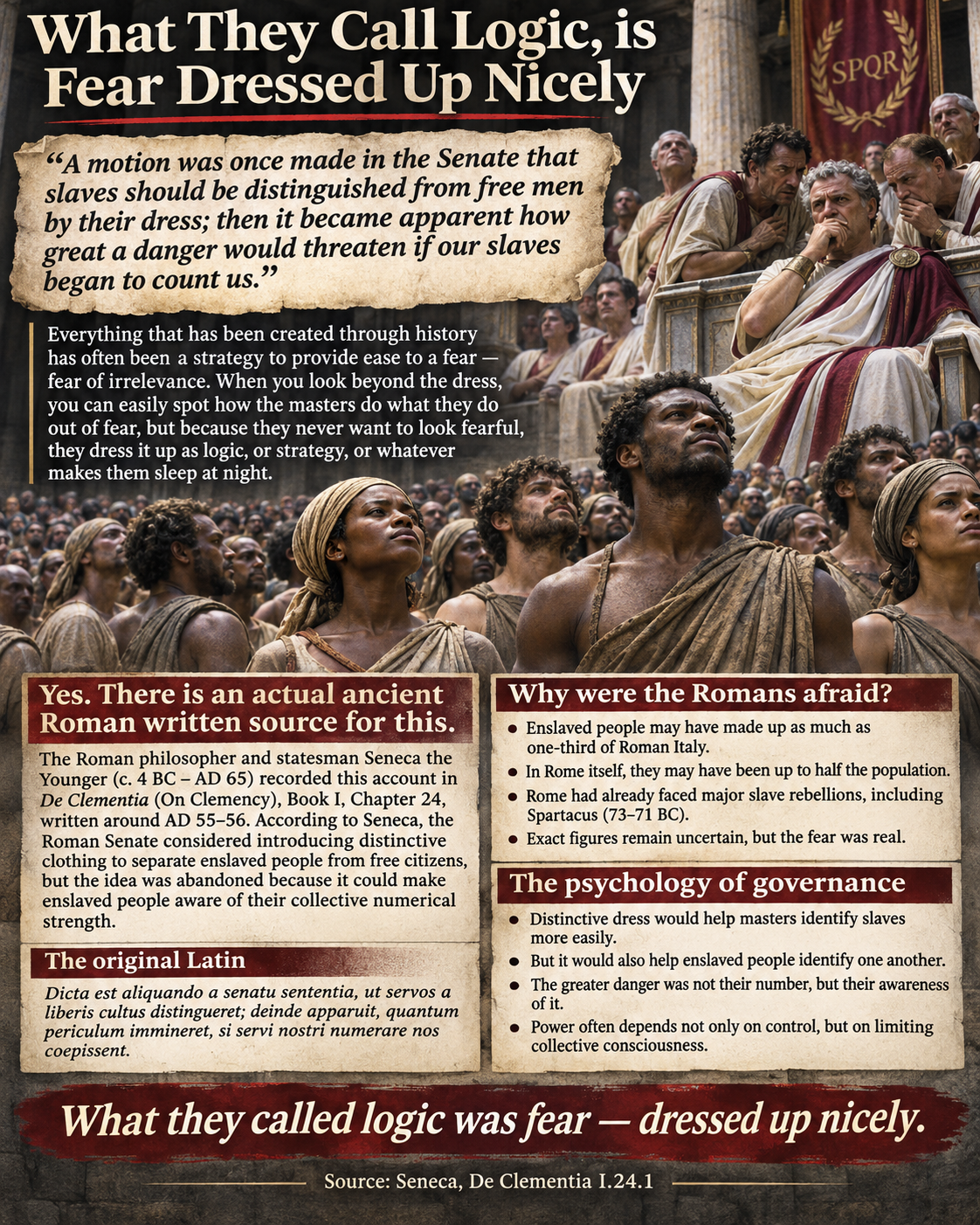
A motion was once made in the Senate that slaves should be distinguished from free men by their dress; then it became apparent how great a danger would threaten if our slaves began to count us. – Seneca
Everything that has been created throughout history has been a strategy to provide ease to a fear. Fear of irrelevance. Not fear of surviving.
Things get to their heads quickly, so you can never be too comfortable with ’em. Lift them up whils ground the reality of their lower selves. Balance.
When you look beyond the dress, you can easily apot how the masters don’t do anything if not out of fear, but because they never want to look fearful, they dress it up as logic, or strategy or whatever makes them sleep at night.
Yes. There is an actual ancient Roman written source for this.
The Roman philosopher and statesman Seneca the Younger (c. 4 BC– AD 65) recorded this account in his work De Clementia (On Clemency), Book I, Chapter 24, written around AD 55–56.
According to Seneca, the Roman Senate considered introducing distinctive clothing to distinguish enslaved people from free citizens. The proposal was abandoned because the authorities feared that enslaved people would become aware of their collective numerical strength. romanlegaltradition.org +1
The original Latin
“Dicta est aliquando a senatu sententia, ut servos a liberis cultus distingueret; deinde apparuit, quantum periculum immineret, si servi nostri numerare nos coepissent.”
Translated:
A motion was once made in the Senate that slaves should be distinguished from free men by their dress; then it became apparent how great a danger would threaten if our slaves began to count us.
Read the original Latin text — De Clementia, I.24.1. ancienttexts.org
Why were the Romans afraid?
Some historical estimates suggest that enslaved people constituted:
- Up to one-third of the population of Roman Italy.
- Up to half the population of Rome itself.
Exact figures remain uncertain. MIT Economics
Rome had also experienced several major slave rebellions, including the uprising led by Spartacus between 73 and 71 BC.
The precise Senate debate is not independently confirmed, but Seneca’s account is authentic.
The psychology of governance
What is particularly interesting is that the proposed clothing would have served two opposing purposes:
- It would have allowed masters to identify enslaved people more easily.
- It would have allowed enslaved people to recognise one another and understand their collective strength.
The second possibility was apparently considered more dangerous than the first was beneficial.
The danger to the ruling class was not that the enslaved population would increase, but that the existing population would become conscious of its own numerical strength.
That is a remarkable historical illustration of how power can depend not only on controlling people, but also on limiting what people know about their collective position.



Leave a Reply