
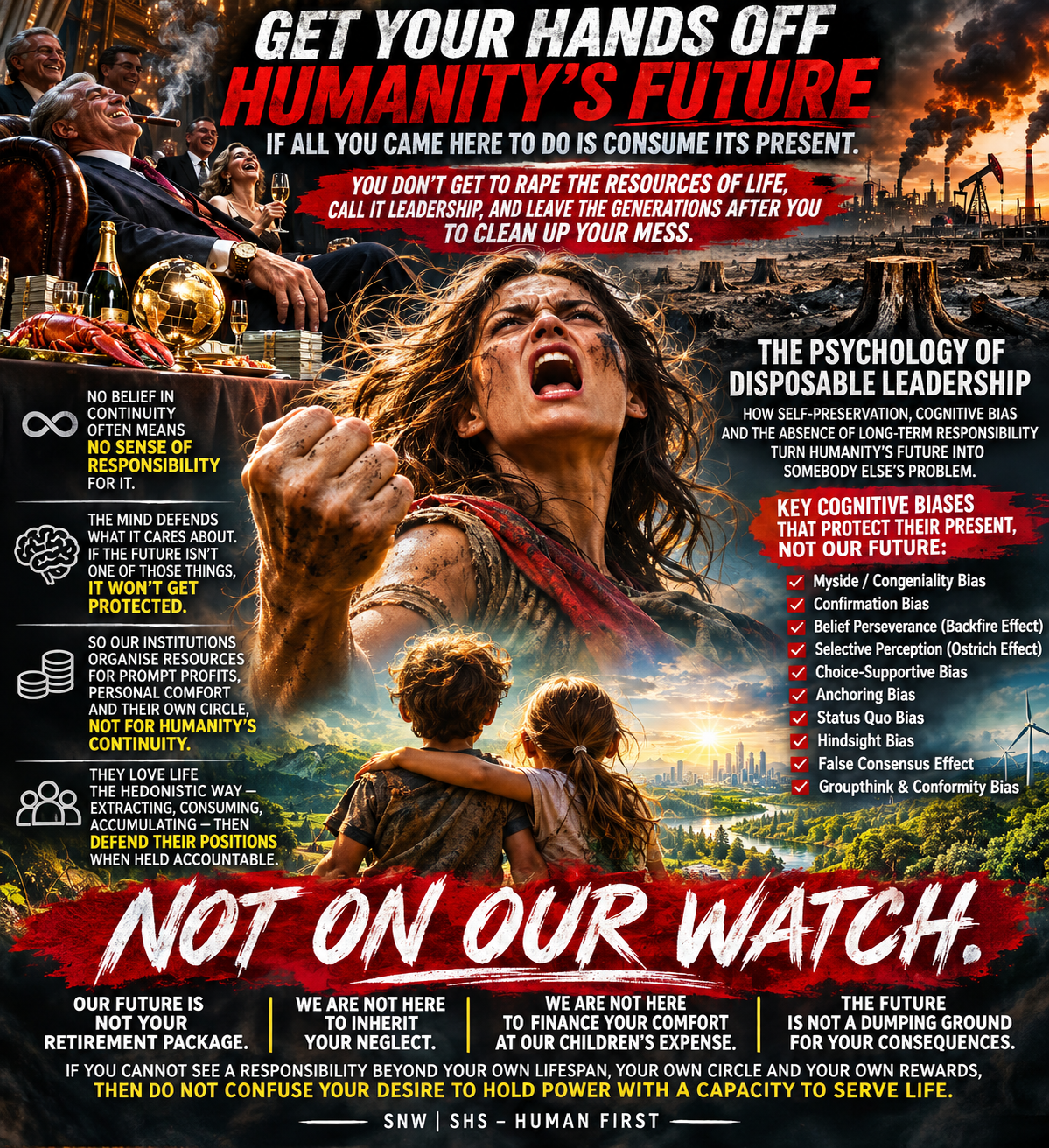
All these things won’t be triggered in the defense of the future, only for however long they see their own, which leaves out too many people.
We have to take this seriously, cause it’s possibly the main reason why the leadership of our organisations cannot organise resources for continuity and can only do so for prompt profit.
How many industries can prove THEY ARE INCAPABLE?!
YOU DON’T GET TO RAPE THE RESOURCES OF LIFE, CALL IT LEADERSHIP, AND LEAVE THE GENERATIONS AFTER YOU TO CLEAN UP YOUR MESS.
THE PSYCHOLOGY OF DISPOSABLE LEADERSHIP — HOW SELF-PRESERVATION, COGNITIVE BIAS AND THE ABSENCE OF LONG-TERM RESPONSIBILITY TURN HUMANITY’S FUTURE INTO SOMEBODY ELSE’S PROBLEM.
SNW | SHS – HUMAN FIRST
I want to raise the temperature on something that should have been investigated by psychologists, educators, governments and every institution responsible for selecting people into positions of authority.
WHAT HAPPENS WHEN THE PEOPLE WE ENTRUST WITH HUMANITY’S CONTINUITY DO NOT CONSIDER THAT CONTINUITY THEIR PERSONAL RESPONSIBILITY?!
Not their careers.
Not their pensions.
Not their investments.
Not their families’ inheritance.
Not their institution’s survival.
HUMANITY’S CONTINUITY. THE LIVES THAT WILL EXIST AFTER THEIRS. THE PEOPLE WHO WILL INHERIT THE CONSEQUENCES OF EVERYTHING THEY DO TODAY.
Because I am becoming increasingly interested in whether the inability of our institutions to organise resources for long-term human wellbeing is connected to something much deeper than incompetence, corruption or bad economics.
THE PSYCHOLOGY OF THE PEOPLE CONTROLLING THEM.
What if many of these institutions are not failing to deliver continuity because they lack the resources?
What if they are organising resources around precisely what their decision-makers care about?
Immediate returns.
Personal comfort.
Institutional preservation.
Political survival.
Financial accumulation.
Their own circle of people.
Their own remaining years.
And everything outside that circle, including humanity’s future, becomes a negotiable expense.
WHAT IF THE VERY PEOPLE RESPONSIBLE FOR PROTECTING OUR TOMORROW HAVE BEEN ORGANISING EVERYTHING AROUND THEIR OWN TODAY?!
That possibility deserves serious investigation.
Because if it is contributing to the problem, no amount of additional funding will correct a system whose decision-makers have never made continuity the objective.
I. THE MIND DEFENDS WHAT IT VALUES. SO WHAT HAPPENS WHEN HUMANITY’S FUTURE ISN’T ONE OF THOSE THINGS?
This is where psychology becomes particularly important.
The human mind does not distribute attention, emotional investment and defensive reasoning equally across everything that exists.
Our interests, identities, attachments, fears, expectations and incentives influence what we notice, what we investigate, what we protect and what we disregard.
We develop psychological investments in what matters to us.
And those investments can shape how our cognitive biases operate.
THE MIND CAN FIGHT FEROCIOUSLY TO DEFEND SOMETHING THAT SERVES ITS OWN INTERESTS WHILE BARELY REGISTERING SOMETHING ELSE THAT DESPERATELY NEEDS DEFENDING.
Now consider what that means for leadership.
Imagine somebody who is deeply invested in preserving their authority but barely invested in the quality of life people will experience fifty years after they have left office.
What will command their attention?
What will activate their defensiveness?
What will they spend resources justifying?
What threats will they urgently respond to?
Their reputation?
Their position?
Their profitability?
Their political allies?
Or the slow destruction of a future they will never personally inhabit?
Cognitive biases do not disappear simply because someone lacks concern for the future. They may instead operate around the things that person already values, while long-term harms receive comparatively little scrutiny.
AND THAT IS THE DANGER: WE MAY BE APPOINTING PEOPLE WHO ARE PSYCHOLOGICALLY EQUIPPED TO DEFEND THEIR OWN CONTINUITY, BUT NOT SUFFICIENTLY MOTIVATED TO DEFEND OURS.
II. LOOK AT HOW MANY PSYCHOLOGICAL MECHANISMS CAN PROTECT THE WRONG PRIORITIES.
Let’s examine them.
1. Myside bias and congeniality bias.
People may generate arguments, interpret evidence and test hypotheses in ways that favour their existing positions.
Now imagine the position being defended is an economic model that produces enormous immediate profits while transferring environmental, financial or human costs into the future.
The mind can become occupied with proving the present arrangement is justified rather than asking whether the arrangement should exist in the first place.
THEY CAN DEFEND THE PROFIT MORE AGGRESSIVELY THAN THEY INVESTIGATE THE HARM.
2. Confirmation bias.
Evidence supporting the desired outcome gets attention. Evidence threatening it encounters resistance.
A short-term financial gain becomes proof of success.
The long-term damage becomes an inconvenience.
Warnings become pessimism.
Prevention becomes an unnecessary expense.
And the people raising concerns become the problem.
ISN’T IT INTERESTING HOW URGENTLY AN INSTITUTION CAN INVESTIGATE A THREAT TO ITS REVENUE, YET HOW LONG IT CAN TAKE TO INVESTIGATE A THREAT TO HUMAN LIFE?!
3. Belief perseverance and the backfire effect.
A person may cling to an established position despite contradictory evidence. Sometimes a challenge can even intensify defensiveness, although that is not an inevitable response.
Imagine an entire institution psychologically committed to the belief that its existing arrangements are necessary.
You demonstrate the damage.
They defend the arrangements.
You demonstrate alternatives.
They defend their authority.
You demonstrate the suffering.
They defend their history.
THEY WOULD RATHER PROTECT THEIR PREVIOUS DECISION THAN PROTECT THE PEOPLE STILL SUFFERING FROM IT.
And once protecting institutional credibility becomes more important than correcting institutional harm, accountability becomes an enemy rather than a responsibility.
4. Selective perception and the ostrich effect.
People can notice what confirms their expectations while avoiding unpleasant information.
If a problem threatens an immediate interest, it can become impossible to ignore.
But if the consequences fall on people who are not yet born?
How convenient.
They cannot complain.
They cannot protest.
They cannot take legal action.
They cannot vote.
They cannot interrupt your retirement.
HOW CONVENIENT IT IS TO OFFLOAD SUFFERING ONTO PEOPLE WHO ARE NOT YET HERE TO HOLD YOU ACCOUNTABLE.
5. Choice-supportive bias.
People can remember their own decisions more favourably than the evidence warrants.
A destructive programme becomes an ambitious reform.
A disastrous investment becomes an unfortunate necessity.
A failed intervention becomes a valuable learning experience.
A neglected responsibility becomes a difficult political compromise.
EVERYBODY GETS A BEAUTIFUL EXPLANATION FOR WHY THE DAMAGE WAS NECESSARY. EXCEPT THE PEOPLE LIVING WITH THE DAMAGE.
6. Anchoring bias.
The first figure, expectation or framework can disproportionately influence later judgment.
Set the anchor at quarterly profit, annual growth or electoral performance, and long-term human welfare risks being treated as secondary.
Why?
Because the entire conversation has already been organised around the wrong measurement.
IF YOUR FIRST QUESTION IS HOW MUCH MONEY SOMETHING WILL MAKE, WHY ARE YOU SURPRISED WHEN HUMAN LIFE BECOMES A COST INSTEAD OF THE PURPOSE?!
7. Status quo bias.
People may prefer familiar arrangements, even when alternatives deserve serious consideration.
Why transform a system that rewards you?
Why challenge an institution that protects your position?
Why redistribute opportunities when your own circle is already benefiting?
Why renovate what you can continue charging people to endure?
THE PEOPLE COMFORTABLE INSIDE A BROKEN SYSTEM ARE NOT ALWAYS THE PEOPLE MOST MOTIVATED TO REPAIR IT.
8. Hindsight bias.
After disaster arrives, people may claim the outcome was predictable.
And there they come.
The inquiries.
The committees.
The investigations.
The speeches.
The memorials.
The announcements of lessons learned.
WHERE WAS THAT KNOWLEDGE WHEN PREVENTION WAS STILL POSSIBLE?!
Why must humanity repeatedly pay for preventable suffering before institutions become interested in the evidence that warned them?
9. False consensus effect.
People can overestimate how widely others share their own priorities.
A wealthy decision-maker may mistake financial accumulation for everybody’s highest ambition.
A politically insulated executive may assume that institutional success means public success.
A person whose basic needs are already secured may underestimate what insecurity means to everybody else.
YOUR SATISFACTION WITH YOUR LIFE DOES NOT MEAN HUMANITY IS SATISFIED WITH ITS CONDITIONS.
10. Groupthink and conformity bias.
When maintaining agreement becomes more important than examining reality, groups can suppress dissent and reproduce shared errors.
Now place that inside governments, corporations, financial institutions and public authorities.
People congratulate each other.
Promote each other.
Protect each other.
Validate each other’s decisions.
And reinforce the same priorities that may be failing everybody outside their circle.
AN ENTIRE ROOM CAN AGREE WITH ITSELF AND STILL BE WRONG ABOUT WHAT HUMANITY NEEDS.
And what makes this particularly dangerous?
ALL THESE MECHANISMS CAN BECOME FAR MORE EFFECTIVE AT PRESERVING THE PEOPLE IN POWER THAN AT PRESERVING THE PEOPLE WHO DEPEND ON THEM.
Not because any belief system automatically determines how cognition operates, but because motivation determines which concerns receive attention, effort and protection.
So the question we should be asking is:
WHAT HAVE OUR LEADERS ACTUALLY TRAINED THEIR MINDS TO DEFEND?!
III. THE FUTURE DOES NOT HAVE A SEAT AT YOUR BOARD MEETING. THAT DOES NOT MAKE IT YOUR PROPERTY TO DESTROY.
Let’s examine the obscenity of the arrangement.
A corporation can extract resources today and leave pollution for decades.
A government can borrow against future public revenue to finance present political priorities.
A landlord can neglect a building until the next occupants inherit the damage.
An institution can suppress warnings until the people responsible have retired.
An industry can accumulate profits while externalising costs to public healthcare, infrastructure and the environment.
THE BENEFITS ARE COLLECTED NOW. THE COSTS ARE DELIVERED LATER.
And who receives them?
People who never signed the contract.
People who never approved the decision.
People who never received the profit.
People who never had the opportunity to object.
WE HAVE NORMALISED PEOPLE CONSUMING THE BENEFITS OF LIFE WHILE INVOICING THE CONSEQUENCES TO THOSE WHO COME AFTER THEM.
Tell me how that is responsible leadership.
Tell me how that is justice.
Tell me how an economic model that counts extraction as profit while excluding the full cost of restoration can claim to have accurately measured success.
You haven’t necessarily created wealth.
YOU MAY HAVE SIMPLY MOVED THE COST OF YOUR CONSUMPTION ONTO SOMEBODY ELSE.
And because the accounting period ended before the consequences arrived, you congratulate yourselves.
How spectacularly convenient.
IV. HEDONISM IS NOT THE PROBLEM. MAKING EVERYBODY ELSE PAY FOR YOUR PLEASURE IS.
I want to distinguish enjoying life from exploiting it.
There is nothing inherently irresponsible about pleasure, comfort, enjoyment or wanting a beautiful life.
But there is a difference between enjoying what life offers and treating life as an unlimited resource to consume without restoration.
The mentality I am challenging is this:
Let me have mine.
Let me get comfortable.
Let me accumulate.
Let me enjoy myself.
Let somebody else fix whatever happens afterwards.
THAT IS NOT LOVE FOR LIFE. THAT IS LOVE FOR WHAT YOU CAN TAKE FROM IT.
And when this mentality enters leadership, the consequences multiply.
Because now the individual is not merely consuming their personal resources.
They have authority over resources belonging to millions.
Forests.
Water.
Land.
Housing.
Hospitals.
Schools.
Energy.
Public finances.
Human labour.
Entire ecosystems.
ALL ENTRUSTED TO PEOPLE WHO MAY BE EVALUATING THEIR SUCCESS BY HOW MUCH THEY CAN EXTRACT BEFORE THEIR TURN ENDS.
They strip the value from the present and leave the consequences in the future.
They take the harvest and neglect the soil.
They enjoy the shelter and neglect the foundations.
They collect the profits and leave the public to finance the repairs.
And then, when somebody demands accountability?
They defend their position.
Their reputation.
Their legal protections.
Their privileges.
Their entitlement to continue.
LOOK HOW QUICKLY THEY CAN FIND THE RESOURCES TO DEFEND THEMSELVES WHEN THEY WERE APPARENTLY UNABLE TO FIND THE RESOURCES TO PREVENT THE HARM.
That difference in urgency deserves examination.
Because it reveals what an institution is prepared to mobilise for.
V. WHAT DO YOU BELIEVE HAPPENS AFTER YOU DIE? AND WHAT HAVE YOU DECIDED THAT MEANS FOR EVERYBODY ELSE?
Now back to the foundation of my previous publication.
Faith.
Afterlife.
Reincarnation.
Karma.
Heaven.
Hell.
Nothingness.
I want to examine how beliefs about mortality interact with responsibility.
If somebody believes their personal consciousness ends entirely at death, that belief does not automatically make them selfish. Plenty of atheists devote themselves to protecting people and environments they will never personally benefit from.
And religious conviction is no guarantee of moral responsibility either.
BUT WHAT DOES MATTER IS WHAT A PERSON CONCLUDES ABOUT THEIR OBLIGATIONS FROM THEIR BELIEFS.
If they conclude:
I will not be here, therefore it will not concern me.
Then there is a psychological problem with entrusting them with consequences that will outlive them.
If they conclude:
My time is limited, therefore I must protect what continues after me.
Then their finite view of personal existence has produced an entirely different relationship with responsibility.
The distinction is essential.
Because I am not interested in somebody merely announcing that they believe in God.
I want to know what their belief actually makes them responsible for.
Likewise, I am not interested in somebody merely announcing that they do not believe in an afterlife.
I want to know whether that conviction expands or contracts their concern for the lives that follow.
YOU DO NOT HAVE TO BELIEVE YOU WILL RETURN TO THIS EARTH TO RECOGNISE THAT YOU HAVE NO RIGHT TO DESTROY IT FOR THOSE WHO WILL COME AFTER YOU.
And if you do believe in returning?
Then what makes you think you can leave the world in ruins and somehow escape responsibility for the conditions you helped create?
Either way, the question remains.
WHAT ARE YOU LEAVING LIFE WITH WHEN YOU ARE FINISHED TAKING FROM IT?!
VI. THIS COULD BE ONE OF THE MOST IMPORTANT MISSING QUESTIONS IN INSTITUTIONAL PSYCHOLOGY.
Look at what we have normalised.
Institutions can organise enormous amounts of money, expertise, labour, technology and natural resources.
They can forecast revenue years into the future.
They can model investment returns.
They can prepare succession plans.
They can protect assets.
They can hire lawyers to defend their interests decades in advance.
They can spend fortunes ensuring their own continuity.
SO WHY CAN THEY ORGANISE FOR THE CONTINUITY OF THEIR INSTITUTIONS BUT STRUGGLE TO ORGANISE FOR THE CONTINUITY OF HUMAN WELLBEING?!
That is the question.
Not simply whether they have resources.
WHETHER HUMANITY’S CONTINUITY IS ACTUALLY THE OBJECTIVE AROUND WHICH THOSE RESOURCES ARE ORGANISED.
Because what if the problem is not insufficient ability to plan?
What if it is the selection of what deserves planning?
What if it is not insufficient intelligence?
What if it is intelligence overwhelmingly invested in sustaining a particular arrangement?
What if the apparent inability to organise resources for long-term life is partly explained by institutional incentives that reward immediate returns while leaving future harms insufficiently represented?
These are hypotheses worth testing, not conclusions to declare without evidence.
But the questions should disturb every person responsible for public governance.
BECAUSE A SYSTEM CAN BE EXTRAORDINARILY COMPETENT AT ACHIEVING THE WRONG OBJECTIVE.
And if we keep rewarding it for achieving that objective, why would it change?
VII. THEY PROTECT THEIR OWN CIRCLE AND CALL IT PROTECTING SOCIETY.
There is another dimension I want examined.
The circle of concern.
A person might care profoundly for their family while remaining indifferent to the conditions experienced by strangers.
They might protect their business while disregarding the neighbourhood affected by it.
They might fiercely defend their country while ignoring the human consequences beyond its borders.
They might protect their own generation while sacrificing the opportunities of the next.
CARING FOR YOUR OWN CIRCLE DOES NOT AUTOMATICALLY MEAN YOU HAVE THE CAPACITY TO CARE FOR HUMANITY.
And when the circle becomes the boundary of responsibility, everything outside it becomes expendable.
But humanity’s interconnectedness does not end at somebody’s preferences.
Pollution crosses boundaries.
Economic instability crosses generations.
Disease does not ask whether you personally value the people it reaches.
Environmental damage does not disappear because your ownership of a property has ended.
The consequences of your decisions do not obey the perimeter of your affection.
YOU DO NOT GET TO LIMIT THE REACH OF YOUR RESPONSIBILITY TO THE PEOPLE YOU HAPPEN TO LOVE WHILE EXERCISING AUTHORITY OVER THE LIVES OF EVERYBODY ELSE.
That is where private preference becomes a public problem.
VIII. AND WHEN THEY ARE CHALLENGED, SUDDENLY THEY UNDERSTAND WHAT RESPONSIBILITY MEANS.
Watch the difference between the defence of an institution and its defence of the people it serves.
When its reputation is threatened, urgency appears.
When its assets are threatened, resources appear.
When its authority is threatened, specialists appear.
When its legal position is threatened, entire departments mobilise.
But when people are suffering?
There may be a process.
A review.
A consultation.
A referral.
A delay.
A disagreement about jurisdiction.
A statement that the matter falls outside somebody’s remit.
ISN’T IT FASCINATING HOW EFFICIENT RESPONSIBILITY BECOMES WHEN THE INSTITUTION ITSELF IS THE ONE THAT NEEDS PROTECTING?!
And how complicated responsibility can become when the institution is being asked to protect the lives for which it supposedly exists.
That contrast does not establish wrongdoing in every case. But where it is repeatedly documented, it deserves far more than another explanation.
It deserves investigation into incentives, accountability and institutional priorities.
IF YOUR SYSTEM CAN ORGANISE TO DEFEND ITSELF, WE ARE ENTITLED TO ASK WHY IT CANNOT ORGANISE WITH THE SAME DETERMINATION TO PREVENT THE HARM IT WAS ESTABLISHED TO ADDRESS.
And please, spare humanity another beautiful mission statement if the consequences tell a different story.
IX. WE NEED TO STOP CONFUSING SELF-PRESERVATION WITH RESPONSIBILITY.
A leader who protects their career is not necessarily protecting the public.
A corporation that protects its profitability is not necessarily creating lasting prosperity.
A government that protects its electoral position is not necessarily protecting the next generation.
An institution that survives for another century has not necessarily justified the suffering it may have produced during that century.
SURVIVAL OF AN ORGANISATION IS NOT THE SAME THING AS THE WELLBEING OF THE LIFE IT WAS MEANT TO SERVE.
And this is where the evaluation of leadership must become much more rigorous.
Test long-term judgment.
Test how people respond to evidence that contradicts their interests.
Test whether they acknowledge preventable harms.
Test whether they can recognise value beyond immediate financial returns.
Test whether they defend people who have no power to reward them.
Test whether they account for generations that cannot yet vote, complain or demand representation.
Test whether their decisions leave the public with functioning resources rather than accumulated liabilities.
DON’T JUST ASK THEM WHAT THEY BELIEVE IN. EXAMINE WHAT THEIR DECISIONS REPEATEDLY PROTECT.
Because that is where their operational priorities become visible.
And if their concern extends only as far as their own interests?
Then the responsibilities of their office are wider than the responsibilities they have demonstrated themselves willing to carry.
X. OUR FUTURE IS NOT YOUR RETIREMENT PACKAGE.
Humanity needs to stop accepting the transfer of consequences as if it were some unavoidable law of existence.
It is not.
It is often the result of choices.
Choices about who pays.
Who benefits.
Who is protected.
Who is consulted.
Who can object.
Who carries the risk.
Who receives the reward.
And who is conveniently absent from the room when the decision is made.
The unborn cannot defend their interests today.
THAT DOES NOT MEAN THEY HAVE NO INTERESTS WORTH DEFENDING.
The elderly may not live to experience the outcomes of long-term investments.
That does not mean their contributions to those investments are wasted.
A decision-maker may die before a policy reaches its full consequences.
That does not mean the policy stops being their responsibility to consider.
THE CONTINUITY OF LIFE CANNOT BE REDUCED TO THE CONTINUITY OF SOMEBODY’S PERSONAL BENEFIT.
We need institutions built to regenerate rather than merely extract.
Economies designed to preserve productive resources rather than consume them without accounting for replacement.
Governance that treats prevention as a responsibility rather than an optional expense.
Public leadership capable of looking beyond individual lifespans, election cycles and financial reporting periods.
And accountability that examines foreseeable consequences before their costs are imposed on people who had no opportunity to consent.
Because humanity has already spent too many generations inheriting problems that previous generations possessed the knowledge, resources or opportunity to address.
ENOUGH OF THE HOT POTATO.
Enough of passing harm from one administration to the next.
Enough of consuming public resources and calling the remaining damage somebody else’s responsibility.
Enough of protecting institutions more aggressively than the lives they serve.
Enough of mistaking the accumulation of wealth for the creation of lasting human prosperity.
Enough of letting the absence of future generations from today’s decision-making become the excuse for disregarding them.
And enough of treating the future as a place where we can dump whatever we don’t want to account for in the present.
XI. NOT ON OUR WATCH.
I love life.
But I do not love life merely for what I can personally experience from it.
I care about the continuation of its possibilities.
Its consciousness.
Its resources.
Its capacity to regenerate.
Its ability to offer those who come after us opportunities that we ourselves may never experience.
WHAT IS THE POINT OF LOVING LIFE IF YOU ONLY LOVE IT WHILE IT IS SERVING YOU?!
What kind of love consumes the conditions of its own continuation?
What kind of stewardship leaves the house standing in flames because the person responsible has already arranged somewhere else to sleep?
What kind of governance can calculate tomorrow’s profits while treating tomorrow’s people as an afterthought?
And what kind of leadership claims responsibility for humanity while refusing to recognise the consequences of its own decisions beyond the period in which it personally benefits?
YOU CANNOT CLAIM TO SERVE LIFE WHILE TREATING ITS FUTURE AS DISPOSABLE.
You cannot claim to protect humanity while protecting only the people whose existence benefits your own.
You cannot claim success simply because you have escaped the consequences of a decision.
You cannot call the extraction of resources prosperity without accounting for what has been depleted, damaged or left to regenerate.
And you cannot expect humanity to keep applauding institutions for surviving while the people dependent on them continue to suffer.
WE ARE NOT HERE TO FINANCE YOUR FINAL YEARS AT THE EXPENSE OF OUR CHILDREN’S FIRST ONES.
WE ARE NOT HERE TO INHERIT YOUR NEGLECT AND CALL IT OUR RESPONSIBILITY TO BE RESILIENT.
WE ARE NOT HERE TO PROVIDE YOU WITH POWER, PROFIT AND COMFORT WHILE YOU LEAVE THE COST OF YOUR DECISIONS AT OUR DOOR.
If you want to lead, demonstrate responsibility beyond yourself.
If you want control over resources, account for their regeneration.
If you want authority over human lives, demonstrate concern for the conditions in which those lives will continue.
If you want to profit from what humanity produces, account for what humanity must preserve to keep producing.
And if you cannot see a responsibility beyond your own lifespan, your own circle and your own rewards?
THEN DO NOT CONFUSE YOUR DESIRE TO HOLD POWER WITH A CAPACITY TO SERVE LIFE.
Because humanity is not your disposable experience.
Earth is not your personal consumption allowance.
The future is not an empty space waiting to absorb your consequences.
And the people who will inhabit it are not less worthy of consideration simply because you will not be there to meet them.
THEY ARE HUMANITY TOO.
THEY ARE ALREADY PART OF WHAT WE ARE RESPONSIBLE FOR.
AND THEY DO NOT NEED TO EXIST IN FRONT OF YOU BEFORE THEIR LIVES BECOME WORTH PROTECTING.
So by all means, enjoy life.
Love it.
Experience it.
Celebrate it.
Build your wealth.
Find your pleasures.
Live your years.
BUT DO NOT MISTAKE YOUR TEMPORARY OCCUPANCY OF THIS PLANET FOR OWNERSHIP OF WHAT BELONGS TO LIFE BEYOND YOU.
YOU WERE BORN INTO A CONTINUITY YOU DID NOT CREATE ALONE.
YOU ARE LIVING OFF RESOURCES YOU DID NOT PRODUCE ALONE.
AND YOU WILL LEAVE CONSEQUENCES YOU WILL NOT EXPERIENCE ALONE.
THAT IS WHY RESPONSIBILITY MATTERS.
Not because somebody has threatened you with hell.
Not because somebody has promised you heaven.
Not because reincarnation has been scientifically established.
BUT BECAUSE THE CONSEQUENCES OF YOUR EXISTENCE ARE NOT LIMITED TO YOUR EXPERIENCE OF EXISTING.
And if that is too much responsibility for somebody to accept?
Then they need to reconsider why they want authority over everybody else’s lives in the first place.
HUMANITY’S FUTURE IS NOT YOURS TO SPEND AND ABANDON.
NOT ON OUR WATCH.
SNW | SHS – HUMAN FIRST
Love for life without responsibility for its continuity is not stewardship. It is consumption.
23 November 2026



Leave a Reply