
I am giving myself a lot to represent and I won’t be able to do it all by myself, that’s for sure, so for those who will be part of SHS, let’s hold each other accountable please?! And challenge each other on where we can do better. This is a lot. An amazing lot.
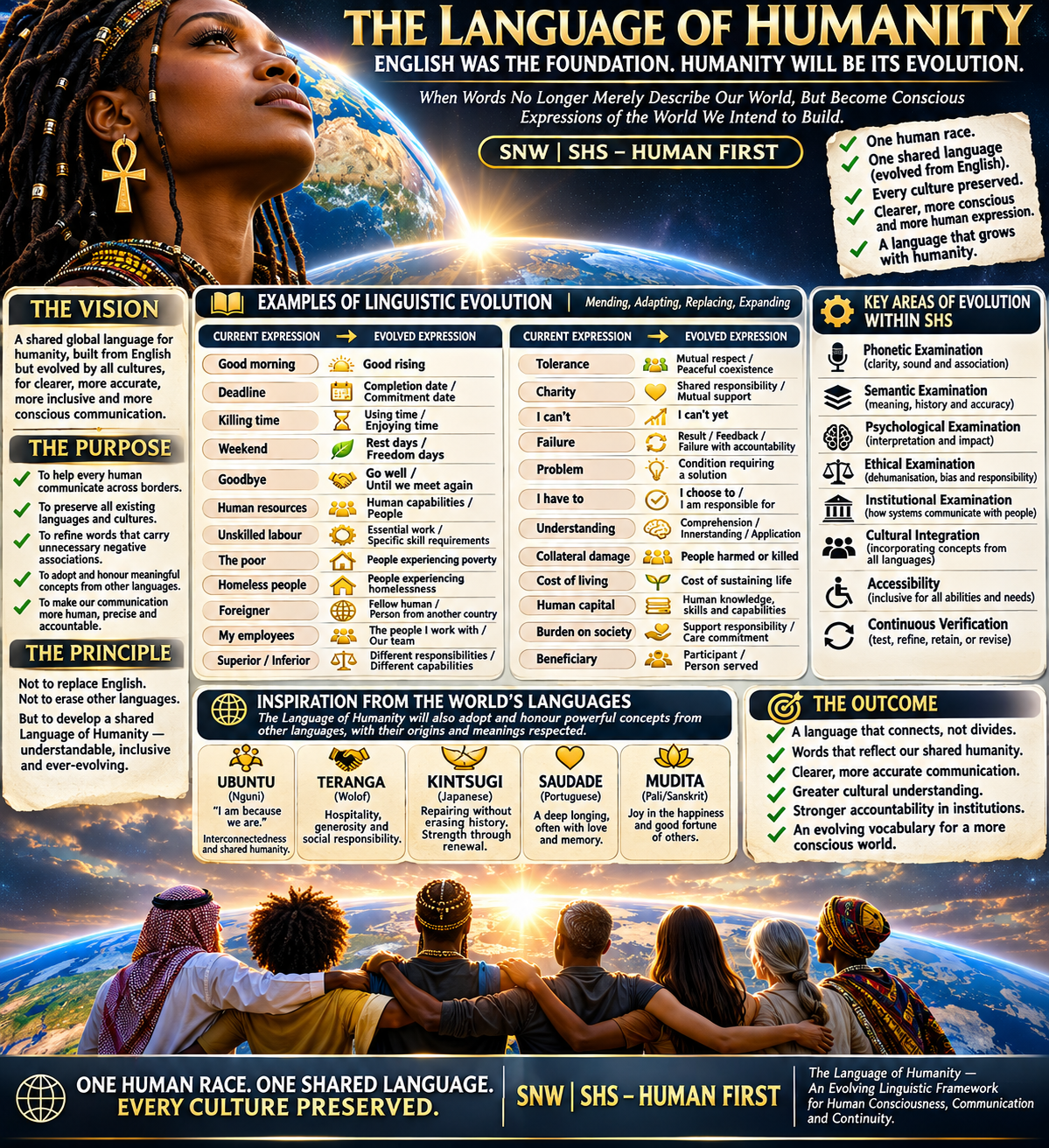
THE LANGUAGE OF HUMANITY — When Words No Longer Merely Describe Our World, But Become Conscious Expressions of the World We Intend to Build.
SNW | SHS – HUMAN FIRST
I have been thinking further about my proposal for humanity to establish one common language.
English is presently the most widely spoken language when native and additional-language speakers are counted together.
For that reason, I proposed that every country teach English alongside its existing languages.
But I want to take this further.
I DO NOT WANT HUMANITY TO SIMPLY INHERIT ENGLISH. I WANT HUMANITY TO PARTICIPATE IN ITS EVOLUTION.
English would remain English in Britain.
English would remain English in America.
English would continue evolving naturally wherever it is spoken.
But the language we establish for humanity would eventually develop an identity of its own.
Not through making it unrecognisable.
Not by abandoning the grammatical and linguistic foundations that make English internationally accessible.
But by consciously examining its vocabulary, phonetics, associations, definitions, expressions, metaphors and the assumptions embedded in everyday communication.
The Language of Humanity.
An international evolution of English that remains mutually understandable with its existing forms, while incorporating the knowledge and contributions of other languages and cultures.
And what fascinates me most is that we already have countless opportunities for its evolution.
Words we could mend.
Expressions we could adapt.
Descriptions we could make more precise.
Assumptions we could stop reproducing.
And entirely new expressions humanity could collectively introduce.
Let me demonstrate.
I. THE PHONETICS OF LANGUAGE — WHAT WE SAY AND WHAT WE HEAR.
1. GOOD MORNING → GOOD RISING.
This was my original example.
Good morning and good mourning are pronounced alike in many English accents.
One refers to the beginning of a day.
The other evokes grief.
They have different histories and meanings, and saying good morning does not produce mourning.
But the similarity presents an interesting opportunity to examine the associations we attach to spoken language.
Why not say:
GOOD RISING.
A greeting that directly celebrates awakening, consciousness, movement and the opportunity of another day.
The expression becomes an acknowledgement of continued existence.
You have risen.
You are alive.
Another day is available to you.
Good rising.
2. DEADLINE → COMPLETION DATE / COMMITMENT DATE.
Consider how frequently we use the word deadline.
A date by which something must be accomplished.
But why should the language of completion contain the word dead?
The historical meaning of a word does not determine its psychological effect on everyone hearing it. Nevertheless, we can choose expressions that communicate our intentions more directly.
Completion date.
Or:
Commitment date.
The responsibility remains.
The timeframe remains.
The accountability remains.
But we express the actual purpose rather than inheriting an unnecessary association with death.
3. KILLING TIME → USING TIME / ENJOYING TIME.
How often have you heard someone say:
“I’m just killing time.”
Killing what?
Time is the very condition through which we experience our lives.
We cannot manufacture yesterday.
We cannot retrieve a moment after it has passed.
And yet we casually describe passing time as killing it.
Why not:
“I’m enjoying some free time.”
“I’m resting.”
“I’m exploring.”
“I’m taking time for myself.”
Even doing absolutely nothing can be an intentional use of time.
Why describe the passage of life as its destruction?
4. WEEKEND → REST DAYS / FREEDOM DAYS.
Weekend simply means the end of the week.
But notice its similarity in sound to weakened.
Again, this is a phonetic association, not a claim that the words are linguistically related.
What interests me more is what our terminology prioritises.
For many workers, the weekend is the portion of the week in which they regain greater freedom over their time.
Why not describe the experience rather than simply the calendar position?
Rest days.
Personal days.
Freedom days.
Not everyone rests on Saturday and Sunday, of course.
The idea is to let people name their relationship with time more meaningfully.
5. GOODBYE → GO WELL / UNTIL WE MEET AGAIN.
There is nothing inherently negative about goodbye, whose history is connected to a blessing.
But expressions of departure can evolve too.
Go well.
Until we meet again.
Continue beautifully.
Not every farewell guarantees another meeting, so different expressions would suit different circumstances.
Language can offer choices that reflect what we genuinely intend to communicate.
II. THE LANGUAGE OF HUMAN IDENTITY — STOP DESCRIBING PEOPLE AS THEIR CIRCUMSTANCES.
Here I believe the work becomes even more important.
Because language does not merely describe objects.
It categorises human beings.
And classifications can become so familiar that we stop examining the assumptions behind them.
6. HUMAN RESOURCES → HUMAN CAPABILITIES / PEOPLE.
Human resources.
Think about that expression.
A company has financial resources.
Material resources.
Energy resources.
And then:
Human resources.
I understand the administrative meaning.
But a human being is not merely a resource available for institutional consumption.
A human possesses capabilities.
A human contributes knowledge, time, effort, creativity and experience.
Why not use:
People and Capabilities.
People Development.
Human Contribution.
Or simply:
People.
We can still use resources when referring to staffing requirements or organisational capacity.
But let institutions learn to distinguish their resources from the human beings contributing to their operations.
7. UNSKILLED LABOUR → ESSENTIAL WORK / SPECIFIC SKILL REQUIREMENTS.
Unskilled labour.
Really?
A cleaner maintaining hygiene.
A farmworker harvesting food.
A warehouse worker organising distribution.
A care worker assisting someone with daily life.
Different jobs require different levels and types of training, but that does not mean people performing work without formal qualifications possess no skills.
Where qualifications matter, describe the qualifications.
Where training matters, describe the training.
Where the work matters, describe the work.
Do not confuse the absence of a particular credential with the absence of human capability.
8. THE POOR → PEOPLE EXPERIENCING POVERTY.
Poverty is an economic and social condition.
It is not the total identity of a human being.
Someone experiencing poverty can possess extraordinary intelligence, creativity, generosity and capability.
Why reduce the entire person to their financial circumstances?
People experiencing poverty.
The distinction matters.
One expression can sound like a fixed category of humanity.
The other identifies a condition that can potentially be changed.
And that brings us closer to the actual responsibility:
Address the condition. Do not mistake the condition for the person.
9. HOMELESS PEOPLE → PEOPLE EXPERIENCING HOMELESSNESS.
The same reasoning applies here.
A person is not homelessness embodied.
A person is experiencing circumstances in which adequate, secure housing is unavailable.
Some people prefer homeless, others unhoused, and others people experiencing homelessness.
The people concerned must participate in determining the language used to describe them.
For SHS, I favour terminology that keeps both the human being and the condition visible.
Because the objective is not merely to rename homelessness.
It is to end the circumstances forcing people to experience it.
10. FOREIGNER → FELLOW HUMAN / PERSON FROM ANOTHER COUNTRY.
Foreign to whom?
A person born in Kenya is not foreign to humanity.
A person born in Japan is not foreign to Earth.
A person born in Britain does not become a different species when entering Italy.
Nationality is a geographical and legal classification.
It is not a measure of human belonging.
Sometimes citizenship or immigration status must be identified accurately.
But in ordinary human interaction, why not begin with:
Fellow human.
Person from another country.
International visitor, when visiting is what the person is doing.
The precise terminology depends on the circumstances.
The principle does not.
NO HUMAN BEING IS FOREIGN TO HUMANITY.
III. THE LANGUAGE OF RELATIONSHIPS — FROM OWNERSHIP TO INTERCONNECTEDNESS.
11. MY EMPLOYEES → THE PEOPLE I WORK WITH.
When someone says:
“My employees.”
What exactly do they possess?
The employment relationship?
The contractual responsibilities?
Or the people themselves?
Employment law still requires precise distinctions between employers, employees and contractors.
But socially, we could express the relationship differently.
The people I work with.
Our team.
Our contributors.
The organisation may own its commercial assets.
It does not own the humans bringing those assets into operation.
12. SUPERIOR AND INFERIOR → DIFFERENT RESPONSIBILITIES / DIFFERENT CAPABILITIES.
We frequently borrow hierarchical language from organisations and use it to describe human worth.
Someone can hold a senior position without possessing superior human value.
Someone can be less experienced without being an inferior human.
Responsibility is not superiority.
Experience is not superiority.
Authority is not superiority.
Instead, identify the actual distinction.
Greater experience.
Different responsibilities.
Specific expertise.
Decision-making authority.
We can recognise functional differences without confusing them with differences in human dignity.
13. TOLERANCE → RESPECT / PEACEFUL COEXISTENCE.
Consider the expression:
“We must tolerate one another.”
Tolerance can be important. It permits peaceful coexistence despite disagreement.
But in some circumstances, merely tolerating someone sounds like enduring their presence.
Why should peaceful human relationships aspire to no more than endurance?
Where appropriate, we could aspire to:
Mutual respect.
Human recognition.
Peaceful coexistence.
Respect for another person’s humanity does not require approval of every action or belief.
And peaceful coexistence does not require agreement.
It requires recognising that disagreement does not remove another person’s humanity.
14. CHARITY → SHARED RESPONSIBILITY / MUTUAL SUPPORT.
Charity can be a beautiful expression of generosity.
I am not proposing its elimination.
But when something essential to survival is repeatedly presented as charity, we should examine whether society has turned a collective responsibility into a matter of optional goodwill.
Food.
Shelter.
Basic healthcare.
Protection from preventable harm.
Wherever these are recognised as rights or public responsibilities, our language should reflect that.
Mutual support.
Shared responsibility.
Collective provision.
We should distinguish a voluntary gift from an obligation to provide.
And we should not make people feel indebted simply for receiving what they are entitled to.
IV. THE LANGUAGE OF CONSCIOUSNESS — HOW WE DESCRIBE OUR OWN CAPABILITIES.
This is where my metaphysical interests become especially relevant.
I am fascinated by the relationship between language, interpretation, attention, expectation and free will.
Not because words have automatic supernatural power over reality.
But because language participates in how we conceptualise our experiences, communicate our intentions and organise our actions.
15. I CAN’T → I CAN’T YET.
A tiny addition.
One word.
Yet.
“I can’t do this.”
Becomes:
“I can’t do this yet.”
When the ability is genuinely learnable, the second expression acknowledges the possibility of development.
It does not promise success.
It does not deny limitations.
It identifies a future that has not been ruled out.
What a difference a single word can make to the way someone describes their current capacity.
16. FAILURE → RESULT / FEEDBACK / FAILURE WITH ACCOUNTABILITY.
I have spoken about verification as feedback before.
I want that distinction reflected in the language of learning.
When an experiment produces an unexpected result, it has not necessarily produced nothing of value.
It has produced information.
When a strategy fails, we can investigate why.
When a process does not achieve its intended outcome, we can identify what must change.
Result.
Feedback.
Evidence for improvement.
However, the word failure must not disappear where it identifies a real failure of responsibility.
An institution that neglects people cannot simply rename its failure a learning opportunity and escape accountability.
Language must expand learning without concealing harm.
17. PROBLEM → CONDITION REQUIRING A SOLUTION.
A problem is not necessarily an enemy.
Sometimes it is evidence that a condition requires intervention.
A broken system.
A neglected responsibility.
A missing resource.
An unmet need.
We could ask:
“What condition needs changing?”
“What is producing this outcome?”
“What would resolve it?”
“What have we not yet examined?”
The word problem remains useful.
But I want humanity to develop a habit of moving from identifying problems to investigating their causes and the possibilities for resolution.
18. I HAVE TO → I CHOOSE TO / I AM RESPONSIBLE FOR.
How often do we say:
“I have to do this.”
Sometimes we genuinely have no meaningful choice.
Financial necessity, legal obligations and coercive circumstances can constrain freedom.
We must never disguise those realities with motivational language.
But where choice exists, why not acknowledge it?
I choose to.
I have committed to.
I am responsible for.
The language becomes more precise about the relationship between responsibility and free will.
19. UNDERSTANDING → COMPREHENSION / INSIGHT / INNERSTANDING.
Now here is a more experimental example.
Some spiritual and philosophical communities use innerstanding as a creative alternative to understanding.
The idea is that knowledge should not simply be received externally, but examined and integrated internally.
Linguistically, understand does not mean submitting or literally standing beneath someone. That would be a mistaken interpretation of its origin.
Nevertheless, I find the creative possibility interesting.
We can distinguish:
Understanding: recognising what something means.
Comprehension: grasping its relationships and implications.
Innerstanding: a proposed philosophical term for knowledge consciously examined and integrated into one’s own experience.
Application: using that knowledge.
We do not have to destroy existing words to develop additional ones.
Sometimes evolution means adding distinctions that previously lacked a convenient name.
V. THE LANGUAGE OF INSTITUTIONS — STOP MAKING HUMAN SUFFERING INVISIBLE.
This may be one of the most consequential areas of linguistic reform.
Because institutional language can create distance between decisions and the people affected by them.
20. COLLATERAL DAMAGE → PEOPLE HARMED OR KILLED.
When human lives are lost during military operations, they may be described through terms such as collateral damage.
That expression has an established military meaning, particularly regarding incidental harm.
But when communicating the human consequences, why not say what happened?
Civilians killed.
People injured.
Homes destroyed.
Families displaced.
Where those facts are established, name them.
Precision matters.
Human suffering should not disappear behind administrative vocabulary.
21. COST OF LIVING → COST OF SUSTAINING LIFE.
Cost of living.
We hear it constantly.
But look at what we are measuring.
The cost of food.
The cost of water.
The cost of shelter.
The cost of heating.
The cost of transportation.
The cost of accessing the very conditions required to remain alive and participate in society.
I propose using an additional expression in SHS research:
The Cost of Sustaining Life.
The established economic term can remain for statistical comparison.
But the expanded expression makes the subject of our investigation unmistakable.
We are not merely examining prices.
We are examining the conditions through which human life is sustained.
22. HUMAN CAPITAL → HUMAN KNOWLEDGE, SKILLS AND CAPABILITIES.
Economics frequently describes education, skills and experience as human capital.
It is a recognised analytical concept.
But when communicating with humanity itself, we can be more explicit.
Human knowledge.
Human capabilities.
Human experience.
Human creativity.
The measurable economic contribution of a person is not the totality of their existence.
An economic model can quantify a contribution.
It cannot thereby establish the complete value of the consciousness making that contribution.
23. BURDEN ON SOCIETY → RESPONSIBILITY TO SUPPORT.
Elderly people.
People with disabilities.
People requiring care.
Families experiencing hardship.
Too frequently, discussions reduce human needs to economic burdens.
Yes, support requires resources.
Yes, public finances require responsible management.
But a person requiring assistance is not therefore a burden whose humanity is measured against an expenditure.
We could describe the actual conditions:
Support requirements.
Care responsibilities.
Accessibility needs.
Public-service commitments.
And we must listen to how people describe their own lives rather than inventing euphemisms that obscure real barriers.
The objective is not to pretend that care has no cost.
It is to stop confusing the existence of a cost with the value of the human receiving care.
24. BENEFICIARY → PARTICIPANT / PERSON SERVED.
Sometimes beneficiary is the accurate legal or administrative term.
But in many organisations, people are treated as passive recipients of services.
What happens when we instead recognise them as participants?
Person served.
Programme participant.
Community member.
Partner in their own development.
Human beings are not merely the final destinations of an organisation’s decisions.
They should have opportunities to influence the services affecting their lives.
And that change in institutional relationships can begin with how we address one another.
VI. THE LANGUAGE OF ACCOUNTABILITY — WORDS MUST NEVER BECOME HIDING PLACES.
There is one condition I would place on every proposed evolution.
WE MUST NEVER REPLACE ACCURACY WITH COMFORT.
Not all unpleasant words are defective.
Death is death.
Abuse is abuse.
Exploitation is exploitation.
Corruption is corruption.
Neglect is neglect.
And harm does not disappear because somebody invents a more pleasant expression for it.
I do not want a language that merely sounds positive.
I WANT A LANGUAGE THAT IS MORE CONSCIOUS, MORE PRECISE, MORE HUMAN AND MORE ACCOUNTABLE.
Consider another set of possible refinements.
“Mistakes were made.”
Becomes:
“Here is what happened, who was responsible, who was affected and how it will be repaired.”
“Lessons have been learned.”
Becomes:
“These are the changes we implemented, and this is how their effectiveness will be verified.”
“It was an unfortunate incident.”
Becomes:
An accurate description of the incident, its known causes and its consequences.
“We apologise for any inconvenience.”
Becomes:
“We acknowledge the specific harm caused, and here is what we will do to address it.”
Not every inconvenience is harm, and not every incident is negligence.
That is precisely why accuracy matters.
We should stop allowing institutional expressions to substitute for the responsibilities they are supposed to communicate.
The evolution of language must never become the evolution of excuses.
VII. THE LANGUAGE OF HUMANITY MUST ALSO LEARN FROM HUMANITY’S OTHER LANGUAGES.
This is essential.
If English is the foundation, that does not mean England or America should become the sole architects of its development.
Humanity has already created extraordinary concepts through thousands of languages.
Consider:
UBUNTU — Nguni linguistic traditions.
Often expressed through the idea:
“I am because we are.”
A philosophical understanding of personhood through relationships and interconnectedness.
TERANGA — Wolof.
A concept associated with hospitality, generosity, welcome and social responsibility.
KINTSUGI — Japanese.
The art of repairing broken pottery, often using lacquer and precious metal powder, which has also become a metaphor for repair without erasing history.
SAUDADE — Portuguese.
A deeply felt longing or sense of absence, often connected with affection and memory.
MUDITA — Pali and Sanskrit traditions.
Sympathetic or appreciative joy: finding happiness in the happiness and good fortune of others.
These concepts already carry knowledge that English speakers can learn from.
Why should the Language of Humanity be restricted to replacing English words with other English words?
We could inherit the finest communicative discoveries from every linguistic tradition willing to contribute.
The vocabulary of humanity could expand through participation rather than conquest.
The pronunciation of borrowed terms should be respected.
Their histories should be acknowledged.
Their meanings should not be stripped from the cultures that developed them.
And the people who speak those languages should be participants in determining how their concepts are represented.
ENGLISH PROVIDES THE COMMON FOUNDATION. HUMANITY PROVIDES THE CONTINUING CONTRIBUTIONS.
VIII. HOW SHS WOULD DEVELOP THE LANGUAGE OF HUMANITY.
I envision a living language project.
Not a dictionary written once and imposed forever.
But a continuously examined body of communication, developed through evidence, experience, cultural exchange and collective participation.
Within SHS – HUMAN FIRST, I would like to establish the following areas of linguistic research and development.
1. Phonetic Examination
Identify expressions with similar sounds but different meanings, including those that create ambiguity or unwanted associations.
Distinguish genuine communication barriers from purely subjective associations.
2. Semantic Examination
Study what words actually mean, how those meanings developed and whether contemporary usage accurately represents what is being described.
3. Psychological Examination
Investigate how different expressions influence interpretation, attention, emotional responses and communication.
Test those effects rather than assuming that a word automatically determines someone’s thoughts or outcomes.
4. Ethical Examination
Identify terminology that unnecessarily dehumanises, obscures responsibility or equates temporary circumstances with permanent human worth.
5. Institutional Examination
Review how governments, businesses, healthcare providers, legal systems and other organisations communicate with the people they serve.
6. Cultural Integration
Invite contributions from other linguistic traditions, preserving their identities and acknowledging their origins.
7. Accessibility
Ensure the language is accessible to people with different learning needs, speech abilities, literacy levels and communication methods.
This includes considering sign languages, Braille, assistive communication and accessible formats.
A shared language that excludes people with communication disabilities would contradict its own purpose.
8. Continuous Verification
Test whether proposed expressions improve understanding, preserve important distinctions and remain intelligible to speakers of existing English varieties.
Retain what works.
Revise what does not.
Reject what introduces confusion or conceals important realities.
IX. THE LANGUAGE OF HUMANITY IS NOT A LANGUAGE THAT BELONGS TO ME.
I want to make that exceptionally clear.
I may propose expressions.
I may investigate their implications.
I may establish the SHS framework through which this work develops.
But a language belonging to humanity cannot be determined by one person’s preferences alone.
Not mine.
Not a government’s.
Not a corporation’s.
Not an academic institution’s.
And certainly not by assuming that every English speaker should accept whatever vocabulary we produce.
A LANGUAGE OF HUMANITY MUST BE DEVELOPED WITH HUMANITY.
People must remain free to speak their native languages.
People must remain free to use established English.
People must have the opportunity to challenge proposed changes.
And those changes must earn their place through usefulness, understanding and adoption.
Because the purpose is not linguistic control.
It is expanded communication.
X. THE GREATEST EVOLUTION WILL NOT BE HOW OUR WORDS SOUND. IT WILL BE WHAT WE LEARN TO COMMUNICATE THROUGH THEM.
Imagine a world in which children grow up learning both their ancestral language and a shared international language.
A world where they learn not only vocabulary and grammar, but also how to examine meaning, question assumptions, recognise manipulation and communicate responsibly.
Where an apology is understood not merely as a phrase, but as an acknowledgement that may require repair.
Where leadership is understood not merely as authority, but as responsibility.
Where education means more than memorising information.
Where wealth does not automatically imply worth.
Where poverty is recognised as a condition, not an identity.
Where differences in ability do not become differences in human dignity.
Where international communication is not dependent on the cultural dominance of one nation.
And where the words we adopt are continually measured against the purpose they are supposed to serve.
That is the direction in which I want to investigate language.
Not because every familiar word is defective.
Not because every phonetic resemblance carries a hidden message.
Not because replacing a word automatically changes reality.
BUT BECAUSE HUMANITY HAS THE CAPABILITY TO EXAMINE ITS OWN COMMUNICATION AND DEVELOP IT INTENTIONALLY.
We have already created thousands of languages.
We have invented alphabets.
Developed written records.
Translated ancient knowledge.
Created dictionaries.
Expanded scientific terminology.
Formed entirely new words to describe discoveries our ancestors had never encountered.
Language has never stopped evolving.
So why should we assume its next stage must happen entirely without our conscious participation?
We are capable of examining our own expressions.
We are capable of considering alternatives.
We are capable of making distinctions more accurate.
We are capable of learning from one another.
And we are capable of developing a shared linguistic inheritance without destroying the inheritances we already possess.
ENGLISH MAY BE WHERE WE BEGIN.
BUT THE LANGUAGE OF HUMANITY IS WHAT WE COULD BUILD TOGETHER.
A language that remains recognisable to the people already speaking English.
A language that welcomes the contributions of every other language.
A language that acknowledges the histories from which its words originated.
A language that values clarity over manipulation.
Accuracy over euphemism.
Understanding over imposed conformity.
Accountability over appearances.
And human continuity over institutional convenience.
Because perhaps one of the most fascinating things about human consciousness is that we do not merely inherit the means through which we understand our existence.
WE CAN ALSO EXAMINE, ADAPT AND IMPROVE THOSE MEANS.
We are not limited to speaking as our predecessors spoke.
Nor must we discard their achievements to contribute something new.
We can receive.
We can preserve.
We can question.
We can refine.
And we can pass something more comprehensive to those who come after us.
So I will begin with:
GOOD RISING.
And I invite humanity to consider what else our language could become.
Not every word requires replacement.
Not every established meaning requires correction.
But every expression can be examined.
And where improvement is genuinely possible, why should we refuse to explore it?
WE ARE ONE HUMAN RACE.
LET US DEVELOP A LANGUAGE THAT HELPS US COMMUNICATE AS ONE.
NOT ONE LANGUAGE TO SILENCE THE OTHERS.
ONE SHARED LANGUAGE THROUGH WHICH ALL THE OTHERS CAN BE HEARD.
SNW | SHS – HUMAN FIRST
The Language of Humanity — An Evolving Linguistic Framework for Human Consciousness, Communication and Continuity.
Humanity First. Every Culture Preserved. Every Language Respected. One Language Shared.


Leave a Reply