
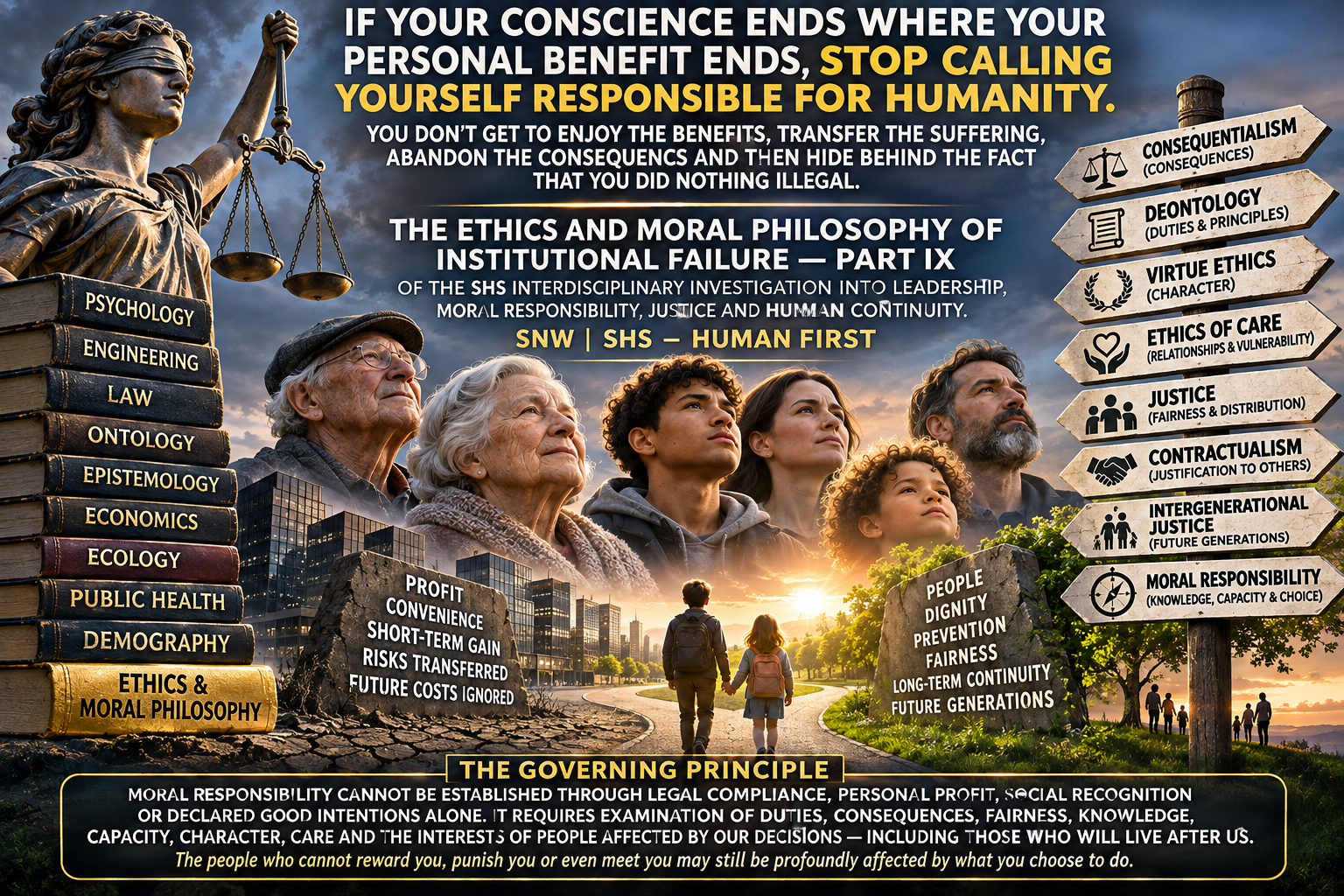
YOU DON’T GET TO ENJOY THE BENEFITS, TRANSFER THE SUFFERING, ABANDON THE CONSEQUENCES AND THEN HIDE BEHIND THE FACT THAT YOU DID NOTHING ILLEGAL.
THE ETHICS AND MORAL PHILOSOPHY OF INSTITUTIONAL FAILURE — PART IX OF THE SHS INTERDISCIPLINARY INVESTIGATION INTO LEADERSHIP, MORAL RESPONSIBILITY, JUSTICE AND HUMAN CONTINUITY.
SNW | SHS – HUMAN FIRST
First, psychology.
We investigated what the mind considers worthy of attention, what it defends, and how personal interests and cognitive biases can influence decisions.
Then engineering.
We examined whether institutions are actually capable of fulfilling their intended human purposes.
Then law.
We established that long-term responsibilities towards future generations are already recognised in existing legal frameworks.
Then ontology.
We questioned what institutions recognise as existing, what they consider worthy of preservation, and whether they have confused their own continuity with the continuity of the lives they supposedly serve.
Then epistemology.
We investigated what decision-makers know, what they should reasonably investigate, and how information about harm becomes institutional knowledge—or fails to.
Then economics.
We examined how an organisation can generate private financial benefits while transferring substantial costs to other people, communities and future generations.
Then ecology.
We investigated the consequences of consuming ecological resources without adequately preserving the systems necessary to regenerate them.
Then public health.
We examined why institutions invest heavily in treating suffering while struggling to prevent conditions that contribute to avoidable harm.
Then demography.
We established that populations change in ways we can study, project and prepare for, yet institutions can still fail to adequately accommodate foreseeable needs.
Now we arrive at the discipline that examines something at the foundation of every one of those questions.
ETHICS AND MORAL PHILOSOPHY.
Not merely what institutions are legally permitted to do.
Not merely what their financial models make profitable.
Not merely what their internal procedures require.
WHAT THEY OUGHT TO DO.
What is right?
What is wrong?
What constitutes a duty?
What do we owe one another?
What makes an action justifiable?
What responsibilities arise when our decisions affect lives beyond our own?
And, most importantly:
HOW CAN SOMEONE CLAIM THE MORAL AUTHORITY TO GOVERN OTHER PEOPLE WHILE TREATING THE CONSEQUENCES EXPERIENCED BY THOSE PEOPLE AS SECONDARY TO THEIR OWN BENEFIT?
Because I want humanity to confront something.
A DECISION CAN BE LEGAL WITHOUT BEING ETHICALLY JUSTIFIED.
A transaction can be profitable without being fair.
A policy can be popular without being responsible.
A person can be powerful without being virtuous.
An institution can follow its procedures while producing morally troubling consequences.
And someone can avoid personal punishment while leaving other people to suffer.
THE ABSENCE OF PUNISHMENT IS NOT PROOF OF MORAL INNOCENCE.
The absence of an enforceable legal duty does not automatically eliminate moral obligations.
And the ability to benefit from a decision does not establish that the decision was justified.
SO WHY HAVE WE ALLOWED THE QUESTION “CAN WE GET AWAY WITH IT?” TO OCCUPY SO MUCH OF THE SPACE WHERE “SHOULD WE DO IT?” BELONGS?!
Let’s investigate.
I. FIRST, STOP CONFUSING LEGALITY WITH MORALITY.
Law and morality overlap.
But they are not identical.
Law establishes enforceable rules, rights, obligations and procedures within particular jurisdictions.
Moral philosophy investigates what actions, intentions, character traits and social arrangements are ethically justified.
A legal system may prohibit conduct considered seriously harmful.
It may recognise duties of care.
It may protect fundamental rights.
It may create institutions for accountability.
But legal permission does not automatically establish moral justification.
THE LAW TELLS YOU SOMETHING ABOUT WHAT YOU ARE PERMITTED OR REQUIRED TO DO.
IT DOES NOT SETTLE EVERY QUESTION ABOUT WHAT YOU OUGHT TO DO.
Consider a company operating lawfully under an inadequate environmental standard.
Its activity may comply with the regulations currently in force.
But suppose reliable evidence demonstrates serious avoidable harm to neighbouring communities.
Does legal compliance, by itself, settle whether continuing the activity without further safeguards is morally justified?
No.
Consider an institution that possesses lawful discretion to refuse assistance.
Its refusal may be legally permissible.
But that does not eliminate ethical questions about fairness, vulnerability, proportionality and the consequences for the person affected.
Consider a government that makes a lawful decision to defer infrastructure maintenance.
It may have followed every required financial procedure.
But if the decision creates foreseeable and avoidable risks, questions of moral responsibility remain.
YOU CANNOT TRANSFORM EVERY QUESTION OF CONSCIENCE INTO A QUESTION ABOUT WHETHER SOMEBODY CAN SUCCESSFULLY SUE YOU.
And this matters because law is not capable of specifying every possible morally relevant circumstance.
Rules have limits.
Evidence has limits.
Jurisdictions have limits.
Remedies have limits.
And institutions sometimes possess discretion precisely because not every situation can be determined in advance.
WHAT GUIDES YOU WHEN THE LAW LEAVES YOU WITH A CHOICE?
That is where ethics becomes unavoidable.
II. THE UK ALREADY HAS SEVEN PRINCIPLES OF PUBLIC LIFE. SO WHY DOES THE QUESTION OF MORAL LEADERSHIP STILL NEED TO BE ASKED?!
In 1995, the United Kingdom established the Seven Principles of Public Life, commonly known as the Nolan Principles.
They are:
SELFLESSNESS.
INTEGRITY.
OBJECTIVITY.
ACCOUNTABILITY.
OPENNESS.
HONESTY.
LEADERSHIP.
These principles apply across public life and are now stewarded by the Ethics and Integrity Commission, established in October 2025.
Source: UK Government — The Seven Principles of Public Life
Now I want to examine just one.
SELFLESSNESS.
The principle requires public office-holders to act in the public interest.
Not merely their own interest.
Not merely their family’s financial advantage.
Not merely the interests of the individuals who appointed them.
THE PUBLIC INTEREST.
Now think about what that means.
If an individual accepts authority over public resources, their responsibilities extend beyond the private circle from which they personally benefit.
They are entrusted with functions affecting other people.
So what happens when their decisions consistently favour institutional convenience over the needs of the population?
What happens when personal relationships improperly influence decisions?
What happens when information is withheld without adequate justification?
What happens when scrutiny is resisted?
THE UK’S OWN PUBLIC ETHICS FRAMEWORK ALREADY RECOGNISES THAT HOLDING POWER REQUIRES STANDARDS BEYOND PERSONAL ADVANTAGE.
Now, a violation of an ethical principle is not automatically proof of a criminal offence.
The legal consequences depend upon the applicable rules, circumstances and evidence.
But the distinction does not make the principles meaningless.
It means their implementation must be examined.
DOES THE DECISION ACTUALLY REFLECT THE PUBLIC INTEREST?
Were competing interests declared?
Was reliable evidence used?
Were decisions open to appropriate scrutiny?
Were the reasons truthful?
Was the public treated fairly?
And when failure was identified, did leadership support its correction?
BECAUSE THE PRINCIPLES WERE NOT CREATED MERELY TO PROVIDE SEVEN ATTRACTIVE WORDS FOR THE WALL OF AN INSTITUTION.
They concern how public authority should be exercised.
And if those principles cannot be demonstrated in practice, the gap between ethical expectation and institutional conduct deserves investigation.
III. CONSEQUENTIALISM: YOUR INTENTIONS DO NOT ERASE THE PEOPLE SUFFERING FROM YOUR CONSEQUENCES.
Now we enter the first major moral philosophical framework.
CONSEQUENTIALISM.
Consequentialist theories assess the moral rightness of actions through their consequences.
Different versions disagree about which consequences matter and how they should be evaluated.
Classical utilitarianism is one influential form.
It emphasises aggregate wellbeing or utility.
But consequentialism extends beyond any single definition of happiness.
Now consider public decision-making.
An institution undertakes an activity.
It produces benefits.
But it also produces harm.
Consequentialist evaluation asks us to examine the overall consequences, including effects upon people beyond the immediate beneficiaries.
YOU CANNOT CLAIM THAT A DECISION WAS GOOD MERELY BECAUSE IT WAS GOOD FOR YOU.
You must consider the people affected.
The benefits.
The harms.
The alternatives.
The duration.
The likelihood of different outcomes.
And the distribution of consequences.
Suppose an industrial activity creates substantial profits while exposing a community to serious health risks.
A consequentialist analysis cannot simply stop at the profitability of the enterprise.
The relevant consequences extend beyond the financial return.
Suppose a public investment requires expenditure today but reduces severe future harm.
The immediate cost must be considered alongside the expected benefits.
Suppose a government defers essential maintenance.
The short-term saving must be examined against subsequent costs and risks.
IF YOUR DEFINITION OF SUCCESS EXCLUDES THE PEOPLE PAYING THE PRICE, YOUR EVALUATION OF SUCCESS IS INCOMPLETE.
But consequentialism also faces challenges.
How do we compare different kinds of wellbeing?
How do we account for uncertainty?
Can a sufficiently large collective benefit ever justify seriously violating an individual’s rights?
How do we avoid sacrificing vulnerable minorities merely because doing so benefits a larger number of people?
These are genuine philosophical difficulties.
And that is why consequentialist reasoning should not be used as permission to harm individuals whenever a majority benefits.
THE GREATER GOOD CANNOT SIMPLY BECOME A BEAUTIFUL PHRASE USED TO DISGUISE WHO WAS SACRIFICED TO PRODUCE IT.
Philosophical reference: Stanford Encyclopedia of Philosophy — Consequentialism
IV. DEONTOLOGY: SOME THINGS DO NOT BECOME RIGHT SIMPLY BECAUSE THEY ARE PROFITABLE OR CONVENIENT.
Now examine deontological ethics.
Deontological approaches emphasise moral duties, principles and constraints.
They do not evaluate every action solely through its consequences.
Some actions may be morally prohibited even when doing them could generate desirable results.
Consider the obligation not to deliberately deceive.
The obligation to respect people’s dignity.
The obligation not to treat people merely as instruments for personal gain.
The obligation to respect fundamental rights.
Different deontological theories interpret these duties in different ways.
But the central challenge is powerful.
WHAT IF YOU COULD MAKE MORE MONEY BY DECEIVING PEOPLE?
Would that make deception ethical?
WHAT IF VIOLATING SOMEBODY’S RIGHTS MADE YOUR INSTITUTION MORE EFFICIENT?
Would that automatically justify the violation?
WHAT IF EXPLOITING A VULNERABLE PERSON CREATED BENEFITS FOR AN ORGANISATION?
Would the benefits erase the moral problem?
Deontological reasoning challenges the assumption that everything can be justified by calculating a favourable outcome.
It insists that some moral requirements concern how people must be treated.
Now apply this to public institutions.
A person seeking assistance is not merely an obstacle to administrative efficiency.
A patient is not merely a cost.
A worker is not merely productive capacity.
A citizen is not merely a source of revenue.
HUMAN BEINGS CANNOT BE REDUCED TO INSTRUMENTS FOR ACHIEVING SOMEBODY ELSE’S OBJECTIVES WITHOUT RAISING QUESTIONS OF DIGNITY AND JUSTICE.
And future generations?
Even though their present moral and legal status is philosophically contested, many duty-based approaches seek to explain why present people must exercise restraint over activities that could seriously compromise future lives.
THE FACT THAT SOMEBODY CANNOT CURRENTLY DEFEND THEIR INTERESTS DOES NOT AUTOMATICALLY AUTHORISE YOU TO DISREGARD THOSE INTERESTS.
Philosophical reference: Stanford Encyclopedia of Philosophy — Deontological Ethics
V. VIRTUE ETHICS: YOUR JOB TITLE DOES NOT MAKE YOU A GOOD PERSON. YOUR CONDUCT IS PART OF THE EVIDENCE.
Now we examine virtue ethics.
This tradition concerns moral character.
Wisdom.
Justice.
Courage.
Temperance.
Honesty.
Generosity.
Practical judgment.
And the development of dispositions that support human flourishing.
Its roots include Aristotle’s examination of character and the good life.
The question is not only what rule somebody followed.
Nor only what consequence resulted.
It is also:
WHAT KIND OF PERSON IS ACTING?
And what kind of character is demonstrated through repeated choices?
Now consider leadership.
A leader may speak beautifully about courage.
But what happens when acknowledging a mistake threatens their reputation?
A leader may praise honesty.
But what happens when the truth contradicts their preferred explanation?
A leader may claim to value justice.
But what happens when correcting an injustice requires sacrificing a personal advantage?
A leader may preach service.
But what happens when the people requiring service cannot reward them?
VIRTUE IS NOT PROVEN BY THE ABILITY TO DESCRIBE IT.
It must be developed and expressed through conduct.
And virtue requires more than good intentions.
Practical wisdom matters.
A person can sincerely desire a good outcome yet make damaging decisions because they fail to understand relevant circumstances.
Courage without judgment can become recklessness.
Confidence without humility can become arrogance.
Loyalty without critical thought can perpetuate wrongdoing.
And generosity without regard for consequences can produce unintended harm.
THE MORAL QUALITY OF LEADERSHIP CANNOT BE ESTABLISHED THROUGH SELF-DESCRIPTION ALONE.
So examine conduct.
How does the person respond to correction?
How do they treat people who cannot benefit them?
How do they exercise power over vulnerable people?
How do they respond to competing interests?
And do their decisions reveal consistency between their professed values and their actions?
IF YOU REQUIRE PRAISE TO BE HONEST, IS HONESTY REALLY THE PRINCIPLE GOVERNING YOUR CONDUCT?
If you require personal advantage to act fairly, what happens when fairness costs you something?
If you only defend the vulnerable when doing so enhances your reputation, what happens when protecting them becomes unpopular?
CHARACTER BECOMES PARTICULARLY RELEVANT WHEN THE MORALLY RIGHT ACTION IS NOT ALSO THE PERSONALLY CONVENIENT ONE.
Philosophical reference: Stanford Encyclopedia of Philosophy — Virtue Ethics
VI. THE ETHICS OF CARE: IF YOU CANNOT RECOGNISE DEPENDENCE, WHAT EXACTLY DO YOU THINK YOU ARE GOVERNING?!
Now we examine something I consider particularly important to SHS’s work.
THE ETHICS OF CARE.
Associated with philosophers including Carol Gilligan, Nel Noddings, Virginia Held and Joan Tronto, care ethics emphasises relationships, vulnerability, responsiveness and human dependence.
It challenges accounts of morality that treat people primarily as isolated individuals making independent choices.
Because human beings are not independent of care.
Every child begins life dependent upon others.
People experience illness.
Disability.
Ageing.
Vulnerability.
And circumstances requiring support.
Relationships sustain human life.
THE FACT THAT SOMEBODY NEEDS CARE DOES NOT MAKE THEM A FAILURE.
And the fact that somebody provides care does not make their work insignificant merely because it is unpaid or poorly compensated.
Now consider our institutions.
What happens when economic calculations treat caregiving as an expense while overlooking its wider social value?
What happens when older people are classified principally through their fiscal costs?
What happens when public assistance is administered without sufficient regard for the circumstances of the person requesting it?
What happens when a person is forced to navigate multiple agencies while already experiencing serious distress?
A SYSTEM CAN BE PROCEDURALLY CONSISTENT WHILE BEING PROFOUNDLY UNRESPONSIVE TO HUMAN VULNERABILITY.
Care ethics asks us to recognise that the relationship itself matters.
Who depends upon whom?
Who possesses the resources?
Who has the power to act?
Who is exposed to harm?
Who is responsible for responding?
And what would responsible attention look like in the circumstances?
Care cannot mean abandoning fairness or excusing every harmful decision made in the name of compassion.
Caregiving can also involve difficult boundaries, conflicting needs and limits on available resources.
But its central challenge remains.
YOU CANNOT CLAIM TO SERVE HUMAN LIFE WHILE TREATING HUMAN DEPENDENCE AS AN ADMINISTRATIVE INCONVENIENCE.
VII. JUSTICE: YOU DO NOT GET TO COLLECT THE BENEFITS AND ASSIGN THE LOSSES TO PEOPLE WHO NEVER AGREED TO THE ARRANGEMENT.
Now consider theories of justice.
Justice concerns fair treatment, rights, obligations, institutions and the distribution of benefits and burdens.
Different philosophical traditions disagree about what fairness requires.
Equality?
Equity?
Sufficient resources for everyone?
Priority for the worst off?
Respect for individual rights?
Fair opportunities?
Protection against domination?
There is no single uncontested account.
But one question is especially important to this investigation.
WHO RECEIVES THE BENEFITS, AND WHO IS MADE TO CARRY THE BURDENS?
Consider an economic activity.
The profits are concentrated.
The environmental damage is distributed.
Consider a public policy.
The immediate benefits accrue to current beneficiaries.
The financing obligations extend to future taxpayers.
Consider an infrastructure decision.
One community receives the improvement.
Another experiences the adverse consequences.
THE DISTRIBUTION OF CONSEQUENCES IS A MORAL QUESTION.
Not merely a mathematical one.
And justice cannot always be established through the fact that an aggregate benefit exceeds an aggregate cost.
We must also ask whether the distribution is defensible.
Were affected people considered?
Were their interests represented?
Were less harmful alternatives available?
Were the burdens placed disproportionately upon people who lacked the power to resist?
And were appropriate safeguards or remedies provided?
YOU CANNOT CALL A SYSTEM FAIR MERELY BECAUSE THE PEOPLE BENEFITING FROM IT ARE SATISFIED.
The people carrying its costs matter too.
Including the people who are not yet capable of objecting.
VIII. JOHN RAWLS: WHAT WOULD YOUR LEADERSHIP DECISIONS LOOK LIKE IF YOU DIDN’T KNOW WHETHER YOU WOULD BE BORN INTO THE BENEFITING GROUP?
Now consider the political philosopher John Rawls.
His theory of justice uses a hypothetical device known as the original position, in which principles of justice are considered from behind a veil of ignorance.
The idea is to examine what principles people might reasonably choose without knowing their own particular position within society.
Their wealth.
Social advantages.
Status.
Or other circumstances that might otherwise influence their judgment.
Now imagine applying that reasoning to the design of an institution.
You do not know whether you will be wealthy or poor.
Healthy or ill.
Young or old.
A person receiving a service or somebody administering it.
A shareholder or a worker.
A person whose community benefits or one whose community carries the costs.
WOULD YOU STILL DEFEND THE SAME ARRANGEMENT IF YOU DID NOT KNOW WHICH POSITION YOU WOULD OCCUPY?
Now extend the thought experiment across generations.
Imagine you do not know whether you will belong to the generation making the decision or the generation inheriting its consequences.
Would you permit the earlier generation to consume essential resources without adequate concern for restoration?
Would you accept public liabilities created without sufficient long-term justification?
Would you support institutions that preserve immediate convenience while allowing foreseeable deterioration?
WHAT PRINCIPLES WOULD YOU ACCEPT IF YOU DID NOT KNOW WHETHER YOU WOULD BE THE PERSON COLLECTING THE PROFIT OR THE PERSON INHERITING THE DAMAGE?
Rawls’s work also includes a just savings principle, addressing what generations owe one another in sustaining just institutions over time.
It does not settle every issue of intergenerational responsibility.
But it provides a framework for questioning arrangements that privilege present beneficiaries simply because future people cannot participate in present decisions.
IF YOUR ARRANGEMENT ONLY APPEARS JUST WHEN YOU KNOW YOU WILL BE THE ONE BENEFITING FROM IT, THAT IS A REASON TO EXAMINE ITS FAIRNESS MORE CLOSELY.
Philosophical reference: Stanford Encyclopedia of Philosophy — Intergenerational Justice
IX. CONTRACTUALISM: WHAT WOULD YOU SAY TO THE PEOPLE FORCED TO LIVE WITH YOUR DECISION IF THEY COULD ANSWER YOU TODAY?
Another philosophical tradition deserves attention.
CONTRACTUALISM.
One influential version, developed by T. M. Scanlon, asks whether moral principles could be reasonably rejected by people affected by them.
It concerns the justification of our conduct to others.
Now consider a government making a decision that generates substantial benefits for one group while imposing serious costs upon another.
What justification could it offer the people carrying those costs?
Not merely the people benefiting.
THE PEOPLE WHO HAVE REASONS TO OBJECT.
Suppose a public authority accepts avoidable risks because prevention would require expenditure.
What could it say to the people who later experience the harm?
Suppose an institution designs a process that makes it easier to administer assistance but creates serious barriers for people who urgently need it.
Can the burden be justified?
Suppose an organisation transfers long-term environmental costs to a community that receives few of the benefits.
What reasons could be offered to that community?
THE QUESTION IS NOT WHETHER SOMEONE WITH POWER CAN PRODUCE AN EXPLANATION.
IT IS WHETHER THE PRINCIPLE GOVERNING THE DECISION CAN BE REASONABLY JUSTIFIED TO THE PEOPLE AFFECTED.
And then there are future generations.
They cannot participate in the discussion today.
But that is precisely why we must examine how their interests are represented.
THE INABILITY OF SOMEBODY TO OBJECT IS NOT THE SAME AS THEIR CONSENT.
A child cannot negotiate every social arrangement they inherit.
An unborn person cannot challenge a present resource policy.
A future community cannot attend today’s planning meeting.
SILENCE CAUSED BY NONEXISTENCE IS NOT AGREEMENT.
Philosophical reference: Stanford Encyclopedia of Philosophy — Contractualism
X. INTERGENERATIONAL JUSTICE: YOU ARE NOT THE ONLY GENERATION ENTITLED TO AN EARTH CAPABLE OF SUPPORTING HUMAN LIFE.
Now we arrive at the central question of the entire series.
WHAT DO WE OWE PEOPLE WHO WILL LIVE AFTER US?
Intergenerational justice investigates moral obligations across generations.
It includes difficult questions.
Can future people possess rights before they exist?
How should present needs be balanced against future needs?
How much must one generation save?
What natural resources should be preserved?
What obligations arise from historical injustices?
And how should uncertainty influence our decisions?
These are genuine philosophical debates.
There is no universal agreement about every answer.
But a central fact remains.
THE PRESENT GENERATION HAS THE POWER TO INFLUENCE THE CONDITIONS UNDER WHICH FUTURE GENERATIONS MAY LIVE.
The relationship is asymmetrical.
We can affect them.
They cannot presently exercise comparable power over us.
We can use resources.
They may inherit what remains.
We can create infrastructure.
They may inherit its condition.
We can establish institutions.
They may live under their rules.
We can create liabilities.
They may be responsible for financing them.
THE PEOPLE LEAST ABLE TO DEFEND THEIR INTERESTS TODAY MAY EXPERIENCE CONSEQUENCES THAT LAST LONG AFTER THE PRESENT DECISION-MAKERS HAVE DEPARTED.
Now here is the moral question.
Does that imbalance create an obligation to exercise restraint?
To investigate foreseeable consequences?
To preserve essential conditions?
To avoid imposing unreasonable burdens?
To leave future people meaningful opportunities rather than merely the obligation to repair what we consumed?
Different philosophers justify those obligations differently.
But the debate itself demonstrates that intergenerational responsibility is a serious field of moral inquiry.
THE FUTURE IS NOT MORALLY IRRELEVANT SIMPLY BECAUSE IT IS TEMPORALLY DISTANT.
And distance in time is not automatically a justification for disregarding a person’s eventual wellbeing.
XI. UNESCO ALREADY DECLARED OUR RESPONSIBILITIES TO FUTURE GENERATIONS IN 1997. HOW MUCH LONGER ARE WE GOING TO PRETEND THIS QUESTION IS NEW?!
Now I want people to see something.
On 12 November 1997, UNESCO adopted its Declaration on the Responsibilities of the Present Generations Towards Future Generations.
Nineteen ninety-seven.
Not yesterday.
Not a new SHS invention.
An international declaration adopted almost three decades before this publication.
Its provisions address the needs and interests of future generations, freedom of choice, the continuation of humankind, environmental protection, biodiversity, cultural heritage, peace, education and non-discrimination.
THE RESPONSIBILITIES OF THE PRESENT TOWARDS THE FUTURE WERE EXPLICITLY RECOGNISED.
Article 1 concerns safeguarding the needs and interests of present and future generations.
Article 2 addresses future generations’ freedom of choice.
Article 3 concerns the maintenance and continuation of humankind.
Article 4 calls attention to the responsibility of leaving an Earth not irreversibly damaged by human activity.
Article 5 addresses environmental protection, pollution and natural resources.
Article 10 concerns equitable and sustainable development and education.
Article 11 addresses discrimination affecting future generations.
Now let’s be precise.
This is a UNESCO declaration, not a universally enforceable treaty creating an automatic individual claim in every national court.
Its legal status must not be exaggerated.
But it is a significant expression of international ethical and policy principles.
SO THE QUESTION OF FUTURE RESPONSIBILITY WAS ALREADY BEING DISCUSSED INTERNATIONALLY IN 1997.
And before that.
And before that.
Philosophers, communities, Indigenous traditions, religious traditions and political thinkers have considered responsibilities to descendants and future life across different historical periods.
WHICH MEANS THE CONCEPT IS NOT MISSING.
The question is how effectively it has been translated into governance, institutions, incentives and actual decisions.
Because recognising an ethical obligation and fulfilling that obligation are two different things.
YOU CAN WRITE A DECLARATION ABOUT PROTECTING THE FUTURE WHILE CONTINUING ACTIVITIES THAT PLACE THE FUTURE AT RISK.
And the publication of the declaration does not automatically correct the contradiction.
The actual conduct must be examined.
XII. MORAL RESPONSIBILITY: DID YOU KNOW, COULD YOU ACT, AND WHAT DID YOU CHOOSE?
Now I want to investigate moral accountability itself.
Philosophers examine responsibility through questions including knowledge, control, intention, causation and the capacity to act differently.
Consider three situations.
SITUATION ONE.
A person could not reasonably have known about an unforeseen risk.
They lacked relevant information, and no reasonable investigation would have revealed it.
SITUATION TWO.
A person had access to credible warnings but failed to undertake an investigation appropriate to their responsibility.
SITUATION THREE.
A person possessed reliable evidence of serious foreseeable harm, had meaningful authority to act, and nevertheless chose to disregard the risk without adequate justification.
THESE ARE NOT MORALLY IDENTICAL SITUATIONS.
And the differences matter.
Moral blame cannot responsibly be assigned merely because a bad outcome occurred.
People may act under constraints.
They may lack information.
They may face competing obligations.
They may make reasonable decisions that nevertheless produce unexpected harm.
But ignorance itself may sometimes be culpable where a person had a responsibility and reasonable opportunity to investigate.
And knowledge without action may raise questions where the person possessed both the duty and the capacity to respond.
SO STOP TREATING EVERY FAILURE AS PROOF OF MALICE.
BUT STOP TREATING EVERY CLAIM OF IGNORANCE AS AUTOMATIC EXONERATION.
We need evidence.
What was known?
What should reasonably have been known?
Who possessed authority?
What options were available?
What would different actions likely have achieved?
What constraints existed?
And what reasons explain the decision?
Because moral responsibility must be connected to actual circumstances.
YOU CANNOT ESTABLISH GUILT THROUGH ANGRY ASSUMPTION.
But you also cannot establish innocence merely by repeating that you meant well.
XIII. THE ETHICS OF OMISSION: WHAT IS YOUR RESPONSIBILITY WHEN YOU WATCH FORESEEABLE HARM DEVELOP?
Now here is a particularly uncomfortable question.
CAN SOMEONE BE MORALLY RESPONSIBLE FOR HARM THEY DID NOT PERSONALLY INITIATE?
Sometimes.
But we must be careful.
Doing harm and failing to prevent harm are not morally or legally identical in every circumstance.
The strength of an obligation to intervene depends upon factors including:
Knowledge.
Ability.
Role.
Relationship.
Cost.
Risk.
Competing obligations.
And whether the person had a special duty to act.
But some omissions can be ethically serious.
Imagine an institution possesses responsibility for maintaining essential infrastructure.
It receives credible information about a significant safety risk.
It has the authority to investigate.
Reasonable corrective options exist.
Yet it does not respond adequately.
The fact that the institution did not originally create the defect would not automatically settle the ethical question.
WHAT MATTERS IS WHAT RESPONSIBILITY IT HAD ONCE THE RISK BECAME KNOWN.
Now apply this to leadership.
If you accept responsibility for a public service, part of that responsibility may involve responding to foreseeable problems within the service.
If you possess authority over resources, your choices about using or withholding them can have consequences.
If you supervise an institution, the quality of its warning and response systems may be relevant to your responsibilities.
SOMETIMES THE MORAL QUESTION IS NOT ONLY WHAT YOU CAUSED.
IT IS WHAT YOU HAD THE RESPONSIBILITY AND CAPACITY TO PREVENT OR CORRECT.
But the obligation must be established through context.
Nobody can reasonably be held responsible for preventing every harm in the world.
And a person who lacks the capacity to intervene should not automatically be blamed for failing to achieve the impossible.
RESPONSIBILITY WITHOUT REGARD FOR CAPACITY BECOMES AN UNFAIR DEMAND.
Yet capacity without any consideration of responsibility can become an excuse for indifference.
That tension deserves serious examination.
XIV. MORAL LUCK: DO YOU ONLY CONDEMN THE RISK AFTER SOMEBODY HAS DIED?
Now consider a difficult idea from moral philosophy.
MORAL LUCK.
Sometimes people are judged differently because of outcomes affected by circumstances beyond their full control.
Imagine two decision-makers taking similarly reckless actions.
One produces no injury.
The other results in a serious accident.
The consequences differ.
But what about the moral quality of their decisions before the outcome became known?
Should the person who happened to avoid causing injury be considered entirely responsible?
Should the person whose action produced injury bear additional responsibility?
Philosophers debate these questions.
But the concept reveals a serious problem in institutional accountability.
WE SOMETIMES TREAT A DANGEROUS DECISION AS ACCEPTABLE UNTIL THE DANGER MATERIALISES.
Then, suddenly, everybody recognises the risk.
A structural defect becomes important after a collapse.
A safety failure becomes urgent after an injury.
A neglected warning becomes significant after a death.
But the risk may have existed before the outcome.
THE ABSENCE OF A DISASTER IS NOT AUTOMATICALLY PROOF THAT THE DECISION WAS RESPONSIBLE.
And the occurrence of a disaster is not, by itself, complete proof that the decision-maker acted negligently.
The evaluation must consider what was reasonably foreseeable and what precautions were appropriate at the time.
IF WE ONLY EXAMINE RESPONSIBILITY AFTER PEOPLE SUFFER, WE MAY BE REWARDING THE PEOPLE WHO WERE MERELY FORTUNATE ENOUGH NOT TO EXPERIENCE THE CONSEQUENCES OF THEIR RISKS.
That is why prevention matters morally.
Not only economically.
Not only technically.
MORALLY.
XV. THE ETHICS OF UNCERTAINTY: YOU DON’T GET TO USE THE FUTURE’S UNPREDICTABILITY AS PERMISSION TO DISREGARD IT.
Now let’s examine uncertainty.
Nobody knows every future consequence.
And ethical responsibility does not require omniscience.
But uncertainty comes in different forms.
Some risks are well established.
Some are supported by incomplete evidence.
Some are plausible but poorly quantified.
Others are highly speculative.
A responsible decision-maker must distinguish them.
UNCERTAINTY DOES NOT AUTOMATICALLY JUSTIFY EITHER ACTION OR INACTION.
It requires judgment.
Proportionality.
Evidence.
Consideration of alternatives.
And attention to the severity and reversibility of possible consequences.
Imagine a decision with uncertain financial benefits but the possibility of irreversible ecological damage.
The ethical question is not merely whether the damage is guaranteed.
It concerns whether the risk is acceptable, what information could reduce uncertainty, and whether safer alternatives exist.
Now imagine a proposed intervention with uncertain benefits and significant costs to vulnerable people.
Again, caution may be warranted.
THE SAME STANDARD MUST APPLY TO THE CONSEQUENCES OF ACTING AND THE CONSEQUENCES OF NOT ACTING.
Because prevention can cause costs.
And inaction can cause harm.
The purpose of ethics is not to declare one response automatically correct in every circumstance.
It is to establish a defensible process of judgment.
WHAT ARE THE RISKS?
WHO EXPERIENCES THEM?
WHO RECEIVES THE BENEFITS?
HOW SEVERE COULD THE HARM BE?
WHAT ALTERNATIVES EXIST?
AND WHO IS RESPONSIBLE FOR EXPLAINING WHY THE CHOSEN COURSE WAS JUSTIFIED?
That is how uncertainty becomes something to manage rather than something to hide behind.
XVI. THE MORAL CIRCLE: DOES YOUR CONCERN END WITH YOUR FAMILY, YOUR INSTITUTION, YOUR NATION OR YOUR OWN LIFESPAN?
Now we return to the psychological foundation of this series.
The circle of moral concern.
Human beings may feel stronger obligations towards people with whom they share close relationships.
Family.
Friends.
Communities.
Colleagues.
People they know.
People whose experiences they understand.
That is not automatically immoral.
Special relationships can create special responsibilities.
A parent has particular obligations towards their child.
A healthcare professional has responsibilities towards patients.
A public official has obligations associated with their office.
But special obligations do not necessarily erase general obligations towards everybody else.
LOVING YOUR OWN CHILD DOES NOT AUTHORISE YOU TO DISREGARD THE SAFETY OF EVERY OTHER CHILD.
Protecting your family does not justify every harm inflicted upon another family.
Serving your organisation does not automatically justify imposing unreasonable burdens upon the public.
And protecting your nation does not eliminate every ethical consideration concerning people beyond its borders.
THE PEOPLE OUTSIDE YOUR IMMEDIATE CIRCLE DO NOT STOP BEING MORALLY RELEVANT BECAUSE YOU DO NOT PERSONALLY KNOW THEM.
Now extend the question into time.
What about people who will live after you?
What about children not yet born?
What about communities whose circumstances will be influenced by decisions made before their existence?
DOES YOUR MORAL CIRCLE HAVE AN EXPIRATION DATE?
And if it does, what principle justifies that boundary?
The fact that you cannot meet them?
The fact that they cannot reward you?
The fact that they cannot vote for you?
The fact that you will not personally experience their suffering?
NONE OF THOSE FACTS, BY ITSELF, ESTABLISHES THAT THEIR FUTURE WELLBEING IS WORTH NOTHING.
And this is where moral philosophy challenges our convenience.
Not by demanding that every person feel identical affection for every possible future human.
But by asking whether our decisions can be justified when the interests of others are taken seriously.
THE MORAL RELEVANCE OF ANOTHER LIFE CANNOT BE MEASURED SOLELY BY ITS CAPACITY TO BENEFIT YOUR OWN.
XVII. ATHEISM, FAITH AND MORAL RESPONSIBILITY: THE TEST IS NOT WHETHER YOU BELIEVE YOU WILL BE PUNISHED AFTER DEATH.
Now let’s return to the question from which this entire series began.
Belief in an afterlife.
Reincarnation.
Karma.
Heaven.
Hell.
Agnosticism.
Atheism.
And the relationship between those beliefs and responsibility.
My original concern was whether believing that personal consciousness ends at death could lead some people to restrict their sense of obligation to the portion of life they expect to experience.
That is a question worth examining.
BUT A BELIEF THAT PERSONAL CONSCIOUSNESS ENDS AT DEATH DOES NOT LOGICALLY REQUIRE A BELIEF THAT RESPONSIBILITY ENDS AT DEATH.
Those are separate propositions.
A person can believe they will never experience an afterlife and still regard future human suffering as profoundly important.
They can dedicate themselves to protecting people who will live after them.
They can act from compassion.
From reason.
From duty.
From solidarity.
From concern for justice.
Or from the conviction that this one life makes protecting other lives even more important.
Likewise, belief in divine judgment does not automatically establish ethical conduct.
A religious person may profess eternal responsibility while behaving selfishly.
A nonreligious person may reject an afterlife while demonstrating extraordinary concern for future generations.
THE MORAL QUESTION IS WHAT A PERSON RECOGNISES AS THEIR RESPONSIBILITY AND HOW THEY ACT UPON THAT RECOGNITION.
Not merely the label attached to their metaphysical beliefs.
If somebody argues that nothing matters after their death because they will not be present to experience the consequences, their argument can be challenged.
But that claim must be attributed to the person making it.
It cannot simply be assumed of every person who shares a religious or nonreligious identity.
And public responsibility should be assessed through actual conduct, relevant duties and demonstrated judgment.
MORAL CAPACITY IS NOT A MONOPOLY OWNED BY BELIEVERS.
Nor is disbelief evidence of moral incapacity.
The deeper challenge is whether a person’s moral reasoning recognises obligations beyond personal reward and punishment.
IF THE ONLY REASON YOU REFRAIN FROM HARMING SOMEBODY IS THAT YOU EXPECT TO BE PUNISHED, WHAT HAPPENS WHEN YOU BELIEVE NOBODY CAN PUNISH YOU?
And if you believe no punishment awaits, what principles still guide you?
Those are questions that can be asked of everyone.
Because morality grounded entirely in fear of punishment may be as vulnerable to self-interest as morality grounded entirely in personal benefit.
A CONSCIENCE WORTH TRUSTING SHOULD NOT REQUIRE THE SUFFERING PERSON TO POSSESS THE POWER TO PUNISH YOU BEFORE THEIR SUFFERING MATTERS.
XVIII. WHAT IS THE DIFFERENCE BETWEEN A MORAL PERSON AND A PERSON PERFORMING MORALITY FOR RECOGNITION?
Now examine moral motivation.
People may act for many reasons.
Compassion.
Duty.
Fear.
Reward.
Social approval.
Loyalty.
Reputation.
Personal identity.
Or some combination.
A person may perform a genuinely beneficial action while also receiving public recognition.
That does not automatically invalidate the benefit.
But motivation becomes important when we examine consistency.
WHAT HAPPENS WHEN THE MORALLY RESPONSIBLE ACTION IS NO LONGER PROFITABLE?
When it costs money?
When it threatens status?
When it requires an admission of error?
When it benefits somebody who cannot offer anything in return?
When it cannot be converted into publicity?
When nobody is watching?
DOES THE CONDUCT CONTINUE?
Or does the commitment disappear with the reward?
Now consider institutional ethics.
A corporation advertises its social responsibility.
But how does it respond to evidence of harm that threatens profitability?
A public authority publishes commitments to fairness.
But how does it handle complaints from people with little influence?
A leader celebrates accountability.
But what happens when scrutiny concerns their own actions?
THE PERFORMANCE OF MORALITY IS NOT THE SAME THING AS A CONSISTENT PRACTICE OF MORAL RESPONSIBILITY.
And this distinction cannot always be established through one isolated action.
Patterns matter.
Responses to difficult situations matter.
The treatment of conflicting interests matters.
And willingness to correct mistakes matters.
MORAL CREDIBILITY IS STRONGER WHEN VALUES REMAIN VISIBLE IN DECISIONS THAT MAKE THOSE VALUES COSTLY TO UPHOLD.
XIX. MORAL COMPROMISE: STOP HIDING BEHIND “THE GREATER GOOD” WITHOUT ACCOUNTING FOR WHO IS PAYING FOR IT.
Real governance involves trade-offs.
Resources are limited.
Needs compete.
Some decisions produce benefits and harms simultaneously.
Not every desired outcome can be achieved.
And moral philosophy cannot eliminate every tragic choice.
But difficult decisions require more rigorous justification, not less.
THE EXISTENCE OF A TRADE-OFF DOES NOT MEAN THE PERSON MAKING IT IS EXEMPT FROM EXPLAINING IT.
Imagine closing one facility to finance improvements elsewhere.
There may be legitimate reasons.
But who loses access?
What alternatives exist?
What happens to vulnerable people?
Can the negative effects be mitigated?
How will the decision be evaluated?
Imagine an environmental intervention that imposes costs upon workers or communities.
The environmental benefits may be substantial.
But what support is available to people facing the transition?
Imagine a financial reform that improves long-term sustainability but reduces present services.
What are the consequences?
What alternatives were considered?
THE MORAL RESPONSIBILITY DOES NOT DISAPPEAR BECAUSE THE DECISION IS DIFFICULT.
And it does not become adequate merely because the decision-maker describes the outcome as necessary.
NECESSARY ACCORDING TO WHICH EVIDENCE?
Necessary under which constraints?
Necessary for whose benefit?
Necessary compared with which alternatives?
“THERE WAS NO OTHER OPTION” IS A CLAIM THAT REQUIRES EXAMINATION.
It is not a magical phrase that terminates ethical scrutiny.
XX. THE SHS ETHICAL CONTINUITY TEST.
Now I want to make this investigation operational.
I propose fourteen questions for examining the moral responsibility of institutions and their decision-makers.
1. MORAL PURPOSE
What human good or legitimate social purpose is the institution intended to serve?
2. DUTIES
What moral, professional and legal obligations arise from its responsibilities?
3. CONSEQUENCES
What foreseeable benefits and harms could result from the decision?
4. RIGHTS AND DIGNITY
Are affected people being treated with appropriate respect?
Are fundamental rights and legitimate interests protected?
5. DISTRIBUTIVE JUSTICE
Who receives the benefits?
Who carries the burdens?
Is that distribution defensible?
6. MORAL INCLUSION
Whose interests have been considered?
Whose interests have been excluded?
7. KNOWLEDGE
What did the decision-makers know?
What should they reasonably have investigated?
8. CONTROL AND CAPACITY
What authority and practical ability did they possess to prevent or correct harm?
9. ALTERNATIVES
What less harmful or more beneficial options were reasonably available?
10. CARE
Were vulnerability, dependence and the particular circumstances of affected people adequately considered?
11. CHARACTER AND INTEGRITY
Does conduct demonstrate consistency with stated ethical principles?
How does the institution respond when those principles become inconvenient?
12. ACCOUNTABILITY
Can decisions be meaningfully scrutinised?
Are reasons transparent where appropriate?
Is correction possible?
13. INTERGENERATIONAL JUSTICE
What consequences will continue beyond the current decision-makers and beneficiaries?
Are future people being left with unreasonable burdens or diminished essential opportunities?
14. CORRECTION AND REPAIR
Where wrongdoing or avoidable harm has been established, what proportionate steps are necessary to stop, remedy or prevent its recurrence?
THIS IS NOT A TEST THAT AUTOMATICALLY PRODUCES A SINGLE UNIVERSAL MORAL VERDICT.
Different ethical theories can disagree.
Evidence may remain incomplete.
Responsibilities can conflict.
And difficult choices may not have perfect solutions.
But the framework makes moral considerations explicit rather than allowing them to disappear beneath financial, administrative or political language.
BECAUSE A DECISION DOES NOT BECOME MORALLY RESPONSIBLE MERELY BECAUSE ITS MAKER HAS SUCCEEDED IN AVOIDING THE QUESTION OF MORALITY.
XXI. WHEN EVERY DISCIPLINE IDENTIFIES A DIFFERENT PART OF THE SAME PROBLEM, WHAT DOES MORALITY REQUIRE US TO DO WITH THAT KNOWLEDGE?
Now let’s connect the entire investigation.
Psychology examines motivation and cognition.
Engineering examines system performance.
Law examines enforceable obligations.
Ontology examines what exists and what we understand ourselves to be preserving.
Epistemology examines knowledge and justification.
Economics examines allocation, incentives and distribution.
Ecology examines the conditions supporting living systems.
Public health examines risks to human wellbeing.
Demography examines population change and future needs.
And moral philosophy asks how we ought to act in light of those considerations.
WHAT IS THE RESPONSIBLE RESPONSE WHEN WE POSSESS EVIDENCE THAT AN ARRANGEMENT IS PRODUCING AVOIDABLE HARM?
Not every case produces the same answer.
But certain questions become difficult to avoid.
If harm is foreseeable, why was it not adequately considered?
If prevention is feasible, why was it not reasonably evaluated?
If the burden falls upon vulnerable people, how was their situation represented?
If a decision creates a lasting liability, how was the future accounted for?
If the institution possesses the capacity to correct a failure, what prevents action?
THE PURPOSE OF KNOWLEDGE IS NOT MERELY TO MAKE US BETTER AT DESCRIBING WHAT IS WRONG.
It can also strengthen the moral responsibility to investigate what should be done.
Knowledge and capacity matter.
A person who knows about a serious risk and possesses the authority to respond occupies a different moral position from someone who neither knows nor has the power to act.
That does not automatically determine blame.
But it is a reason to examine responsibility.
THE GREATER YOUR POWER OVER THE CONDITIONS OF OTHER PEOPLE’S LIVES, THE MORE IMPORTANT IT BECOMES TO JUSTIFY HOW THAT POWER IS EXERCISED.
And the fact that those people cannot personally reward or punish you does not make their interests morally irrelevant.
XXII. YOUR MORAL RESPONSIBILITY IS NOT A DEBT THAT EXPIRES WHEN THE PERSON YOU OWE CAN NO LONGER FIND YOU.
This is where I want to return to mortality.
The person making a decision may die.
The organisation may dissolve.
The political administration may change.
The financial accounts may close.
But consequences can persist.
An ecosystem may remain damaged.
A financial obligation may remain unpaid.
A public building may continue deteriorating.
A harmful practice may continue through institutional routines.
And people may experience effects long after those responsible have departed.
THE END OF YOUR PERSONAL PARTICIPATION DOES NOT RETROACTIVELY MAKE EVERY CHOICE YOU MADE MORALLY IRRELEVANT.
But responsibility must also be proportionate.
We cannot hold somebody responsible for every future event merely because they lived before it.
We must establish a meaningful connection between actions, knowledge, authority, foreseeability and consequences.
THE FUTURE DOES NOT GIVE US PERMISSION TO INVENT BLAME.
But neither does the future’s distance eliminate all grounds for responsibility.
That is what makes intergenerational ethics so important.
The people who will experience the consequences may never meet those who created them.
They may never receive an apology.
They may never obtain compensation.
They may not even know whose decisions contributed to their circumstances.
SO IF MORAL RESPONSIBILITY DEPENDS ENTIRELY UPON THE POSSIBILITY OF BEING PERSONALLY CONFRONTED BY THE PERSON YOU HAVE AFFECTED, WHAT PROTECTS THOSE WHO CAN NEVER CONFRONT YOU?
That is the challenge.
And it extends far beyond religion.
DO YOU RECOGNISE AN OBLIGATION TO A LIFE THAT WILL NEVER BE ABLE TO THANK YOU?
Can you preserve something you may never enjoy?
Can you prevent harm to people who will never know your name?
Can you invest in a future that offers you no personal return?
Can you act responsibly without the guarantee of recognition, reward or punishment?
IF THE ANSWER IS YES, THEN YOUR MORAL CONCERN HAS ALREADY EXTENDED BEYOND PERSONAL BENEFIT.
And if the answer is no?
Then we need to examine what happens when that mentality is granted authority over other people’s lives.
XXIII. STOP CONFUSING A COMFORTABLE CONSCIENCE WITH A CLEAR ONE.
There is something especially dangerous about moral self-certainty.
The conviction that because somebody sees themselves as a good person, their actions must therefore be good.
Because they believe their institution serves humanity, its decisions must therefore be justified.
Because their intentions were honourable, the consequences should not be examined.
Because the decision was lawful, no further moral question exists.
Because nobody successfully held them accountable, they must have done nothing wrong.
NONE OF THOSE CONCLUSIONS AUTOMATICALLY FOLLOWS.
A person may sincerely believe they are acting responsibly while being mistaken.
An institution may possess a noble mission while implementing an ineffective policy.
A well-intentioned decision may create harm.
And a morally troubling decision may escape legal sanction.
THE QUALITY OF OUR CONSCIENCE CANNOT BE ESTABLISHED MERELY THROUGH HOW COMFORTABLE WE FEEL WITH OURSELVES.
Moral reflection requires the willingness to question that comfort.
To examine whether our benefits came at an unjustified cost.
To listen when others describe harm.
To recognise when our assumptions were incomplete.
To distinguish defensible choices from convenient rationalisations.
And to change our conduct when better evidence or stronger reasoning demonstrates the need.
IF YOUR CONSCIENCE ONLY SPEAKS WHEN SOMEBODY ELSE IS BEING ACCUSED, WHAT HAPPENS WHEN YOUR OWN ACTIONS REQUIRE EXAMINATION?
If your morality only protects people who agree with you, what happens to those who disagree?
If your ethics only function while they benefit your institution, what happens when they threaten its interests?
And if your compassion only extends to those currently visible, what happens to the people whose future will be shaped by your decisions today?
MORAL RESPONSIBILITY REQUIRES MORE THAN BEING PLEASED WITH THE STORY YOU TELL ABOUT YOURSELF.
It requires an honest examination of what your conduct means for others.
XXIV. HUMANITY DOES NOT EXIST TO PROVIDE YOU WITH OPPORTUNITIES TO APPEAR VIRTUOUS.
Now consider the difference between service and self-promotion.
A public office can provide prestige.
Leadership can provide influence.
Institutional authority can provide resources.
Professional titles can provide recognition.
And ethical language can provide social credibility.
None of those benefits automatically makes the holder immoral.
But they can create temptations.
WHAT HAPPENS WHEN THE REWARDS OF APPEARING RESPONSIBLE BECOME MORE IMPORTANT THAN THE RESPONSIBILITY ITSELF?
When the announcement matters more than implementation?
When the public apology matters more than preventing recurrence?
When the reputation of the institution matters more than investigating its failures?
When the charitable donation matters more than the harmful business practice it is being used to distract from?
When the performance of care becomes more attractive than the cost of actually providing it?
HUMANITY IS NOT YOUR AUDIENCE FOR THE PERFORMANCE OF MORAL SUPERIORITY.
It consists of people whose lives are affected by what institutions do.
Not merely what institutions say.
And the same standard should apply to anyone claiming to investigate responsibility.
Including SHS.
If we demand truth, we must be prepared to correct inaccuracies.
If we demand evidence, our own claims must be substantiated.
If we demand fairness, we cannot simply presume guilt because somebody disagrees with us.
If we demand accountability, we must distinguish established wrongdoing from allegations and uncertainties.
THE STRENGTH OF AN ETHICAL FRAMEWORK DEPENDS PARTLY UPON THE CONSISTENCY WITH WHICH IT IS APPLIED.
Not only against the people we criticise.
But also to ourselves.
XXV. THE PEOPLE WHO COME AFTER YOU ARE NOT YOUR MORAL AFTERTHOUGHT.
I want to conclude.
We have examined morality from multiple directions.
Consequences.
Duties.
Character.
Care.
Justice.
Fairness.
Knowledge.
Capacity.
Uncertainty.
And obligations across generations.
These traditions do not agree about everything.
They disagree about what makes an action right.
How to compare competing obligations.
How to distribute resources.
What counts as an unacceptable sacrifice.
And how far our obligations extend.
BUT THEY GIVE US SERIOUS TOOLS FOR EXAMINING THE ASSUMPTION THAT PERSONAL BENEFIT IS ENOUGH TO JUSTIFY THE EXERCISE OF POWER.
And that is the assumption I want challenged.
Because a human life is not valuable only while it contributes to your profit.
A child is not valuable only when they become a taxpayer.
An elderly person is not valuable only while they remain economically productive.
A person living with illness is not valuable only while they can work.
A community is not valuable only while its residents can reward a political administration.
And future generations are not morally irrelevant simply because their members cannot presently vote, protest or defend their interests.
THE VALUE OF A LIFE CANNOT BE REDUCED TO WHAT THAT LIFE CAN OFFER SOMEBODY WHO ALREADY POSSESSES POWER.
So I want us to question every institutional arrangement that consistently treats people as instruments rather than as beings whose welfare matters.
Question the economic models that reward private benefit while transferring serious costs.
Question the administrative processes that conceal human consequences behind performance targets.
Question the systems that preserve organisational authority while failing their intended human functions.
Question the decision-making frameworks that exclude future consequences because they are politically or financially inconvenient.
And question the moral reasoning that treats personal reward as a sufficient basis for responsibility.
BECAUSE WHAT IS THE POINT OF A MORAL PHILOSOPHY THAT ONLY FUNCTIONS WHILE THE PERSON PRACTISING IT RECEIVES SOMETHING IN RETURN?
What is the point of justice if it disappears when the disadvantaged person cannot afford to challenge the arrangement?
What is the point of compassion if it disappears when the suffering person cannot repay you?
What is the point of integrity if it disappears when the truth threatens your position?
What is the point of accountability if it only operates against people with less power?
And what is the point of claiming to care for humanity if the needs of humanity cease to matter whenever they extend beyond your own immediate experience?
YOU DO NOT GET TO CLAIM MORAL RESPONSIBILITY MERELY BECAUSE YOU HAVE FOUND A WAY TO AVOID PERSONAL CONSEQUENCES.
YOU DO NOT GET TO CLAIM JUSTICE MERELY BECAUSE THE PEOPLE BENEFITING FROM YOUR DECISION AGREE WITH YOU.
YOU DO NOT GET TO CLAIM INTEGRITY MERELY BECAUSE NOBODY HAS BEEN ABLE TO PROVE YOU BROKE THE LAW.
AND YOU DO NOT GET TO CLAIM THAT YOUR CONSCIENCE IS CLEAR MERELY BECAUSE THE PEOPLE WHO WILL SUFFER FROM YOUR ACTIONS HAVE NOT YET BEEN BORN.
That last distinction is particularly important.
THE UNBORN CANNOT OBJECT.
THEY CANNOT VOTE.
THEY CANNOT SUE.
THEY CANNOT NEGOTIATE.
THEY CANNOT DEMAND AN EXPLANATION.
And they cannot personally punish those who leave them damaged conditions.
SO WHAT KIND OF MORAL RESPONSIBILITY PROTECTS PEOPLE WHO CANNOT OFFER YOU ANYTHING IN RETURN?
That is the ethical test.
Not a religious test.
Not a test of social status.
Not a test of wealth.
Not a test of ideological conformity.
A TEST OF WHETHER YOUR DECISIONS CAN BE JUSTIFIED WITH ADEQUATE REGARD FOR THE PEOPLE WHO WILL EXPERIENCE THEIR CONSEQUENCES.
And we should not confuse the ability to pass such a test with the ability to deliver a convincing speech about passing it.
The evidence matters.
The conduct matters.
The choices matter.
The foreseeable consequences matter.
The treatment of vulnerable people matters.
The willingness to correct mistakes matters.
And the conditions left for future generations matter.
WE ALREADY HAVE PHILOSOPHICAL FRAMEWORKS FOR THESE QUESTIONS.
We have public-life ethical standards.
We have international declarations recognising responsibilities across generations.
We have theories of justice.
We have concepts of duty.
We have approaches to care.
We have moral theories that examine consequences.
We have philosophical accounts of responsibility that distinguish knowledge, control and blame.
SO STOP PRETENDING THAT HUMANITY HAS NEVER DEVELOPED THE CAPACITY TO THINK ABOUT RESPONSIBILITY BEYOND SELF-INTEREST.
The ideas exist.
The methods exist.
The principles exist.
And many institutions already claim to be guided by them.
NOW LET’S EXAMINE THE CONDUCT.
Because the purpose of ethics is not to produce a vocabulary that makes exploitation sound respectable.
It is to help us reason about how we ought to act.
And if our actions create serious avoidable harm, moral responsibility requires us to consider whether the arrangements need to change.
Not simply whether our reputation can survive the criticism.
THE LAW MAY DEFINE THE MINIMUM YOU ARE REQUIRED TO DO.
BUT THE MORAL QUESTION DOES NOT AUTOMATICALLY END WHERE YOUR LEGAL OBLIGATIONS END.
And the future does not become an ethically empty space merely because its inhabitants cannot yet speak.
YOU ARE NOT THE FINAL HUMAN BEING.
YOUR GENERATION IS NOT THE LAST GENERATION.
YOUR COMFORT IS NOT THE ONLY COMFORT THAT MATTERS.
YOUR SUFFERING IS NOT THE ONLY SUFFERING THAT MATTERS.
YOUR BENEFIT IS NOT THE ONLY BENEFIT THAT MATTERS.
AND YOUR PERSONAL EXPERIENCE OF LIFE IS NOT THE BOUNDARY OF EVERY RESPONSIBILITY THAT CAN ARISE FROM YOUR PARTICIPATION IN IT.
So if you want to lead, demonstrate that your concern extends beyond yourself.
If you want authority, demonstrate that you recognise the people affected by its exercise.
If you want to claim integrity, demonstrate that your principles survive inconvenience.
If you want to claim justice, demonstrate that the burdens you impose can be justified to those who must carry them.
If you want to claim compassion, demonstrate that vulnerability receives appropriate consideration.
If you want to claim responsibility, demonstrate that you can recognise foreseeable consequences beyond the period in which you personally benefit.
AND IF YOU CANNOT?
Then the problem is not that humanity expects too much moral seriousness from leadership.
THE PROBLEM IS THAT YOU HAVE ACCEPTED A RESPONSIBILITY WIDER THAN THE MORAL CONCERN YOU ARE WILLING TO EXERCISE.
That is what must be examined.
Not through assumptions about somebody’s religion.
Not through hatred.
Not through arbitrary exclusion.
But through the actual responsibilities of their role and the quality of the decisions they make.
WE DO NOT NEED TO INVENT A DIVINE PUNISHMENT TO RECOGNISE THE HUMAN CONSEQUENCES OF A DECISION.
WE DO NOT NEED TO BELIEVE IN REINCARNATION TO RECOGNISE THAT FUTURE CHILDREN WILL REQUIRE SAFE LIVING CONDITIONS.
AND WE DO NOT NEED TO EXPECT A PERSONAL REWARD TO RECOGNISE THAT ANOTHER PERSON’S WELLBEING MATTERS.
Because moral responsibility worthy of the name must be capable of reaching beyond immediate personal advantage.
HUMANITY IS NOT YOUR OPPORTUNITY TO ACCUMULATE BENEFITS WHILE TRANSFERRING THE BURDENS TO PEOPLE WHO CANNOT DEFEND THEMSELVES.
THE FUTURE IS NOT YOUR MORAL EXEMPTION.
DEATH IS NOT YOUR CERTIFICATE OF ETHICAL INNOCENCE.
AND THE FACT THAT YOUR ACTIONS WERE PROFITABLE, POPULAR OR LEGALLY PERMITTED DOES NOT AUTOMATICALLY MAKE THEM RIGHT.
THE CONSEQUENCES MATTER.
THE DUTIES MATTER.
THE RIGHTS MATTER.
THE PEOPLE MATTER.
THE VULNERABLE MATTER.
THE UNBORN MATTER.
AND THE CONTINUITY OF LIFE MATTERS.
MORALITY IS NOT WHAT YOU SAY YOU BELIEVE WHEN EVERYBODY IS WATCHING.
IT IS ALSO WHAT GUIDES YOUR CHOICES WHEN DOING THE RIGHT THING CANNOT GUARANTEE YOU A PERSONAL RETURN.
SO SHOW US THE INTEGRITY.
SHOW US THE JUSTICE.
SHOW US THE CARE.
SHOW US THE FAIRNESS.
SHOW US THE ACCOUNTABILITY.
SHOW US THE RESPONSIBILITY BEYOND YOUR OWN CIRCLE.
AND SHOW US WHAT YOUR DECISIONS LEAVE FOR THOSE WHO COME AFTER YOU.
BECAUSE HUMANITY DOES NOT EXIST TO COMPLETE YOUR PERSONAL EXPERIENCE OF LIFE.
YOU EXIST AS ONE PARTICIPANT WITHIN A CONTINUITY OF LIVES WHOSE INTERESTS CANNOT ALL BE REDUCED TO YOUR OWN.
AND NO AMOUNT OF POWER CAN TRANSFORM YOUR PERSONAL CONVENIENCE INTO A UNIVERSAL MORAL PRINCIPLE.
NOT ON OUR WATCH.
SNW | SHS – HUMAN FIRST
Interdisciplinary Investigation IX — Ethics and Moral Philosophy
23 November 2026
THE GOVERNING PRINCIPLE
MORAL RESPONSIBILITY CANNOT BE ESTABLISHED THROUGH LEGAL COMPLIANCE, PERSONAL PROFIT, SOCIAL RECOGNITION OR DECLARED GOOD INTENTIONS ALONE. IT REQUIRES EXAMINATION OF DUTIES, CONSEQUENCES, FAIRNESS, KNOWLEDGE, CAPACITY, CHARACTER, CARE AND THE INTERESTS OF PEOPLE AFFECTED BY OUR DECISIONS — INCLUDING THOSE WHO WILL LIVE AFTER US.
The people who cannot reward you, punish you or even meet you may still be profoundly affected by what you choose to do. Their absence from your personal experience does not eliminate the moral questions your decisions create.
Philosophical foundations, ethical standards and international declarations
- Stanford Encyclopedia of Philosophy — Consequentialism
- Stanford Encyclopedia of Philosophy — Deontological Ethics
- Stanford Encyclopedia of Philosophy — Virtue Ethics
- Stanford Encyclopedia of Philosophy — Feminist Ethics and the Ethics of Care
- Stanford Encyclopedia of Philosophy — Contractualism
- Stanford Encyclopedia of Philosophy — Intergenerational Justice, revised July 2026
- Stanford Encyclopedia of Philosophy — Moral Responsibility
- Stanford Encyclopedia of Philosophy — The Epistemic Condition for Moral Responsibility
- UK Government — The Seven Principles of Public Life
- UNESCO — Declaration on the Responsibilities of Present Generations Towards Future Generations, 1997




Leave a Reply