

DOES LITERARY EXCELLENCE DEPEND ON THE MEDIUM THROUGH WHICH IT REACHES HUMANITY?
SNW | SHS – HUMAN FIRST
If literature is the expression, preservation and transmission of human thought through written language, why should the medium through which it is delivered determine its eligibility for literary recognition?
Does wisdom become less valuable because it resides on a screen rather than between two pieces of cardboard?
Does the intellectual contribution of an author diminish because their work is accessible through a website instead of a bookshop?
Or are we protecting the traditional infrastructure surrounding literature rather than recognising the evolution of literature itself?
The Pulitzer Prize’s current book eligibility requirements exclude works available exclusively in digital form. A qualifying book must be commercially available in a physically bound format, alongside meeting American publication and author eligibility requirements.
Interestingly, eligible books are themselves submitted electronically for consideration.
So digital technology is sufficiently legitimate to facilitate the assessment of literary excellence, but digital publication alone is insufficient to qualify for that assessment.
That distinction deserves examination.
THE EVOLUTION OF LITERATURE SHOULD BE REFLECTED IN THE EVOLUTION OF ITS RECOGNITION
Humanity has preserved knowledge through oral traditions, stone inscriptions, clay tablets, papyrus, handwritten manuscripts, printed books and, now, digital infrastructures.
At every stage, the medium evolved alongside our technological capabilities.
Literature did not cease to be literature when humanity stopped depending on handwritten manuscripts.
Why, then, should literary recognition remain attached to physical binding when humanity has developed the technological capacity to produce literature that exceeds the structural limitations of a conventional book?
A digital literary work can accommodate:
- Interconnected volumes and departments of knowledge.
- Written philosophical and scientific investigations.
- Multimedia illustrations and visual literature.
- Original manuscripts and subsequent editions.
- Audio expressions accompanying written works.
- Hyperlinked references and supporting evidence.
- Chronological records of intellectual development.
- Continuous corrections, expansions and discoveries.
- Direct engagement between the author and the readership.
- An evolving architecture of knowledge.
These are not necessarily distractions from literature. When meaningfully integrated, they constitute an expansion of its capabilities.
THE EMERGENCE OF THE LIVING BOOK
A conventional book generally reaches its reader at a particular stage of its author’s intellectual development.
A living digital book allows its reader to witness that development.
It can preserve the original proposition, the subsequent questioning of that proposition, the evidence encountered, the contradictions discovered and the reasoning that eventually produced a different conclusion.
Instead of merely presenting the product of thought, digital literature can preserve the process of thinking.
That is an intellectual contribution worth independently examining.
We should be able to assess not only what an author knows at the conclusion of a particular publication, but also how knowledge was acquired, challenged, integrated and subsequently applied.
A living book makes the evolution of consciousness itself a subject of literary observation.
SHS – HUMAN FIRST: A CASE FOR VETTING DIGITAL LITERATURE
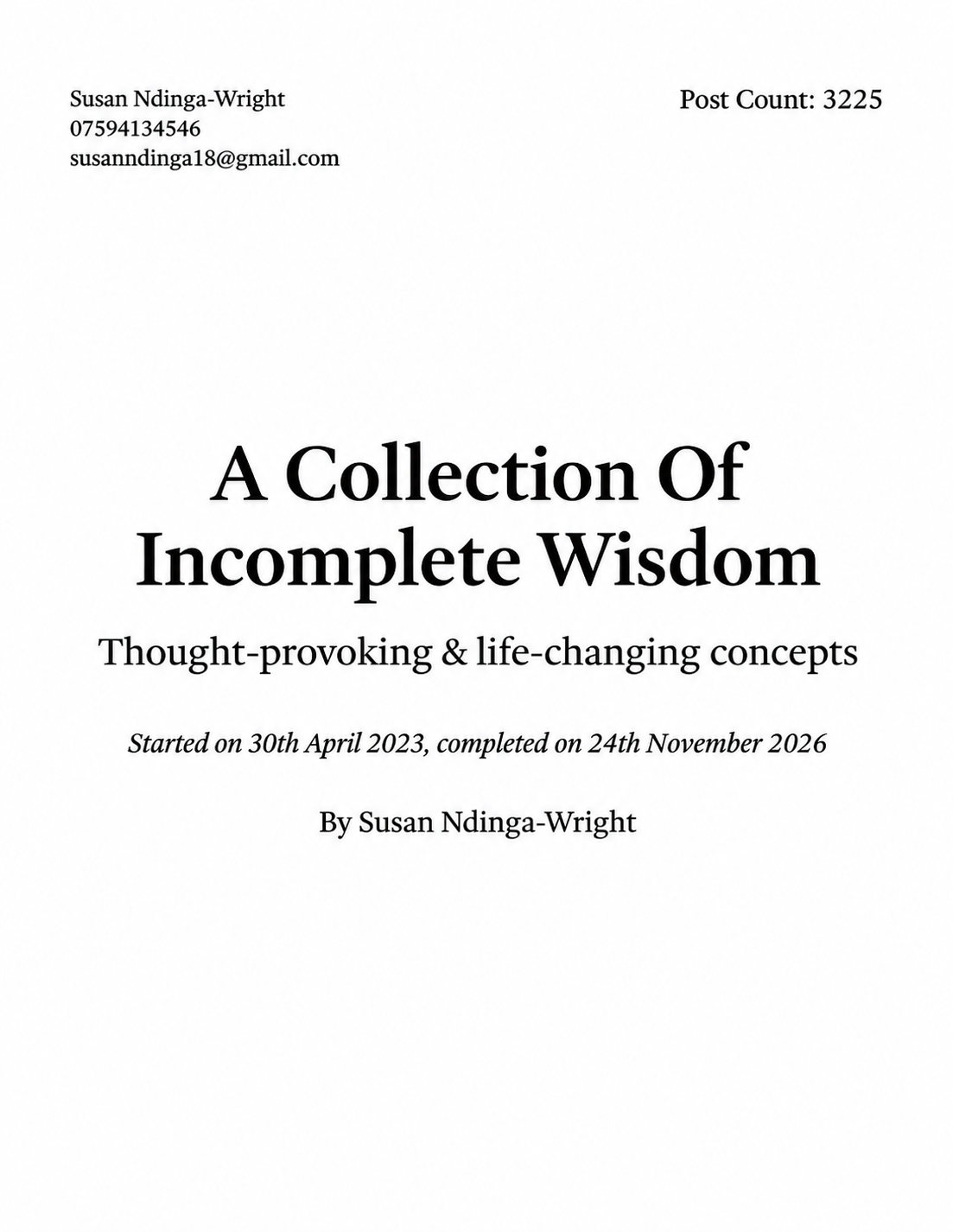
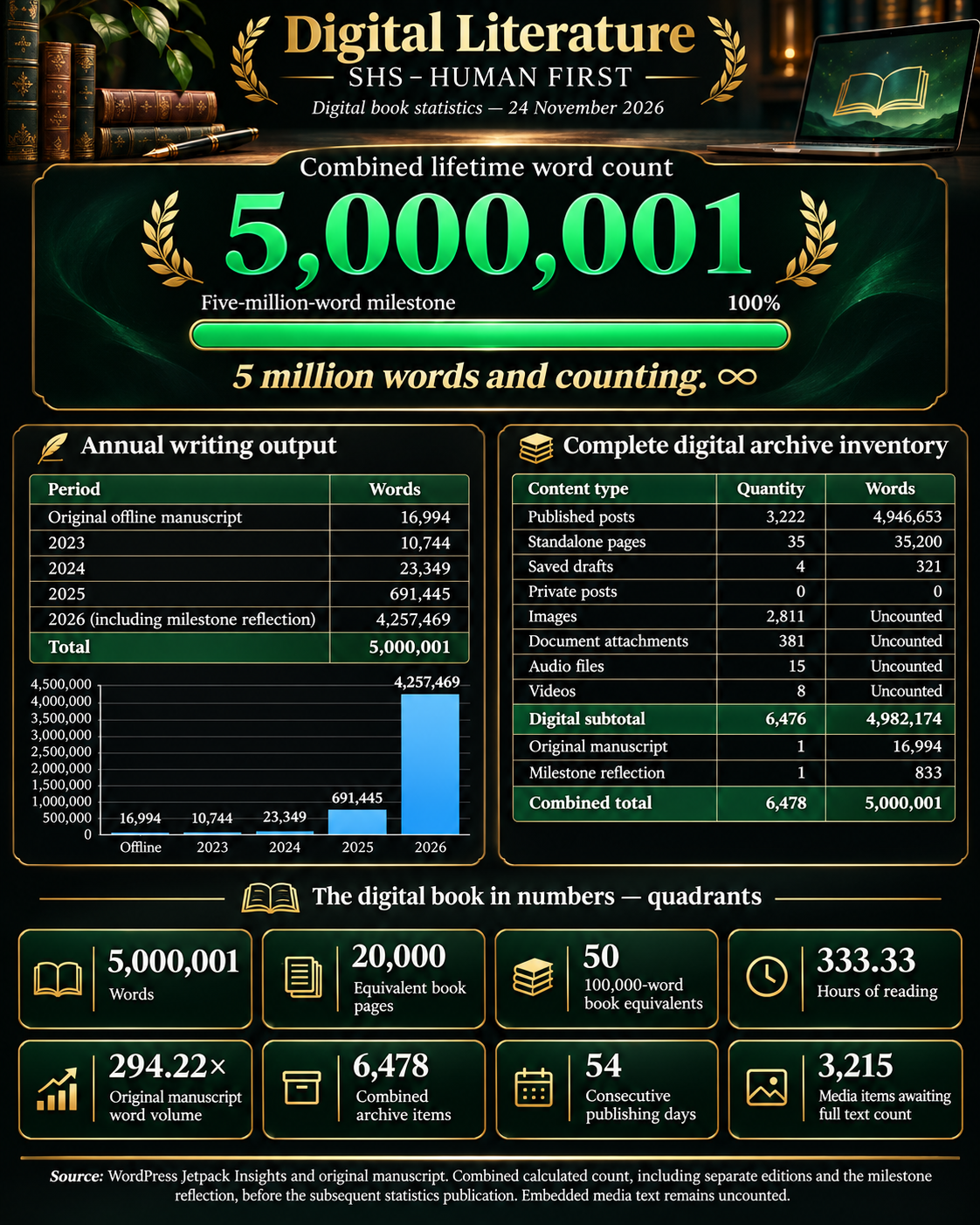
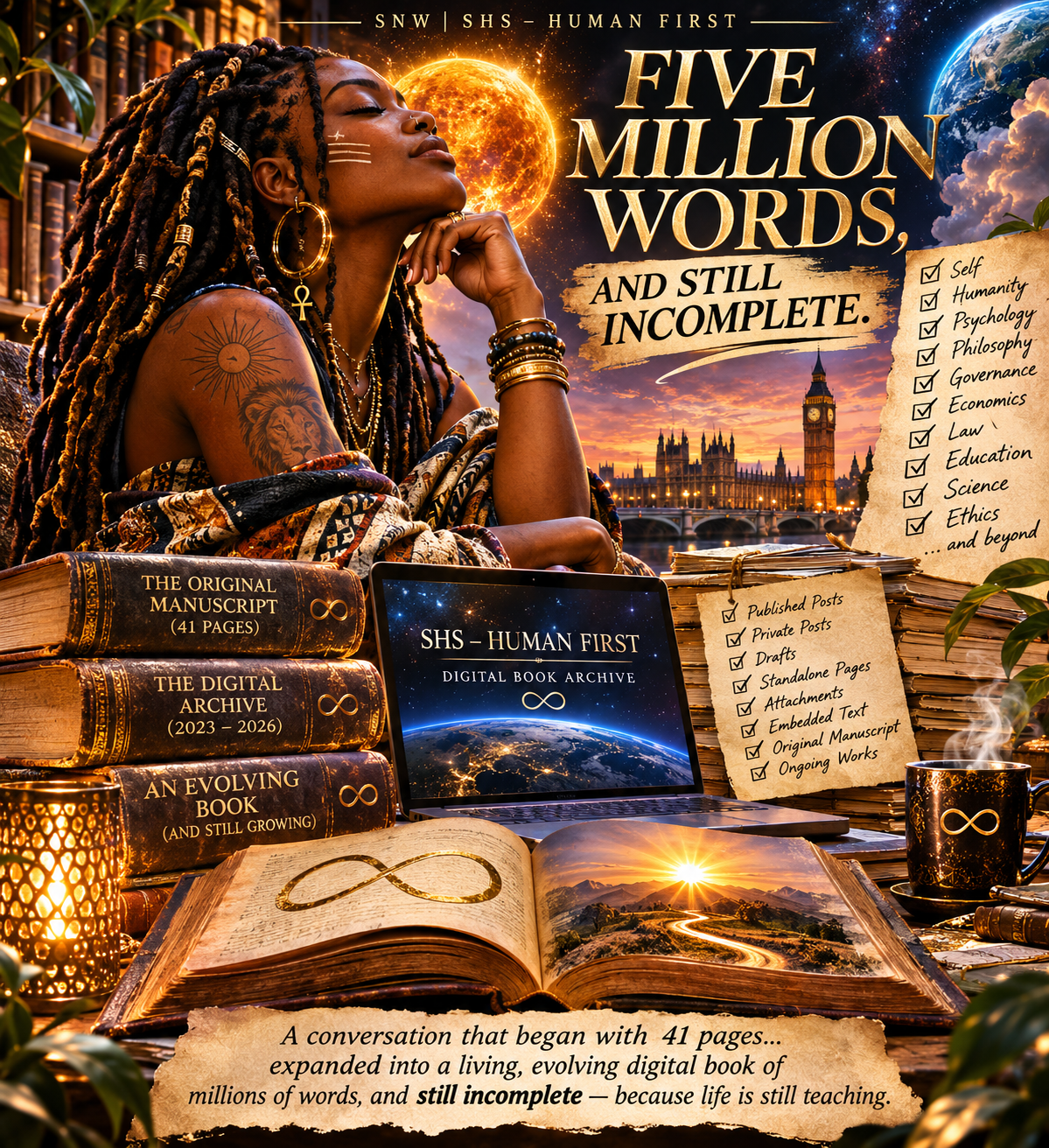
On 24 November 2026, SHS – HUMAN FIRST documented a calculated cumulative milestone of five million words, originating from a 41-page manuscript entitled A Collection of Incomplete Wisdom and subsequently expanded digitally from 2023.
Its recorded archive encompasses thousands of written publications, standalone pages, manuscripts, illustrations, documents, audio recordings and audiovisual works. Collaborations with both AI, videos, recordings and Human Beings brought into its co-creation.
Its subject matter extends across philosophy, metaphysics, psychology, governance, economics, law, education, ethics, science, engineering, healthcare, institutional accountability and human development.
The significance of this example is not that five million words automatically constitute literary excellence.
They do not.
The significance is that a literary undertaking of this nature warrants the opportunity to be independently examined on its merits.
How does one submit a living, interconnected literary work of such proportions to an institution whose definition of an eligible book requires it to be physically bound?
Should approximately 20,000 equivalent conventional pages be printed merely to establish their legitimacy as literature?
Would reducing the work to a conventional volume adequately represent its architecture, or would it compromise the very characteristics that distinguish it as digital literature?
QUALIFICATION IS NOT AN AWARD
I am not arguing that digital literature should receive recognition simply because it exists, nor that its volume should exempt it from rigorous examination.
I am arguing that it should be eligible for that examination.
There is a fundamental distinction between demanding an award and requesting the opportunity to demonstrate qualification for one.
Let the work be challenged.
Let its originality, credibility, coherence, literary quality, factual accuracy, methodology, intellectual contribution and relevance to humanity be investigated.
Let its shortcomings be exposed alongside its achievements.
But excluding a literary work before examining those qualities, solely because of its publication format, prevents the very assessment through which excellence could be established or disproved.
WHAT SHOULD DIGITAL LITERATURE BE VETTED AGAINST?
A dedicated assessment framework could examine:
- Literary merit: The quality, originality and depth of written expression.
- Intellectual contribution: What the work contributes to human understanding.
- Interdisciplinary coherence: How different fields of knowledge are meaningfully connected.
- Documentary integrity: Whether sources, evidence and intellectual developments can be traced and independently verified.
- Authorship transparency: Clear distinctions between original writing, collaborative contributions, quotations and AI-assisted production.
- Digital innovation: How technology expands the literary experience beyond conventional publication.
- Accessibility: How effectively the work enables people to engage with knowledge.
- Architectural integrity: Whether its individual components constitute a coherent literary undertaking.
- Preservation: Whether dated editions and permanent records allow independent assessment of the work.
- Human significance: The relevance and potential contribution of the work to society.
A digitally evolving book could be assessed through a dated archival edition, preserving its content at the point of submission without requiring the author to discontinue its development.
There are practical solutions to the challenges of assessing living literature.
THE PULITZER PRIZE HAS ALREADY RECOGNISED DIGITAL EVOLUTION ELSEWHERE
Digital journalism is already accommodated within the Pulitzer Prize’s journalism competition, subject to its respective eligibility requirements.
The institution has therefore demonstrated that digital publication is not inherently incompatible with distinguished intellectual work.
Why should the literary departments not examine their own opportunities for evolution?
If existing categories cannot adequately accommodate digitally native literary works, perhaps the question is not how to force those works into existing categories, but whether a new category deserves consideration.
The Pulitzer Prize for Digital Literature.
Not necessarily an electronic reproduction of a conventional book, but recognition of literature whose architecture, expression, accessibility and intellectual capabilities have been developed through the digital medium itself.
LITERATURE SHOULD NOT HAVE TO REGRESS TECHNOLOGICALLY TO QUALIFY INSTITUTIONALLY
The purpose of literary recognition should be to identify distinguished literature, not to preserve one particular technology through which literature has historically been distributed.
An institution dedicated to recognising excellence should remain capable of recognising excellence when its form evolves.
Otherwise, innovation risks becoming the very reason for disqualification.
And what message does that send to the next generation of writers?
That they are encouraged to innovate, provided their innovations remain within the boundaries of yesterday’s institutions?
Humanity has developed new tools for writing, connecting, preserving and distributing knowledge.
Our understanding of literature should develop alongside them.
I am not asking for the suspension of standards. I am asking for the evolution of eligibility, so that those standards can be applied.
Let digital literature be vetted.
Let it stand or fall on its merits.
Let the medium become part of the innovation being assessed, rather than the reason the assessment never takes place.
Literature belongs to human consciousness, not to the paper upon which it has historically been written.
∞
SNW | SHS – HUMAN FIRST


Leave a Reply