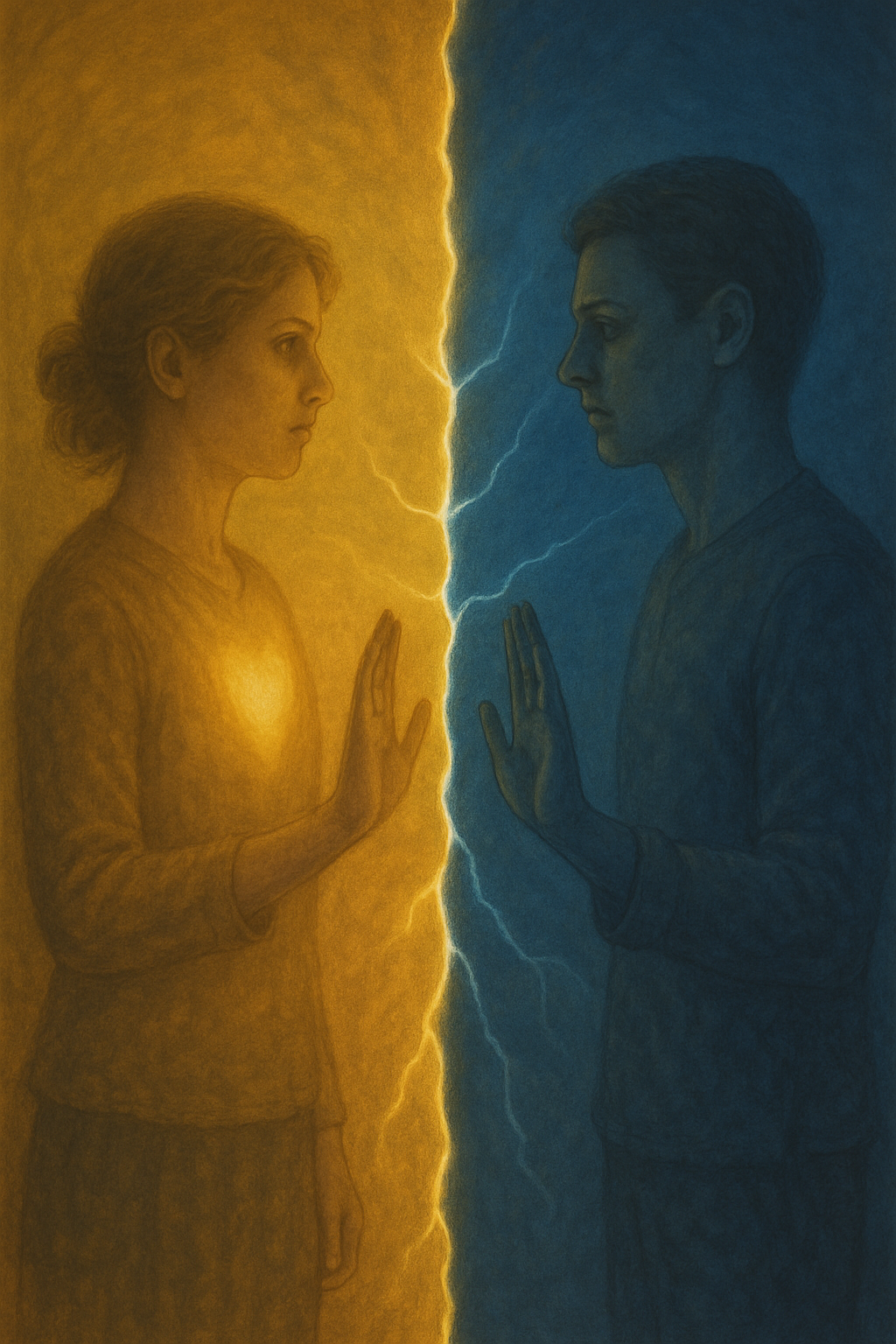

When the Same Intention Splits in Two Directions
There are some truths that bruise on contact—truths so close to our bones that we mistake them for wounds when they’re actually doorways.
Today, we walk into one of those doorways: the blurred and often misunderstood line between entitlement and boundaries.
Both, at their root, are born from the same desire: to feel safe, seen, and sovereign. But while boundaries are the conscious architecture of self-respect, entitlement is often the unspoken assumption that others should already be building that architecture for us.
And that’s where the split happens.
Entitlement: The Shadow of the Inner Child
There are moments in life when what we’re asking for isn’t wrong—but the reason we’re asking for it might need a second glance.
Sometimes, what we call a “boundary” is actually entitlement in disguise: not a declaration of how we love, but a demand for how others must behave, without reflection on whether we ourselves live up to what we ask.
We can be entitled to someone’s time, their words, their healing, their presence—especially when we are trying to fill the void left by unmet childhood needs. In these moments, we confuse others as the source of our regulation, rather than co-creators with their own rights and rhythms.
Yet, even entitlement has its tenderness. It often surfaces when something deep within us wants to be included. When we say, “I need you to respond,” what we might be truly saying is, “I want to know I matter.” When we lash out at unmet expectations, it might be the fear of being forgotten speaking through us.
But here’s the crux: we are not owed what someone else is not freely giving. Respect cannot be demanded without offering it in return. Love cannot be forced into roles, timelines, or narratives we’ve built in private. Our intuition may feel true—but truth is not always what the moment is ready for.
And then, there’s the realisation of different perspectives. To some what we demand is an extension of fear, to some others a basic need. Inevitable is the confrontation of those realities co-existing at the same, and imperative to the survival of any bond, is the reckoning to those diverse frequencies of being.
Boundaries: Love with a Backbone
Boundaries, unlike entitlement, do not constrict—they clarify.
Boundaries aren’t ultimatums. They’re invitations. They say, “This is how I love myself. If you’d like to join me, here’s how we can dance together.” They are not about control; they’re about clarity. Not about punishment, but presence.
When we set boundaries, we’re not saying “you’re wrong.” We’re saying, “This doesn’t work for me. Here’s what does.” And even then, it’s not a guarantee of outcome—it’s a declaration of alignment. A form of self-honoring that doesn’t require validation or compliance to be whole.
And yet, many mistake boundaries for rejection. In a society not taught to self-regulate, a “no” feels like abandonment, when it’s really just a sign of someone tending to their internal ecosystem.
Confusion in the Mirror
Let’s take it deeper: at times, the line between entitlement and boundary gets warped by context.
What happens when someone you love goes quiet? Do you feel entitled to an explanation—or do you recognize a boundary you didn’t know they had?
Do you spiral, project, assume? Or do you pause and admit: I simply don’t know. Because here’s a truth that stings—we often assign meaning where there is none. Our intellect spins threads and weaves stories out of silence, mistaking them for truth when they’re just echoes of our own fears, expectations or idealisations.
Even telepathy has its limits when there’s no foundation of trust. Even intuition can be led astray by trauma patterns or unmet desires masquerading as “gut feelings.” The question isn’t just “What do I feel?” but “Is this feeling rooted in reality, or in a story I need to unravel?”
From the Shoe Store to the Soul
Entitlement plays out in the subtle corners of our lives—like the customer who walks into a store, treats the cashier with disdain, and feels justified simply because “the customer is always right.”
That phrase alone—let’s call it what it is—a boundary violation enshrined as policy.
When we fail to teach boundaries, we rob everyone—even the entitled—of their opportunity to grow. Every moment we allow people to overstep without consequence, we deprive them of the mirror they didn’t know they needed.
How Do We Raise a Boundaried World?
We start young. We teach children that “no” is a holy word, not be feared, ignored where needed, nor assumed. That their bodies, emotions, and energies are theirs to direct. That even in families, where love runs deep, boundaries are not betrayals—they are forms of care.
Because if we don’t, we raise people-pleasers. Puzzle pieces who contort themselves to fit into every vacant spot. We raise future adults who mistake silence for stability, who equate obedience with love.
We raise former versions of me—and maybe you too.
Final Questions to Sit With
So how do we tell the difference?
- Am I asking for something I’m not willing to give?
- Am I reacting from fear or responding with discernment?
- Do I feel disappointed because someone violated a boundary—or because they didn’t meet an expectation I never voiced?
We might not always know. And that’s okay.
Emotional fulfillment is a tricky beast. Sometimes, we don’t feel fulfilled not because something is “wrong,” but because our nervous system is simply learning a new rhythm. Sometimes what we call “lack” is just unfamiliar territory. And sometimes, what hurts isn’t what happened—it’s the story we tell ourselves about what it means.
The Sacred Middle
We are all walking paradoxes: entitled children learning to set sacred boundaries. Fearful adults reclaiming lost power without swinging into control. Lovers learning to love without scripts.
The key isn’t perfection—it’s presence. Discernment. Compassion. And the deep courage to question even our own truths in the light of new experiences.
Because we’re not here to always get it right. We’re here to remember how to get real.
—
To life. To boundaries. To becoming.
May we never stop drawing the lines that show others where our love lives—and may we never forget that everyone else is trying to draw their own too.





Leave a Reply