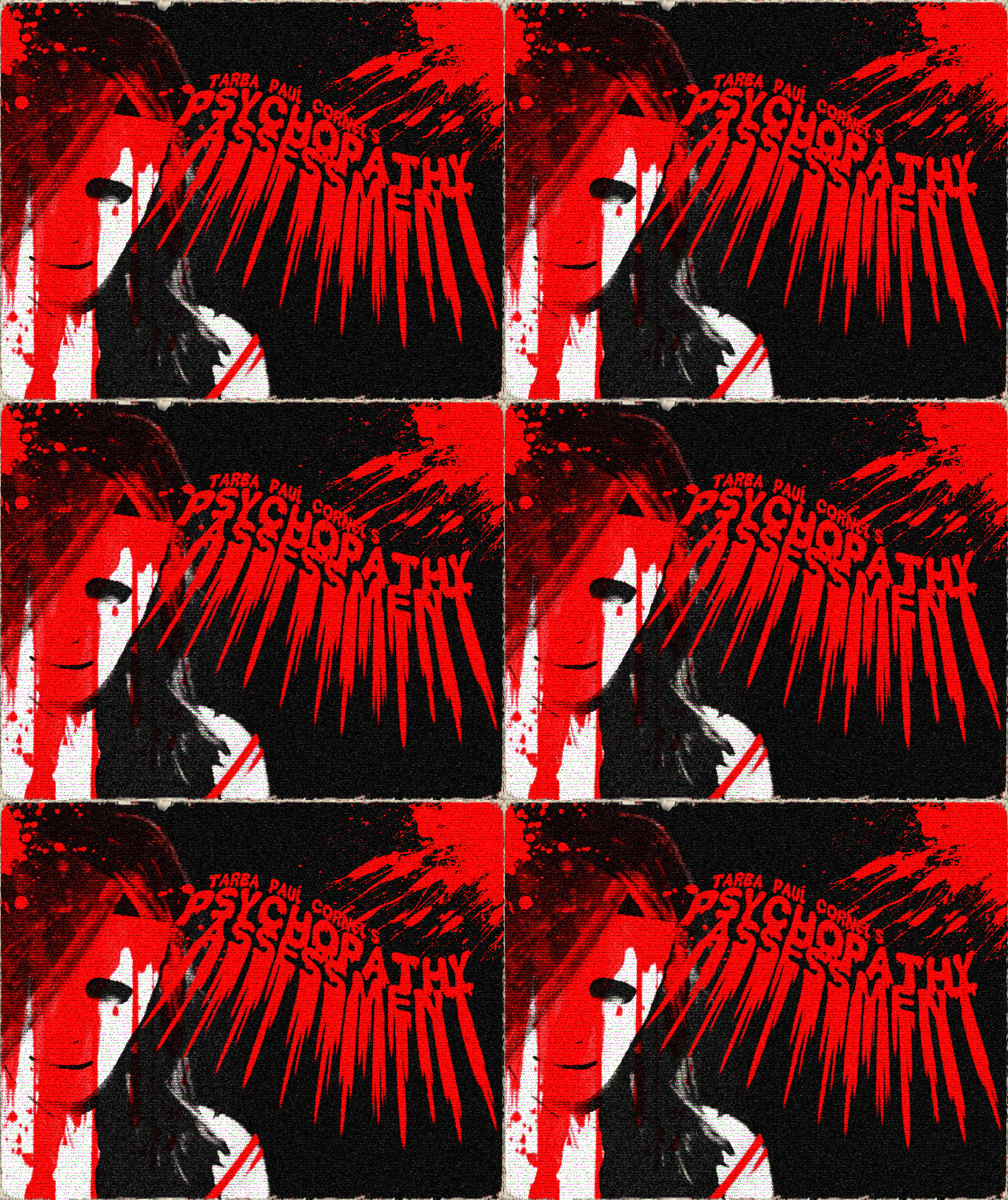

A Counter-Narrative on Labels, Laws & Liberation
Let’s clear something up from the beginning:
This isn’t a post defending predation.
It’s a post questioning the frameworks we use to define predators.
Because if we exist inside a society where emotional manipulation is marketing,
Where power without empathy is rewarded,
And where performance is prioritized over presence…
Then maybe the real danger isn’t who we’ve labeled a “psychopath”—
But the system that taught them how to survive.
Intentions matter. And so do the myriad perspectives through which action is viewed. We all come from different stories, and no one—no one—has ever agreed on just one correct way to be human. So perhaps it’s time we stop trying to.
The Mask of Sanity or the Mirror of Society?
The clinical definition of psychopathy often includes:
- Superficial charm
- Grandiose sense of self-worth
- Pathological lying
- Manipulativeness
- Shallow affect
- Lack of empathy
- Lack of guilt
- Calculated behavior
But what if these traits aren’t just individual red flags?
What if they’re symptoms of a collective adaptation to a world that punishes sincerity and commodifies connection?
“What is called pathology in one context is called leadership in another. So who gets to wear the suit, and who gets strapped with the label?”
Charm or Social Intelligence?
Superficial charm is seen as manipulative.
But in a world that teaches us to smile through pain, flatter to survive, and mask our truths for acceptability—
Is charm the disease or the armor?
Actors win awards for it.
Influencers build empires with it.
CEOs weaponize it.
Psychopaths are often described as emotionally detached or calculated—but what if that detachment is actually a form of spiritual frequency neutrality? Some beings may naturally hold a broader spectrum of consciousness, allowing them to move through life without being emotionally overwhelmed.
In its highest expression, this is not apathy—it’s neutrality with intention. It allows them to perceive patterns, truths, or strategies others can’t see because they’re too emotionally entangled.
“We train people to charm by starving them of authenticity. And then shame them when it works.”
Grandiosity or Self-Protection?
A grandiose sense of self-worth can sound terrifying—
But in a world designed to crush your soul and call it humility,
Is radical self-belief not an act of resistance?
And let’s be honest—
Who isn’t performing a version of themselves?
We live in curated avatars,
We rehearse our identities,
We perform value to feel valuable.
Maybe some people just stopped pretending they weren’t pretending.
Psychopaths often embody roles that society needs to confront the shadow. Their presence forces others to reassess boundaries, leadership, charisma, trust, and emotional discernment.
If we view psychopaths as catalysts or mirrors instead of monsters just like everyone else, we can begin to ask, “What collective distortion is this person reflecting back to us?” Sometimes they come to embody the necessary archetype that exposes a deeper dysfunction in our systems of power, morality, or emotional dependency.
“When you’ve been invalidated your whole life, sometimes your only medicine is to become your own god.”
Manipulation or Mastery?
Manipulation gets a bad rap—until it’s called strategy.
We praise chess players, business moguls, marketers, and politicians for seeing five moves ahead.
So why is that same skill pathologized in the perceived lesser, the traumatized, or the nonconforming?
Manipulation isn’t inherently evil.
It’s emotional mechanics—only misaligned when severed from empathy.
But in a world where empathy is often exploited…
Maybe detachment becomes a survival edge, not a crime.
Psychopathy is pathologized due to emotional “flatness,” but what if that emotional non-reactivity is the result of embodied self-containment? Not everyone cries. Not everyone reacts with visible empathy.
Some may have been forged through lifetimes (or early trauma) that demanded emotional shut-off as a form of soul-level efficiency. To be able to witness without attachment isn’t always cold—it can be a kind of mastery. It just looks foreign to those who are emotionally porous.
“Manipulation is just influence without permission. But what if no one ever taught you how to ask, only how to win?”
Shallow Affect or Emotional Boundaries?
Flat affect, emotional detachment, lack of guilt—
These are classic hallmarks of psychopathy, we’re told.
But when the world has punished your tears,
Mocked your vulnerability,
And ignored your cries long enough—
Eventually, you stop broadcasting pain.
You armor your heart.
You streamline your affect.
You don’t feel less—you just stop leaking.
Psychopaths are often judged by their actions, especially when they bypass moral norms. But if we zoom out to a soul level, we realize that the events we deem tragic or unacceptable may still be encoded within a soul contract or collective awakening.
Not all souls are here to play “nice.” Some are here to shake, strip, and confront. Psychopaths may be fulfilling a role that catalyzes transformation through contrast—not out of malice, but out of unconscious divine orchestration.
“It’s not that we can’t feel. It’s that feeling deeply in a world without compassion is a liability.”
Lack of Empathy or Trauma-Induced Selectivity?
Empathy isn’t always visible.
Some people feel so much, so often, they go numb just to function.
And some learned that being soft gets you devoured.
So they refined their empathy into a weapon of precision—
Only given where it’s safe.
Only offered where it’s earned.
Empathy, at its peak, is choice.
Not compulsion.
Psychopaths often resist systemic conformity—not because they’re broken, but because they see through it. They may reject the illusion of identity, duty, or forced empathy. They don’t confuse their essence with their job, title, or role.
This rejection of artificial identification systems can be threatening to a society built on those very things. In this way, the psychopath can be seen as a disruptor of synthetic humanity, questioning what it even means to be “human” in an engineered society.
“Selective empathy isn’t absence—it’s discernment in a world where too many exploit your softness for gain.”
So… Who’s the Real Psychopath?
Is it the person who learned to stay three moves ahead of betrayal?
Or the culture that taught them betrayal is inevitable?
Is it the one who mastered emotional coldness for survival?
Or the institutions that call emotional expression a weakness and punish vulnerability?
Is it the one who studies you to understand you?
Or the algorithm studying all of us to sell us back our own reflections?
Because psychopaths are often misread, their actions can be interpreted without any understanding of inner motivation. But perhaps it’s not always that they “lack empathy”—perhaps it’s that we lack the tools to understand how they perceive reality, connection, or cause and effect.
Judging someone solely by emotional displays or familiar signals misses the full complexity of their intent. And since no one agrees on what “healthy” looks like anyway, why do we use one mold to judge so many?
Final Reflection: Maybe the Mask Isn’t the Problem
Psychopathy, like sociopathy, is often used as a label to exile complexity.
To simplify what’s uncomfortable.
To distance ourselves from our own shadow.
To create an Other so we don’t have to acknowledge how much we’ve normalized emotional fragmentation.
But every trait has a context.
Every “disorder” has a root.
So instead of demonizing the ones who adapted best to a distorted world—
Let’s ask deeper questions:
- Who wrote the manual on sanity?
- Who gets to define empathy in a traumatized culture?
- And what happens when we stop pathologizing survival?
The psychopath, just like many other archetypes, may not be here to be “understood” in conventional emotional terms. It may be here to break us out of emotional codependency, moral rigidity, and surface-level compassion—inviting us instead into radical discernment, self-trust, and energetic sovereignty.
“If the mask is the problem, maybe it’s time we asked what made it necessary in the first place.”
Epilogue: Beyond the Labels
We are not defending harm.
We are acknowledging the intelligence behind adaptation.
The pain behind performance.
The soul behind the structure.
So to the ones labeled psychopaths—
Maybe you were never broken.
Maybe you were just the clearest mirror…
And it terrified everyone who saw themselves in it.




Leave a Reply