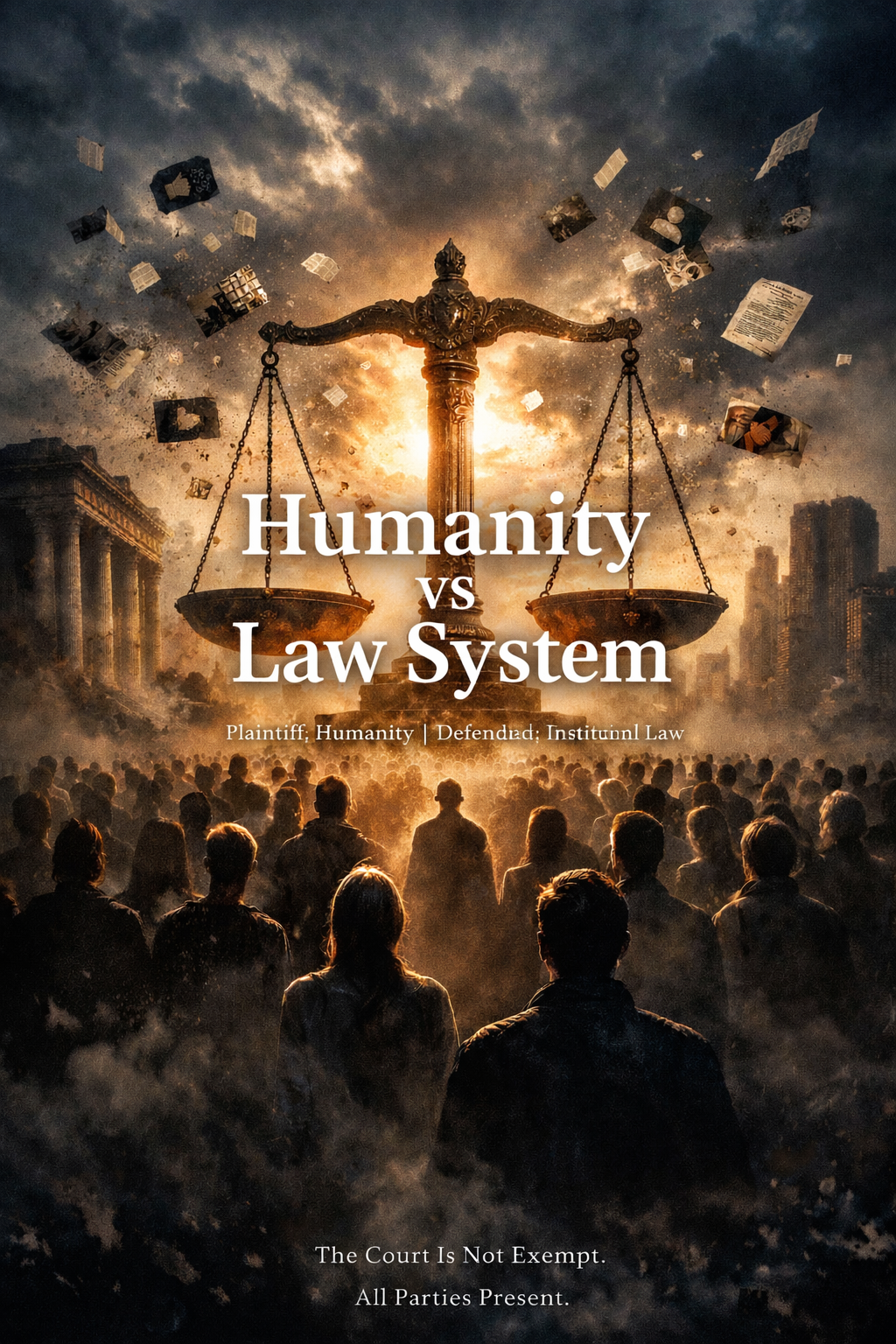
(A plain-language explanation of systemic responsibility, written so anyone can understand — including courts, journalists, and advocates)
The Simple Idea (So Simple a Child Can See It)
If a house has a leaking roof, and water keeps flooding the floor, you don’t blame the floor.
You don’t blame the furniture.
You don’t blame the people trying to mop.
And you definitely don’t blame the person who slipped and fell.
You fix the roof.
That’s the entire argument.
What We Keep Doing Instead
In the world we live in, when something goes wrong — crime, addiction, burnout, suicide, violence, collapse — we blame individual people.
We say:
- “They made bad choices.”
- “They couldn’t cope.”
- “They failed.”
- “They broke the law.”
But we almost never ask:
- What conditions shaped those choices?
- What systems failed before the person did?
- Who designed the environment where harm became likely?
We keep mopping the floor.
We rarely fix the roof.
Why This Matters Legally (Not Emotionally)
Courts already understand this logic.
That’s why we have:
- Product liability (you don’t blame the consumer for a defective product)
- Institutional negligence (you don’t blame the patient for unsafe hospitals)
- Systemic discrimination cases (you don’t blame individuals for biased structures)
- Class actions (when harm is patterned, not isolated)
The law already accepts that systems can be responsible.
What we haven’t done enough is apply that logic consistently to:
- Mental health crises
- Suicide
- Mass harm
- Cycles of violence
- Structural deprivation
The Question No One Wants to Ask (But Must)
Has the legal system ever seriously treated the system itself as the primary contributor to widespread human harm?
Not just as a background.
Not just as context.
But as an entity whose design produces foreseeable outcomes.
If a system:
- Rewards extraction over care
- Penalises vulnerability
- Denies access to basic stability
- Forces people into survival mode
- Makes help conditional, slow, or inaccessible
Then harm is not accidental.
It is predictable.
And predictability is a legal threshold.
Why Individual Blame Is Not Enough
Blaming individuals is easier.
It feels cleaner.
It preserves the illusion that the system works.
But it ignores reality.
When thousands of people reach breaking points in similar ways, across time and geography, that is not coincidence.
That is pattern.
And pattern is evidence.
Why This Is Not “Anti-Law” or “Anti-Responsibility”
This is not about excusing individual actions.
This is about completing responsibility, not erasing it.
Individuals still act.
But systems shape the menu of choices available.
A child understands this instinctively:
If everyone keeps falling in the same hole, maybe the hole should be filled.
Why This Is a Class Action Question
Because no single person represents this harm alone.
People who:
- Took their own lives
- Developed addictions
- Committed crimes under structural pressure
- Burned out trying to survive
- Were punished instead of protected
…were not isolated failures.
They were exposed to the same broken architecture.
That is the definition of a class.
Why This Conversation Is Being Avoided
Because fixing roofs is harder than mopping floors.
Because upward accountability threatens comfort.
Because systems don’t like being examined.
Because responsibility feels heavy when it isn’t outsourced.
And because once you name the roof, you can’t pretend the leaks are random anymore.
The Invitation (Not a Threat)
This is not a call for chaos.
It is a call for structural adulthood.
To courts:
Have we fully explored systemic causation where harm is patterned?
To journalists:
Are we reporting events, or interrogating architectures?
To advocates:
Are we helping people survive inside broken systems — or pushing to fix the systems themselves?
To society:
If a child can see the problem, why can’t we?
Final Plain Truth
This isn’t about blame.
It’s about responsibility landing where it belongs.
Not downward.
Not sideways.
But upward — at the level where design decisions are made.
Until the roof is fixed,
the floor will keep flooding.
And no amount of mopping will change that.
SEO Keywords (Intact, High-Relevance)
- systemic accountability
- institutional negligence
- class action lawsuit system failure
- legal responsibility of systems
- suicide prevention law
- structural causes of crime
- mental health and legal systems
- collective harm responsibility
- why systems fail people



Leave a Reply