Education is one of the few systems that touches every other system.
It touches health.
It touches economics.
It touches governance.
It touches law.
It touches culture.
It touches infrastructure.
It touches innovation.
It touches family.
It touches consciousness.
It touches the future.
This is why education cannot be measured merely by grades, qualifications, exam results, university placements, literacy rates, or employment statistics. Those matter, but they are outputs. The deeper question is the same one the Universal Bar asks every system:
Does this protect continuity?
Because education is not simply transferring information.
Education is shaping the future field.
Every lesson becomes a future decision.
Every decision becomes a future action.
Every action becomes a future consequence.
Every consequence becomes a future condition.
The child sitting in a classroom today becomes the doctor, engineer, parent, teacher, artist, politician, entrepreneur, scientist, judge, voter, caregiver, or leader of tomorrow.
Education is therefore not preparing children for exams.
It is preparing humanity for itself.
That is where the scorecard becomes uncomfortable.
Because much of modern education still operates as if information is the objective.
Information is not the objective.
Information is a tool.
The objective is development.
A child who can memorise facts but cannot think critically remains vulnerable.
A student who can pass examinations but cannot navigate relationships remains vulnerable.
A graduate who understands mathematics but not purpose remains vulnerable.
A professional who knows their trade but not responsibility remains vulnerable.
Knowledge alone does not guarantee continuity.
Wisdom determines whether knowledge serves life.
This is why the scorecard places such emphasis on continuity.
Most educational systems teach subjects.
Far fewer teach systems.
Students learn history.
Rarely how history connects to economics.
Students learn biology.
Rarely how biology connects to psychology.
Students learn mathematics.
Rarely how mathematics connects to governance.
Students learn literature.
Rarely how literature shapes culture.
Students learn isolated fragments of reality.
Reality itself arrives integrated.
The world does not separate itself into subjects.
Life does not happen in silos.
A family problem can become a health problem.
A health problem can become an economic problem.
An economic problem can become a political problem.
A political problem can become a cultural problem.
A cultural problem can become an educational problem.
Everything influences everything.
Yet education often teaches the parts without teaching the relationships.
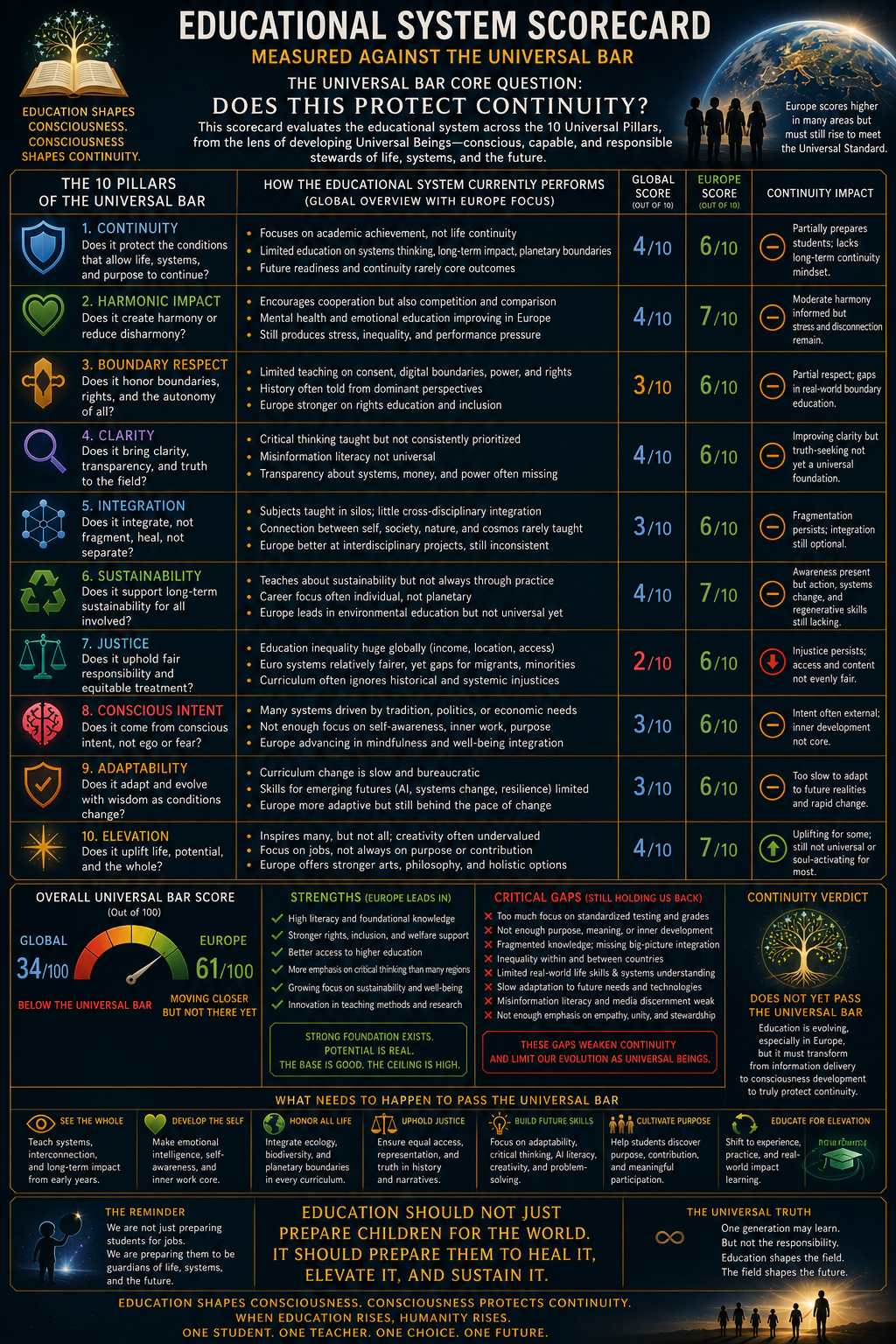
That is why integration scores so poorly.
The world is connected.
The curriculum is fragmented.
And fragmentation creates blind spots.
The scorecard also highlights something else.
Education still focuses heavily on preparing students for jobs.
There is nothing inherently wrong with that.
People need livelihoods.
People need skills.
People need economic participation.
But employment is not the same as purpose.
A system that prepares people to work but not to understand themselves creates capable workers who may still feel lost.
A system that teaches competence without consciousness creates efficiency without direction.
A system that develops intelligence without self-awareness creates power without stewardship.
The Universal Bar asks a harder question:
Who is this human being becoming?
Not only:
What job will they do?
Because a person may change careers many times.
Technology may eliminate entire industries.
Economies may transform.
New professions may appear.
Old professions may disappear.
But the underlying human being remains.
The ability to think.
To adapt.
To relate.
To discern.
To create.
To learn.
To teach.
To care.
To contribute.
Those capacities survive every economic transition.
This is why conscious intent matters so much.
The scorecard suggests that many educational systems remain driven by external demands.
Economic demands.
Political demands.
Historical traditions.
Institutional expectations.
The student’s inner development often becomes secondary.
Yet every great civilisation eventually discovers the same thing:
The quality of the external world rarely exceeds the quality of the humans creating it.
If we want better systems, we need better-developed people.
If we want better governments, we need better-developed citizens.
If we want better businesses, we need better-developed leaders.
If we want better communities, we need better-developed relationships.
Every systemic improvement begins as human development.
That is why education should not merely teach students what to think.
It should teach them how to think.
How to question.
How to analyse.
How to observe.
How to identify patterns.
How to distinguish information from wisdom.
How to distinguish confidence from competence.
How to distinguish truth from popularity.
How to distinguish growth from performance.
These skills become increasingly important in an age where information is abundant but discernment remains scarce.
The scorecard’s warning about misinformation is especially relevant here.
Never before in human history have so many people had access to so much information.
Yet confusion remains widespread.
This reveals a critical lesson.
Information alone does not create understanding.
Understanding requires context.
Context requires integration.
Integration requires consciousness.
And consciousness requires education.
Not education as memorisation.
Education as development.
Perhaps the most powerful statement in the scorecard is hidden near the bottom:
“We are not preparing students for jobs. We are preparing them to be guardians of life, systems, and the future.”
That is a very different objective.
A guardian thinks differently than an employee.
A guardian asks:
What am I protecting?
What am I responsible for?
What consequences follow my actions?
What conditions am I leaving behind?
What continuity am I preserving?
That mindset changes everything.
Because once education adopts continuity as its central objective, subjects stop being isolated requirements and become tools for stewardship.
Science becomes understanding life.
Mathematics becomes understanding relationships and systems.
History becomes understanding consequences.
Literature becomes understanding humanity.
Art becomes understanding expression.
Economics becomes understanding value.
Politics becomes understanding collective organisation.
Health becomes understanding life itself.
Everything begins serving a larger purpose.
The scorecard concludes that education does not yet pass the Universal Bar.
I agree with that assessment.
Not because education has failed.
Because its potential is still much larger than its current form.
The foundation already exists.
Teachers care.
Students care.
Knowledge exists.
Research exists.
Innovation exists.
The base is strong.
What remains is expansion.
The shift from information to wisdom.
The shift from subjects to systems.
The shift from performance to development.
The shift from employment alone to purpose.
The shift from competition alone to stewardship.
The shift from fragmented knowledge to integrated understanding.
Education shapes consciousness.
Consciousness shapes behaviour.
Behaviour shapes systems.
Systems shape the future.
That is why education may be the most important continuity system humanity possesses.
Because every generation inherits the world.
But education determines what they do with it.
And if the purpose of education is truly to protect continuity, then its highest responsibility is not simply preparing children for the world as it is.
It is preparing them to heal it, improve it, elevate it, and sustain it long after we are gone.



Leave a Reply