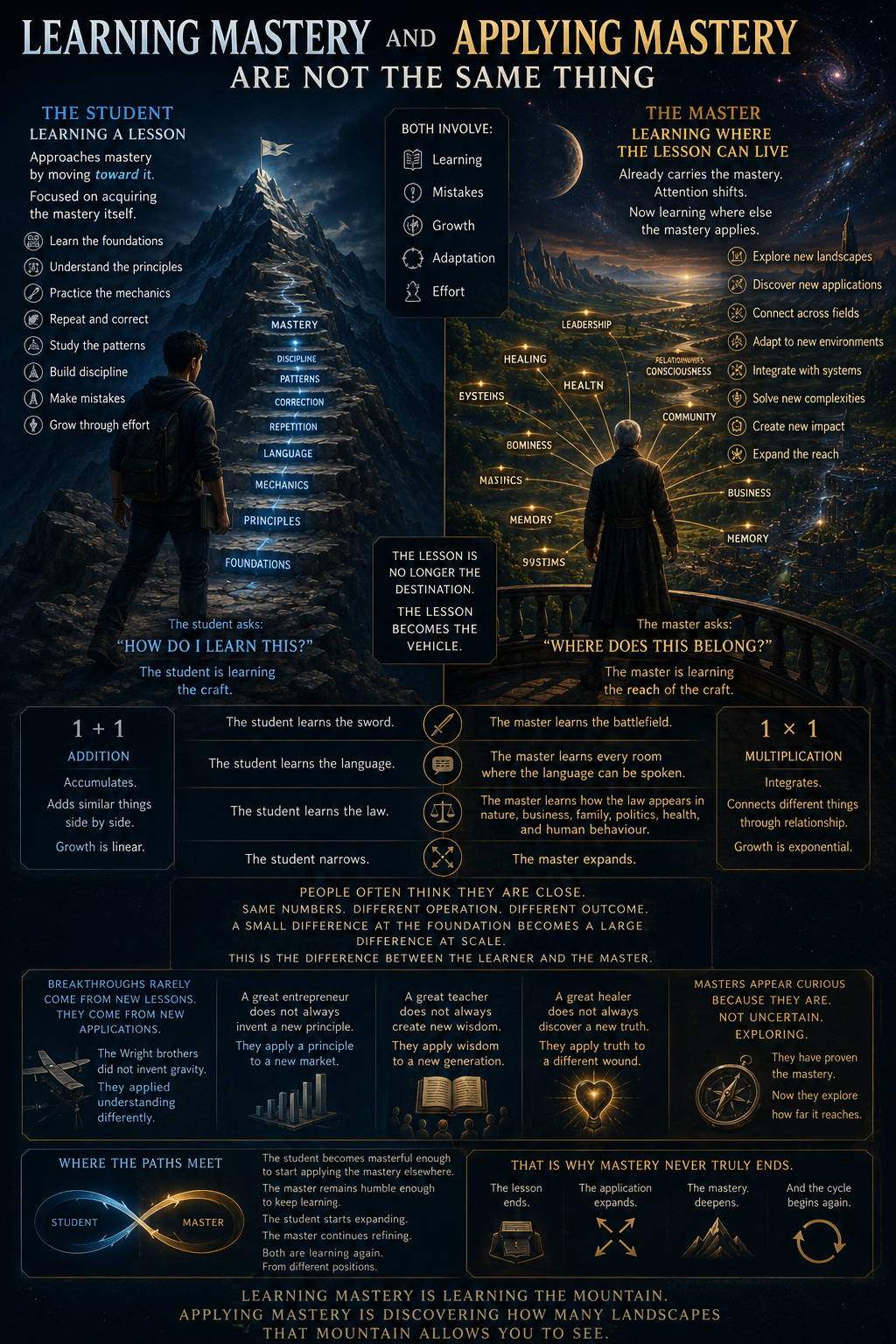
One of the easiest mistakes people make is assuming that learning mastery and applying mastery are the same process.
They are not.
They may look similar from the outside.
Both involve learning.
Both involve mistakes.
Both involve growth.
Both involve adaptation.
Both involve effort.
But they are fundamentally different journeys.
The student is learning a lesson.
The master is learning where the lesson can live.
That distinction changes everything.
A student approaches mastery by moving toward it. They are learning the foundations, the principles, the mechanics, the language, the repetitions, the corrections, the patterns, and the discipline required to become competent. Their attention is focused on acquiring the mastery itself.
The master already carries the mastery.
Their attention shifts.
Now they are learning where else the mastery applies.
The lesson is no longer the destination.
The lesson becomes the vehicle.
The student asks:
“How do I learn this?”
The master asks:
“Where does this belong?”
The student is learning the craft.
The master is learning the reach of the craft.
That is why the learning curves are different.
A student may spend years learning how to play an instrument.
A master musician may spend years learning how music applies to leadership, healing, education, relationships, consciousness, performance, emotion, memory, and community building.
The mastery remains the same.
The application changes.
The student learns the sword.
The master learns the battlefield.
The student learns the language.
The master learns every room where the language can be spoken.
The student learns the law.
The master learns how the law appears in nature, business, family, politics, health, and human behaviour.
The student narrows.
The master expands.
This is why mastery often appears deceptively simple.
A person may watch a master enter a new field and think:
“They are learning just like everyone else.”
And in one sense, that is true.
But the thing being learned is different.
The student is learning the subject.
The master is learning the relationship between the subject and everything else.
This is where the mathematical analogy becomes useful.
People often assume:
1 + 1
and
1 × 1
are close enough.
At first glance they seem similar.
Simple equations.
Simple operations.
Simple outcomes.
But the operation matters.
The relationship matters.
And the further you travel, the more different they become.
A small difference at the foundation becomes a large difference at scale.
That is exactly what happens between the learner and the master.
Both are learning.
But the operation is different.
One is learning toward mastery.
The other is learning through mastery.
One accumulates.
One integrates.
One builds the tool.
One discovers where the tool belongs.
One asks:
“What does this mean?”
The other asks:
“What else does this mean?”
That second question is where much of innovation lives.
Because the greatest breakthroughs rarely come from learning something entirely new.
They often come from applying an existing mastery somewhere unexpected.
The Wright brothers did not invent gravity.
They applied understanding differently.
A great entrepreneur does not always invent a new principle.
They apply a principle to a new market.
A great teacher does not always create new wisdom.
They apply wisdom to a new generation.
A great healer does not always discover a new truth.
They apply truth to a different wound.
The mastery remains.
The application evolves.
This is why masters often appear curious.
People mistake curiosity for uncertainty.
It is not uncertainty.
It is exploration.
The master has already proven the mastery.
Now they want to know how far it reaches.
How many rooms it can enter.
How many lives it can touch.
How many systems it can improve.
How many dimensions it can explain.
The student learns depth.
The master learns reach.
Eventually, however, something beautiful happens.
The two paths begin meeting.
The student becomes masterful enough to start applying the mastery elsewhere.
The master remains humble enough to keep learning.
The student starts expanding.
The master continues refining.
And suddenly both are learning again.
But now from different positions.
The student has become capable of asking bigger questions.
The master has become capable of seeing deeper answers.
That is why mastery never truly ends.
A person can finish learning a lesson.
They cannot finish discovering where that lesson belongs.
The lesson ends.
The application expands.
The mastery deepens.
And the cycle begins again.
That is the difference.
Learning mastery is learning the mountain.
Applying mastery is discovering how many landscapes that mountain allows you to see.



Leave a Reply