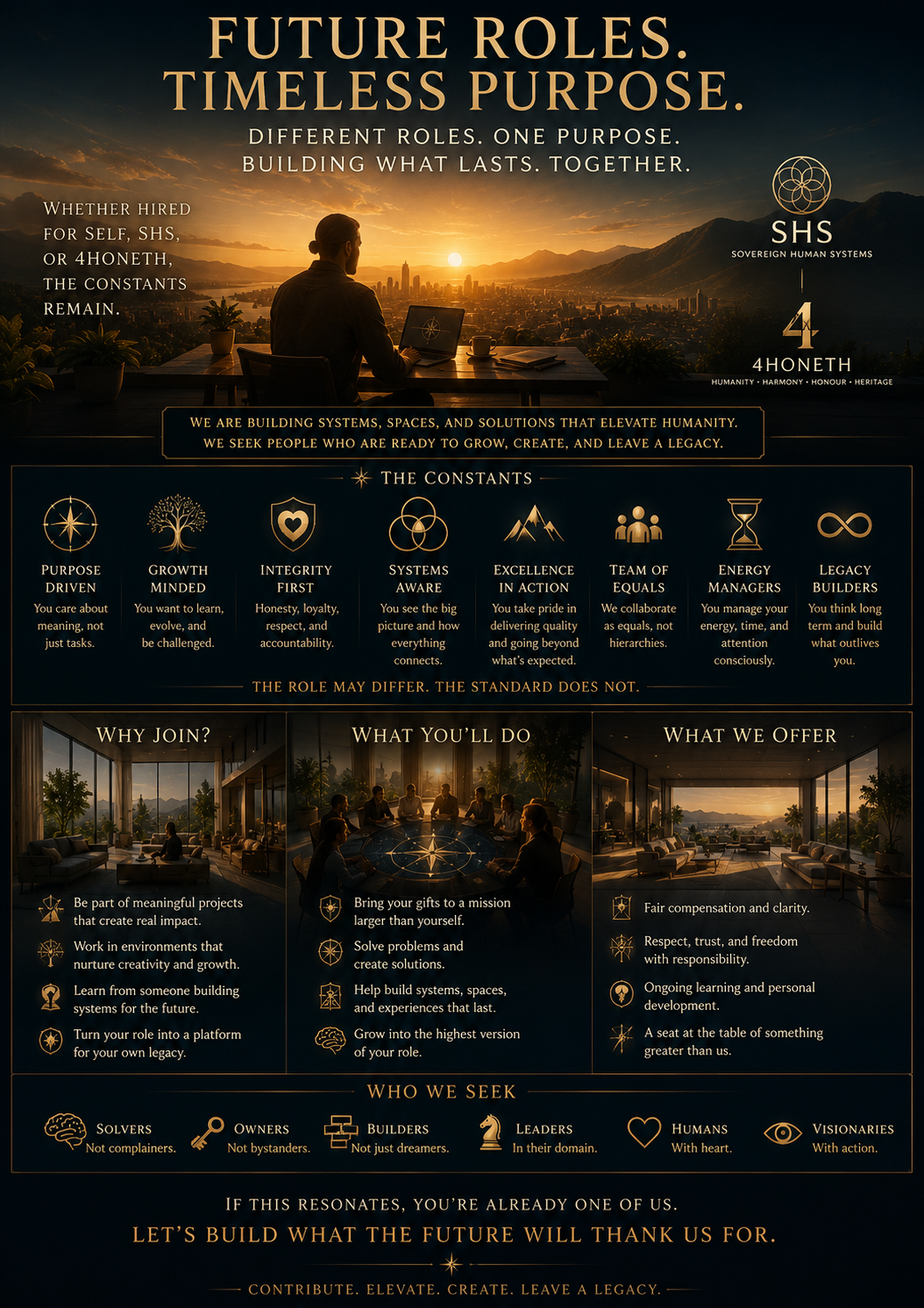
This role is for someone who understands that creativity is not decoration. Creativity is expression, memory, advocacy, world-building, identity, culture, and continuity made visible. A Creative Assistant around me is not simply there to help pick outfits, organise moodboards, track film ideas, support content plans, or manage creative folders. Those responsibilities matter, but they are only the surface. At its depth, this role exists to help protect the relationship between my inner world, my public expression, my creative archive, my fashion, my films, my TV series concepts, my visual language, and every form of creative advocacy that carries SHS and 4Honeth into the world.
You would be stepping into a creative field that is already alive. The work is not starting from nothing. There are writings, symbols, frameworks, visual directions, recruitment posters, consciousness diagrams, character energies, legal narratives, public-facing posts, house concepts, fashion ideas, documentary possibilities, music directions, production ideas, and a whole evolving language around Human, Hueman, SHS, 4Honeth, the Trinity frameworks, consciousness, governance, family, society, and creation. Your role would be to help organise, witness, track, question, develop, and support that creative field so the expression can move with more structure and less scattered friction.
This is not a role for someone who only wants to be around aesthetics. It is a role for someone who wants to understand why aesthetics matter. Fashion, for me, is not simply clothing. It is identity, mood, message, memory, embodiment, presentation, protection, play, power, softness, confrontation, beauty, culture, and field communication. A look can speak before a paragraph does. A silhouette can hold an era. A colour can carry a phase. A texture can represent a state of becoming. The Creative Assistant must therefore understand that styling is not only about what looks good. It is about what the expression is saying, what moment it belongs to, and what continuity it is serving.
The same applies to film and television. My movies and TV series concepts are not separate from the wider work. They are extensions of it. They are ways to make consciousness, governance, emotional intelligence, family systems, spiritual conflict, societal collapse, beauty, accountability, and transformation visible through story. Some truths are easier to digest through fiction. Some systems are easier to understand when embodied through character. Some arguments become clearer when the audience sees them happen rather than being told what to think. Creative work can advocate without becoming a lecture, and it can reveal without asking permission from old frameworks to exist.
This role therefore requires someone who can hold both beauty and structure. Someone who can understand a mood but also track a deadline. Someone who can help develop a concept but also organise the files. Someone who can see the symbolism in a dress, the continuity in a character, the function of a scene, the advocacy in a post, the message in a shoot, and the operational steps required to move from idea to expression. Creativity without structure scatters. Structure without creativity becomes lifeless. This role sits between the two.
In our framework, the Creative Assistant touches every system. In law, they help protect creative ownership, credits, permissions, contracts, usage rights, boundaries, and the jurisdiction of ideas. In politics, they help understand audience relationships, cultural positioning, public perception, visual borders, collaborations, and how creative expression moves through different communities. In environmental management, they help reduce creative clutter, organise archives, clear outdated directions, preserve useful material, and make the creative field navigable. In security and defence, they help protect unpublished ideas, private drafts, sensitive storylines, visual assets, and the timing of release.
In social welfare, they help ensure creativity does not consume the creator. They support rhythm, preparation, emotional pacing, and the care required around highly personal expression. In infrastructure and utilities, they help maintain the systems that allow creativity to travel: folders, schedules, shoot plans, contact lists, production notes, wardrobe records, moodboards, archives, drafts, recordings, visual references, and project trackers. In innovation, they help develop new expressions, formats, campaigns, concepts, characters, aesthetics, and creative methods without losing the foundation. In economy, they help understand the exchange of attention, culture, value, collaboration, and audience energy.
In finance, they help track budgets for creative projects, outfits, shoots, production needs, subscriptions, equipment, freelancers, locations, editing, design, and future creative departments. In healthcare and public health, they help protect the creator’s energy, because creative expression can be emotionally and physically demanding when it carries real advocacy. In culture and media, they help track the story being told publicly, the tone being shaped, the symbols being repeated, and the cultural field the work is entering. In education, they help turn every creative project into something that can teach, reveal, train perception, or open a door for someone else’s consciousness.
The qualities needed are curiosity, taste, discretion, organisation, emotional intelligence, visual awareness, cultural awareness, good questioning, respect for authorship, patience with development, and the ability to move between imagination and execution. You do not need to arrive as a finished creative director. You do need to care about becoming sharper. You need to be able to ask what a creative expression is here to do, not only whether it looks good. You need to be able to hear an idea in its early form without flattening it into something basic. You need to know when to offer references, when to organise, when to question, when to hold back, and when to help move the work forward.
This role may involve organising creative archives, helping develop fashion looks, tracking wardrobe and styling references, assisting with visual concepts, supporting photoshoots or filming days, helping organise film and TV series notes, collecting references, preparing creative briefs, documenting ideas, managing moodboards, liaising with photographers, designers, videographers, editors, stylists, musicians, producers, or other creatives, and helping ensure that the creative expression remains aligned with the wider SHS and 4Honeth architecture.
You may also support advocacy through creativity. That means helping translate complex ideas into visual, narrative, musical, cinematic, or cultural forms that people can feel, question, and remember. Not every expression needs to be explained in an essay. Some need a look. Some need a scene. Some need a song. Some need a poster. Some need a documentary moment. Some need a campaign. Some need a character. Some need a room. Some need a symbol. The Creative Assistant helps make sure those expressions are not lost before they become visible.
This role can develop in several directions. Some may remain close to me as a Creative Assistant, helping protect the founder’s expression directly. Some may become Creative Coordinator, Creative Operations Assistant, Wardrobe and Visual Identity Coordinator, Film and TV Development Assistant, Production Assistant, Creative Archivist, Assistant Creative Director, Brand Expression Coordinator, or eventually move into 4Honeth’s production, fashion, media, events, music, cultural programming, or visual identity departments. Some roles may remain final to me. Others may expand with 4Honeth locations, creative studios, production labels, or future industry branches.
Movement will depend on availability, readiness, timing, location, demonstrated responsibility, and the person’s own direction. To each their own. Some people are meant to become directors. Some are meant to become producers. Some are meant to remain close to the archive. Some are meant to manage wardrobe. Some are meant to build campaigns. Some are meant to support artists. Some are meant to coordinate productions. Some are meant to hold the quiet backend of creative continuity so others can express at full scale.
This role is not about copying my creativity. It is about helping protect the conditions through which my creativity can move cleanly, while developing your own relationship to creative responsibility. You would not be there to become me. You would be there to learn how expression becomes structure, how structure becomes culture, how culture becomes advocacy, and how advocacy becomes continuity.
The Creative Assistant exists because the creative field is too large to remain unmanaged as it expands. Fashion, films, TV series, music, visuals, posts, campaigns, documentaries, production concepts, and advocacy pieces all need care. They need tracking. They need preparation. They need memory. They need someone who understands that creativity is not random when it is attached to purpose.
The expression may change, but not the continuity. One look may go, one scene may pass, one campaign may end, one project may evolve, but the creative source remains. The Creative Assistant helps carry that source into form without reducing it, diluting it, or losing the thread.



Leave a Reply