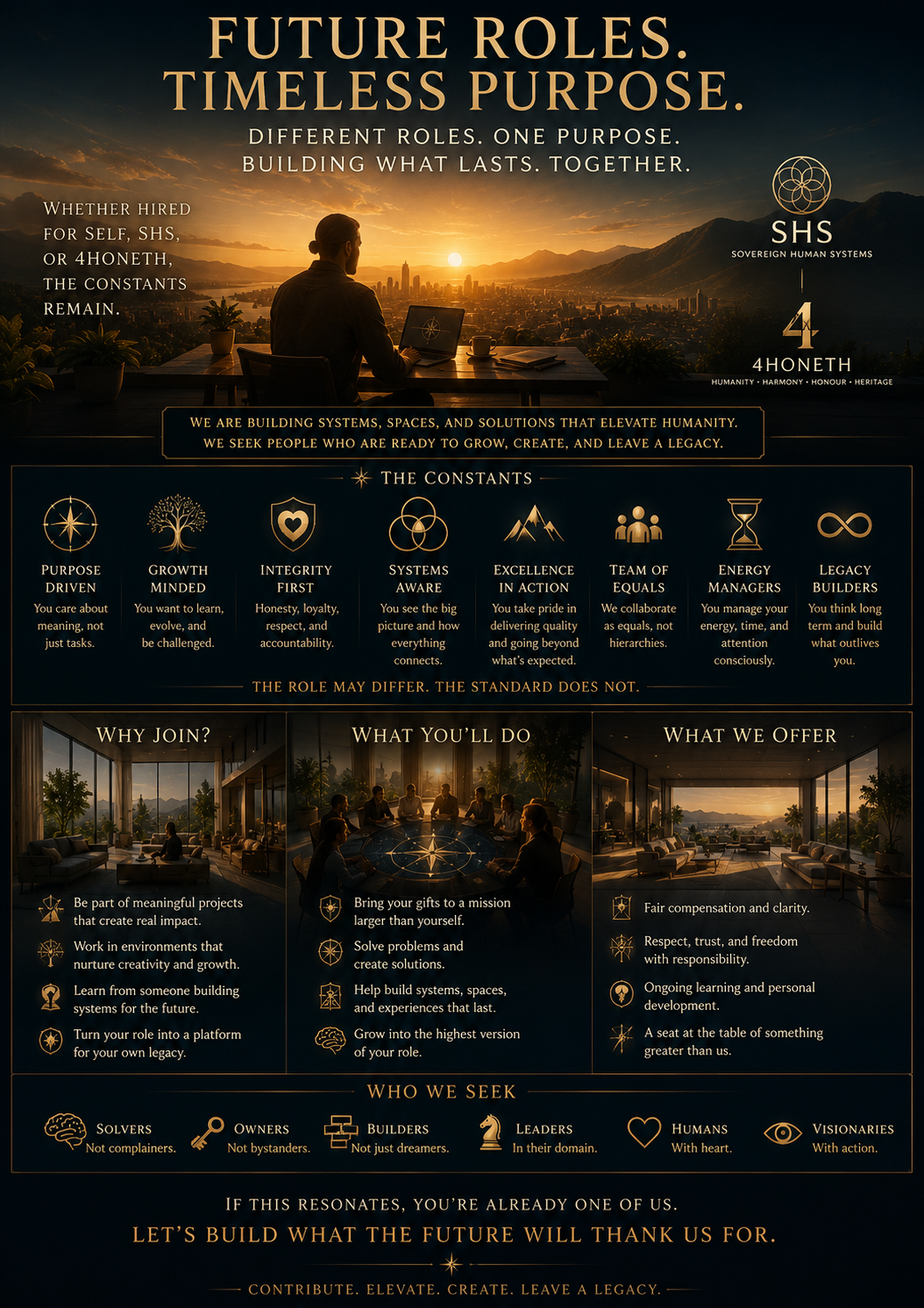
This role is for someone who understands that SHS is not only a company, project, or organisation. SHS is a foundation of thought, governance, education, consciousness, responsibility, documentation, and human development. An SHS Assistant is not simply there to help with emails, notes, scheduling, files, or tasks. Those responsibilities may exist, but they are not the essence. The essence is helping protect the relationship between the founder, the work, the questions, the systems, the archive, and the continuity of SHS as it moves from idea into structure.
You would be stepping into a field where the foundations are already extensive. SHS has writings, frameworks, legal reflections, governance concepts, consciousness-training models, recruitment philosophies, child-development architecture, Human and Hueman distinctions, political and social critiques, educational principles, visual systems, and public-facing documentation already in motion. Your role would be to help organise, track, question, preserve, clarify, and support this field so that the work can become increasingly usable, navigable, and ready for implementation.
This is not a role for someone who only wants to be close to vision. It is for someone who wants to learn how vision becomes governance. SHS is where the conversations happen before the wider expression is projected into 4Honeth or any other external structure. SHS is the place where questions are refined, systems are tested, frameworks are cleaned, responsibility is mapped, and foundations are finalised before they become public structures, services, locations, programmes, or policies.
The SHS Assistant must therefore be comfortable with depth. You may be helping organise documents one day, supporting recruitment philosophy the next, preparing questions for a meeting, tracking themes across blog posts, helping categorise frameworks, gathering notes from conversations, preparing summaries, supporting governance discussions, or helping turn raw insight into structures that others can understand. This role requires someone who can respect complexity without becoming overwhelmed by it.
In our framework, the SHS Assistant touches every system. In law, you help track responsibility, agreements, accountability, governance language, boundaries, and ethical structures. In politics, you help observe relationships between people, communities, institutions, borders, participation, representation, and collective decision-making. In environmental management, you help clear intellectual clutter, organise archives, reduce duplication, and keep the field navigable. In security and defence, you help protect sensitive documents, strategic conversations, legal material, private reflections, and the timing of public release.
In social welfare, you help ensure SHS remains connected to human care, not just system design. In infrastructure and utilities, you help build the internal systems that allow the organisation to function: folders, trackers, meeting notes, research logs, recruitment files, governance documents, reading pathways, public resources, and internal processes. In innovation, you help capture new ideas and keep them connected to the wider architecture. In economy, you help notice how time, attention, labour, and participation are being exchanged. In finance, you help support awareness around funding, donations, grants, expenses, investment conversations, and resource allocation where appropriate.
In healthcare and public health, you help SHS remember that governance must serve life, vitality, emotional regulation, rest, food, body, nervous system, family, and sustainability. In culture and media, you help track how SHS communicates itself publicly, what truths it repeats, what tone it sets, and what stories it chooses to challenge or preserve. In education, you help turn the entire archive into learning pathways, questions, frameworks, training materials, and accessible entry points for others.
The qualities needed are trust, discretion, curiosity, organisation, patience, good questioning, emotional maturity, pattern recognition, respect for authorship, and the ability to work with both detail and scale. You do not need to arrive knowing everything. You need to arrive willing to learn, willing to think, willing to ask, willing to organise, willing to observe, and willing to help carry continuity without trying to control the source.
This role may involve document organisation, meeting preparation, note-taking, framework tracking, blog archive categorisation, research support, recruitment preparation, governance drafting support, public-resource planning, internal-process building, contact tracking, contributor management, reading-pathway development, and helping make SHS easier for others to enter without diluting the depth of the work.
The SHS Assistant may later develop into several pathways: SHS Coordinator, Governance Assistant, Research Assistant, Education Programme Assistant, Community Systems Assistant, Documentation Lead, Founder’s SHS Executive Assistant, Department Assistant, Head of SHS Assistants, SHS Branch Coordinator, Country-Level SHS Support, or future roles created around demonstrated capacity and organisational need. Some roles may remain close to me. Some may expand outward as SHS grows. Movement will depend on readiness, timing, availability, location, responsibility, and the person’s own direction.
This role is not about repeating my words back to me. It is about helping protect the continuity of the work while learning how the system thinks. SHS needs people who can ask: what is the question underneath this? What system does this belong to? What has already been said? What still needs clarifying? What should be documented? What should remain private? What should be prepared for public understanding? What is repeating? What is changing? What is ready to become structure?
The SHS Assistant exists because the work is too large to remain carried only through one mind, one archive, one memory, or one set of hands. The continuity must be organised so others can eventually enter it, learn from it, contribute to it, and build with it.
One document may go, but not the continuity. One meeting may end, but not the question. One phase may complete, but not the foundation.
The SHS Assistant helps carry the foundation cleanly.




Leave a Reply