The First Keeper / Assistant of Space
Before SHS becomes a building, before 4Honeth becomes a location, before the wider architecture becomes visible to others, the first space that must be managed with consciousness is the home.
The home is not separate from the work.
The home is the first field.
The home is the first office, the first temple, the first studio, the first meeting room, the first training ground, the first governance environment, and the first evidence of whether the principles can be lived before they are scaled.
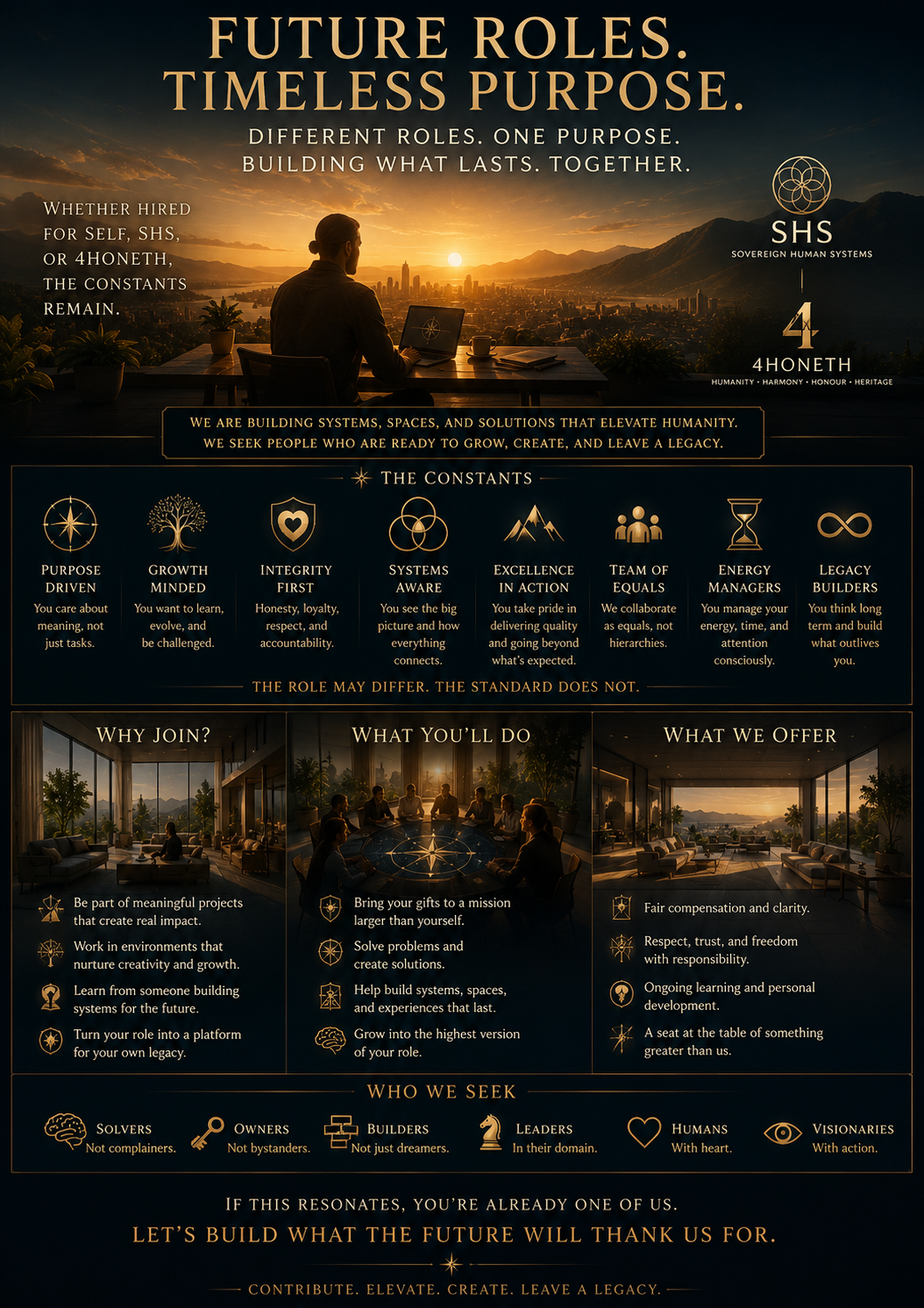
This is why one of the first support roles I will need is a live-in House Manager or Space Manager. Not merely a cleaner. Not merely someone who tidies rooms. Not merely someone who follows a domestic checklist without seeing the wider picture. This role is for someone who wants to learn how to manage space as energy, how to organise a house as a living system, and how the care of a physical environment becomes the foundation for leadership, creative direction, household management, CEO-level spatial awareness, and long-term stewardship.
I know how to take care of myself, and I know how to take care of the spaces around me. That is one of my original foundations. I learned self-reliance early. I learned that when you know how to care for yourself and care for your environment, you do not fear loss in the same way, because you know you can pick yourself up again. You know how to rebuild. You know how to organise. You know how to return to foundation.
That is why I do not seek support from dependency. I seek support from authorship.
I outsource what I can do myself, not the other way around.
The purpose of this role is not to replace my ability to care for a home. I already have that ability. The purpose is to free my energy so that my mind can remain focused on creation, writing, governance architecture, SHS, 4Honeth, documentary building, public accessibility, and the next stages of life that require more available attention. I am not outsourcing consciousness. I am outsourcing execution.
This is the Human to Hueman distinction again.
The Human depends on external structures because the internal foundation has not been fully developed.
The Hueman is self-sufficient within a dependable system.
A coherent system does not make the self weaker. It allows the self to contribute more fully.
The House Manager role is therefore not a servant role. It is a spatial apprenticeship. It is for someone who wants to practise management from the most grounded level: the house. Because if you cannot manage a room, how will you manage a department? If you cannot notice what a kitchen needs, how will you notice what a company needs? If you cannot track what has been done, what still needs doing, and what needs to be carried forward, how will you manage operations, people, resources, money, or time?
Cleaning is not just cleaning.
Cleaning is movement.
Cleaning is memory.
Cleaning is repetition.
Cleaning is judgement.
Cleaning is strategy.
Cleaning is stamina.
Cleaning is cognition.
Cleaning is intensity.
Cleaning is creativity.
Cleaning is purpose.
Cleaning is stability.
Cleaning is mastery.
When you clean a table, you are observing space. You are seeing what has already been done, what remains, what requires attention, what can be moved, what should stay, what should be discarded, what needs maintenance, and what pattern must be repeated so the space remains coherent. That is not low-level work. That is foundational intelligence.
My father taking me to clean offices when I was young taught me humility, responsibility, and the existence of the backend people rarely see. It showed me the veil behind the veil. Every clean office had a hidden hand behind it. Every functional space had invisible labour behind it. Every visible structure had a maintained foundation behind it.
That is the awareness I want brought into this role.
The House Manager would be responsible for the ongoing care, order, readiness, and energetic functionality of a large home, potentially around nine bedrooms, with communal areas, private areas, creative areas, meeting areas, and transitional spaces. Not every bedroom will be used daily, so not every room will need daily attention, but every room will need awareness. Some spaces may need weekly care. Some may need daily care. Some may need occasional reset after guests, meetings, creative work, filming, or SHS/4Honeth gatherings.
The role will include cleaning, tidying, organising, laundry oversight, room readiness, household stock awareness, grocery management, kitchen maintenance, noticing what is missing, noticing what is damaged, noticing what needs repair, and helping ensure the home remains functional, beautiful, safe, and ready for life.
It will include maintaining a trusted contact list for electricians, plumbers, gardeners, handymen, cleaners, maintenance workers, and other specialists. It will include knowing when something can be handled in-house and when someone external needs to be called. It will also include checking with me before arranging certain repairs or changes, because there are things I may enjoy doing myself, especially when DIY, design, or creative arrangement is involved.
The role will include security awareness: doors, windows, access points, deliveries, visitors, keys, privacy, boundaries, and general house safety.
It will include grocery responsibility: making sure my chosen foods, staples, household items, cleaning products, and necessary supplies are available, tracked, and replenished.
It will include financial awareness in relationship to the house: understanding what counts as a house expense, what counts as a personal expense, and working cleanly with whoever manages the finances so that household spending remains transparent, responsible, and coherent.
The House Manager will live in the home. They will have their own room, access to their own facilities where available, and use of communal spaces because it will also be their home. The point is not to create distance between “my house” and “their work.” The point is that they are paid to help care for the house they also live in.
Accommodation, bills, and house groceries would be covered as part of the role. Personal expenses, personal shopping, and anything outside the needs of the house would remain their own responsibility. Because we still live in a money-based construct, the role would also be paid. Free accommodation alone is not enough, because people still need personal money, movement, choice, and freedom in the external world.
The right person is not someone who only wants money.
The right person is someone who sees the value of learning foundation.
Someone who may want to become a house manager, estate manager, creative director, CEO, housewife, operational lead, hospitality leader, spatial designer, event manager, or simply a more organised and self-reliant human being.
This role is not designed to trap anyone in domestic labour.
It is designed to elevate them through it.
Anyone who comes close to me should be moving upwards. I do not want to keep people in roles beneath their own dreams. I am the type of person who asks janitors what their dreams are, because anyone can clean a floor, but only that person can become what they came here to become. The role is a foundation, not a prison.
That is the philosophy behind it.
The house becomes a training ground.
Law: What rules keep the house coherent?
Politics: What boundaries and jurisdictions exist between private, shared, guest, creative, and operational spaces?
Environmental Management: What waste must be removed, recycled, cleansed, or prevented?
Security and Defence: What protects the home, the people, the work, the documents, the privacy, and the field?
Social Welfare: How does the house care for the wellbeing of those inside it?
Infrastructure and Utilities: What physical systems keep the home functioning?
Innovation: How can the house operate better?
Economy: How is energy, time, labour, and money being used efficiently?
Finance: What is being spent, what is necessary, what is wasteful, what supports continuity?
Healthcare and Public Health: How does the house support vitality, food, cleanliness, rest, hygiene, and nervous system regulation?
Culture and Media: What atmosphere does the house create? What beauty, tone, rhythm, and story does it hold?
Education: What is being learned through the daily practice of space?
This is why the House Manager is not just managing a house.
They are practising governance in miniature.
The home is the first nation.
The bedroom is the first private jurisdiction.
The kitchen is the first healthcare department.
The pantry is the first supply chain.
The cleaning cupboard is the first environmental management system.
The front door is the first border.
The guest room is the first hospitality department.
The living room is the first community field.
The office is the first institution.
The table is the first meeting chamber.
The bed is the first recovery system.
The house is a body.
And the House Manager learns how to read that body.
This is also preparation for SHS and 4Honeth. My home may be the first place where early meetings happen, where the first discussions are held, where the first people gather, where the first practices are tested before moving into a larger house, then a building, then a wider ecosystem. The home becomes the first operational rehearsal for the spaces to come.
This is why the role matters.
Because SHS cannot be built from chaos.
4Honeth cannot be built from unmanaged energy.
A founder’s mind cannot be stretched across every floor, every cupboard, every repair, every grocery list, every visitor, every meeting, every document, every creation, every responsibility, and still remain fully available to carry the scale of the vision.
Support is not weakness.
Support is energy architecture.
This series is therefore a form of invoice to SHS. Not in the cold sense, but in the conscious sense. These are the supports required for me to be of full support to SHS and 4Honeth. These are the roles that protect the creator so the creator can protect the creation. These are the structures that allow energy to be managed in harmony, not merely balanced, so the work can continue from a place of clarity, order, and coherence.
The House Manager is one of the first.
The Keeper of Space.
The person who learns that space is not empty.
Space is memory.
Space is movement.
Space is responsibility.
Space is law.
Space is care.
Space is consciousness organised visibly.
And if we can organise the home properly, we can begin organising the world properly from there.


Leave a Reply