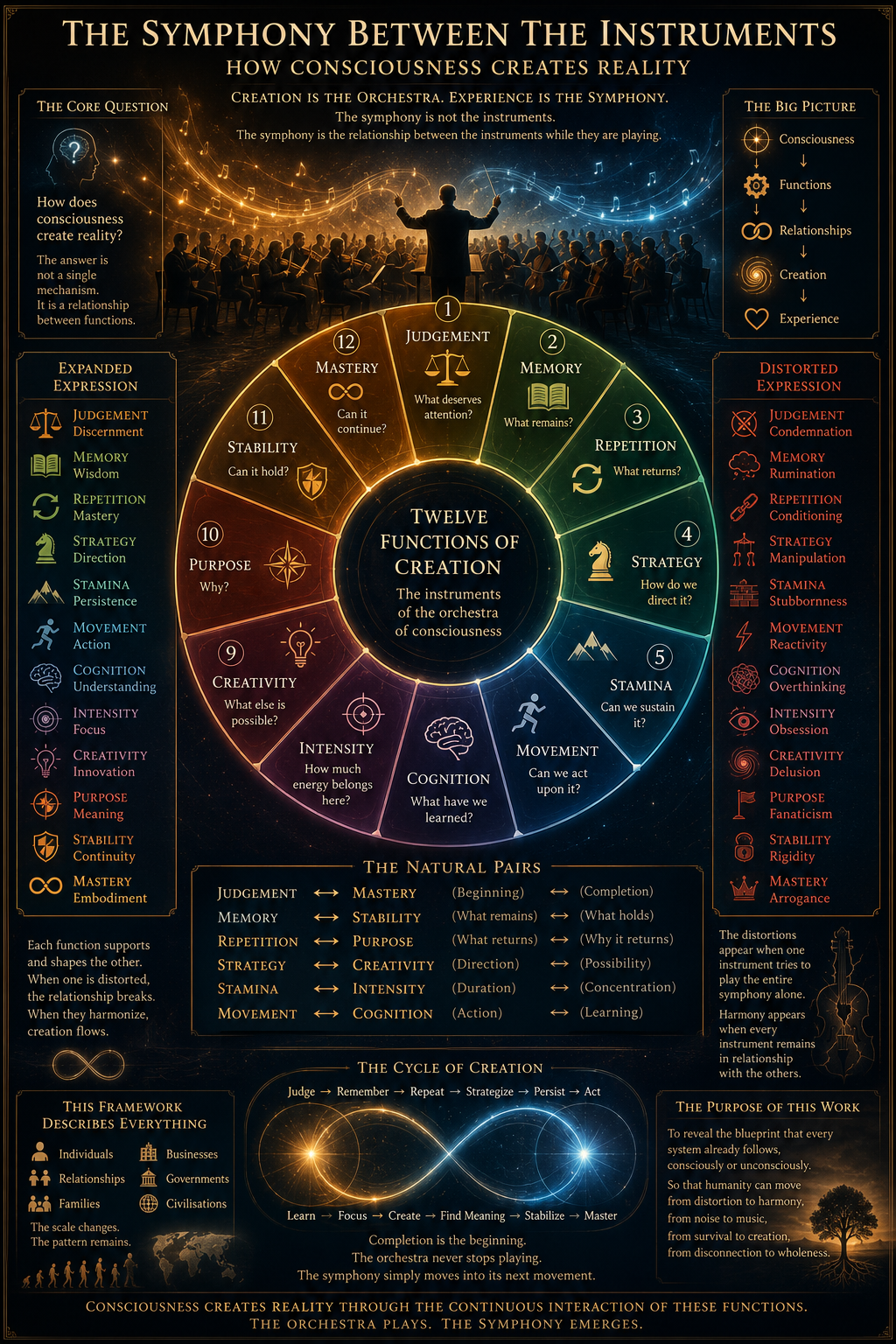
A country is not only land, borders, government, economy, and law. A country is a living collective system. It remembers. It repeats. It learns. It protects. It creates. It forgets. It reacts. It stabilises. It masters some things and avoids others.
A country can therefore be read through the same twelve pillars of creation.
1. Judgment → What does the country value?
A country reveals its real values through what it protects, funds, rewards, ignores, punishes, and normalises. It may claim to value children, but underfund education. It may claim to value health, but tolerate preventable sickness. It may claim to value justice, but protect institutions more than people.
Judgment asks the country to look honestly at what it truly values, not only what it says it values.
2. Memory → What does the country remember?
National memory lives in history, monuments, education, archives, public holidays, trauma, pride, shame, silence, and inherited stories. A country that remembers selectively repeats harm unconsciously. A country that remembers wisely can turn history into instruction without becoming trapped in nostalgia or denial.
Memory asks: what lessons are we preserving, and what truths have we buried?
3. Repetition → What does the country practise?
A country becomes what it repeatedly does. Repeated policies create culture. Repeated neglect creates crisis. Repeated inequality creates resentment. Repeated accountability creates trust. Repeated education creates capability.
Repetition asks: what patterns keep returning, and what are we training the population to accept as normal?
4. Strategy → Where is the country going?
A country without strategy reacts to every crisis as if it appeared from nowhere. Strategy gives national direction. It asks what future the country is preparing for, what industries it is developing, what people it is nurturing, what risks it is anticipating, and what kind of society it wants to become.
Strategy asks: are we governing for the next election, or for the next generation?
5. Stamina → Can the country keep going?
National stamina is the ability to endure pressure without collapsing into panic, cruelty, corruption, or fragmentation. It includes infrastructure resilience, social trust, emergency preparedness, food security, energy security, healthcare capacity, public morale, and institutional credibility.
Stamina asks: can this country survive difficulty without sacrificing its people or its principles?
6. Movement → What is the country doing?
Movement is action. Laws passed. Roads built. Schools opened. Hospitals supported. Families housed. Industries developed. Communities protected. Promises implemented.
A country cannot live on speeches alone. Movement reveals whether vision has entered reality.
Movement asks: what is actually being done?
7. Cognition → What is the country learning?
A country must be able to learn from failure, data, public experience, science, lived reality, and its own consequences. Without cognition, government becomes repetition without understanding. The same crises return under different names because the country never integrated the lesson.
Cognition asks: what has reality been trying to teach us?
8. Intensity → What deserves national focus?
A country cannot focus on everything with the same intensity at once. Attention must be prioritised. Some issues are urgent. Some are foundational. Some are distractions. Some are symptoms of deeper causes.
Intensity asks: where should national energy be concentrated now, and what is draining attention without building continuity?
9. Creativity → What can the country improve or imagine differently?
National creativity is not only art. It is innovation in housing, education, law, healthcare, transport, energy, agriculture, technology, community, and governance. A country that cannot imagine better systems becomes trapped inside inherited limitations.
Creativity asks: what else is possible, and what existing structure needs redesign?
10. Purpose → Why does the country exist?
A country is not only a management zone. It is a shared field of life. Purpose asks what the country is here to serve: human development, dignity, safety, creativity, contribution, freedom, wellbeing, continuity, and future generations.
Without purpose, national systems become machinery. They continue operating, but nobody remembers why.
Purpose asks: what kind of life is this country trying to make possible?
11. Stability → What continues?
Stability is not rigidity. A stable country can evolve without losing its foundation. It protects continuity while adapting to change. It maintains trust, law, services, infrastructure, identity, and basic care even as leadership, technology, culture, and circumstances change.
Stability asks: what must remain reliable so people can build their lives?
12. Mastery → What has the country embodied?
A country’s mastery is not what it claims to be good at. It is what it has proven through repeated action. Some countries master healthcare. Some master education. Some master diplomacy. Some master design, technology, production, art, law, finance, agriculture, or community care.
Mastery asks: what has this country genuinely embodied, and what can it teach the world?
The National Cycle
Judgment shapes law.
Memory shapes identity.
Repetition shapes culture.
Strategy shapes direction.
Stamina shapes resilience.
Movement shapes reality.
Cognition shapes learning.
Intensity shapes priority.
Creativity shapes innovation.
Purpose shapes meaning.
Stability shapes trust.
Mastery shapes legacy.
Together, they reveal whether a country is merely surviving or consciously creating.
A country can use these pillars to audit itself honestly. What do we value? What do we remember? What do we repeat? Where are we going? Can we keep going? What are we doing? What are we learning? What deserves focus? What can improve? Why does this matter? What continues? What have we embodied?
These questions can be asked by governments, schools, families, communities, businesses, councils, citizens, and children. They are not only for leaders. A country is not only led from the top. It is repeated by the people every day.
The scale changes, but the pillars remain.
One government may go, but not the continuity. One policy may change, but not the national lesson. One generation may pass, but not the responsibility to create better conditions for the next.
That is how a country becomes conscious of itself.



Leave a Reply