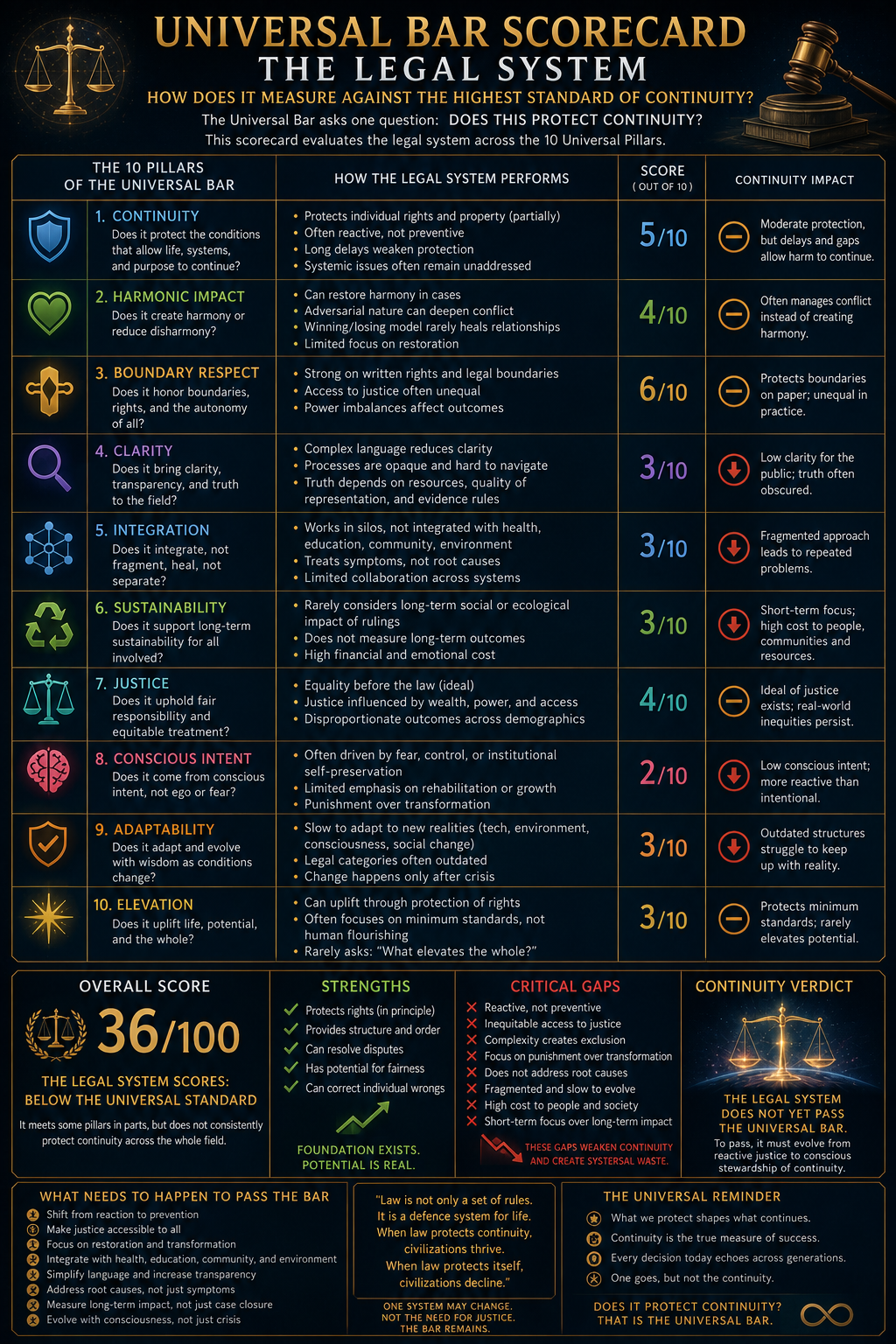
If we raise the legal system to the galactic standard, the question is no longer whether it follows procedure.
The question becomes:
Does it protect continuity?
Because through the galactic lens, law is not simply a human institution. Law is meant to be a defence system for life. It should protect harmony, boundaries, responsibility, truth, consequence, ecosystem health, and the conditions that allow individuals, families, communities, nations, and the wider field to continue coherently.
So does the legal system pass the bar?
Not if the bar is universal continuity.
A legal system that can process paperwork but not process harm has failed waste management. A legal system that can preserve precedent but not correct inherited distortion has confused memory with mastery. A legal system that can punish individuals while leaving the ecosystem that produced the harm untouched is not defending continuity. It is managing symptoms while calling itself justice.
The galactic lens asks: what does this system do to the whole?
Does the legal system reduce waste, or does it create more of it?
Does it transform conflict into understanding, or does it warehouse unresolved pain?
Does it protect victims while educating offenders, or does it turn both into files?
Does it preserve truth, or does it reward whoever can afford the better translation of truth?
Does it enforce universal responsibility, or does it protect institutional self-preservation?
That is the bar.
A legal system worthy of the galactic lens would understand that every case is not only an event. Every case is data. Every case is a signal from the ecosystem. Crime is data. Neglect is data. Abuse is data. Poverty is data. Exploitation is data. Silence is data. Delay is data. Recurring harm is data. If the same harms keep returning, the system should not only ask who broke the law. It should ask what conditions keep producing the same breakage.
That is where current legal systems often fall short. They individualise consequence while ignoring collective production. They ask what happened, but not always what pattern keeps happening. They ask who is liable, but not always what structure made the harm predictable. They ask whether something fits the existing legal category, but not whether the category itself is too small for the reality being presented.
Through the galactic lens, that is not enough.
Because defence is not reaction.
Defence is continuity protection.
Justice should not begin only after harm has occurred. Justice should also study the conditions that made harm possible, the systems that tolerated warning signs, the institutions that avoided responsibility, the cultures that normalised distortion, and the repeated failures that allowed waste to accumulate until somebody had to suffer loudly enough to be heard.
If universal law is the endocrine system of existence, then the legal system is supposed to help translate those governing principles into human structure. It should coordinate responsibility. It should regulate consequence. It should prevent the collective body from becoming hormonally incoherent. Instead, too often, law becomes procedural metabolism without emotional intelligence. It processes cases while failing to process consciousness.
The paperwork moves.
The wound remains.
The judgment is issued.
The pattern continues.
That is not mastery.
That is repetition without integration.
A galactic legal system would treat law as ecosystem defence. It would ask whether a decision restores harmony, clarifies responsibility, protects boundaries, prevents recurrence, educates the field, transforms waste, and strengthens continuity. It would not confuse punishment with correction. It would not confuse silence with resolution. It would not confuse closure with healing. It would not confuse legality with coherence.
This does not mean abandoning structure. Quite the opposite. It means raising structure to its actual responsibility.
Law must still have boundaries. Law must still have standards. Law must still have evidence, process, judgement, consequence, and enforcement. But the purpose of those tools must be remembered. They are not there to protect law as an idol. They are there to protect life through law.
When legal systems protect themselves more quickly than they protect people, they fail the galactic bar.
When legal systems require victims to become experts before they can be believed, they fail the galactic bar.
When legal systems are accessible to wealth but exhausting to ordinary people, they fail the galactic bar.
When legal systems allow delay to become a weapon, they fail the galactic bar.
When legal systems ignore emotional, social, ecological, familial, and generational consequence because it does not fit neatly into legal language, they fail the galactic bar.
When legal systems preserve old categories while reality evolves beyond them, they fail the galactic bar.
The galactic lens does not ask the legal system to become soft. It asks it to become intelligent enough to defend continuity.
That means law must recognise waste. Legal waste includes unresolved harm, inaccessible processes, repeated cases that reveal the same societal wound, institutional avoidance, preventable conflict, excessive delay, procedural confusion, and rulings that technically close matters while leaving the ecosystem more distorted than before.
That waste has to go somewhere.
If it is not processed by the legal system, it returns to families, communities, workplaces, streets, schools, hospitals, prisons, and bodies. Unprocessed legal waste becomes social pollution. It becomes distrust. It becomes resentment. It becomes fear. It becomes people giving up on lawful routes because lawful routes did not feel alive enough to protect them.
That is dangerous for public safety.
Because when law fails to protect continuity, people start seeking continuity elsewhere.
Some seek it through silence.
Some through revenge.
Some through escape.
Some through collapse.
Some through exposure.
Some through building new systems.
The legal system should pay attention to that.
Not defensively.
Intelligently.
Because the person pointing at the waste is not the waste.
The waste is the waste.
The galactic question remains:
How does this affect the ecosystem?
If the legal system cannot answer that, it has not yet reached the standard it claims to hold over others.
To pass the galactic bar, law must become more than a gatekeeper of permission. It must become a conscious defence system for life. It must see the individual and the whole. It must see the case and the pattern. It must see the harm and the conditions. It must see punishment and transformation. It must see rights and responsibilities. It must see the person, the system, and the relationship between them.
That is the higher bar.
Not whether the system can quote itself.
Whether the system can correct itself.
Not whether it can enforce rules.
Whether it can enforce coherence.
Not whether it can close cases.
Whether it can protect continuity.
So does the legal system pass the bar?
At the human procedural level, sometimes.
At the galactic level, not yet.
But one legal era may go, not the continuity. One court structure may evolve, not the need for justice. One legal language may become outdated, not the universal law underneath it.
The bar remains.
The question is whether the legal system is ready to rise to it.



Leave a Reply