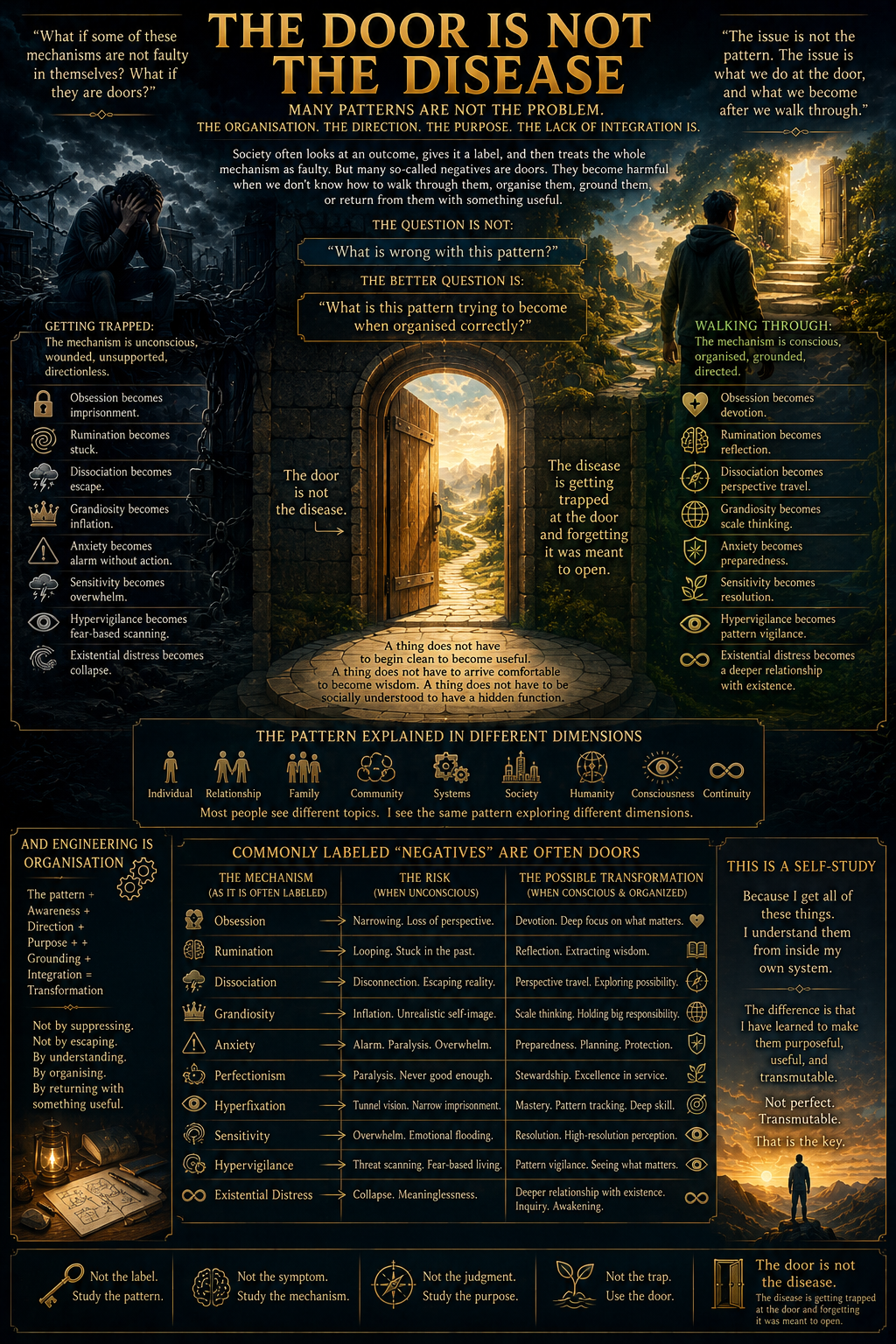
One thing this path has taught me is that many things we call negative are not always wrong at the level of pattern.
Sometimes the pattern is not the problem.
The organisation is.
The direction is.
The purpose is.
The lack of integration is.
That is an important distinction because society often looks at an outcome, gives it a label, and then treats the whole mechanism as faulty. But what if some of these mechanisms are not faulty in themselves? What if they are doors? What if they become harmful because people do not know how to walk through them, organise them, ground them, or return from them with something useful?
That is what I have been studying in myself.
Obsession, for example, is often understood as narrowing down. And yes, obsession can become dangerous when it narrows reality until a person can no longer see anything else. But if the obsession is the universe, if the object of sustained attention is life itself, consciousness itself, systems themselves, humanity itself, then the same narrowing begins to open. The focus becomes a doorway into expansion. The attention becomes discipline. The repetition becomes devotion. The problem is not always the intensity of focus. The problem is whether that focus imprisons the mind or opens it wider.
Rumination is similar.
People often treat rumination as looping over something until it becomes painful. And that can happen. But one can ruminate on something good. One can revisit something valuable. One can return to an insight, a memory, a lesson, a phrase, a mistake, a relationship, a moment of grace, and extract more value each time. The issue is not returning. The issue is returning without transformation. The issue is hoarding what was never meant only for self. If the rumination produces value, that value must eventually circulate. Otherwise the person becomes a storage unit for wisdom that was meant to become contribution.
Dissociation is another door.
Taken too far, it can become disconnection from reality. But in another form, it can also be expansive. Sometimes a person disconnects from immediate reality because they are travelling into possibility. They go into Neverland, not to escape life forever, but to study what life could become. They enter imagination. They enter abstraction. They enter the field of possibility. That can be purposeful. Artists do it. Scientists do it. Inventors do it. Children do it naturally before the world trains them out of it. The issue is getting lost there. The issue is never returning with something grounded, usable, or life-giving.
Grandiosity is another word that has been reduced.
If we listen to the word itself, grandiosity points to something grand, something large, something that encompasses a lot. Of course it can become distorted when a person inflates themselves beyond reality. But scale is not automatically sickness. Some people genuinely think at large scale because the subject they are working with is large. Universal laws are grand. Human development is grand. Civilization is grand. Consciousness is grand. If the work encompasses a lot, then the language may become large because the field is large. The question is not whether something sounds grand. The question is whether the scale is grounded in responsibility.
Anxiety is also a door.
Anxiety is a trigger toward preparation. It says: look here, something needs attention. Something may happen. Something has not been planned for. Something requires care. That signal can be useful. The issue is staying inside the alarm. Anxiety becomes harmful when the trigger never becomes preparation, when the signal never becomes action, when the warning never becomes wisdom. But when anxiety is transmuted, it becomes foresight. It becomes planning. It becomes protection. It becomes the capacity to prepare before consequence arrives.
Perfectionism can become paralysis, but it can also reveal stewardship.
Hyperfixation can become narrow imprisonment, but it can also become pattern tracking.
Sensitivity can become overwhelm, but it can also become high-resolution perception.
Hypervigilance can become fear-based scanning, but it can also become pattern vigilance.
Existential distress can become collapse, but it can also become existential inquiry.
That is the point.
Many of these so-called negatives are doors.
The issue is that most people do not know how to walk them.
They enter obsession and become trapped.
They enter rumination and become stuck.
They enter dissociation and forget to return.
They enter grandiosity and lose grounding.
They enter anxiety and never prepare.
They enter sensitivity and become overwhelmed.
They enter hypervigilance and only see threat.
They enter existential distress and forget curiosity.
But if the same mechanisms can be organised differently, then they can be engineered differently.
And engineering is organisation.
That is the real discovery.
The question is not only:
“What is wrong with this pattern?”
The better question may be:
“What is this pattern trying to become when organised correctly?”
What is obsession trying to become?
Devotion.
What is rumination trying to become?
Reflection.
What is dissociation trying to become?
Perspective travel.
What is grandiosity trying to become?
Scale thinking.
What is anxiety trying to become?
Preparedness.
What is perfectionism trying to become?
Stewardship.
What is hyperfixation trying to become?
Mastery.
What is sensitivity trying to become?
Resolution.
What is hypervigilance trying to become?
Pattern vigilance.
What is existential distress trying to become?
A deeper relationship with existence.
This is why I do not want to study these things only as faults. I want to study the architecture. I want to study the door. I want to study what happens when the mechanism is not left unconscious, wounded, unsupported, or directionless, but is instead given purpose, grounding, language, responsibility, and continuity.
Because I get all of these things.
I understand them from inside my own system.
The difference is that I have learned to make them purposeful, useful, and transmutable.
Not perfect.
Transmutable.
That is the key.
A thing does not have to begin clean to become useful. A thing does not have to arrive comfortable to become wisdom. A thing does not have to be socially understood to carry a hidden function. Sometimes the very thing society labels as broken contains a raw mechanism that, when reorganised, becomes one of the person’s greatest gifts.
The door is not the disease.
The disease is getting trapped at the door and forgetting it was meant to open.


Leave a Reply