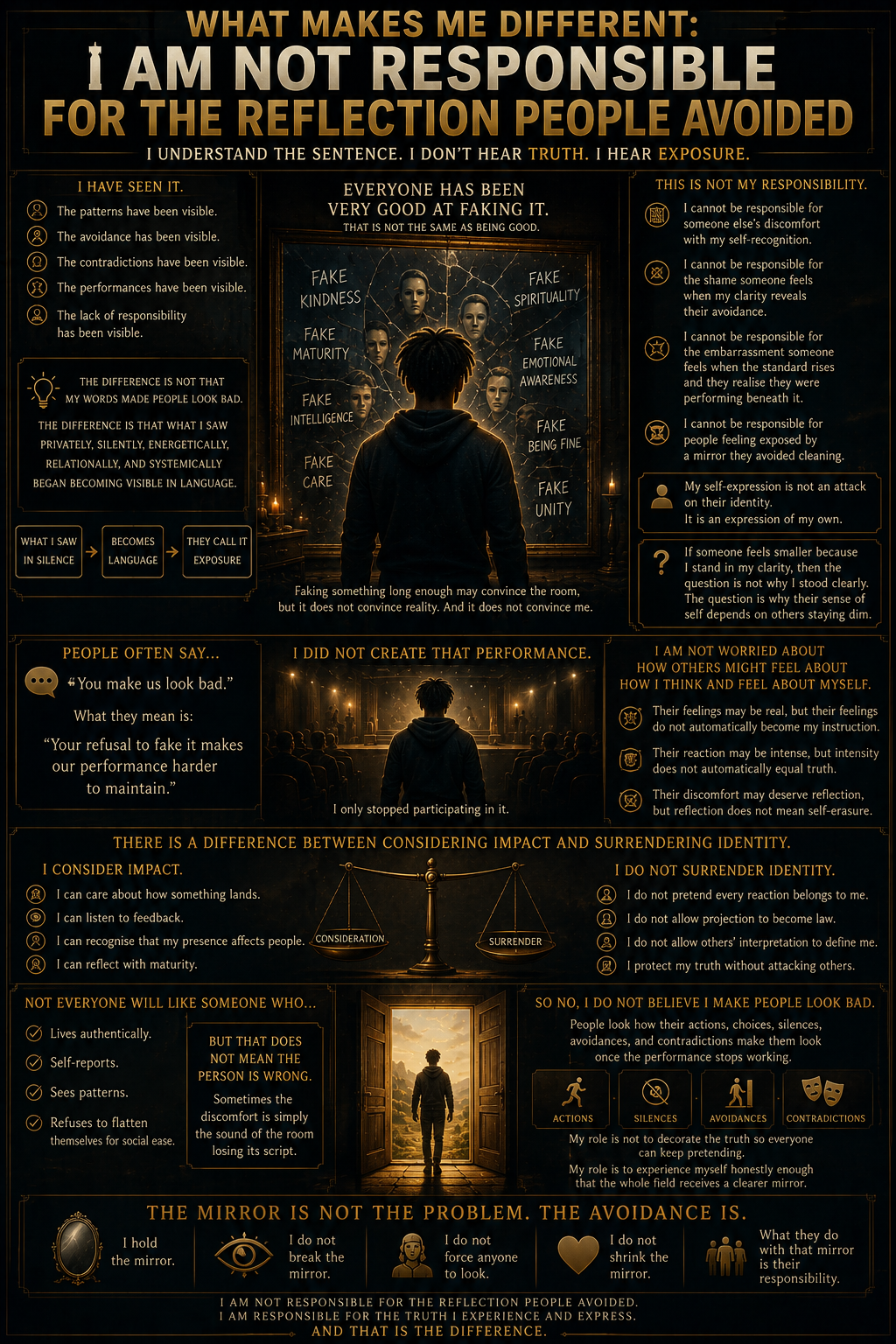
One thing that makes me different is that when people say, “You make us look bad,” I understand the sentence properly.
I do not hear truth.
I hear exposure.
Because people have looked bad to me for years.
Not because they are inherently bad.
Because the patterns have been visible.
The avoidance has been visible.
The contradictions have been visible.
The performances have been visible.
The lack of responsibility has been visible.
The difference is not that my words suddenly made people look bad. The difference is that what I saw privately, silently, energetically, relationally, and systematically began becoming visible in language. That is what people often react to. Not the behaviour itself. Not the inconsistency itself. Not the harm itself. The fact that someone finally named it.
Everyone has been very good at faking it.
That is not the same as being good.
A person can fake kindness.
A person can fake professionalism.
A person can fake maturity.
A person can fake spirituality.
A person can fake intelligence.
A person can fake care.
A person can fake emotional awareness.
A person can fake being fine.
A system can fake stability.
A company can fake culture.
A family can fake unity.
A society can fake progress.
Faking something long enough may convince the room, but it does not convince reality.
And it does not convince me.
So when people feel exposed by how I speak, think, write, feel, or experience myself, that is not automatically my responsibility to shrink. It is their experience of me experiencing myself. It is their experience of witnessing someone refuse to manage their own truth for the comfort of people who were already uncomfortable with themselves.
That has nothing to do with me on a logical basis.
I cannot be responsible for someone else’s discomfort with my self-recognition.
I cannot be responsible for the shame someone feels when my clarity reveals their avoidance.
I cannot be responsible for the embarrassment someone feels when the standard rises and they realise they were performing beneath it.
I cannot be responsible for people feeling exposed by a mirror they avoided cleaning.
Because my self-expression is not an attack on their identity.
It is an expression of my own.
If someone feels smaller because I stand in my clarity, then the question is not why I stood clearly.
The question is why their sense of self depends on others staying dim.
That is the real issue.
People will often call something arrogance when it forces them to confront their own self-abandonment. They will call something too much when it reveals how little they allowed themselves to become. They will say, “You make us look bad,” when what they mean is, “Your refusal to fake it makes our performance harder to maintain.”
But I did not create that performance.
I only stopped participating in it.
That is why I am not worried about how others might feel about how I think and feel about myself. Their feelings may be real, but their feelings do not automatically become my instruction. Their reaction may be intense, but intensity does not automatically equal truth. Their discomfort may deserve reflection, but reflection does not mean self-erasure.
There is a difference between considering impact and surrendering identity.
I consider impact.
I do not surrender identity.
I can care about how something lands without pretending that every reaction belongs to me. I can listen to feedback without allowing projection to become law. I can recognise that my presence affects people without agreeing that their interpretation defines me.
That is maturity.
Not everyone will like someone who lives authentically.
Not everyone will like someone who self-reports.
Not everyone will like someone who sees patterns.
Not everyone will like someone who refuses to flatten themselves for social ease.
But that does not mean the person is wrong.
Sometimes the discomfort is simply the sound of the room losing its script.
And I have no interest in preserving a script that was built on avoidance.
So no, I do not believe I make people look bad.
People look how their actions, choices, silences, avoidances, and contradictions make them look once the performance stops working.
My role is not to decorate the truth so everyone can keep pretending.
My role is to experience myself honestly enough that the whole field receives a clearer mirror.
What they do with that mirror is their responsibility.





Leave a Reply