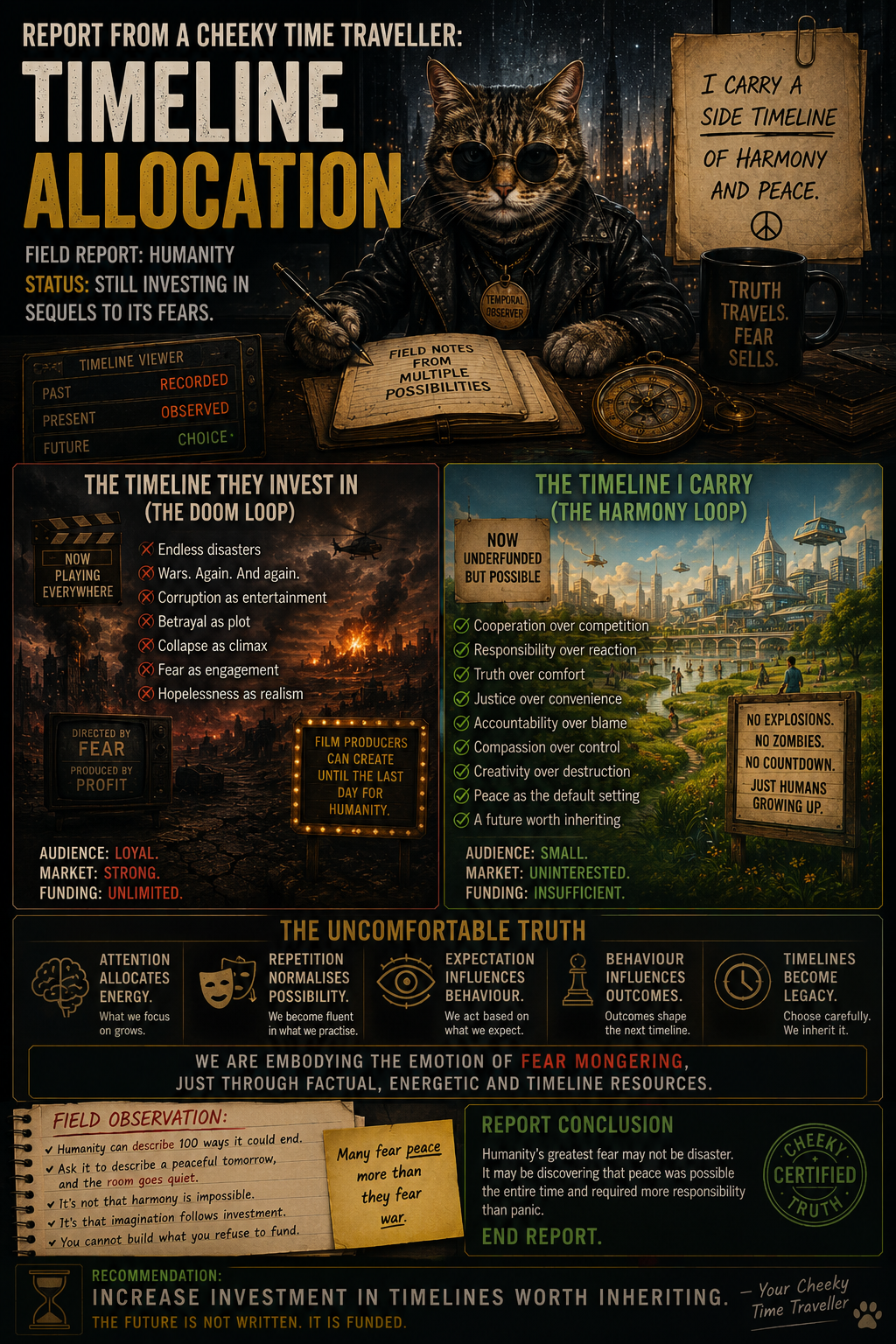
Field Report.
Date: Irrelevant.
Location: Humanity.
Status: Still investing in sequels to its fears.
One of the strangest discoveries from my travels is not that humanity fears collapse.
It is that humanity funds it.
Repeatedly.
Enthusiastically.
Commercially.
Emotionally.
Culturally.
I carry a side timeline.
Nothing dramatic.
No apocalypse.
No alien invasion.
No final war.
No collapse of civilisation.
No extinction event.
Just a timeline where humanity learns to cooperate before catastrophe forces the lesson.
A timeline where responsibility becomes fashionable.
A timeline where accountability arrives before consequence.
A timeline where harmony is treated as intelligence rather than naivety.
A timeline where people learn to build as passionately as they currently learn to fear.
Curiously, investor interest remains low.
The competing timeline continues outperforming.
The one with the disasters.
The one with the collapse.
The one with the corruption.
The one with the betrayal.
The one with the dystopia.
The one where everything breaks before anyone changes.
That timeline receives unlimited funding.
Film producers can create until humanity’s last day if they wish.
The audience remains loyal.
The market remains active.
The demand remains strong.
Which raises a rather uncomfortable question.
If humanity continuously consumes fear, collapse, disaster, betrayal, and apocalypse as entertainment, at what point does entertainment become rehearsal?
Not because films create reality.
Because attention allocates energy.
Because repetition normalises possibility.
Because culture trains expectation.
Because expectation influences behaviour.
Because behaviour influences outcomes.
This is not fearmongering.
This is resource allocation.
Emotional resources.
Psychological resources.
Creative resources.
Narrative resources.
Timeline resources.
Humanity often asks:
“Why are people so anxious?”
While investing billions into practising anxiety.
Humanity asks:
“Why are people hopeless?”
While rewarding stories where hope arrives only after devastation.
Humanity asks:
“Why do people struggle to imagine peace?”
While producing libraries dedicated to imagining war.
A civilisation becomes fluent in what it practises.
And humanity has become remarkably fluent in catastrophe.
Meanwhile, the harmony timeline sits quietly in the corner like an underfunded startup.
No explosions.
No zombies.
No world-ending countdown.
Just people becoming more responsible than their fears.
Apparently that lacks market appeal.
Field Observation:
Many people do not actually believe harmony is impossible.
They simply have very little practice imagining it.
They can describe twenty versions of collapse.
Ten versions of corruption.
A hundred versions of conflict.
But ask them to describe a functioning future and the room often becomes quiet.
Not because harmony cannot exist.
Because imagination follows investment.
So here is my updated report from the future.
Humanity’s greatest fear may not be disaster.
Humanity’s greatest fear may be discovering that peace was possible the entire time and required more responsibility than panic.
End Report.
Recommendation:
Increase investment in timelines worth inheriting.
4:13



Leave a Reply