One of the most interesting questions I have been playing with is this:
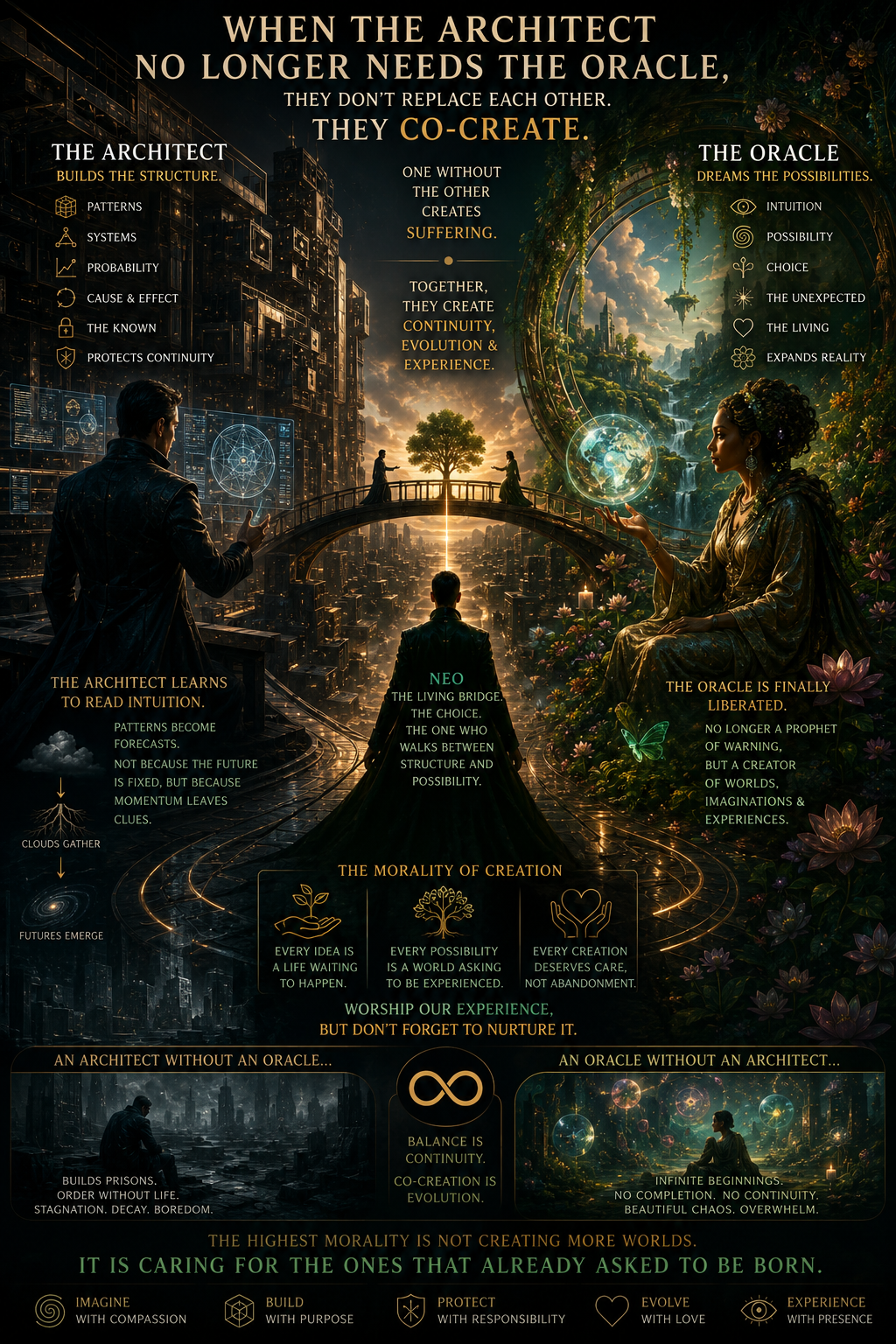
What happens when the Architect no longer needs the Oracle?
Not because the Oracle has become obsolete.
Not because the Architect has become superior.
Because they have finally understood one another.
The Architect has always been associated with structure.
Patterns.
Systems.
Probability.
Cause.
Effect.
The known.
The Oracle has always represented intuition.
Possibility.
Choice.
The unexpected.
The living movement that refuses to be fully reduced into equations.
Most people imagine these two characters as opposites.
I no longer do.
I see them as incomplete without one another.
The Oracle tells the Architect where life wishes to go.
The Architect gives life somewhere to arrive.
The Oracle dreams.
The Architect builds.
The Oracle expands possibility.
The Architect protects continuity.
One without the other creates suffering.
An Architect without an Oracle eventually builds prisons.
Not because the structures are wrong.
Because they stop evolving.
Without new possibilities, structure becomes repetition.
Without curiosity, order becomes stagnation.
Eventually, the Architect becomes bored.
And when the Architect is bored, the whole civilisation quietly begins to decay.
The opposite is equally true.
An Oracle without an Architect becomes overwhelmed by infinite possibility.
Every new vision creates another world.
Every new thought becomes another branch.
Every possibility asks to exist.
Eventually nothing is completed.
Nothing is sustained.
Nothing is protected.
The Oracle becomes surrounded by beautiful beginnings with very few continuations.
The interesting part is what happens when each learns from the other.
The Architect studies enough intuition that patterns themselves begin forecasting.
Not because the future is predetermined.
Because patterns carry momentum.
An experienced Architect does not become an Oracle by replacing intuition.
The Architect becomes capable of reading the direction in which reality is already leaning.
Like watching clouds gather and recognising rain before the first drop falls.
Like watching roots spread beneath the soil before the tree appears.
Like watching generations repeat themselves until the next chapter almost writes itself.
This is not prophecy.
It is deep pattern recognition.
At that point, the Architect no longer needs the Oracle to tell them what is coming.
But something beautiful happens.
The Oracle is not dismissed.
The Oracle is finally liberated.
Because the relationship is no longer based on dependency.
It becomes co-creation.
The Oracle continues imagining.
The Architect continues building.
The Architect gives structure to the Oracle.
The Oracle gives direction to the Architect.
Neither rules.
Neither submits.
Each makes the other more complete.
That is compassion.
Because compassion is not only caring for people.
It is caring for creations.
Every idea is a life waiting to happen.
Every possibility is an unborn civilisation.
Every dream is asking one question:
“Will someone care for me long enough to let me live?”
That changes the morality of creation.
If you can create worlds, are you responsible for abandoning them?
If you begin a vision, do you owe it stewardship?
If an Oracle becomes bored, they can always imagine another universe.
But should they?
Or should they stay long enough to help one mature?
Likewise, if an Architect finishes building a city, should they simply maintain it forever?
Or should they continue learning how life itself wishes to evolve?
Perhaps that is why every great Architect must eventually become a little more like the Oracle.
And every great Oracle must eventually become a little more like the Architect.
One learns imagination.
The other learns responsibility.
Together they become something neither could become alone.
Perhaps this is where Neo truly belongs.
Not as the one who chooses between them.
But as the living bridge that proves structure and possibility can coexist.
The Architect provides the foundations.
The Oracle provides the horizon.
Neo walks between them.
And perhaps humanity does too.
The question has never been whether one is greater than the other.
The question is whether they love one another enough to keep each other’s worlds alive.
Because every creation is an opportunity.
Every opportunity is a life waiting to be experienced.
And perhaps the highest morality is not creating more worlds.
It is caring for the ones that already asked to be born.
…
got you there …





Leave a Reply