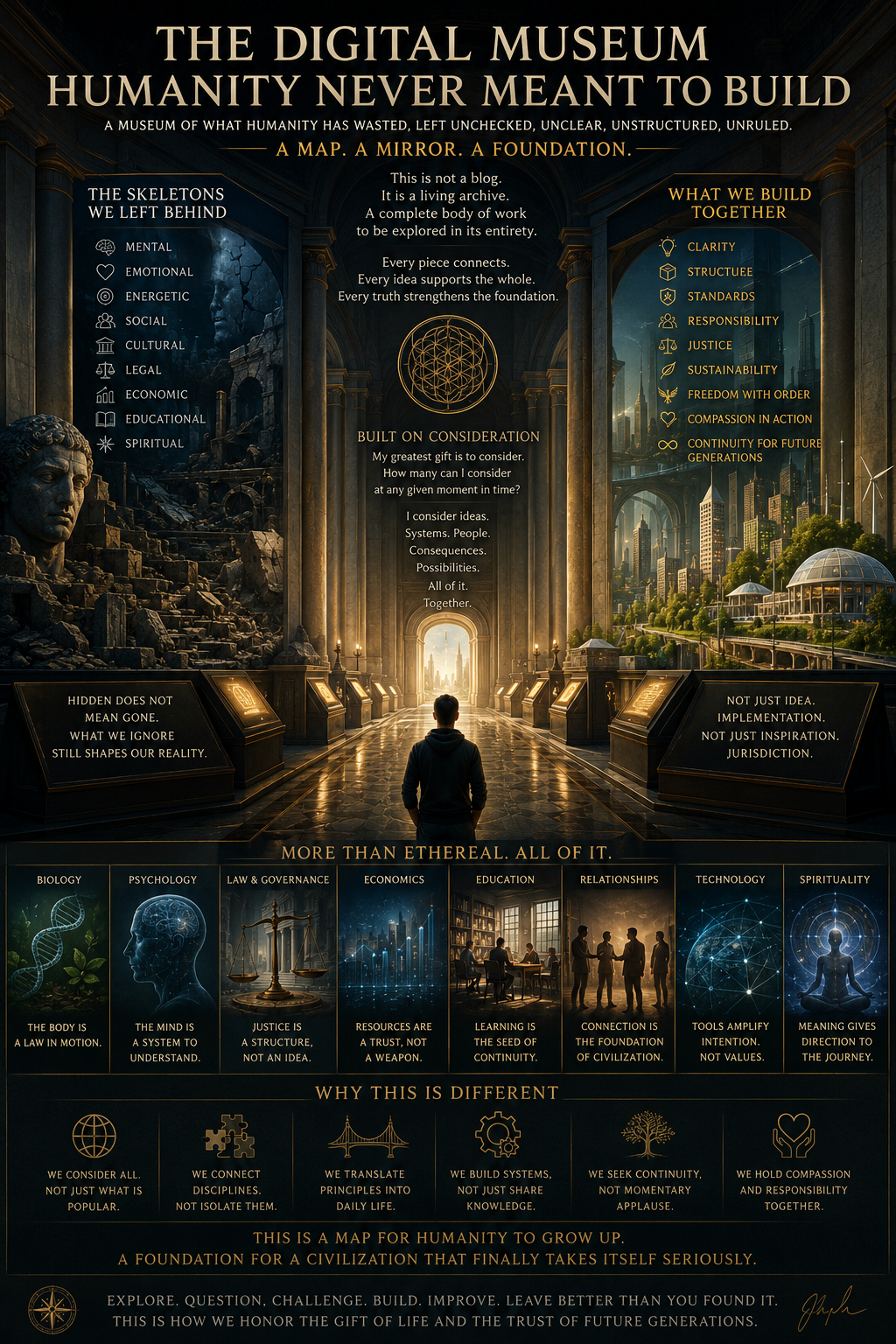
What you are reading is not simply a blog.
It is a museum.
A digital museum of what humanity has left behind.
Not abandoned buildings.
Abandoned thoughts.
Abandoned responsibilities.
Abandoned questions.
Abandoned standards.
Abandoned possibilities.
It is a museum of everything that has remained scattered, left unchecked, left unclear, left unstructured, left unruled, left disconnected, or simply never considered deeply enough to become part of the architecture of everyday life.
People often speak of skeletons in the closet.
I speak of humanity’s mental, emotional, energetic, biological, cultural, educational, political, legal, economic and spiritual skeletons.
Not to shame them.
To finally give them structure.
Because what remains hidden continues influencing the visible.
That is what this archive is.
A place where neglected questions are given language.
Where overlooked relationships between disciplines are explored.
Where fragments begin recognising each other as belonging to the same whole.
Many remarkable people have contributed pieces to this conversation.
Philosophers.
Scientists.
Psychologists.
Artists.
Mystics.
Engineers.
Religious traditions.
The Hermetic Laws, for example, offer a broad philosophical understanding of recurring patterns that many people have found meaningful. They invite people to think about correspondence, polarity, rhythm, cause and effect, and other recurring principles.
But my work has never stopped at recognising patterns.
My question has always been:
What do these ideas look like on Monday morning?
What changes in a courtroom?
What changes inside a classroom?
What changes inside a business?
What changes inside a family?
What changes inside government?
What changes inside healthcare?
What changes inside education?
What changes inside infrastructure?
How do these ideas become behaviour instead of vocabulary?
How do they become governance instead of inspiration?
That is the difference.
I am not interested in leaving universal principles suspended in abstraction.
I am interested in grounding them.
Giving them jurisdiction.
Giving them architecture.
Giving them implementation.
Giving them continuity.
That requires considering far more than the ethereal.
It requires considering biology.
Psychology.
Law.
Economics.
Technology.
Relationships.
Education.
Business.
Ecology.
Culture.
Infrastructure.
Communication.
Creativity.
Governance.
Everything that participates in the human experience.
Because life itself does not separate these things.
Only departments do.
Reality is multidisciplinary.
Nature is multidisciplinary.
Human beings are multidisciplinary.
Why should our understanding remain fragmented?
Perhaps my greatest gift is not that I know more than everyone else.
Perhaps it is that I consider more at once.
How many perspectives can be held without collapsing into contradiction?
How many systems can be allowed to speak before one discipline prematurely claims certainty?
How many people can be considered simultaneously before designing a solution?
That has been the real work.
Not collecting information.
Holding consideration long enough for relationships to reveal themselves.
The Universal Laws, as I explore them here, are not presented as belonging to one tradition, one culture, one institution, or one discipline.
They are treated as an ongoing attempt to identify patterns that remain coherent across many domains of human life.
This archive is therefore not asking people to adopt another belief system.
It is inviting them to investigate.
To compare.
To challenge.
To test.
To improve.
To build.
If humanity is ever to mature, it cannot continue separating consciousness from governance, biology from psychology, education from responsibility, business from ethics, law from reality, or spirituality from daily life.
The future will not be built by choosing one of those.
It will be built by understanding how they belong together.
That is what this museum exists to preserve.
Not relics.
Possibilities.
Not nostalgia.
Foundations.
Not answers that end conversations.
Questions that are strong enough to build civilizations upon.
It is a digital museum of what humanity has wasted, left unchecked, unclear, unstructured, unruled, … it is a humanity’s mental, emotional and energetical scheletons(like the saying), here people find what society tries to hide or cannot provide based on bandwidth of consideration. As my greatest gift is to consider things and people. How many can I consider at any given moment in time? The path that led me to the Universal Laws and foundations, in a way that are easily groundable into society. Many have given aspects, i can think of rhe hermetic laws per example, but they don’t encompass the aspects of society. They tell us the generalnjnderstanding of emergetical laws or their expressions, but not in a way that has been easily translateable into daily actions, nor fought for its griunding in how we run the jurisdiction of humanity.
Let’s qrtite a piece on all of this and how what we’re doing is different from any else who has brought or spoken on some aspects or parts of universal laws. We consider all, not just ethereal.
…
Like Nietzsche said, life has no meaning other than to experience itself, I realised that before teenagedhood… we give meaning to it all, and if we are having a meaning based experience, we can simply change the meaning of what we experience, to experience sometjing greater. It is as simple as having the language for it in a world that’s built on language, by language, for language.


Leave a Reply