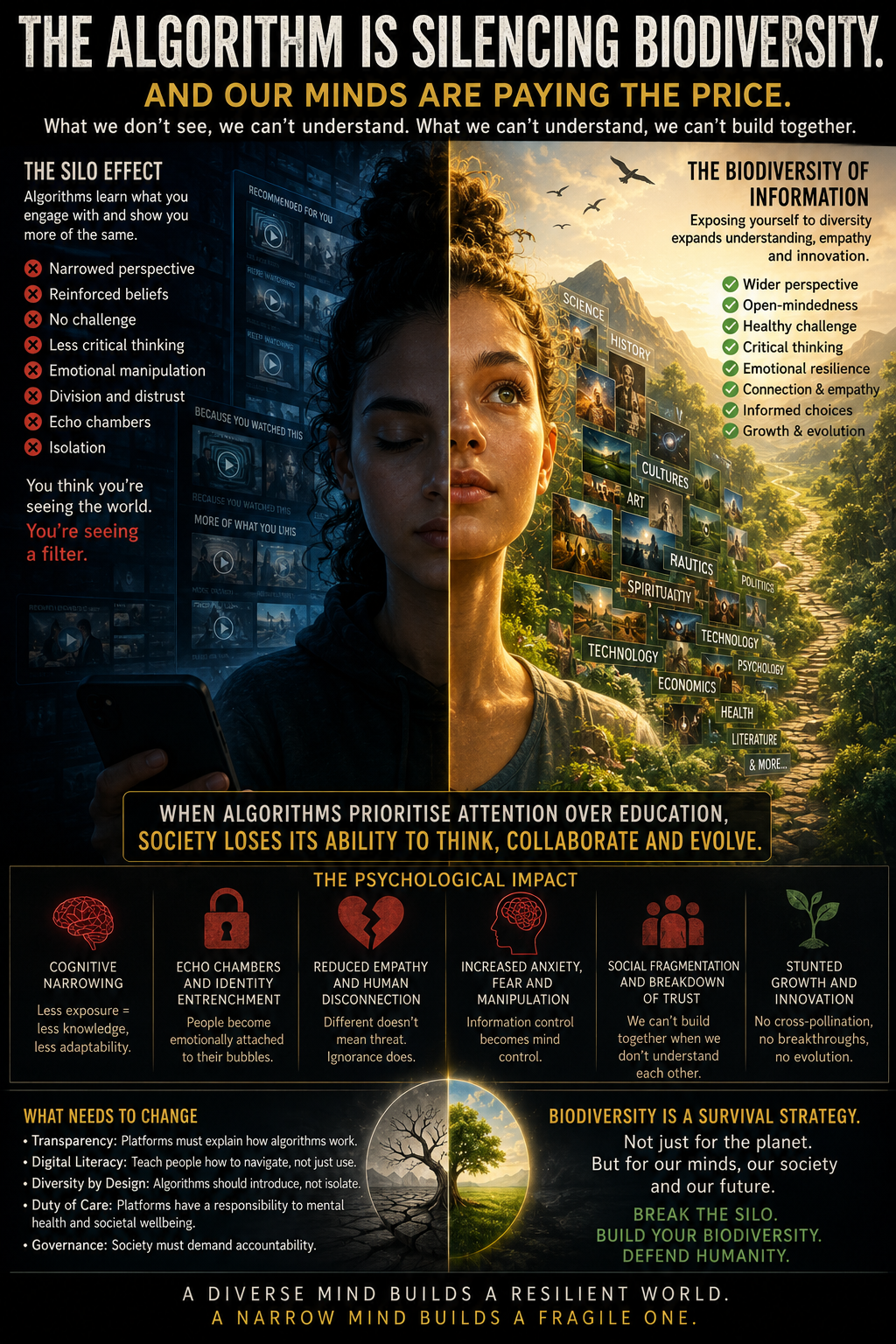
When we hear the word biodiversity, we immediately think of forests, oceans, endangered species and ecosystems. Yet one of the greatest biodiversity crises of our time is happening somewhere else entirely.
It is happening inside human consciousness.
Every day, billions of people open platforms that promise unlimited access to information. Yet the moment we interact with them, they begin doing the opposite.
They narrow us.
Algorithms reward repetition.
They identify what captures our attention and proceed to feed us increasingly similar material until our perception slowly becomes a corridor rather than an open landscape.
The internet was built to connect humanity.
Algorithms have increasingly turned it into millions of isolated villages.
Each village believes it is seeing reality.
Most are only seeing a carefully reinforced slice of it.
This is not merely a technological issue.
It is a psychological one.
A person whose perception continually receives reinforcement without challenge gradually loses opportunities to exercise discernment. Discernment is not something we are simply born with. Like any cognitive ability, it develops through practice. It develops through contrast. Through disagreement. Through encountering perspectives that force us to question our assumptions rather than endlessly confirm them.
Algorithms quietly remove much of that friction.
Instead of introducing biodiversity, they optimise familiarity.
Instead of asking,
“What would help this person become more educated?”
they ask,
“What will keep this person watching?”
Those are fundamentally different objectives.
The consequence reaches far beyond entertainment.
Entire communities become informational silos.
Political bubbles.
Spiritual bubbles.
Financial bubbles.
Health bubbles.
Conspiracy bubbles.
Academic bubbles.
Every bubble develops its own language, its own assumptions, its own heroes, its own villains and eventually its own reality.
Then we ask why society struggles to understand itself.
How could it not?
People who never encounter one another’s worlds cannot meaningfully collaborate with one another.
A civilisation depends upon the interaction between differences.
Algorithms often minimise those interactions.
Ironically, my own experience recently reminded me of this.
For a period of time, YouTube had almost entirely become tarot readings.
Not because that is all YouTube contains.
Because that is what the algorithm believed I wanted.
Only after deliberately watching videos completely outside that category did diversity slowly begin returning to my recommendations.
That should concern us.
Not because tarot exists.
But because one interest almost erased thousands of others from view.
The system wasn’t encouraging exploration.
It was encouraging enclosure.
This affects far more than curiosity.
It affects cognition itself.
The narrower the informational ecosystem becomes, the fewer conceptual tools people possess to understand reality outside their preferred framework.
When unexpected situations arise, they lack alternative reference points.
Psychologically, this creates rigidity.
Socially, it creates fragmentation.
Collectively, it creates misunderstanding.
We are asking people to collaborate in a civilisation whose digital infrastructure increasingly separates them into invisible ideological rooms.
Then we wonder why dialogue collapses.
There is another question we rarely ask.
Why do these platforms teach us almost nothing about how to use them?
When you purchase furniture, machinery or technology, you receive instructions.
How to assemble it.
How to maintain it.
How to use it safely.
Yet billions of people use platforms for hours every day without ever receiving meaningful education about how recommendation systems work, how attention is shaped, how echo chambers form, how algorithms reinforce behaviour, or how to intentionally diversify what they consume.
Terms and conditions are not education.
Feature announcements are not education.
Teaching someone where a button is does not teach them what prolonged use of that system may do to their perception.
If society expects citizens to spend a significant portion of their lives inside digital environments, then digital literacy cannot simply mean learning how to click buttons.
It must include learning how those environments shape the mind itself.
That should become a governance issue.
Not because governments should dictate what people watch.
But because every system has a duty of care toward those who inhabit it.
Education should not begin after harm has occurred.
It should exist before the system is even entered.
The irony is almost painful.
Nature survives through biodiversity.
Civilisations survive through diversity of thought.
Healthy minds survive through exposure to difference.
Yet many of our most influential technologies optimise the opposite.
They optimise repetition.
The future should not eliminate algorithms entirely.
Algorithms have genuine value.
They help us discover relevant information, reduce noise and navigate overwhelming amounts of content.
The problem begins when relevance becomes exclusivity.
When personalisation becomes enclosure.
When optimisation replaces exploration.
Perhaps recommendation systems should carry another responsibility.
Not simply to understand what we already like.
But to intentionally preserve our cognitive biodiversity.
To occasionally introduce opposing ideas.
Different disciplines.
Different cultures.
Different sciences.
Different philosophies.
Different art.
Not because they generate more clicks.
Because they generate stronger human beings.
I often move deliberately between industries, communities and disciplines.
Not because I cannot commit.
But because I understand that every field teaches something another cannot.
Each becomes part of my own biodiversity.
A forest is healthier because many species coexist.
The same is true of consciousness.
If we continue designing digital ecosystems that reward intellectual monoculture, we should not be surprised when society begins thinking like one.
Biodiversity was never only about protecting nature.
It was always about protecting the conditions that allow life itself to remain adaptive, resilient and capable of flourishing.
Perhaps it is time we recognised that the human mind is one of those ecosystems too.





Leave a Reply