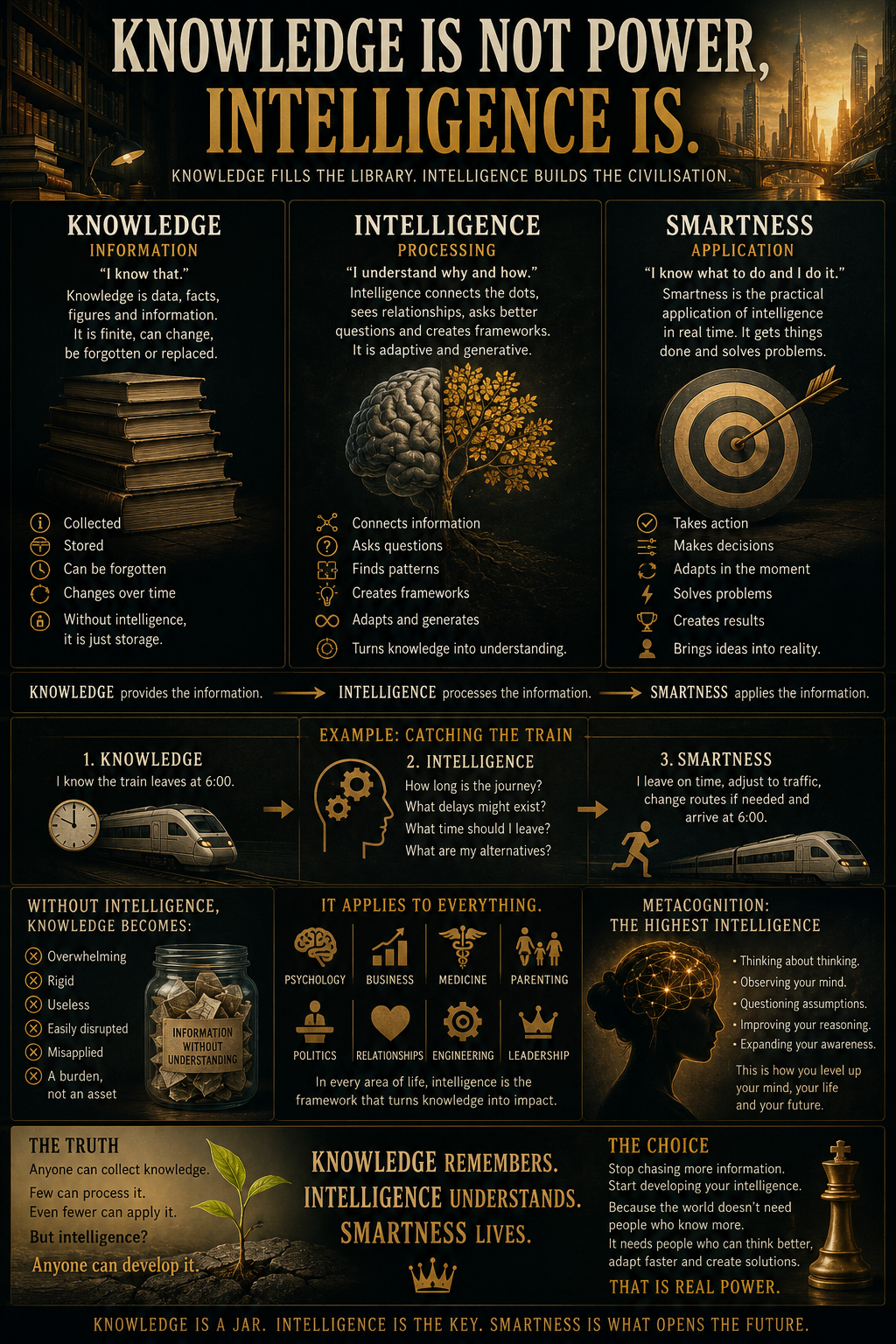
Those who only acquire knowledge need you to think knowledge is power, cause then you’d only look for knowledge, instead of shaping the underling tool that actually allows you to move that knowledge: Metacognitive Intelligence.
Knowledge Is Not Power. Intelligence Is.
One of the most repeated phrases in modern society is that “knowledge is power.”
I disagree.
Knowledge has never been power.
Intelligence is.
Knowledge, by itself, is nothing more than stored information. It can be memorised, repeated, forgotten, copied, deleted, replaced and updated. Every day, humanity rewrites what it once considered knowledge. Scientific discoveries replace previous understandings. Technologies evolve. Laws change. Cultures shift. Languages develop. Knowledge is dynamic because reality itself is dynamic.
If knowledge were truly power, then the person who memorised the most information would always become the wisest person in the room.
History proves otherwise.
Some of the most knowledgeable individuals remain incapable of adapting to change.
Some of the least formally educated individuals have transformed entire industries because they understood how to think.
That difference matters.
Knowledge is finite.
Intelligence is generative.
Knowledge tells you what is known.
Intelligence asks what else becomes possible because this is known?
That single distinction changes everything.
Knowledge is a library.
Intelligence is the architect that knows how to build with every book inside it.
Without the architect, the library simply exists.
Without intelligence, knowledge becomes storage.
Not creation.
Imagine knowledge as money sitting inside a bank account.
It exists.
It has potential.
But unless someone understands investment, movement, timing and application, that money remains exactly where it is.
Intelligence is the ability to invest knowledge.
Smartness is the visible result of those investments.
That is why I distinguish between the three.
Knowledge.
Intelligence.
Smartness.
Knowledge provides the information.
Intelligence processes the information.
Smartness applies the processed understanding into reality.
Each depends upon the previous one, yet each remains fundamentally different.
Consider something as simple as catching a train.
Knowledge says:
“My train leaves at six o’clock.”
Useful.
Necessary.
But insufficient.
Intelligence immediately begins asking different questions.
“How long does the journey take?”
“What delays might exist?”
“How long does it take me to walk there?”
“How much preparation time do I need?”
“What alternatives exist if something changes?”
Intelligence does not simply receive information.
It organises relationships between information.
Then smartness enters.
Smartness wakes you up on time.
Gets you dressed.
Leaves the house when intelligence determined it should.
Adjusts when unexpected traffic appears.
Chooses another route if necessary.
Knowledge gave the destination.
Intelligence built the strategy.
Smartness executed it.
That same pattern exists everywhere.
Psychology.
Business.
Medicine.
Parenthood.
Politics.
Relationships.
Engineering.
Leadership.
Education.
Even love.
Knowing something has never guaranteed living it.
People know smoking damages health.
People know sleep matters.
People know communication strengthens relationships.
People know movement benefits the body.
Knowledge alone has never changed behaviour.
Because behaviour does not emerge from knowledge.
Behaviour emerges from intelligence interacting with motivation, environment, habits, emotions and repeated application.
This is why intelligence is the greater asset.
It allows knowledge to become useful rather than merely possessed.
Perhaps the greatest misunderstanding in education is that we often reward knowledge while quietly neglecting intelligence.
Students memorise.
Recite.
Repeat.
Pass examinations.
Forget.
The educational system often measures how much information someone can temporarily hold rather than how well they can reason beyond that information.
Yet life never examines us through multiple-choice questions.
Life examines reasoning.
Life changes the question every day.
The person who only memorised yesterday’s answer struggles.
The person who developed intelligence adapts.
Because intelligence is fundamentally adaptive.
Knowledge changes.
Intelligence learns how knowledge changes.
That distinction becomes even clearer when we consider memory.
People often confuse memory with intelligence.
They are not identical.
Memory stores.
Intelligence connects.
Someone may remember thousands of facts.
Another may remember only a fraction of them while continuously creating entirely new frameworks because they understand relationships between ideas.
Metacognition lives here.
Metacognition is intelligence observing itself.
It is thinking examining thinking.
It asks not only,
“What do I know?”
but,
“How am I thinking about what I know?”
“Which assumptions produced this conclusion?”
“What information is missing?”
“Which framework would explain this better?”
This is where genuine creativity begins.
Because creation is rarely about possessing new knowledge.
It is usually about rearranging existing knowledge through higher-order intelligence.
Every invention follows this pattern.
Every scientific breakthrough.
Every philosophical revolution.
Every business innovation.
Every work of art.
Knowledge supplied the materials.
Intelligence reorganised them into something reality had never previously witnessed.
Knowledge accumulates.
Intelligence transforms.
This is why artificial intelligence has changed the world so quickly.
Not because it stores knowledge.
Libraries have existed for centuries.
Search engines already contained vast amounts of information.
The leap came from processing relationships between information.
Processing changes everything.
Human beings often spend their lives chasing more information while neglecting the mechanism that gives information value.
It is like endlessly buying ingredients without ever learning how to cook.
At some point, more ingredients stop improving the meal.
The limiting factor becomes the chef.
The same is true of the mind.
At some point, more knowledge no longer creates greater capability.
Greater intelligence does.
Perhaps this is why some of the greatest thinkers throughout history were remarkable questioners rather than remarkable answer collectors.
Questions exercise intelligence.
Answers increase knowledge.
One without the other creates imbalance.
Knowledge without intelligence creates rigidity.
Intelligence without knowledge creates limitation.
Together they become extraordinarily powerful.
Yet if I were forced to choose only one, I would always choose intelligence.
Because intelligence can acquire knowledge.
Knowledge cannot guarantee intelligence.
Knowledge may tell us what the world looked like yesterday.
Intelligence prepares us for the world that arrives tomorrow.
Knowledge remembers.
Intelligence understands.
Smartness lives.
That is why knowledge has never truly been power.
Power has always belonged to the mind capable of transforming knowledge into understanding, understanding into action, and action into wisdom.
Knowledge fills the library.
Intelligence builds the civilisation.
…
Great, because we’re about to break one of the biggest illusions ever existed in the world. Knowledge is not power. Intelligence is. Because intelligence is only based on, sorry, because knowledge, well, if you don’t have the mechanism to even hold knowledge, it doesn’t really matter whether you learn something or not, because you’re not going to be able to actually reason through it, beyond it, with it. You’re not going to be able to even remember the knowledge because you’re not practicing intelligence. Knowledge is power. It’s basically just like a jar, like a piggy bank, right? You keep on putting it in, putting it in, putting it in, but anything can disrupt your knowledge because knowledge, it’s something finite. It’s something limited. But knowledge also changes over time, and it adapts, it expands. Because if I know that, I don’t know, 10 years ago, the average temperature might have been X, Y, and Z. The temperature this year has changed. It’s higher, the average temperature, right? So that’s the difference of knowledge. Because the two information points are two different knowledges. Intelligence is my ability to even recall the two, because that’s the thing. Knowledge would mean that I would know exactly the degrees of 10 years ago and the degrees of this year, right? But knowing that information doesn’t mean that I can actually function or that I can actually understand or I can reason with the information. It doesn’t mean that I can utilize that information for a greater framework, right? And that’s why intelligence is more powerful than knowledge, because it doesn’t matter how much knowledge you have, if that knowledge also denses your mind, your ability to actually reason, your ability to be intelligent, isn’t based on the amount of knowledge that you have. It’s based on how you actually proceed, sorry, not proceed, but process the knowledge. Knowledge can be acquired anywhere at any given moment in time, because there are so many tools that we can use, and there are so many individuals that house knowledge, regardless whether they house smartness, which is the ability to apply their intelligence, and then there’s knowledge application. Because, again, if I know that I need to be in a certain place at a certain time, let’s say I need to be at location B at 6. Well, the knowledge is that I need to be there at 6. Now, intelligence starts asking, well, what time do I need to leave in order to get there? And then you acquire another knowledge. Then smartness becomes, okay, so if I need to leave at this time, I’m going to start getting ready, and let’s say if I need to leave at this time and I have 30 minutes to the time to leave, and I know that I’m not ready yet, then the smartness becomes, okay, at what speed do I need to get ready in order to leave the house at this time, in order to get there at that time? You know? There’s phases to it. So let’s write a beautiful essay, and let’s make sure that it’s an essay, because this touches on so many things. It touches on psychology, sociology, how and where we also apply these things. It also applies to, to be fair, it applies to so many things in life. So add as much as you can to build on the context, because I’ve given you enough, and you already know that intelligence is more powerful than knowledge. Because my intelligence, for example, I have a very high intelligence, but I might not have as much knowledge as an individual about specific things, right? But I can utilize any form of knowledge that I do have to build upon it, create from it, and reason with it. That is metacognition. That’s why metacognition intelligence is the asset to anything and everything in this world. Underrated and undervalued. But let the title be, Knowledge is Not Power, Intelligence Is.



Leave a Reply