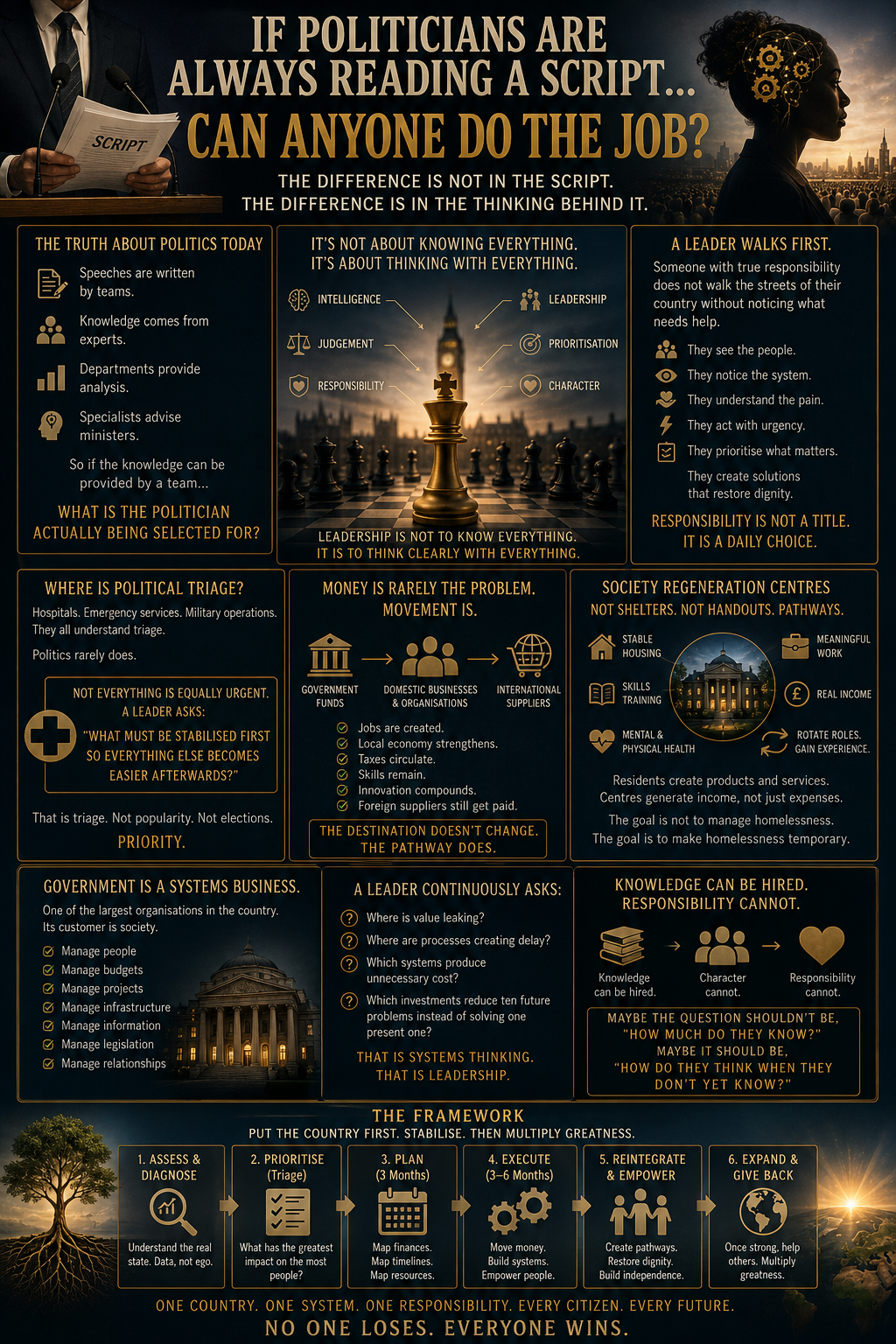
One of the questions I rarely hear asked is perhaps one of the most important.
If politicians spend so much of their public life reading prepared speeches, then what is actually the skill that makes a good politician?
The reading?
Or the thinking behind what is being read?
Because these are not the same thing.
A script can be written by researchers.
By advisors.
By policy teams.
By economists.
By communications specialists.
By speechwriters.
The words themselves are often the result of collective work.
So the question becomes far more interesting.
If the knowledge can be provided by a team, then what is the politician actually being selected for?
To me, the answer isn’t industry knowledge.
It’s intelligence.
Judgement.
Character.
Responsibility.
Leadership.
The hard skills can be taught.
The knowledge can be acquired.
Experts already exist in every field imaginable.
No Prime Minister knows more medicine than every doctor.
No Chancellor knows more economics than every economist.
No minister understands every engineering discipline.
Nor should they.
That is why governments have departments.
Experts.
Researchers.
Civil servants.
The role of leadership is not to know everything.
It is to think with everything.
To organise priorities.
To make coherent decisions.
To ask better questions.
To recognise patterns others overlook.
To carry responsibility for consequences that stretch years beyond today’s headlines.
That is leadership.
Not memorisation.
Not performance.
Not reading eloquently from a script.
Politics Has Become a Job.
I think that is one of its deepest problems.
Politics increasingly looks like employment.
It should feel like stewardship.
There is a difference.
Someone doing a job asks,
“What are my responsibilities?”
A steward asks,
“What is my responsibility to everyone?”
One is role-centred.
The other is people-centred.
When I watch politics, I often don’t see a shortage of intelligence.
I see a shortage of prioritisation.
Because if your country is visibly suffering…
Surely your first responsibility is restoring balance before expanding elsewhere.
That isn’t isolationism.
It is stewardship.
If a house is flooding, you don’t ignore your own foundations because your neighbour also needs paint.
You stabilise the house first.
Then you become strong enough to help others.
Healthy systems help more people than collapsing ones.
Where Is Political Triage?
Hospitals understand triage.
Emergency services understand triage.
Military operations understand triage.
But politics rarely behaves as though triage exists.
Every issue becomes urgent.
Every department wants more funding.
Every project becomes politically valuable.
Yet not every problem carries the same consequence.
If homelessness rises…
Mental health deteriorates…
Crime increases…
Education declines…
Healthcare struggles…
Infrastructure weakens…
Those are signals.
A leader should constantly ask:
What must be stabilised first so everything else becomes easier afterwards?
That is triage.
Not popularity.
Not elections.
Priority.
Money Is Rarely The Real Problem.
Governments often speak as though money simply isn’t available.
I don’t think that’s usually the real question.
The real question is:
Where is money flowing?
Every budget tells a story.
Every allocation reflects priorities.
Money isn’t merely expenditure.
It is attention made visible.
Instead of asking,
“How do we find more money?”
Perhaps governments should ask,
“How do we make the same money move through the country more intelligently?”
Because movement matters.
Imagine government investment flowing through domestic businesses first wherever practical.
Local companies hire people.
Those people spend locally.
Local suppliers grow.
Taxes circulate.
Skills remain.
Innovation compounds.
International trade still happens.
Foreign suppliers still get paid.
But the movement first strengthens the country’s own foundations before flowing outward.
The destination doesn’t necessarily change.
The pathway does.
And pathways shape economies.
Society Regeneration, Not Survival Management
Take homelessness.
Too often we treat it as a permanent expense.
I wouldn’t.
I’d build regeneration.
Imagine centres where people receive stable accommodation while simultaneously gaining experience across multiple roles.
Cooking.
Maintenance.
Administration.
Manufacturing.
Gardening.
Logistics.
Hospitality.
Technology.
Media.
Education.
The centres themselves generate products and services.
Residents gain income.
Gain references.
Gain skills.
Gain confidence.
Rotate through departments.
Leave with experience instead of merely shelter.
The objective isn’t to manage homelessness.
It’s to make homelessness temporary.
That changes everything.
Government Is A Systems Business.
People often forget this.
Government is one of the largest organisations in the country.
It already manages people.
Budgets.
Projects.
Infrastructure.
Information.
Legislation.
Relationships.
It is already operating like a business.
The only difference is that its customer is society itself.
If that is true, then government should continuously ask:
Where is value leaking?
Where are processes creating delay?
Which systems produce unnecessary cost?
Which investments reduce ten future problems instead of solving one present one?
That is systems thinking.
That is leadership.
Knowledge Can Be Hired.
Responsibility Cannot.
This brings me back to the original question.
If the knowledge comes from experts…
If speeches are written collaboratively…
If departments provide analysis…
If specialists advise ministers…
Then perhaps the defining quality of leadership isn’t expertise alone.
Perhaps it is the ability to think clearly with expertise.
To organise it.
To prioritise it.
To integrate it.
To carry the responsibility of acting upon it.
Knowledge can be hired.
Character cannot.
Judgement cannot.
Responsibility cannot.
Those belong to the individual.
Which means perhaps we’ve been interviewing politicians for the wrong qualities all along.
Maybe the question shouldn’t be,
“How much do they know?”
Maybe it should be,
“How do they think when they don’t yet know?”
Because governments are not paid to recite information.
They are entrusted to steward a nation’s continuity.
And continuity has never depended on who could read the best script.
It has always depended on who could think beyond it.




Leave a Reply