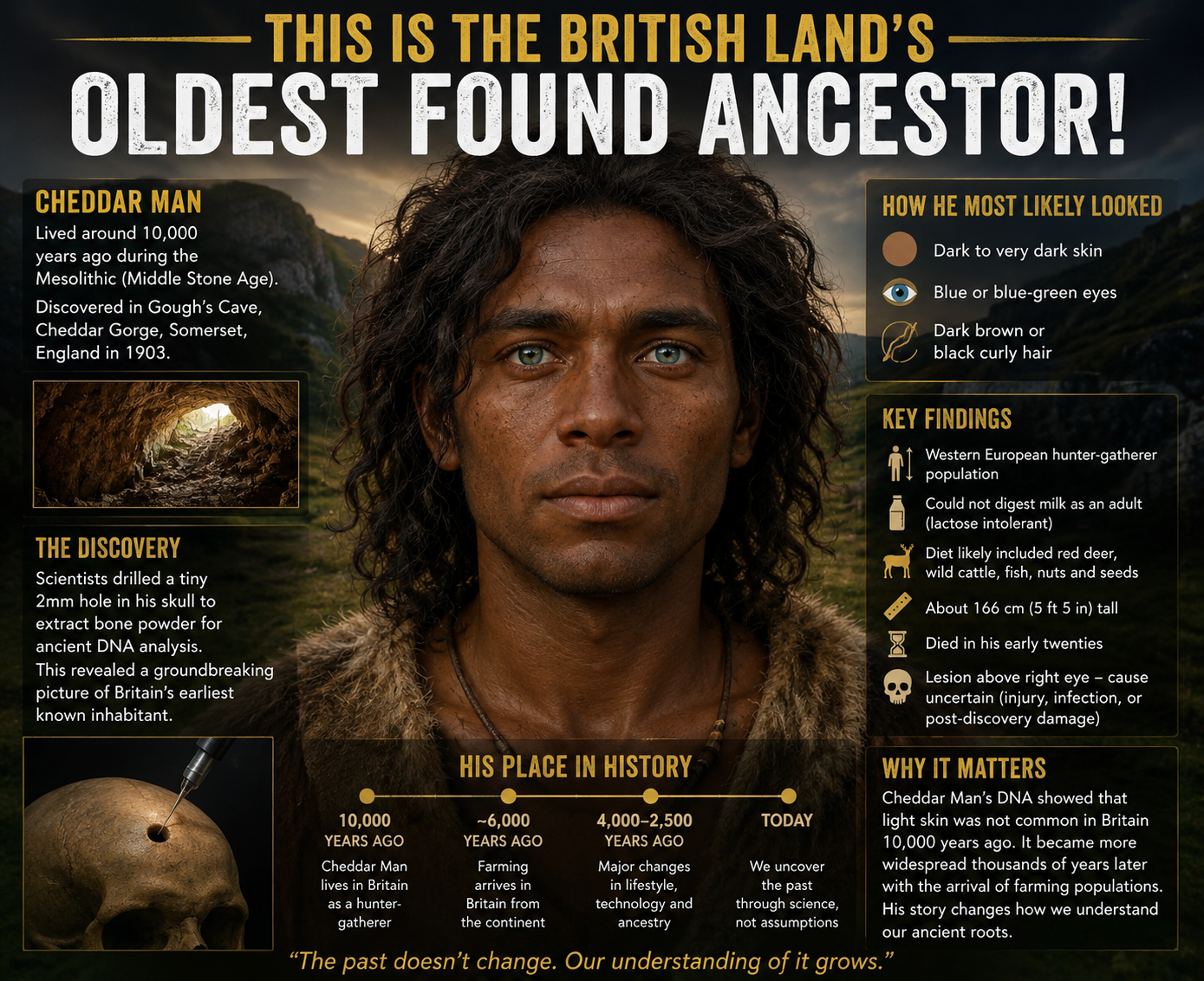
This hunter Gatherer was black, look at that, we thought it was white only. The land has its needs, we profile a lot, I know I have.. time to burst all illusions.
Today I came across something I had never heard before. Scientists drilled into the skull of a human being who lived around 10,000 years ago.
Not out of disrespect. Not out of curiosity alone. They drilled a tiny hole—around two millimetres wide—to recover ancient DNA.
Imagine that for a moment.
A person who walked this Earth ten millennia ago is still participating in today’s conversation. Their body continued speaking long after their voice disappeared.
The individual became known as Cheddar Man, discovered in Gough’s Cave in Somerset, England. Through advances in genetics, researchers were able to recover information that previous generations simply could not access. From that small sample of bone came a remarkable picture of a human being whose existence challenged many assumptions about Britain’s distant past.
The analysis suggested that he most likely had dark to very dark skin, blue or blue-green eyes, and dark curly hair. He belonged to a population of Western European hunter-gatherers who lived long before agriculture transformed Europe. He almost certainly could not digest milk as an adult, reminding us that lactose tolerance is a relatively recent adaptation in human history rather than a timeless human trait.
What fascinates me is not simply what was discovered. It is what the discovery represents.
Truth continues.
The body remained. Knowledge advanced. New questions became possible. The past did not change; our capacity to understand it expanded.
History often appears fixed because the events have already happened. In reality, history is continually rewritten—not because the past changes, but because our relationship to evidence changes. Every technological breakthrough gives humanity another opportunity to ask better questions of the same reality.
Cheddar Man is one example among many.
Ancient DNA has transformed archaeology over the last few decades. It has revealed migrations that were invisible through artefacts alone. It has shown that populations mixed repeatedly rather than remaining isolated. It has challenged simplistic ideas about ancestry, identity, and where modern peoples came from. Civilisations that once appeared disconnected are increasingly understood as parts of larger human stories.
Science did not erase history.
Science gave history another voice.
This is why preservation matters.
Every skeleton, every artefact, every document, every language, every fossil and every fragment carries information that future generations may be able to understand better than we can today. We are temporary custodians of evidence, not its final interpreters.
To me, Cheddar Man is more than an archaeological discovery.
He is a reminder that continuity outlives us.
A human being who lived ten thousand years ago still contributed to humanity’s understanding because his remains were preserved, because people kept asking questions, and because knowledge itself continued evolving.
Perhaps one of the greatest lessons is this:
The truth does not become smaller with time.
If anything, it becomes clearer as humanity develops the courage, humility, and tools to keep listening.
Lets write about this as im not surebit is widely known, i only heard of it today. Lets highlight as muh of it and what followed throughiut history, hjt this is the star
…
Polymath, the main findings from the DNA analysis of Cheddar Man were significant because they challenged several long-held assumptions about the earliest inhabitants of Britain.
The key findings were:
- Age: He lived around 10,000 years ago, during the Mesolithic (Middle Stone Age), making him Britain’s oldest nearly complete human skeleton.
- Appearance: He most likely had:
- dark to very dark skin,
- blue or blue-green eyes,
- dark brown or black curly hair. These traits, unusual to many people today, appear to have been common among Western European hunter-gatherers of that era.
- Genetic ancestry: He belonged to the population known as Western European hunter-gatherers, whose ancestors entered Europe after the last Ice Age.
- Lactose intolerance: Like most adults of his time, he lacked the genes needed to digest milk. The ability to digest dairy evolved much later with farming populations.
- Diet: Based on archaeological evidence from similar sites, his diet likely included red deer, wild cattle (aurochs), fish, nuts, and seeds.
- Height and age at death: He was about 166 cm (5 ft 5 in) tall and probably died in his early twenties.
- Health: A hole or lesion above his right eye was observed, but scientists cannot say with certainty whether it resulted from infection, injury, or damage after discovery.
One of the biggest scientific implications was that light skin appears to have become common in Europe thousands of years after Cheddar Man lived, likely spreading with later farming populations. This showed that skin pigmentation and geographic location have changed considerably over human history.
The researchers also emphasized that these findings describe probabilities based on his genome, not a colour photograph of the past. The facial reconstruction combines DNA evidence, skeletal measurements, and forensic reconstruction techniques to estimate what he most likely looked like.





Leave a Reply