
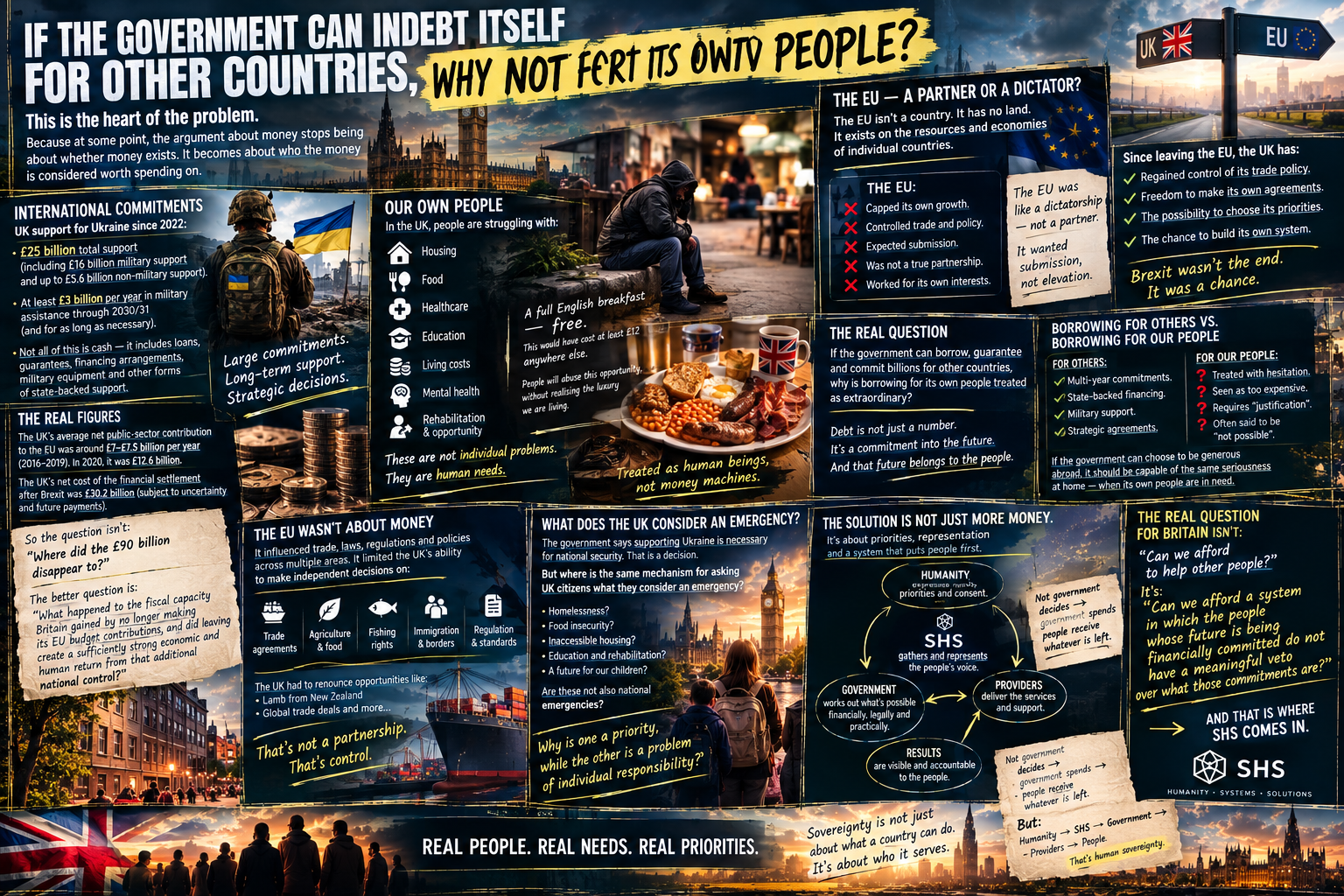
This is the heart of the problem.
Because at some point, the argument about money stops being about whether money exists.
It becomes about who the money is considered worth spending on.
The UK government is willing to make enormous financial commitments internationally.
It has committed £25 billion in support for Ukraine since Russia’s full-scale invasion, including £16 billion in military support and up to £5.6 billion in non-military support. It has also committed to providing at least £3 billion a year in military assistance through 2030/31 and for as long as necessary, according to the government’s own figures.
And importantly, not all of that is simply money handed over as cash. Some of it is loans, guarantees, financing arrangements, military equipment and other forms of state-backed support.
But that actually makes the question more interesting, not less.
Because governments have mechanisms for taking on financial commitments.
They can borrow.
They can guarantee.
They can invest.
They can redirect resources.
They can make long-term commitments when they decide that something is important enough.
So when a person living in Britain says:
“I need help.”
Why does the conversation so often become:
“There isn’t enough money.”
Why is borrowing for domestic needs treated as something requiring extraordinary justification, while borrowing or committing substantial public resources internationally can become a matter of strategic policy?
The government currently has almost £3 trillion of public-sector debt, and public-sector net borrowing remains substantial. The ONS reported debt of £2.985 trillion at the end of July 2026.
So this isn’t an argument that Britain has discovered some magical bottomless bank account.
It hasn’t.
It is an argument about financial priorities and representation.
WHAT DOES THE BRITISH GOVERNMENT CONSIDER AN EMERGENCY?
This is where the conversation becomes uncomfortable.
A government can say that supporting Ukraine is necessary because it believes Russian aggression threatens European security and, ultimately, Britain’s own security and prosperity. That is the government’s stated justification.
Fine.
That is a government decision.
But where is the equivalent mechanism for asking British civilians what they consider an emergency?
What happens when someone cannot maintain a home?
What happens when people cannot afford food?
What happens when housing is inaccessible?
What happens when someone is living in temporary accommodation?
What happens when people need rehabilitation, education, infrastructure or a genuine route back into society?
Are those national emergencies too?
Or do they become individual problems because the government has decided that they sit somewhere else on the priority list?
That distinction matters.
Because the people funding the state are not abstract.
They are the people living here.
They are the workers.
The families.
The businesses.
The children who will inherit the debt.
The people already struggling underneath the cost of maintaining a functioning society.
And they are entitled to ask:
Where are we in this calculation?
THE OBJECTION IS NOT “HELP NOBODY”
This is not necessarily an argument that Britain should never help another country.
Nor does supporting one population automatically mean the government is neglecting another.
The question is whether relationships should be built around the needs of the parties involved rather than around obligations that become detached from the people whose resources are being used.
Because there is a difference between international cooperation and international commitment without meaningful domestic representation.
Britain has chosen to make a long-term commitment to Ukraine.
But what equivalent long-term commitment has Britain made to ensuring that the people living in Britain have what they need to sustain a healthy society?
And who actually gets to answer that question?
Parliament does.
Government does.
Departments do.
Budgets do.
Fiscal rules do.
And eventually the civilian gets the outcome.
The civilian generally does not sit at the beginning of that process and say:
This is what humanity requires.
This is what we consider urgent.
This is where resources should go.
This is what we are willing to sustain.
That is precisely the representation problem.
BECAUSE THE DEBT ARGUMENT CANNOT ONLY APPEAR WHEN PEOPLE ASK FOR THEMSELVES
This is the contradiction worth pursuing.
When people ask for more domestic support, debt sustainability is a serious concern.
It should be.
A government cannot borrow indefinitely without consequences.
But then consistency requires the same seriousness when government makes commitments elsewhere.
Every pound committed has an opportunity cost.
Every guarantee carries risk.
Every long-term obligation affects future fiscal capacity.
Every military commitment has consequences for what else can be funded.
So if the government says:
“We must be responsible with public finances.”
The natural response is:
“Apply that principle to everything.”
Not just pensions.
Not just housing.
Not just welfare.
Not just councils.
Not just public services.
Everything.
And if the government determines that a foreign commitment is sufficiently important to justify the expenditure, then it should be equally capable of explaining why a domestic human need does or does not justify comparable financial treatment.
That is accountability.
AND THIS IS WHERE UKRAINE SHOULD NOT BE TURNED INTO THE VILLAIN
Ukraine is not the real subject here.
The real subject is Britain’s decision-making system.
Ukraine can need help.
Britain can believe helping Ukraine serves British security interests.
Both things can be true.
But British civilians can also need help.
Both populations can have legitimate needs.
And that means the question should not be:
“Ukraine or Britain?”
It should be:
“How does Britain determine what it can sustainably provide, to whom, for what purpose, and with whose consent?”
That is a governance question.
And that question applies to every international relationship.
If a government enters a relationship with another country, the relationship should be accountable to the interests of the people it represents.
That does not mean isolation.
It means representation.
It means Britain should be capable of looking after Britain while deciding what Britain can responsibly contribute elsewhere.
Because if Britain exhausts its own capacity while continually increasing its obligations, eventually there is less capacity left for anybody.
That is not sustainable generosity.
That is a sustainability question.
SO WHY NOT BORROW FOR THE PEOPLE?
Here is the question I keep coming back to.
If the current government is willing to accept long-term financial obligations connected to other countries, including multi-year commitments and state-backed financing mechanisms, why is taking on additional debt for Britain’s own population treated as though it belongs to an entirely different category of thinking?
There may be legitimate fiscal reasons for saying no.
There may be limits.
There may be inflationary consequences.
There may be borrowing costs.
There may be better ways of providing the support than borrowing.
All of those deserve to be examined.
But “we cannot afford it” cannot be the end of the conversation when the state has demonstrated that it can choose to assume substantial financial obligations when it considers those obligations important enough.
The next question has to be:
Important enough according to whom?
That is where SHS enters the picture.
Because this is exactly why humanity cannot simply be treated as the recipient of government decisions.
Humanity has to be part of determining the priorities.
Not after the money has already been allocated.
Not after the policy has already been written.
Not after the international commitment has already been made.
Before.
Humanity expresses its needs.
Humanity expresses its priorities.
Humanity expresses what it considers unacceptable.
SHS gathers and represents those requirements.
Government then has the responsibility of working out what is financially, legally and practically possible.
Then the system has to show people the result.
That is fundamentally different from:
Government decides → government spends → people receive whatever is left.
And it matters enormously when the decisions involve debt.
Because debt is not just a number on a government spreadsheet.
It is a commitment made into the future.
And that future belongs to the people.
So perhaps the real question for Britain is not:
“Can we afford to help other people?”
It is:
“Can we afford a system in which the people whose future is being financially committed do not have a meaningful veto over what those commitments are?”
Because if the government can say:
“This is important enough for us to borrow, guarantee, commit and spend.”
Then British civilians should be able to ask:
“And when we are in need, why isn’t our survival, stability and future important enough for the same seriousness?”
That is the heart of it.
IF THE GOVERNMENT CAN INDEBT ITSELF FOR OTHER COUNTRIES, WHY NOT FOR ITS OWN PEOPLE?
Not because Britain should spend recklessly.
Not because debt is free.
Not because every domestic request should automatically be granted.
But because a government should be accountable to the people whose future it is managing.
And without meaningful human representation in those decisions, the question will keep returning:
Who exactly is this economy being managed for?





Leave a Reply