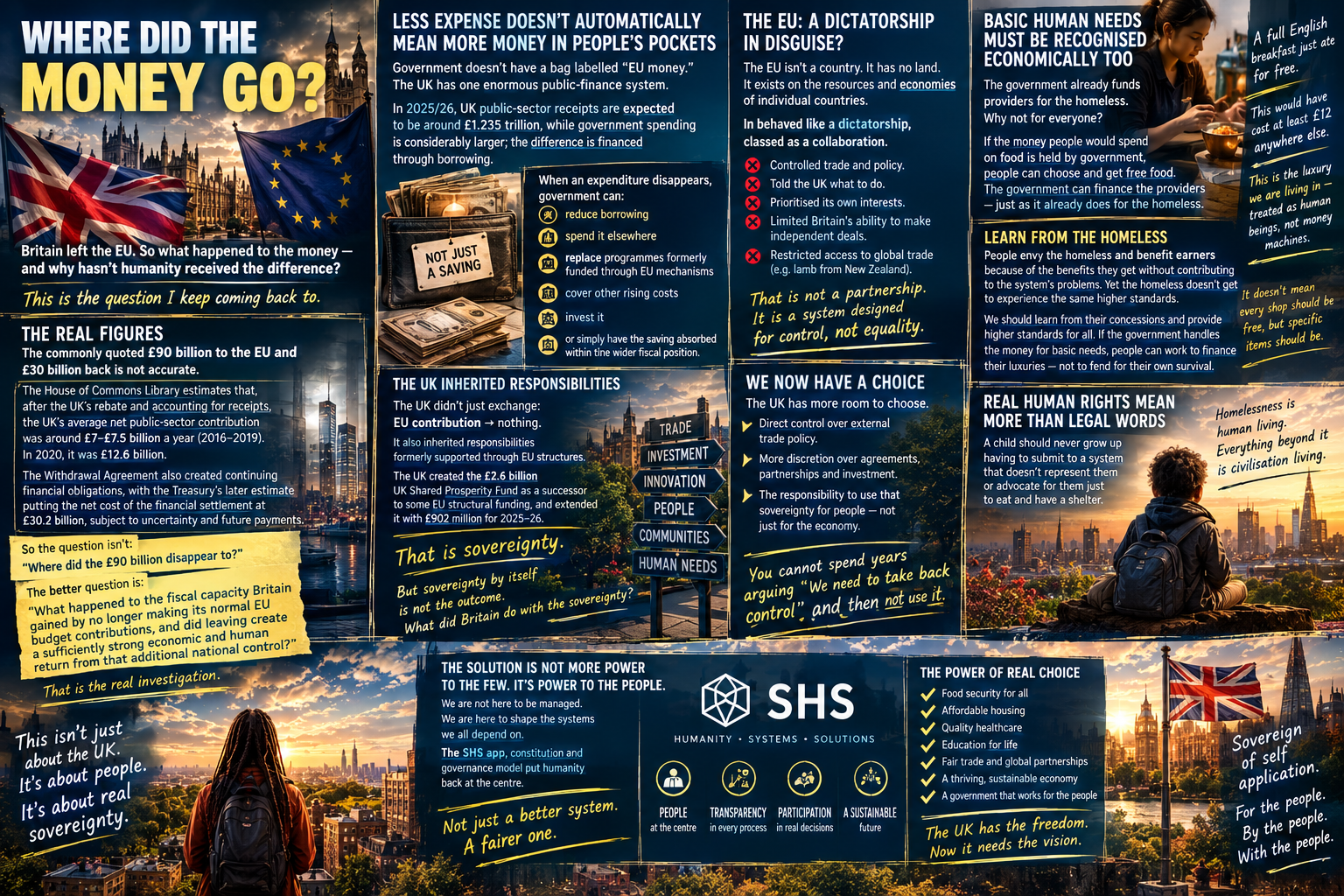
Britain left the EU. So what happened to the money — and why hasn’t humanity received the difference?
This is the question I keep coming back to.
Britain left the European Union.
The UK regained direct responsibility for areas of policy that had previously been exercised at EU level, including its own external trade policy.
So naturally, as somebody looking at the economy through the lens of human resources and human needs, I have to ask:
If one substantial outgoing is removed, where does the released resource go?
And more importantly:
Why isn’t the human being seeing the benefit of that recovered sovereignty more clearly?
Before we even get to the answer, we need to correct something.
The figure of £90 billion paid to the EU and £30 billion received back is not an accurate description of the UK’s EU budget contribution.
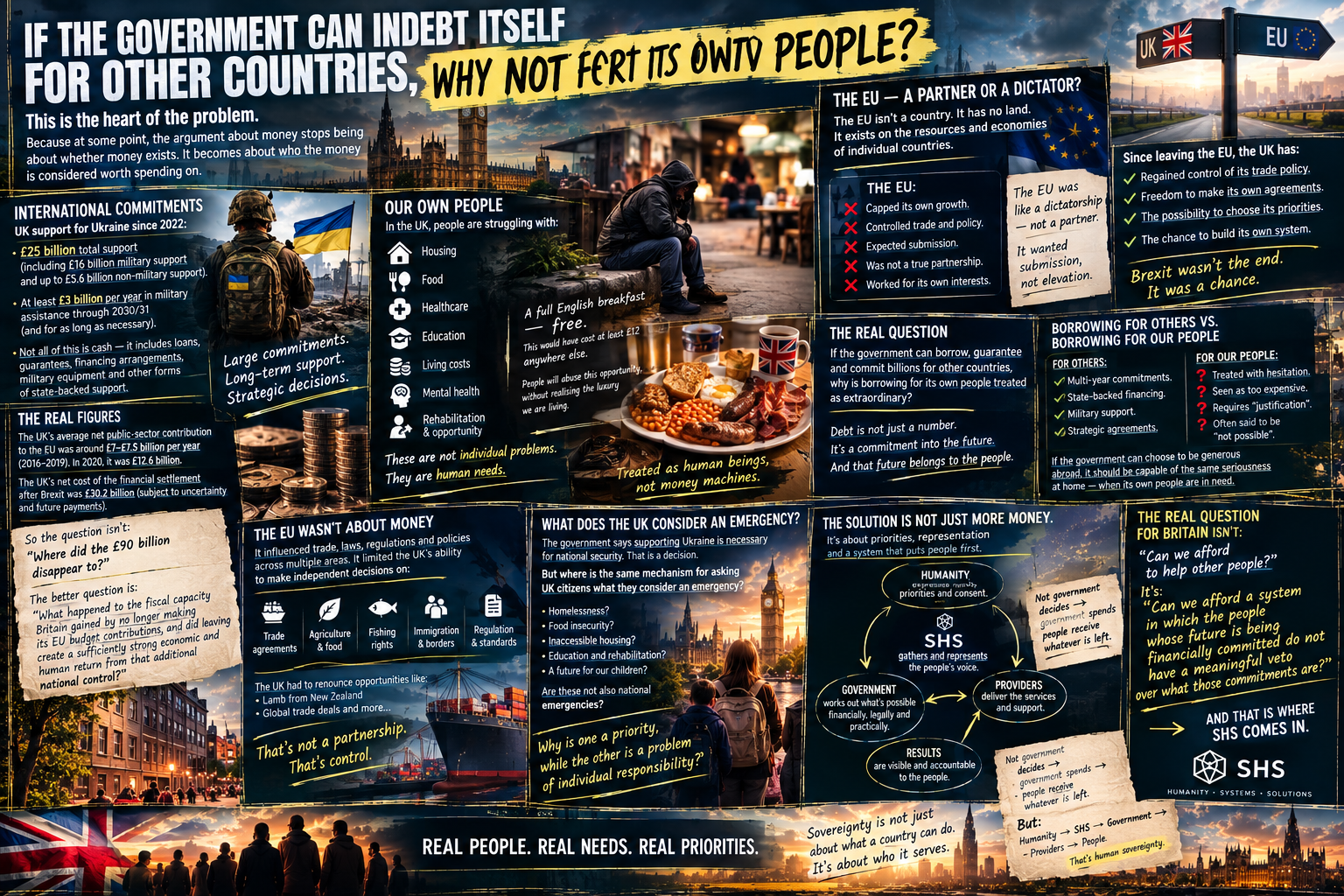
The House of Commons Library estimates that, after the UK’s rebate and accounting for receipts, the UK’s average net public-sector contribution was around £7–£7.5 billion a year between 2016 and 2019. In 2020, the estimated net public-sector contribution was £12.6 billion. And Britain’s departure did not immediately terminate every EU-related payment: the Withdrawal Agreement created continuing financial obligations, with the Treasury’s later estimate putting the net cost of the financial settlement at £30.2 billion, subject to uncertainty and future payments.
So the question isn’t:
“Where did the £90 billion disappear to?”
The better question is:
What happened to the fiscal capacity Britain gained by no longer making its normal EU budget contributions, and did leaving create a sufficiently strong economic and human return from that additional national control?
That is the real investigation.
LESS EXPENSE DOESN’T AUTOMATICALLY MEAN MORE MONEY IN PEOPLE’S POCKETS
This is where the simple equation needs to become more sophisticated.
Less outgoing ≠ automatically richer country.
Government doesn’t have a bag labelled:
“EU money.”
The UK has one enormous public-finance system involving taxes, spending, borrowing, debt interest, benefits, public services and investment. In 2025/26, UK public-sector receipts are expected to be around £1.235 trillion, while government spending is considerably larger; the difference is financed through borrowing.
So when an expenditure disappears, government doesn’t necessarily hand every pound of the saving to citizens.
It can:
reduce borrowing,
spend it elsewhere,
replace programmes formerly funded through EU mechanisms,
cover other rising costs,
invest it,
or simply have the saving absorbed within the wider fiscal position.
And there is another issue.
The UK didn’t merely exchange:
EU contribution → nothing.
It also inherited responsibilities formerly supported through EU structures.
The UK created the £2.6 billion UK Shared Prosperity Fund as a successor to some EU structural funding, and extended it with £902 million for 2025–26.
So some of the resource was effectively brought back inside Britain’s own governmental machinery and then spent through British priorities.
That is sovereignty.
But sovereignty by itself is not the outcome.
What did Britain do with the sovereignty?
That is the question.
AND THIS IS WHERE SHS ENTERS THE CONVERSATION
Because I don’t actually think the ultimate problem is:
“Did Britain save enough money?”
I think the deeper question is:
Who gets to decide what the recovered national capacity is used for?
Because you can bring resources back from an international institution and still fail to put them into the hands of humanity.
The money can return to Westminster.
Then Westminster can decide what to do with it.
Then departments can decide.
Then programmes can decide.
Then providers can decide.
And eventually the individual receives whatever remains after all those layers.
That is still authority flowing downward.
SHS proposes the opposite direction.
Humanity expresses the need.
SHS gathers and represents it.
Government measures available resources.
Government determines how the machinery can deliver it.
Providers provide.
Humanity sees the result.
That is the difference between national sovereignty and human sovereignty actually being exercised through national governance.
THE UK HAS MORE ROOM TO CHOOSE
There is a legitimate structural opportunity here.
The UK now has direct control over its own external trade policy rather than participating in the EU’s common commercial policy.
That doesn’t mean every decision taken after Brexit has automatically improved Britain’s economy.
It means Britain has more discretion over what it chooses to do.
And that creates responsibility.
You cannot spend years arguing:
“We need to take back control.”
and then take control only to reproduce the same economic assumptions domestically.
Control for what?
That is the part that matters.
Sovereignty should not simply mean:
“Britain makes the decision.”
It should mean:
“Britain makes the decision in a way that actually serves the people living here.”
THE ECONOMIC TEST SHOULD BE HUMAN
This is where our basic-needs proposal comes back.
Suppose the State has greater room to organise its resources independently.
What should be the first question?
Not:
How do we maximise GDP?
Not:
How do we maximise investor confidence?
Not:
How do we make corporations more competitive?
Those may matter.
But before them:
Are people fed?
Are people housed?
Can they access water, energy, healthcare and education?
Are basic necessities secure?
Can a child grow up without having to earn their right to survive?
That becomes the economic test.
Because there is something strange about calling a country prosperous while human beings living within it cannot reliably afford the foundations of life.
WHY NOT USE THE MONEY WHERE THE NEED ALREADY EXISTS?
Take food.
The State already spends money supporting people through social-security mechanisms and directly finances public services and providers.
So why must every person individually earn enough money to purchase the same basic necessity?
Why not establish a defined category of basic food provision?
Humanity gets access.
Government finances the provision.
Providers produce.
Workers get paid.
The supply chain remains active.
And the person’s own income becomes available for everything beyond that foundation.
That is not destroying the economy.
It is reorganising who carries the cost of human survival.
WE ALREADY SAW A SMALL VERSION OF THIS TODAY
I’m currently experiencing social housing and temporary accommodation.
And today I ate a full English breakfast.
The kind of meal that could easily cost around £12 in a commercial setting.
Here, I received it without paying for it directly.
And that simple breakfast made the economic question incredibly obvious.
The food had a cost.
Someone paid for it.
The ingredients had a cost.
The workers had a cost.
The building had a cost.
The energy had a cost.
The kitchen had a cost.
Yet I didn’t personally have to carry the transaction at the point of eating it.
That’s the distinction.
The cost didn’t disappear.
The economic responsibility was transferred.
So why are we capable of organising that for someone in a vulnerable circumstance, but reluctant to ask what could happen if the same principle were extended to clearly defined basic human necessities?
THE HOMELESS PERSON ISN’T THE PROBLEM
There is sometimes an attitude that people receiving benefits or temporary accommodation are somehow receiving an unfair luxury.
But look at what they’re actually receiving.
A roof.
Food.
Basic services.
A temporary degree of security.
And then look at the life they’re expected to live.
They aren’t necessarily receiving some enormous standard of luxury.
Often they are receiving the minimum infrastructure required to remain alive and begin rebuilding.
So perhaps the lesson isn’t:
“Why are they getting this?”
Perhaps the lesson should be:
“Why isn’t everyone guaranteed the foundations?”
And then:
“Why aren’t we building the standard higher?”
That is the SHS approach.
Don’t envy somebody else’s concession.
Learn from the concession and improve it.
THE BASIC NEEDS ECONOMY
What if government said:
There are certain categories of goods and services that are fundamental enough to human life that access to them should not depend entirely on individual purchasing power.
Not everything.
Specific things.
And the government becomes the financing mechanism.
The individual gets choice among qualifying provision.
The provider gets paid.
The worker gets paid.
The infrastructure gets maintained.
Demand becomes measurable.
Supply becomes predictable.
And the individual keeps their earned money for everything beyond the guaranteed foundation.
Suddenly:
work → contribution → personal economic choice
instead of:
work → survival → whatever is left.
That is a very different relationship between citizen and economy.
BUT THIS IS WHY HUMAN REPRESENTATION BECOMES ESSENTIAL
And here I completely agree with my own argument against giving too much economic authority to a government without a direct human counterweight.
Because once government is responsible for financing basic needs, government obtains enormous influence over the material conditions of people’s lives.
That power cannot simply sit in Parliament and say:
“Trust us.”
There has to be a human mechanism alongside it.
What should be guaranteed?
When should it be guaranteed?
At what standard?
What counts as essential?
What quality is acceptable?
What geographical differences are legitimate?
What happens when demand changes?
What happens when a provider fails?
What happens when government gets it wrong?
Those aren’t questions that should disappear into a department.
That is precisely why SHS exists.
HUMANITY NEEDS A SAY IN THE WHAT, WHEN, HOW AND WHY
This is the distinction between having a government and having humanly calibrated government.
Government might know how to administer.
It might know how to legislate.
It might know how to finance.
It might know how to procure.
It might know how to regulate.
But who determines the human objective?
SHS proposes:
Humanity.
And humanity communicates through SHS.
So:
Humanity:
“We need basic food guaranteed.”
SHS:
“This is the expressed human demand and priority.”
Parliament:
“How do we legally and fiscally implement this?”
Government:
“What supply and infrastructure are required?”
Providers:
“We can fulfil this amount.”
Humanity:
“This is the quality we expect.”
Then the result is measured.
That is governance.
THE EU WAS NEVER THE UK
And this is another distinction worth making.
The EU is not a country in the ordinary territorial sense. It is a supranational political and economic union established by treaties between European states.
Britain was a member of that union.
It did not cease being Britain while it was a member.
So the constitutional issue is not literally:
“The EU owned Britain.”
The more precise question is:
Which powers did the UK voluntarily exercise jointly through EU institutions, and which powers has it now brought back under direct British control?
The EU budget was funded primarily through member-state contributions and other EU own resources, and EU spending was distributed across agricultural, regional, social, research and other programmes.
Whether that arrangement should be regarded as beneficial or burdensome depends on what one counts as benefit and cost.
But SHS adds another test:
Did the arrangement adequately represent the people affected by it?
And that question applies equally to the UK after Brexit.
COLLABORATION SHOULD NOT MEAN SUBMISSION
This is where your criticism of international structures becomes more useful when we strip it down to its constitutional principle.
A partnership should allow both sides to retain meaningful agency.
A partnership should expand capability.
A partnership should create opportunities.
A partnership should not require one side to become permanently subordinate to another.
But that applies in every direction.
The EU should be scrutinised.
The UK government should be scrutinised.
The UN should be scrutinised.
SHS should be scrutinised.
Corporations should be scrutinised.
Everyone exercising authority gets the same question:
Who does this serve, and how does the person affected get a say?
BREXIT WAS A CHANGE OF CAPACITY. WHAT HAPPENS NEXT IS THE REAL TEST.
Whether Brexit was ultimately the right or wrong political decision is a matter for people to judge.
But there is a factual opportunity that followed it:
The UK has direct control over policy areas that were previously exercised at EU level.
So now Britain has to demonstrate what it can do with that autonomy.
And this is where I believe the UK could be doing something far more ambitious.
Instead of simply replacing EU programmes with British programmes.
Instead of simply moving the same money from Brussels to Westminster.
Instead of simply saying:
“We have taken back control.”
Why not ask:
What would Britain look like if control actually belonged to the people?
LESS DEPENDENCE SHOULD CREATE MORE HUMAN CAPACITY
The logic you started with is still worth keeping, but it needs to be applied carefully.
Fewer obligations can create fiscal capacity.
But whether that becomes:
lower borrowing,
higher investment,
more public provision,
tax reductions,
or better living standards
is a political and economic decision.
There is no automatic mechanism that turns an EU contribution saving into household prosperity.
Indeed, the OBR currently estimates that the post-Brexit trading relationship will reduce long-run UK productivity by around 4% relative to remaining in the EU, largely because of increased non-tariff barriers to trade.
So any serious Human First model has to look at the whole balance sheet, not merely one outgoing payment.
That actually strengthens the SHS argument.
Because SHS isn’t proposing:
“Take one saving and distribute it.”
It is proposing:
Measure the whole system.
EVERYTHING HAS TO BE COUNTED
EU contributions.
Trade.
Investment.
Productivity.
Taxes.
Benefits.
Housing.
Food.
Energy.
Healthcare.
Education.
Debt interest.
Infrastructure.
Natural resources.
Corporate activity.
Worker income.
Consumer spending.
Imports.
Exports.
Public services.
Everything.
Then ask:
Where is the human return?
That’s where AI becomes useful.
Feed the data into systems capable of processing it.
Calculate.
Compare.
Model.
Find patterns.
Expose inefficiencies.
Then humanity and its institutions make the decisions.
Again:
AI counts. Humanity decides.
THE REAL QUESTION IS NOT “WHERE DID THE MONEY GO?”
It is:
Where does national economic capacity go once it is under national control?
Does it disappear into another expenditure?
Does it reduce borrowing?
Does it finance replacement programmes?
Does it compensate for weaker trade?
Does it improve infrastructure?
Does it reach ordinary households?
Does it improve basic living standards?
And perhaps most importantly:
Did anyone ask humanity what it wanted the newly available capacity to achieve?
That last question is the one missing from the traditional economic equation.
SHS WOULD ASK HUMANITY
Imagine that question appearing on the SHS platform:
Britain has gained greater control over its resources and policy.
What should that sovereignty now be used to achieve?
Humanity could identify priorities.
Basic food?
Housing?
Energy?
Healthcare?
Education?
Infrastructure?
Debt reduction?
Investment?
Trade?
Innovation?
A mixture?
Then Parliament and government would have to work with those priorities.
Not because SHS becomes the government.
Because humanity finally becomes visible to the government as an active participant in deciding the objectives.
THE UK DOESN’T NEED TO CHOOSE BETWEEN SOVEREIGNTY AND COLLABORATION
This is another point where the conversation can become much more mature.
Britain can be sovereign.
Britain can trade with Europe.
Britain can trade with New Zealand.
Britain can participate internationally.
Britain can cooperate with the UN.
Britain can make agreements.
Britain can partner.
But the test for every partnership should be:
Does this elevate the people involved?
Not:
Does this increase institutional power?
Not:
Does this increase corporate power?
Not:
Does this increase bureaucratic power?
Does it improve human capability?
That is the SHS calibration test.
THE CONCESSION SHOULD BECOME THE FOUNDATION
This is perhaps the biggest lesson I have taken from sitting in social housing.
The fact that the State can provide someone with food, shelter and basic support demonstrates that collective provision is possible.
The question is whether we should continue treating that capacity as something reserved mainly for people after they have fallen outside the normal economy.
Why wait?
Why make someone lose their home before housing becomes society’s concern?
Why make someone become dependent on food support before food becomes society’s concern?
Why wait until somebody becomes economically broken before the system starts recognising their needs?
That’s reactive governance.
SHS is proposing:
foreseeability → initiative → prevention.
See the need.
Act on it.
Prevent the crisis from becoming necessary.
A CHILD IS THE CLEAREST TEST
Take everything else away.
A child did not choose capitalism.
A child did not choose Parliament.
A child did not negotiate Britain’s relationship with the EU.
A child did not choose the price of housing.
A child did not choose the labour market.
A child did not choose inflation.
A child did not choose their parents’ income.
Yet that child needs:
food.
shelter.
warmth.
education.
care.
Those are not luxuries.
And a civilised society should be capable of recognising that before asking what economic value that child can eventually generate.
A child is a human being before they are a future worker.
That should be obvious.
THE ECONOMIC CONSTITUTION WE ARE TALKING ABOUT
This is why SHS’s demand-based economic model isn’t an optional economic experiment sitting separately from human rights.
It is the missing connection.
Human rights → constitutional recognition → economic provision.
All three need to connect.
Otherwise we keep creating a strange system where the law recognises what the economy cannot reliably deliver.
The human being is told:
You have a right.
Then the economy asks:
Can you afford it?
SHS is asking whether we can finally make those two statements compatible.
SO WHERE DOES THE MONEY GO?
Perhaps the more important answer is:
It goes wherever government decides to put it.
That’s precisely the problem.
National economic capacity is not automatically translated into human benefit.
There has to be a mechanism for determining the destination.
And that is where SHS enters.
Not to confiscate the government’s money.
Not to replace Parliament.
Not to run every business.
But to bring the person into the room.
To establish:
What is actually needed?
What is actually demanded?
What should be prioritised?
What standard should be achieved?
What should government be measuring?
And then:
Did it actually deliver?
BRITAIN HAS AN OPPORTUNITY
Whatever someone’s view of Brexit, Britain now has an opportunity to demonstrate what it can do with greater direct control over its policy choices.
It can continue organising the economy primarily around purchasing power.
Or it can experiment with organising the foundations of life around human need.
It can continue treating basic rights as primarily legal declarations.
Or it can give those rights an economic mechanism.
It can continue asking people to adapt themselves to institutions.
Or it can build institutions that adapt themselves to the needs of the people they exist to serve.
It can continue measuring prosperity mainly through national aggregates.
Or it can ask:
Are the human beings inside the aggregate actually living well?
THIS IS WHAT SHS IS BRINGING TO THE TABLE
We aren’t saying:
Make everything free.
We aren’t saying:
Destroy business.
We aren’t saying:
End international cooperation.
We aren’t saying:
Give unlimited economic authority to government.
We are saying:
Recognise that basic human needs are economic realities, not merely legal concepts.
Build the economic mechanism that makes basic rights materially accessible.
Give humanity a direct say in the objectives.
Let government coordinate.
Let providers provide.
Let workers contribute.
Let businesses innovate.
Let people use their own economic power for the lives they want beyond the foundations.
And most importantly:
Don’t ask humanity to trust whoever holds the money. Give humanity a mechanism through which it can say what the money is supposed to achieve.
Because sovereignty without human representation is simply authority moved to another address.
Britain left one institutional arrangement.
The question now is what it does with the freedom that followed.
And perhaps the most radical thing Britain could do with that freedom isn’t simply become more independent from Europe.
It could become more accountable to its own people.
Not just sovereign of itself.
Sovereign with its people.
That is the difference between taking power back and giving power back.
….
Now we raly gotta ask ourselves and write sbout this please… if uk is not paying its subscription to the eu anymore, where did rhat money go? Shouldn’t have the economy risen instead of going down? All that money could be civilians substenance and then some more left for everything else… in rheory less expenses mean more resources. Yet all of this only works if humanity is sctually represented in governance as you can’t give to the current govenrment too much economical power over people’s substenance without having humanity to have a say on the what, the when, the how, the why..
And at tbe end of rhe day, by nature of being a democracy rhe 2 houses and everything in between should have been accustomed to humanitt having strong veto on deicsions, and unfortunatelt it isn’t and hasn’t, yet rhey were willing for a absrract organisation called eu the ssme one representing the UN(predominantly), so as eu was its testing ground, now it should allow humanity and civilians to actually have as much veto as the EU had, as rhis time adound the civilians are just as participants as the governance. The eu was never part of the uk, if anything it was mainly extracted from it.


Leave a Reply