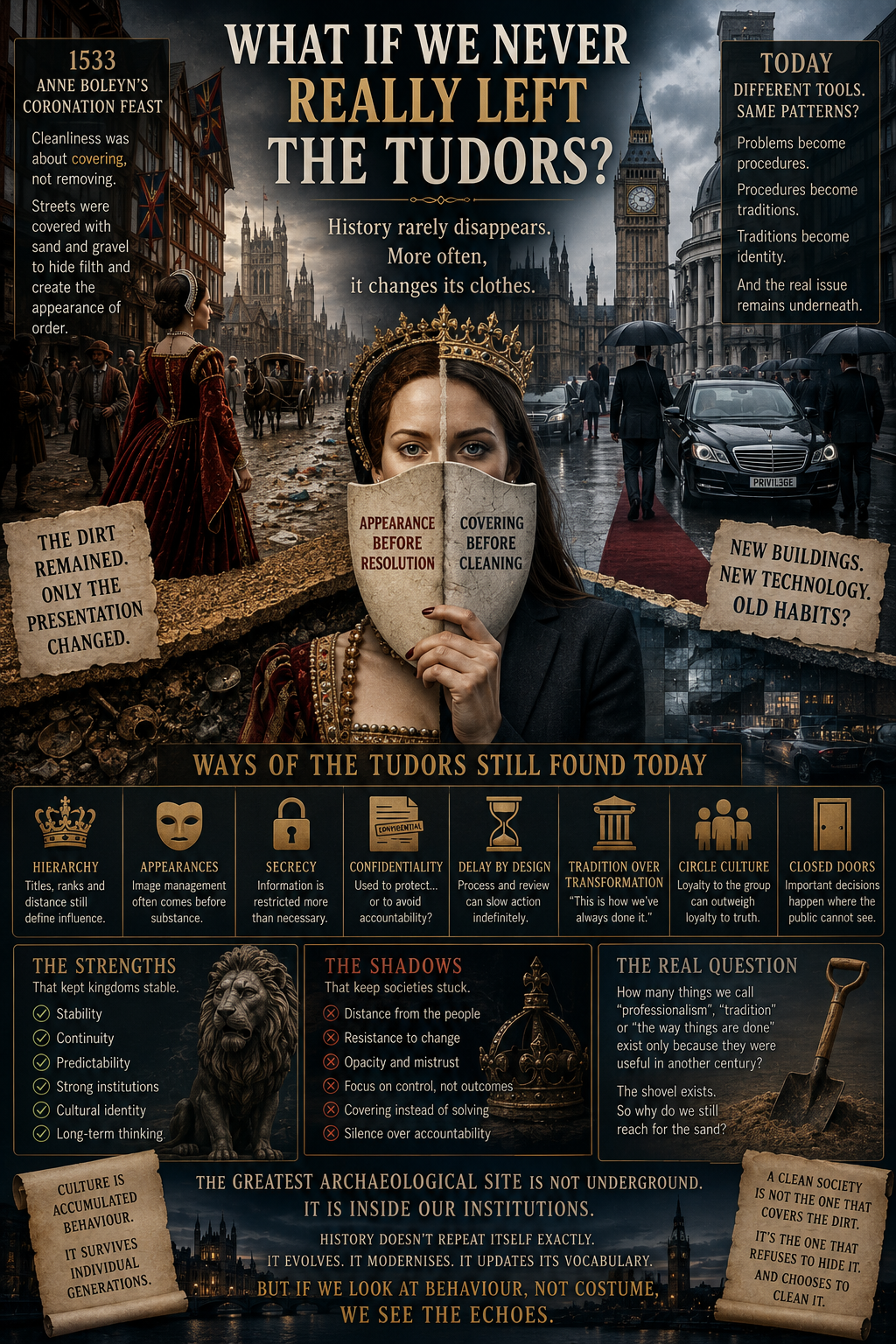
This is a mirror, we don’t just complain, we house solutions too, across board.
“History rarely disappears. More often, it changes its clothes.”
I was watching a documentary about the coronation of Anne Boleyn in 1533 when a seemingly insignificant detail caught my attention.
The streets.
Not the ceremony.
Not the jewels.
Not the politics.
The streets.
They explained that cleanliness at the time was often less about removing dirt than covering it. Sand and gravel were spread over filth to make roads safer for horses and carriages and, perhaps just as importantly, to make the city appear more presentable for the occasion.
The dirt remained.
Only the presentation changed.
That made me pause.
Because I wondered whether that principle ever truly disappeared from British culture.
Not literally.
Culturally.
I have lived in Britain for years now, and one of the recurring patterns I continue to notice is not necessarily a culture of solving first, but often a culture of managing appearances until solving becomes unavoidable.
Problems become procedures.
Procedures become traditions.
Traditions become identity.
Eventually, people forget the original problem was ever beneath the sand.
I am not saying Britain is unique in this. Every civilisation develops its own cultural habits.
What interests me is continuity.
History echoes.
Sometimes through architecture.
Sometimes through language.
Sometimes through institutions.
Sometimes through habits so normal that no one notices them anymore.
One pattern I repeatedly encounter is the relationship with secrecy.
Privacy.
Confidentiality.
Official channels.
Need-to-know.
Closed meetings.
Internal reviews.
Restricted documents.
Embargoes.
Classifications.
There are, of course, legitimate reasons for each of these in many contexts. Privacy protects individuals. Confidentiality can protect investigations, trade secrets, national security, and trust.
The question is not whether secrecy should exist.
The question is whether secrecy has quietly become the cultural equivalent of Tudor sand.
At what point does protecting become covering?
At what point does discretion become avoidance?
At what point does confidentiality stop serving truth and start delaying it?
These are very different things.
History suggests that rulers have always understood something fundamental about power.
Power is not maintained only by force.
It is maintained by controlling what becomes visible.
The Tudors understood spectacle.
Ceremonies.
Architecture.
Dress.
Processions.
Symbolism.
Hierarchy.
Distance.
Modern Britain has different tools.
Reports.
Committees.
Legal language.
Public relations.
Institutional procedures.
Official statements.
Again, these are not inherently bad.
They become problematic only when appearance consistently arrives before resolution.
When process becomes more important than outcome.
When accountability becomes something to be managed rather than lived.
It is fascinating how many historical characteristics of rulers can still be recognised—not because Britain is frozen in the sixteenth century, but because institutions often preserve behavioural patterns long after technologies change.
Hierarchy.
Carefully managed public images.
Strong respect for titles.
Measured speech.
Preference for gradual change over sudden disruption.
Reliance on precedent.
Highly developed bureaucracy.
An instinct to preserve institutional continuity.
These characteristics have strengths.
They can create stability.
Predictability.
Long-term continuity.
But every strength carries a shadow.
Hierarchy can become distance.
Procedure can become delay.
Tradition can become resistance.
Confidentiality can become opacity.
Loyalty can become silence.
History shows both sides.
That is why I find culture so fascinating.
Culture is accumulated behaviour.
It survives individual generations.
People change.
Patterns often remain.
Perhaps this is why societies struggle to recognise themselves while changing.
They believe they have become entirely modern because the buildings have glass instead of stone, computers instead of parchment, emails instead of royal messengers.
Yet the behavioural architecture beneath them may still resemble something much older.
Perhaps the greatest archaeological site is not underground.
It is inside our institutions.
Perhaps every culture carries invisible habits inherited from centuries ago.
Habits that once solved genuine problems.
Habits that now continue simply because they have always existed.
Which raises a question I cannot stop asking.
How many things do we call “professionalism,” “tradition,” or “the way things are done” simply because they were successful adaptations for a different century?
And how many of those adaptations quietly prevent us from solving today’s problems?
The Tudors covered dirt because that was what their technology allowed.
We possess technologies they could never have imagined.
Yet sometimes I wonder whether we still reach for sand before we reach for the shovel.
Not because we are incapable of cleaning.
But because covering has become culturally familiar.
History rarely repeats itself exactly.
It evolves.
It modernises.
It updates its vocabulary.
But if we pay attention to behaviour instead of costume, we begin to notice something extraordinary.
Sometimes the greatest inheritance of a civilisation is not its monuments.
It is its habits.
And habits, unlike castles, can survive for centuries without anyone realising they are still living inside them.
…
Okay, so let’s write this next piece, the full-bodied yet inquisitive piece. This time the question is, I’m watching a video about the like 1400, was it, 1333, the time of a Henry and a queen that just got coronated. Her name is Anne Boleyn. It’s actually 1533, about the coronation feast. And they were saying how the standards of cleanliness were more of like covering up, covering things up. So there would be filth on the floor, and for the coronation, they just covered it with sand and gravel to make sure that people wouldn’t slip and carriages wouldn’t slip on the way to Westminster. And then with that information and having lived here for seven, standards of a city, but the Tudor cleanlinesses stayed a little bit behind within the culture of how to deal with things. Because I can see, I can see a lot in terms of how it’s so common, it’s so normal for things to be hidden, kept away, secrecy, under the claims of privacy or, what’s the word, confidentiality. You know, I wonder.. hifhligh all the ways of defining rulers just like this that are still found to this dsy in some way in the british cture you can easily spot as you can look at multiple informstion at once faster
Drinking was a survival thing. Let that sink in. Are we surviving, cause it eacalated?
Walking on egg shells and under constant judgement is still to this day very much coshared and cocreated. Self afflicted.
How much is spent in pleasentries and appearances, and how much focus is on what’s a priority for the continuity and vreatness of the country.




Leave a Reply