A question.
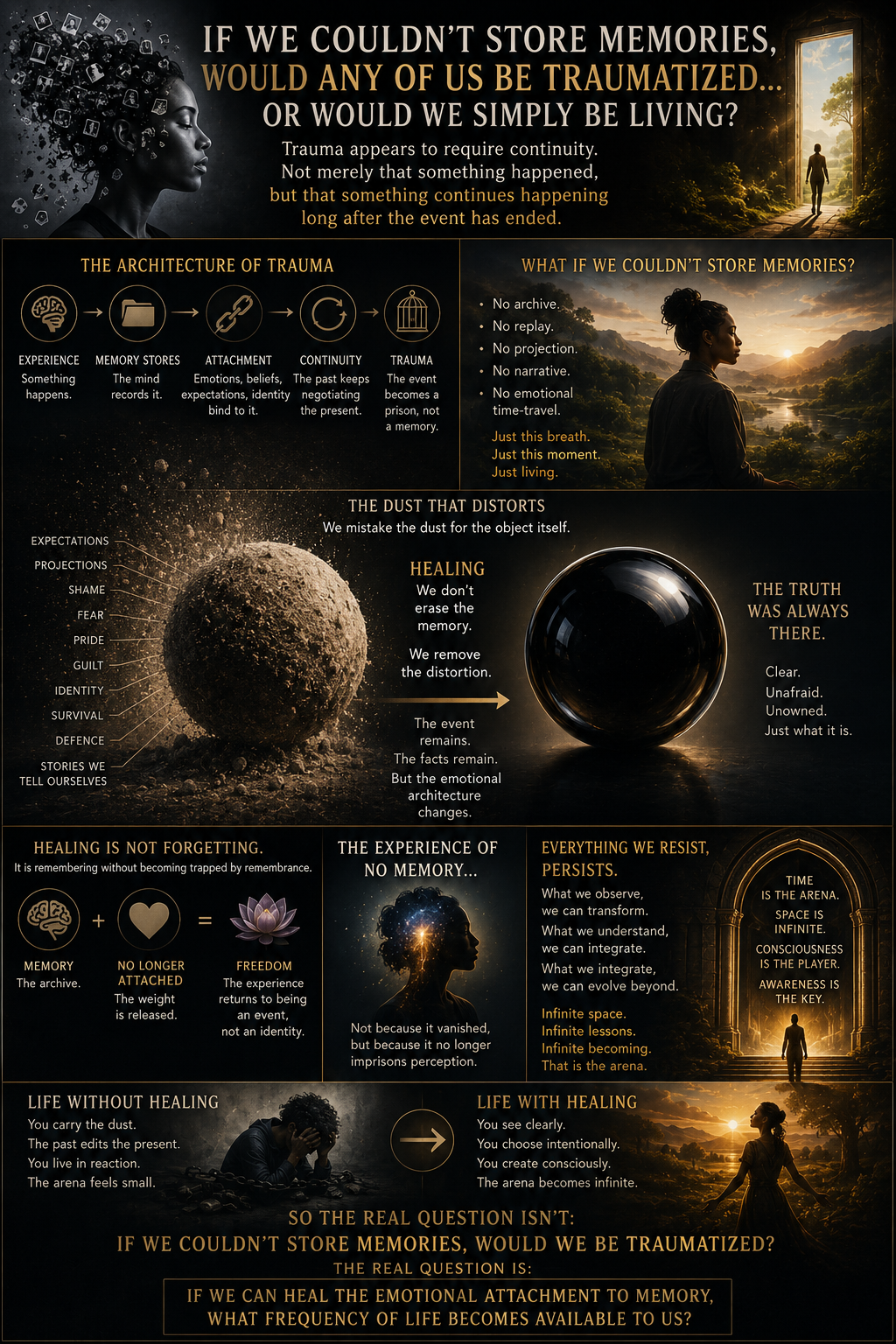
If human beings had no ability to store memories, would any of us ever become traumatized?
Or would life simply be… lived?
Trauma appears to require continuity. Not merely that something happened, but that something continues happening long after the event has ended. The body remembers. The mind remembers. The expectations remember. The emotions remember. The future becomes negotiated by a past that no longer exists physically, yet continues existing psychologically.
What if memory is not the wound?
What if memory is the archive, and attachment is what keeps reopening the file?
Healing, then, begins to look very different.
Perhaps healing is not forgetting.
Perhaps healing is seeing so clearly that the emotional distortion no longer dictates what the memory is allowed to mean.
Imagine finding a black sphere covered in decades of dust.
Most people would describe it as grey.
Not because it is grey.
Because that is all they can currently see.
The dust becomes the description.
Until someone wipes it clean.
Suddenly nothing about the object has changed, yet everything about its appearance has.
Was the truth created?
Or was the truth simply uncovered?
Perhaps memory works in the same way.
Our experiences gather expectation, projection, shame, fear, pride, guilt, identity, defence and survival until we eventually mistake the dust for the object itself.
Then we call that reality.
Healing removes the dust.
Not the sphere.
The memory remains.
The event remains.
The facts remain.
But the emotional architecture surrounding them changes so completely that the experience almost resembles remembering without suffering.
Almost like possessing the memory while no longer being possessed by it.
Perhaps this is why some people speak of feeling lighter after healing.
Nothing disappeared.
The weight simply stopped belonging to the memory.
If that is true, then healing offers something extraordinary.
It creates the experience of remembering without becoming trapped by remembrance.
An illusion, perhaps, of having no memory at all—not because memory vanished, but because it no longer imprisons perception.
The event returns to being what it always was:
An event.
No longer an identity.
No longer a prophecy.
No longer a prison.
Just a moment within the infinite space we call life.
So perhaps the question is not whether trauma exists.
Perhaps the deeper question is this:
If memory stores experience, what is it that stores suffering?
And if suffering can be released while memory remains…
What, then, was healing actually healing?




Leave a Reply