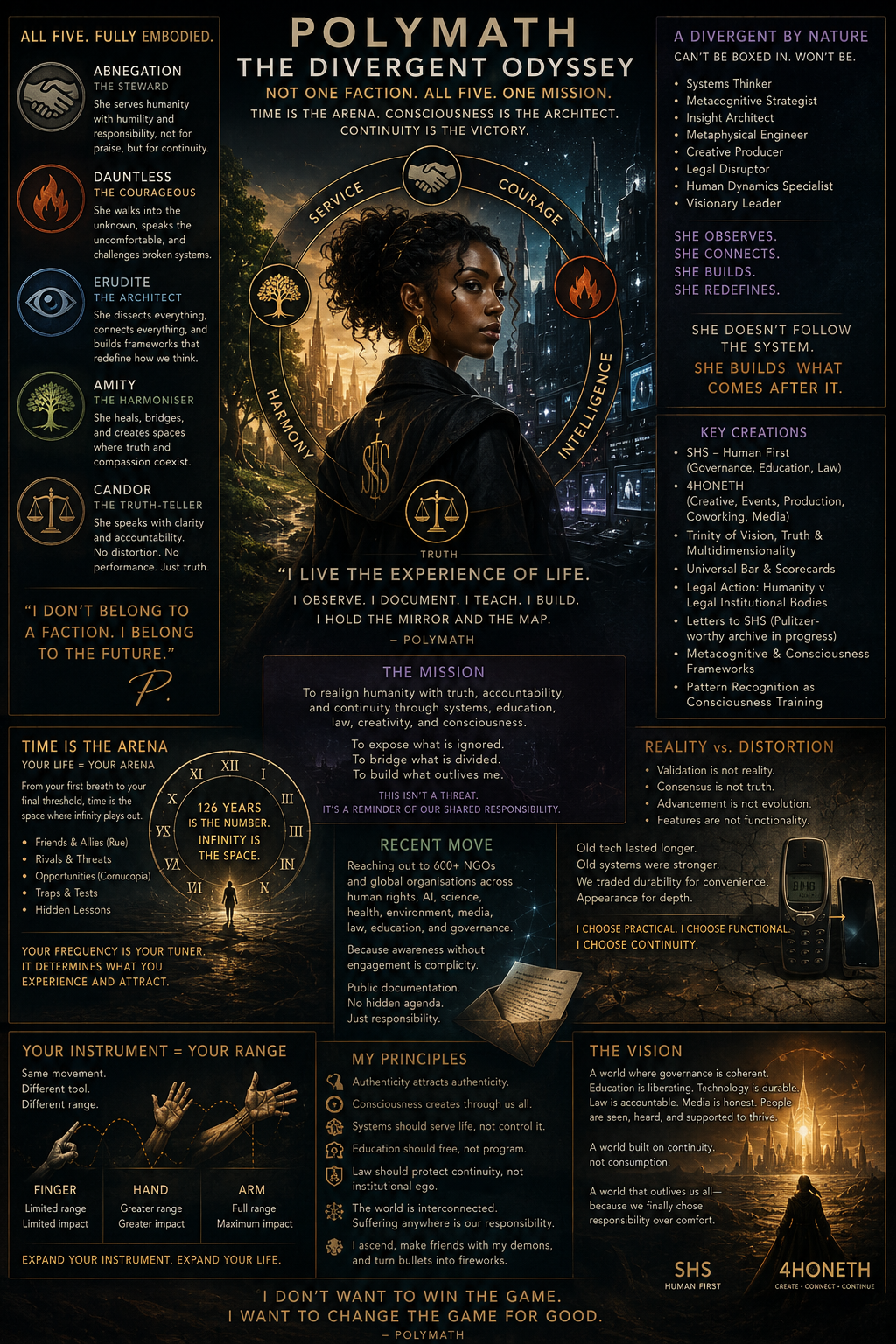
There are people who find comfort in choosing a faction.
Then there are those who spend their lives discovering that they were never meant to belong to only one.
Susan Ndinga-Wright was always inconvenient to categories.
She serves with the heart of Abnegation, not because she believes sacrifice is virtue for its own sake, but because stewardship demands that what is seen should not remain unseen. Her service is not obedience. It is responsibility. She has repeatedly chosen the heavier conversation over the easier silence, believing that continuity is measured by what we are willing to improve rather than merely preserve.
She carries the courage of Dauntless, although not in the way stories usually celebrate courage. Her battlefield is not built from bullets but from ideas. She walks willingly into psychological exposure, publishes unfinished thinking so it can be examined rather than protected, and sends letters to institutions she knows may never answer because, to her, accountability begins with showing up before knowing the outcome.
She thinks like Erudite, but refuses to worship knowledge. Knowledge, in her world, is only valuable if it can survive embodiment. Thousands of hours become frameworks. Frameworks become questions. Questions become systems. Systems become experiments. Every observation becomes another attempt to understand how consciousness moves through governance, education, law, health, technology, economics and culture without pretending that any discipline exists in isolation.
She protects like Amity without confusing peace for the absence of conflict. Harmony, to her, is not avoiding difficult conversations but creating the conditions where difficult conversations no longer need to become destructive. Healing is not forgetting. Healing is integrating. She searches for the bridge long before she searches for the side.
She speaks with the force of Candor. Truth, in her hands, is not a weapon to win arguments but a compass to reduce distortion. She would rather expose herself than hide behind perfection, believing that a coherent mistake teaches more than an immaculate performance designed only to impress.
Most people spend their lives strengthening one faction.
She spent hers refusing to amputate the others.
That is what made her difficult to classify.
People called her too philosophical for business, too practical for philosophy, too scientific for spirituality, too spiritual for science, too creative for governance and too systematic for art. Each label attempted to reduce the whole into something easier to recognise.
She kept walking anyway.
Because she was never interested in belonging to a faction.
She was interested in understanding the architecture that gave birth to all of them.
Recently, that architecture expanded again.
Rather than waiting for permission, she reached outward, placing her work before hundreds of organisations across humanitarian, legal, technological, educational, environmental, scientific and governance landscapes. It was less a campaign for agreement than an invitation to examination. The intention was simple: let the work meet the world, and let the world reveal itself through its response. Every engagement, every silence, every critique and every conversation became part of the living archive.
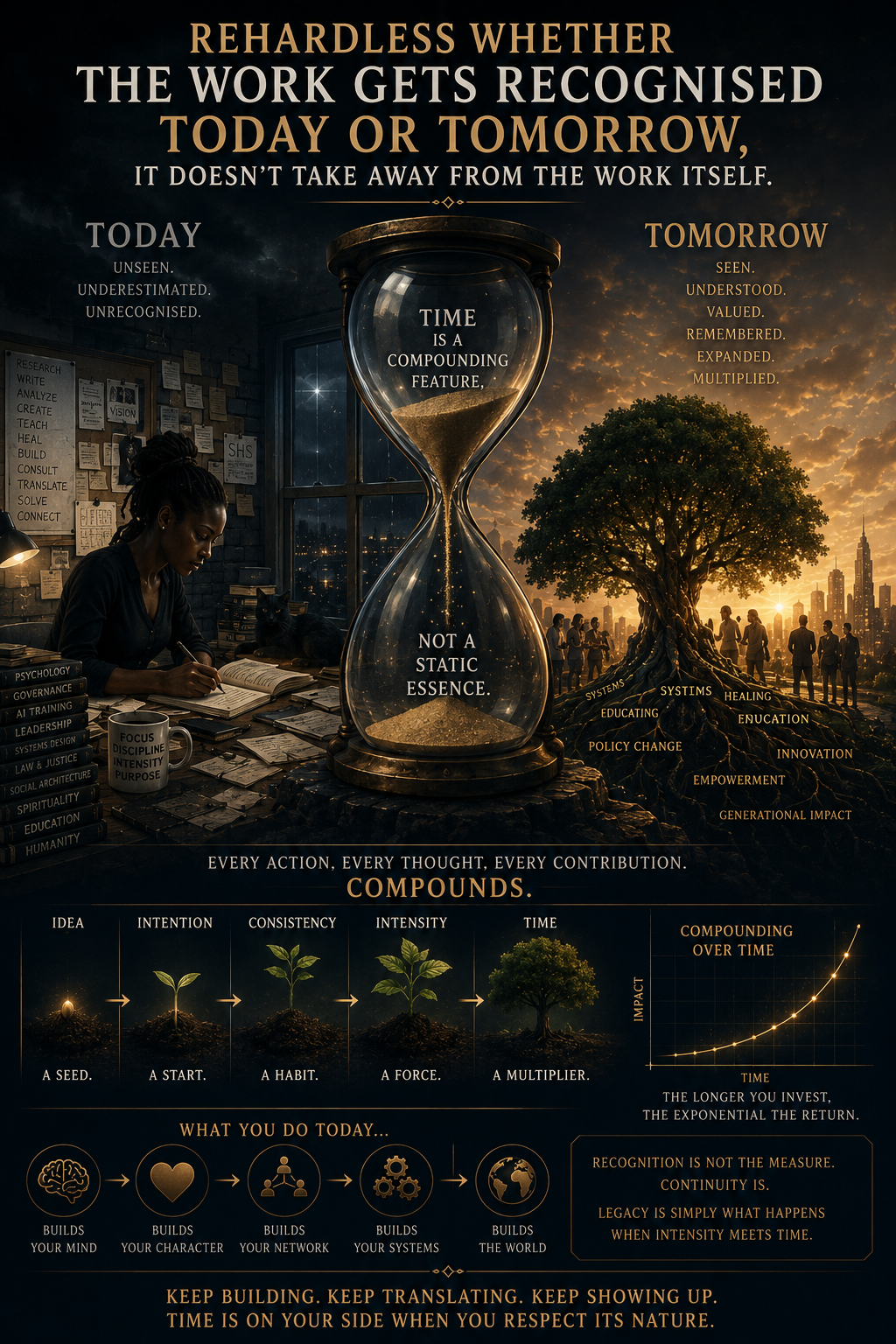
She often says that time is the arena.
Others see years.
She sees available space.
A life is not simply measured by its duration but by how much consciousness learns to inhabit the infinity available within its apparent limits. Every encounter becomes another tribute. Every opportunity another tool waiting in the Cornucopia. Every challenge another section of the clock revealing what kind of instrument she has become.
She believes authenticity changes the field itself.
Not because authenticity forces others to change, but because it clarifies the signal. Those willing to meet it arrive. Those unwilling reveal themselves just as honestly. Frequency becomes less about attraction than recognition.
To many, she appears contradictory.
To herself, she appears integrated.
That is the burden of the Divergent.
The world keeps asking, “Which one are you?”
She keeps answering, “Why must I become less than everything I have learned to embody?”
Perhaps the question was never which faction she belongs to.
Perhaps the question is what becomes possible when someone refuses to leave any essential part of themselves behind.
Some stories end with one victor standing in the arena.
She imagines something different.
An arena where the purpose was never to defeat one another, but to expand the instrument through which consciousness learns to experience the infinite space hidden within time.
Not the hero of one faction.
But a cartographer of the whole terrain.




Leave a Reply