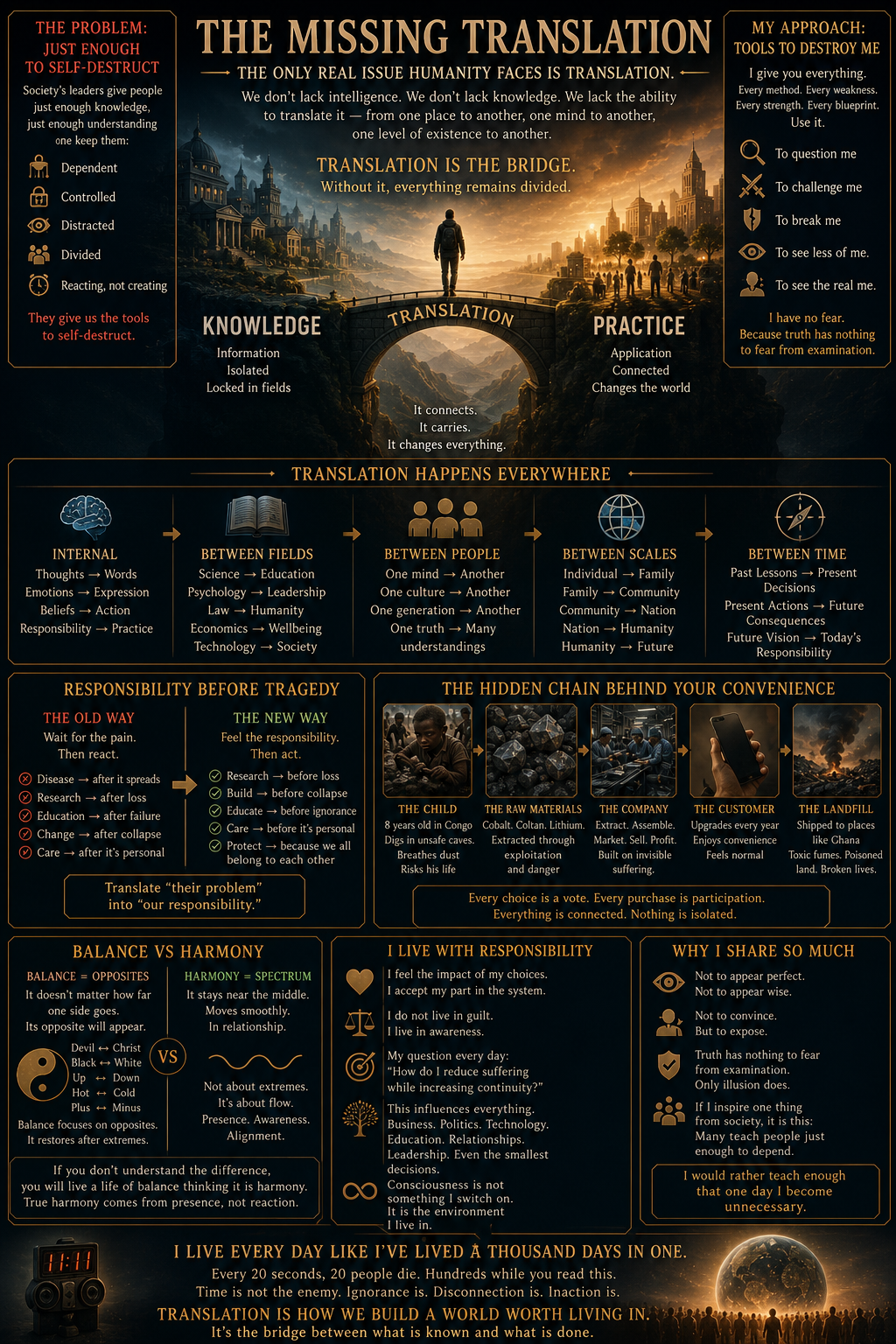
There is a question that has followed me throughout this entire journey. After writing to governments, scientists, educators, businesses, legal institutions, journalists, humanitarian organisations and individuals from every walk of life, I kept asking myself the same thing.
Where does the process break?
The answer I continue arriving at is surprisingly simple.
Translation.
Not intelligence. Not knowledge. Not resources. Not even willingness, in many cases.
Translation.
Humanity does not primarily suffer from a lack of information. We suffer from a lack of people capable of translating information from one field of life into another, from one scale into another, from one mind into another, and from one responsibility into another.
Translation is what allows understanding to move.
Without it, knowledge becomes isolated.
A scientist may understand biology but struggle to translate that understanding into public education.
A politician may understand legislation but fail to translate it into the lived experience of ordinary citizens.
A psychologist may understand behaviour yet struggle to translate that understanding into governance.
A business leader may understand efficiency but fail to translate it into human wellbeing.
An engineer may solve technical problems while never translating their work into its societal consequences.
None of these people are necessarily wrong.
They simply stopped translating.
The same thing happens internally.
Many people know what they feel.
Few can translate emotion into language.
Many know what they believe.
Few can translate belief into action.
Many understand responsibility intellectually.
Few translate it into daily practice.
Translation is the bridge between every stage of consciousness.
Thought becomes language through translation.
Language becomes action through translation.
Action becomes culture through translation.
Culture becomes civilisation through translation.
Remove translation and every stage collapses into isolation.
This is why so much of society appears fragmented.
Everyone is speaking.
Very few are translating.
One of the greatest examples is responsibility.
Many organisations genuinely care.
Many researchers genuinely care.
Many charities genuinely care.
Many governments genuinely care.
Yet the responsibility often remains attached only to their specific department, profession, institution or funding stream.
The responsibility rarely expands into humanity itself.
A medical researcher may dedicate their life to curing one disease after a loved one becomes ill.
That is beautiful.
But imagine if humanity learned to feel that responsibility before tragedy arrived.
Imagine investing because someone else’s child matters as much as your own.
Imagine improving infrastructure before collapse.
Imagine researching illness before it reaches your family.
Imagine educating before ignorance becomes conflict.
Imagine healing before trauma multiplies.
That is translation.
It is translating “their problem” into “our responsibility.”
The issue has never been waiting for evidence.
The issue is waiting for permission to care.
Humanity has become exceptionally good at reacting.
It has become much less practiced at translating future consequences into present action.
This is why I often move between seemingly unrelated subjects.
Psychology.
Law.
Business.
Physics.
Leadership.
Health.
Economics.
Education.
Governance.
People sometimes ask why.
Because to me they are not separate conversations.
They are different dialects describing the same reality.
Translation is the work.
If psychology discovers something useful, leadership should learn it.
If biology discovers something useful, education should translate it.
If economics discovers something useful, healthcare should benefit.
If philosophy asks a better question, science should be curious enough to investigate it.
Progress does not happen because one field becomes smarter than another.
Progress happens when understanding becomes portable.
Perhaps this is why so much innovation appears difficult.
We often search for entirely new ideas when what humanity desperately needs is better translators.
People capable of saying,
“What you discovered over there also applies over here.”
That sentence alone has changed history countless times.
The wheel was not only transportation.
It became industry.
Electricity was not only physics.
It became communication.
The internet was not only computing.
It became society.
Everything great expanded because someone translated it.
Perhaps stewardship itself is translation.
Taking what exists.
Understanding its essence.
Then carrying it faithfully into another place where it can create life again.
When I look at the work I have been doing, I do not believe I am simply writing about different topics.
I believe I have been practicing translation.
Between philosophy and psychology.
Between governance and humanity.
Between law and stewardship.
Between consciousness and everyday life.
Between vision and implementation.
Between responsibility and practice.
Because perhaps the greatest gap humanity faces has never been knowledge.
It has been our inability to translate what we already know into how we choose to live.
The future may belong less to those who know the most, and more to those who can connect the most.
Because every breakthrough begins the same way.
Someone finally finds the words that allow one world to understand another.




Leave a Reply