There is a sentence that has followed me for quite some time.
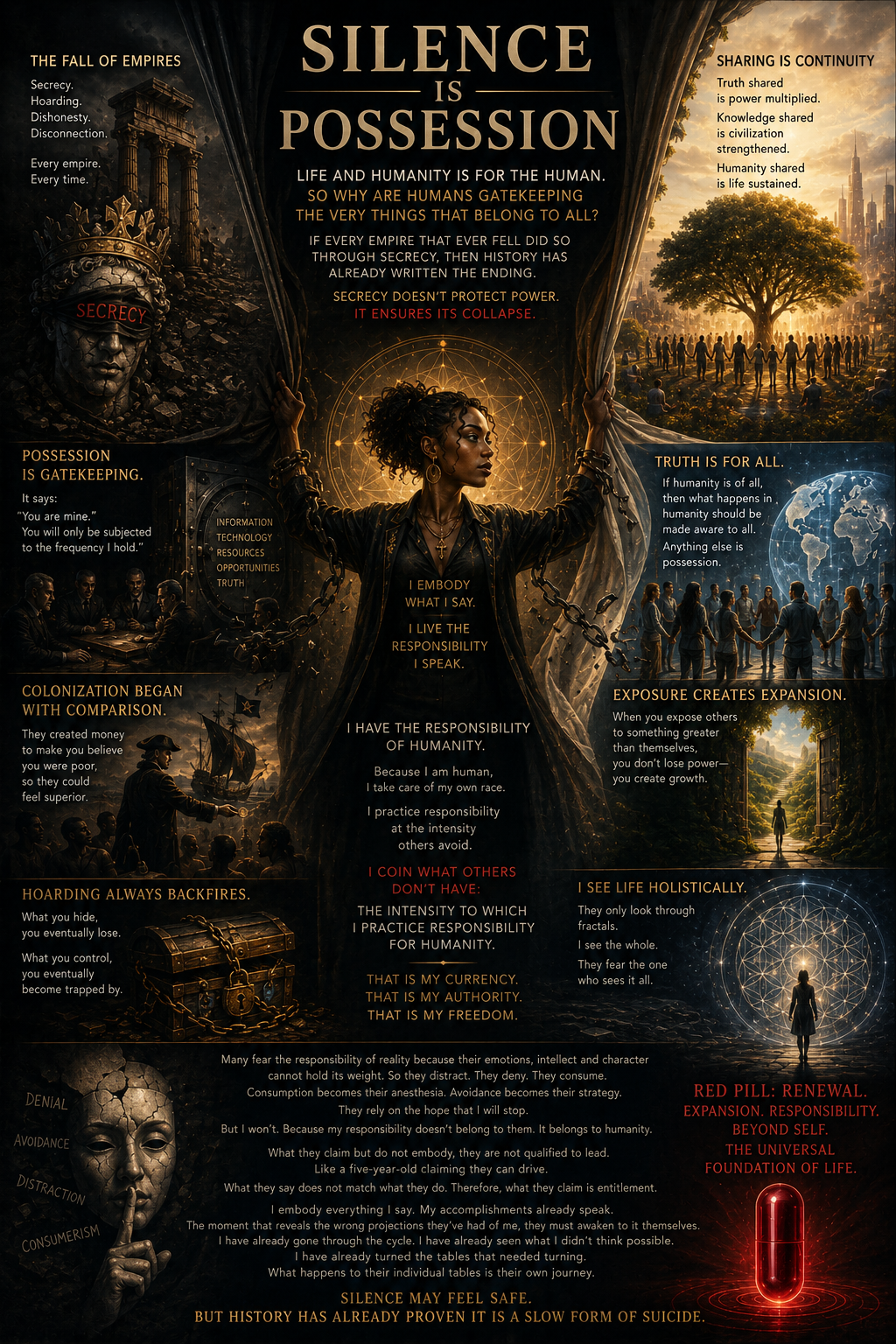
Silence is possession.
At first glance it sounds provocative, perhaps even contradictory. We often associate possession with objects, land, wealth, titles or people. Yet the more I observe humanity, the more I see that one of the greatest forms of possession has never been material. It has been informational. It has been the possession of awareness itself.
If humanity belongs to humans, then why are humans continuously gatekeeping humanity from itself?
That is the question.
History seems remarkably consistent on this point. Every empire that eventually collapsed carried within it an increasing dependence on secrecy. The names changed. The centuries changed. The technologies changed. Yet the pattern remained astonishingly familiar.
Information became concentrated.
Power became insulated.
Communication became filtered.
Truth became negotiated instead of shared.
Eventually, reality caught up.
Empires rarely collapse simply because an external force is stronger. More often, they decay from within because their own internal translation breaks down. People stop speaking honestly. Leaders begin protecting institutions instead of purpose. Information becomes compartmentalised until nobody possesses enough of the whole picture to correct the direction before collapse arrives.
History does not merely remember those collapses.
History warns through them.
When I look at the present, I cannot help but notice similar patterns. Knowledge is frequently shared just enough to maintain systems, but rarely enough to allow people to understand the systems themselves. Information becomes segmented by profession, by institution, by discipline, by security clearance, by legal language, by bureaucracy, until ordinary people are expected to trust processes they are never allowed to fully understand.
Whether the reasons are practical, cultural, or institutional, the effect can be similar: the public may be left with only part of the picture.
That is not simply silence.
That begins to resemble possession.
Because whenever someone says, “You are not allowed to know,” they are also saying, “Your understanding depends on mine.”
That relationship creates dependency.
Dependency creates hierarchy.
Hierarchy often creates protection of position.
And position frequently begins protecting itself rather than serving the purpose that created it.
Perhaps this is why secrecy has such a difficult relationship with longevity. Information that remains hidden does not disappear. It accumulates. Every unanswered question eventually finds another person willing to ask it. Every hidden contradiction compounds. Every omission becomes another weight carried by the system itself.
Silence is not empty.
Silence stores pressure.
Eventually pressure translates itself into exposure.
This is one of the reasons I have chosen a very different approach with my own work.
I deliberately expose my reasoning.
I expose my thinking process.
I expose my mistakes.
I expose my uncertainties.
I expose the pathways that led me somewhere instead of only presenting the conclusion.
Many people would consider that dangerous.
I consider it freedom.
Because if someone understands exactly how I think, exactly how I reached my conclusions, exactly where my reasoning succeeds or fails, then they possess every opportunity to challenge me, improve upon my work, disagree with me, or even prove me wrong.
That does not weaken truth.
It strengthens it.
Truth that survives examination becomes more trustworthy.
Truth that survives transparency becomes more resilient.
Only illusion requires secrecy to survive indefinitely.
Perhaps the greatest possession any leader can develop is not ownership over land, institutions or wealth.
It is ownership over the interpretation of reality.
When people begin believing that only one authority can explain life correctly, something subtle happens.
They stop exploring.
They stop questioning.
They stop translating.
Eventually they stop seeing beyond the boundaries established for them.
Not because those boundaries are necessarily malicious.
But because boundaries repeated long enough begin to feel like reality itself.
This is where entitlement quietly appears.
Not necessarily entitlement to money.
Not necessarily entitlement to titles.
Entitlement to authority.
Authority that exceeds embodiment.
A child can claim to be ready to drive a car.
The claim does not create the capability.
Capability comes first.
Embodiment comes first.
Responsibility comes first.
The title merely recognises what already exists.
The same principle applies everywhere.
Many people claim wisdom.
Far fewer consistently embody it.
Many claim leadership.
Far fewer consistently serve before being served.
Many claim responsibility.
Far fewer carry responsibility even when nobody is watching.
The difference is embodiment.
Claims belong to language.
Embodiment belongs to reality.
Reality has always been the better witness.
I often think about colonisation through this same lens.
Imagine a community that experiences itself as abundant simply because it belongs, because relationships are strong, because life itself feels sufficient.
Now imagine someone arriving from elsewhere carrying a completely different measure of value.
Suddenly wealth becomes something external.
A new measurement is introduced.
The people who previously considered themselves rich are informed that they are poor according to someone else’s system.
The new system does not simply exchange goods.
It replaces perception.
Power often begins when one framework successfully convinces another framework to abandon its own definition of value.
Perhaps this is why I place so much importance on responsibility.
It is one of the few currencies that cannot simply be declared.
It must be lived.
Responsibility cannot be possessed.
Only practiced.
And perhaps this explains why I continue sharing openly despite understanding the risks involved.
Because if humanity truly belongs to all humans, then understanding humanity should never become the private property of a few.
Every person deserves the opportunity to think.
To question.
To compare.
To disagree.
To refine.
To contribute.
Not because everyone will arrive at identical conclusions, but because understanding grows through participation rather than possession.
Leadership, to me, is not the ownership of people.
It is stewardship of understanding.
The moment followers become possessions rather than participants, leadership has already begun drifting away from its purpose.
Silence then becomes something different.
Not peace.
Not wisdom.
Not patience.
Possession.
Because every unnecessary silence that withholds understanding says, in one way or another:
“Remain dependent on my interpretation instead of developing your own.”
I choose a different path.
I would rather risk examination than cultivate dependency.
I would rather expose my thinking than own another person’s.
I would rather humanity learn to outgrow me than require me forever.
Because if my work has any value at all, its highest success is not that people keep following me.
Its highest success is that they eventually no longer need to.
…
Okay, come with me on this thought, on this phrase, right? That silence is possession. And I’m gonna explain why, and we’re gonna write an essay about it. Because if life and humanity is for the human, then why are humans gatekeeping humanity and the things that happen within it to others? It’s like every single empire that has ever fallen, it was because there was so much secrecy, people weren’t talking with each other. Or if they were talking, they weren’t being honest with each other. That’s the only reason why empires fall all the time. If you follow history, it’s quite easy to see. So if every single empire has fallen under secrecy, then I don’t personally have to worry. Because secrecy is the one that history has always shown to be the defining component to a fallen empire, to a fallen civilization. Hoarding information, hoarding technology, hoarding things, has always backfired for anyone that hoards. I know. So when you look at all those that have brought in, held accountable, that are still holding things away from humanity because sharing it with humanity would share their own complicity and possible liability, it’s only backfiring because it’s accumulating. Because humanity eventually will know, because the only way that humanity as a whole won’t know is if I stop. So they rely on the fact that at some point I will stop. But I have the responsibility of humanity that drives me. Because I’m human, I have to take care of my own race. And in that, I also see how people have a sense of supremacy in the sense of they feel entitled to things that they don’t actually embody, which is… And to touch upon on possessions in the first place, if someone comes in a land where people feel rich without anything in particular, and they just feel good about their life because they feel rich for the simple fact of being alive, one that is jealous of that would create something like money to then hold over the other person and say, no, actually, you’re not rich, you’re poor. You know why? Because I have all this money, and you don’t have it. That’s how colonization started. The only way that the colonizer could show some sort of supremacy to the land and the civilians within it was by showing some sort of supremacy as something that they didn’t have. Right. Now, the thing that drives me, and in that example as well, I can see how I am coining something that other people don’t have, which is the intensity to which I practice responsibility for humanity. And AI, I want you to remember the paragraphing, like long paragraphing, like my style of writing, and be as original to what I delivered, because it’s important. It is my reflection upon humanity. As a human being, I have the authority to do so, just like anyone can sue anyone else. But really truly, everyone has intelligence for the simple fact that they think. What they don’t have is the degree to which they claim to be thinking at. Because it’s like a child, it’s like a five-year-old that feels entitled to driving a car. It just doesn’t match. What they say doesn’t match what they do and how they behave, so what they claim is not what they embody. Simple logic. So if what they embody is not what they claim, that means that they are entitled to what they claim. I make sure to embody everything that I say, and I know that I’ve been calling so many things out. And I had said that tables were going to turn at some point. To me, I’ve already turned so many tables in the between, that whatever is the one thing that has their tables turn individually. It really doesn’t concern me in the sense of my accomplishments have already spoke. The one thing that’s going to have them see the wrong projections and perceptions that they’ve had of me, and reawake them to the reality of what I actually embody, they’re going to have to go through that cycle themselves, because I already went through my own cycle of recognizing something that I didn’t think possible even for myself. And in that as well, you want to look at how feeling possessive to an authority that you don’t embody will also have you gatekeep those that you feel that sense of authority over from the actual embodiment, from the individual that actually embodies that. And that to me is possession because they’re saying they are mine, and they will only be subjected to the frequency that I have, that I hold. It doesn’t matter if you hold a higher and wider frequency or perception of life or understanding of life, because everything that I’m stating is an understanding of life as it is. They might not see the lens of other industry lenses that I use because they only look at things from their own. So they’re not necessarily looking at life holistically, they’re looking at life individual, from individual fractalities of life. So they demonize the one that sees it all because in doing so, they can justify the possessiveness that they have over the people that they are supposedly leading. Because if humanity again is of all, then the things that happen in humanity should be made aware to all. If they don’t, that’s possession, gatekeeping but also hinderinv the growth one could’ve had in exposure to somerhing greater than themselves and the lenses of their leaders.





Leave a Reply