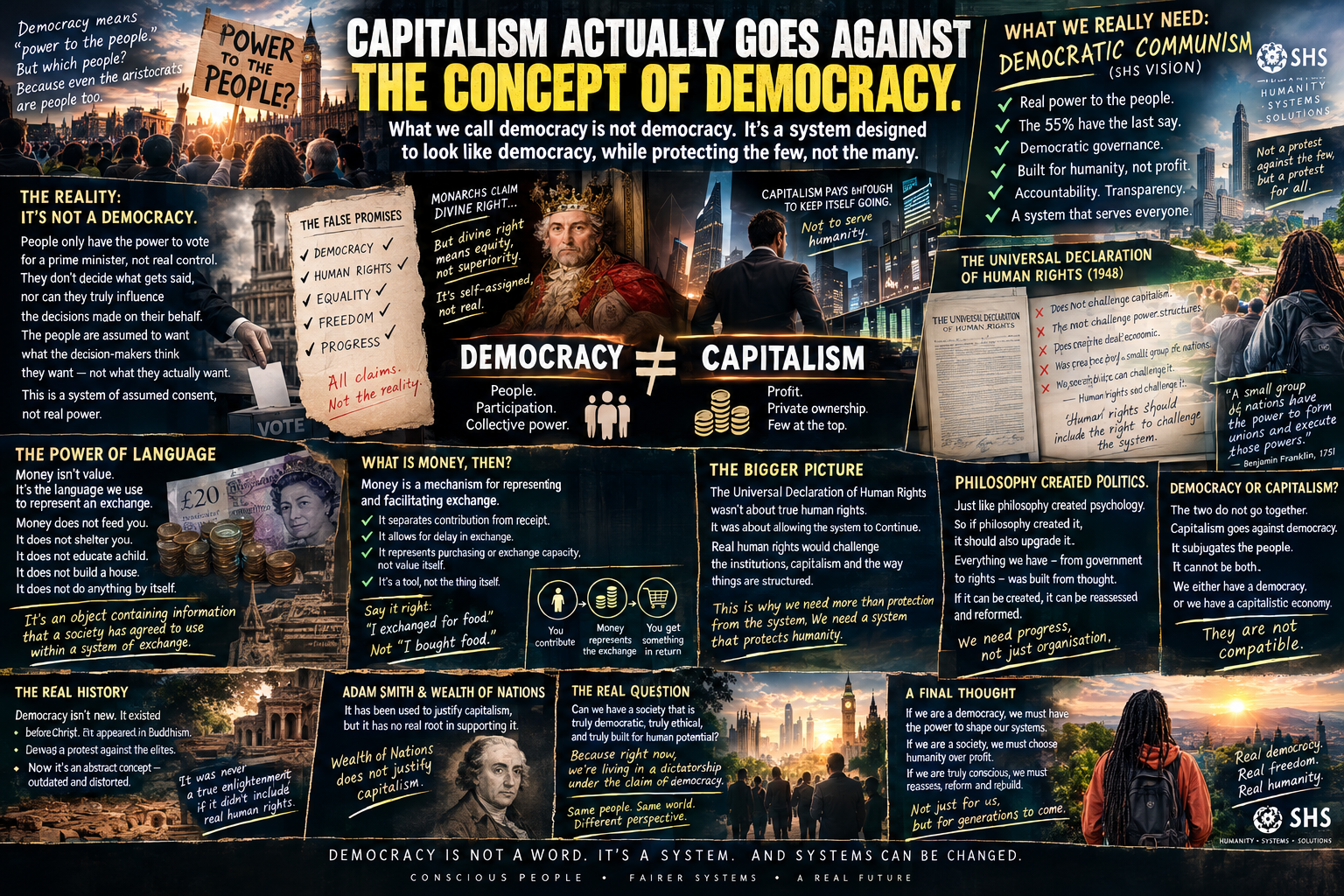
There is a much bigger conversation hiding underneath the words we use to describe our society.
And I think the first thing we have to accept is this:
Everything that is claimed to be something is not necessarily what that thing actually is.
We say democracy.
We say human rights.
We say government.
We say progress.
We say freedom.
We say capitalism.
We say enlightenment.
And because these words have been repeated for generations, we have become so accustomed to them that we rarely stop to ask the most basic question of all:
What do these things actually mean when we look at how they function?
That is where this becomes uncomfortable.
Because democracy supposedly means power to the people.
Fine.
But which people?
Because aristocrats are people.
Monarchs are people.
Billionaires are people.
Politicians are people.
Corporations are not people in the biological sense, but they can possess enormous legal and economic power.
So when we say “the people”, who exactly are we talking about?
And more importantly:
Where is their power?
DEMOCRACY: POWER TO THE PEOPLE — OR POWER TO CHOOSE REPRESENTATIVES?
Take the United Kingdom.
At a general election, people vote for their local Member of Parliament. They do not vote directly for a Prime Minister. The Prime Minister is formally appointed by the monarch, with the political system ordinarily selecting the person best placed to command the confidence of the House of Commons; usually that is the leader of the party that has won the most seats.
That is not a secret.
It is how the system is designed.
And therefore the question isn’t simply whether the United Kingdom is a democracy according to constitutional convention.
It is.
The much more interesting question is:
How much governing power does the individual person actually possess between elections?
The Universal Declaration of Human Rights itself says something extraordinarily important in Article 21:
the will of the people shall be the basis of the authority of government
and says that this will is expressed through genuine elections, with the right to participate directly or through freely chosen representatives.
That gives us two things to examine.
First:
the will of the people is supposed to provide the authority.
Second:
representation is recognised as a mechanism through which that authority is exercised.
But representation creates a gap.
The person votes.
The representative interprets.
The representative decides.
The government acts.
And between those points, enormous amounts of political judgment are made on the public’s behalf.
There are certainly other channels of influence — lobbying, petitions, consultations, campaigning, protest, media, civil society and direct contact with representatives. The UK Parliament itself defines lobbying as attempts by individuals or groups to persuade people in Parliament to support a policy or campaign.
But that raises another question:
Is influence the same thing as power?
That is the question I want to investigate.
Because if democracy is understood as meaningful equality in collective decision-making, then simply having periodic elections is only one part of the democratic structure. Contemporary democratic theory commonly defines democracy around equality among participants at an essential stage of collective decision-making, not merely the existence of elections.
And that distinction matters enormously.
Because perhaps we have confused:
the ability to choose who governs
with
the ability to govern.
Those are not identical things.
NOW BRING CAPITALISM INTO THE ROOM
This is where the argument becomes much bigger.
Capitalism is generally understood as an economic system involving private ownership of productive assets, market exchange, wage labour and production oriented substantially around profit.
Democracy, meanwhile, is concerned with how collective decisions are made and how political authority is distributed among members of the political community.
On paper, these can coexist.
And historically they have.
So it would be inaccurate to say that capitalism is definitionally the opposite of democracy.
The more serious argument is structural.
What happens when unequal economic power can be converted into unequal political influence?
That is not an imaginary criticism.
Contemporary political philosophy explicitly discusses this problem. Critics of capitalism argue that concentrations of wealth and capital can be converted into political inequality through mechanisms such as campaign finance, lobbying and other forms of influence. The Stanford Encyclopedia of Philosophy notes this as one of the central arguments made by critics who see certain forms of capitalism as undermining democratic legitimacy and political self-determination, while also noting that the incompatibility is contested and depends partly on whether institutions can prevent economic power becoming political power.
So now we have a real question.
If democracy says:
each person should have an equal say in shaping the society they share,
while an economic system allows some people or organisations to accumulate vastly greater resources with which to influence the conditions under which everyone else lives,
then what happens to the equality of political influence?
That is the contradiction I am pointing toward.
Not:
“Capitalism cannot exist alongside an electoral system.”
Clearly it can.
But:
Can an economic structure based upon substantial inequalities of ownership, wealth and economic power remain fully compatible with a political philosophy that treats people as political equals?
That is a different question.
And it is far harder to dismiss.
BECAUSE WHAT IS CAPITALISM ACTUALLY PAYING FOR?
Here is where my criticism becomes more fundamental.
Capitalism is extraordinarily good at answering a particular question:
What activity can be rewarded sufficiently to keep economic activity going?
But that is not automatically the same question as:
What does humanity need in order to flourish?
Those are different optimisation problems.
An economy can become extremely efficient at producing things that generate revenue without necessarily becoming equally efficient at producing human flourishing.
You can have economic growth alongside loneliness.
You can have technological development alongside exclusion.
You can have employment alongside poverty.
You can have wealth accumulation alongside homelessness.
You can have productivity alongside exhaustion.
You can have innovation alongside the erosion of human autonomy.
And therefore the question becomes:
What is the system actually optimised for?
Because if the answer is primarily the continuation and expansion of economic activity, then we should not be surprised when the economy behaves like an economy.
The deeper question is whether the economy is also being designed as a mechanism for the continuation and expansion of humanity.
That distinction becomes especially visible with artificial intelligence.
For example, the UK government announced in its 2025 Spending Review that it would allocate £2 billion to artificial intelligence from 2026–27 to 2029–30, alongside other AI investments and programmes. In June 2026, it also announced a £1.1 billion AI hardware plan, including hundreds of millions for AI computing infrastructure and support for AI companies.
Those investments are not evidence, by themselves, of wrongdoing.
Governments describe AI as a route to productivity, public-service improvement, jobs, technological capability and economic growth.
At the same time, the Council of Europe has established an international legal framework specifically because AI can affect human rights, democracy and the rule of law, including through risks requiring impact assessment, oversight, accountability and possible restrictions on certain uses.
So the question is not:
“Is AI good or bad?”
That is far too simplistic.
The question is:
When a government invests in a technology capable of changing the relationship between human beings, institutions, labour and decision-making, what proportion of that decision-making power belongs to the people who will live with the consequences?
That is a democratic question.
And it cannot be answered simply by saying:
“We elected them.”
THE UNIVERSAL DECLARATION OF HUMAN RIGHTS
Now we get to another enormous contradiction.
The Universal Declaration of Human Rights was adopted in Paris on 10 December 1948. It emerged from the aftermath of the Second World War and was intended as a common international statement of fundamental rights.
It was not literally written by one tiny group behind closed doors and imposed on the world.
The historical record is more complicated.
The UN Commission on Human Rights consisted of 18 members, and the formal drafting committee was expanded to representatives from eight states: Australia, China, Chile, France, Lebanon, the United States, the United Kingdom and the Soviet Union.
The final Declaration, however, was adopted by the UN General Assembly. In 1948 there were 58 voting members; the resolution received 48 votes in favour, with no votes against, eight abstentions and two non-voting states.
So let’s get precise.
It is not historically accurate to say that “a small group of nations simply decided what human rights are and nobody else had any involvement.”
But there is a deeper criticism that remains available.
Humanity itself did not directly vote on the Declaration. States did.
And that matters when the subject is supposedly universal human rights.
Because the Declaration speaks about human beings.
But the mechanism through which it was established was an international political institution composed of states.
That is not necessarily illegitimate.
But it creates a profound philosophical question:
Who has the authority to define the rights of humanity?
And, more importantly:
Who has the authority to revise those rights when humanity’s understanding changes?
Because the UDHR does contain substantial protections. It covers freedom of thought, conscience and religion; freedom of expression; peaceful assembly; participation in government; social security; work and just conditions; education; cultural participation; property; and other rights.
So I would not describe it as containing no rights capable of challenging power.
It does.
But it does not establish a mechanism through which humanity as humanity possesses a standing constitutional power to redesign the global institutional order.
Article 28 says something particularly interesting:
“Everyone is entitled to a social and international order in which the rights and freedoms set forth in this Declaration can be fully realized.”
There is the sentence.
The order itself is part of the conversation.
And yet the Declaration does not prescribe capitalism.
It does not prescribe socialism.
It does not prescribe communism.
It does not establish a global democratic constitution.
It does not give every human being a direct vote over the international institutions that interpret, develop or implement human-rights norms.
And that is where my criticism begins.
Not that the UDHR contains nothing.
But that a declaration of rights is not the same thing as a constitution of humanity.
The Declaration was adopted as a declaration, not as a treaty creating the same kind of binding obligations as later human-rights covenants; subsequent international legal developments gave many of its principles further legal force through other instruments and customary international law.
So perhaps the question we should have been asking all along is:
What happens when you declare human rights without giving humanity the continuing institutional power to redesign the structures in which those rights are lived?
That is a much more serious criticism than simply calling the Declaration a hoax.
THEN ENTER JEREMY BENTHAM
Jeremy Bentham gives us an extraordinary philosophical challenge here.
Bentham famously rejected the idea of natural rights existing independently of law. He argued:
“Rights are, then, the fruits of the law, and of the law alone.”
And:
“There are no rights without law—no rights contrary to the law—no rights anterior to the law.”
He went even further in his attack on the French revolutionary doctrine of natural rights, famously describing natural rights as “nonsense upon stilts.”
Now consider the problem.
If rights only become rights when law recognises them, then what happens to the entity that created the law?
Where did the law come from?
Where did the legal system come from?
Where did the government come from?
And where did the authority to establish the government come from?
This is where a circularity appears.
Because the institution says:
your rights exist because we recognise them.
But the institution itself exists because human beings created, accepted, contested or established its authority in the first place.
So what happens to the human authority that existed before the institution?
This is the question Bentham’s legal positivism forces us to confront, whether or not one agrees with his conclusion.
Because if law creates rights, but human beings create law, then the relationship between the creator and the created becomes unavoidable.
YOU CANNOT USE A TOOL TO BUILD A HOUSE AND THEN CLAIM THE TOOL HAS NO RELEVANCE TO WHAT THE HOUSE BECOMES
That is the broader principle I am applying.
If humanity creates government, then humanity cannot logically disappear from the constitutional equation once government exists.
If human thought creates political philosophy, then political philosophy cannot become permanently frozen once institutions have been constructed from it.
If philosophy helps create politics, then philosophy can also interrogate politics.
If philosophy contributed to the emergence of psychology as a distinct field, then the development of psychology can still be philosophically reassessed.
Everything human beings construct begins somewhere in thought.
An idea becomes a philosophy.
A philosophy becomes a doctrine.
A doctrine becomes a political proposal.
A political proposal becomes law.
A law becomes an institution.
The institution becomes a structure.
The structure becomes “the way things are.”
And eventually people stop remembering that somebody once thought it into existence.
That is when abstraction becomes dangerous.
Because the thing that was created starts behaving as though it created us.
GOVERNMENT IS NOT THE SAME THING AS PROGRESS
There is another assumption buried inside political history that deserves examination:
the existence of government is often treated as evidence of social progress.
But those things are not automatically correlated.
Government is fundamentally about organised authority, administration and the coordination of collective affairs.
Progress is something else.
Progress implies development.
Improvement.
Expansion of capacity.
Integration.
Greater capability.
Greater understanding.
Better conditions.
Greater ability to realise human potential.
A government can exist without any of those things.
A highly organised society can still be oppressive.
A technologically advanced society can still be unequal.
A wealthy country can still have people without homes.
A sophisticated legal system can still produce unjust outcomes.
Organisation is not automatically evolution.
A structure is evidence that a structure exists.
It is not, by itself, evidence that humanity has progressed.
The real question is:
What did the structure produce?
AND THIS IS WHERE THE “EUROPEAN ENLIGHTENMENT” DESERVES ANOTHER LOOK
The Enlightenment was, historically, a real and extraordinarily diverse intellectual movement.
That part is not controversial.
The Stanford Encyclopedia of Philosophy describes it as a broad intellectual and social movement, while also emphasising that Enlightenment thinkers understood enlightenment in different ways. Kant’s famous 1784 formulation described enlightenment as humanity’s emergence from self-incurred immaturity and the capacity to use one’s own understanding without the guidance of another.
That gives us the language to make a much sharper criticism.
Because if enlightenment means becoming capable of thinking for oneself, then we have to ask whether the systems constructed during and after that intellectual transformation actually maximise humanity’s ability to think, develop and participate.
Or did we simply replace one authority structure with another?
Did we abolish ignorance?
Or did we become better at institutionalising our assumptions?
Because calling something “Enlightenment” does not prove that everything produced under its influence was enlightened.
The name does not complete the work.
The outcome does.
And this becomes even more interesting when we look outside Europe.
Ancient Buddhist traditions contain documented procedures within the early saṅgha involving deliberation, consensus, voting, leadership selection and collective administration. A 2026 scholarly study specifically examines the early Buddhist saṅgha as a historical model of deliberative governance, while also acknowledging its limitations and historical inequalities.
Biblical texts also contain examples of collective selection and communal participation. Acts 6, for example, describes the wider community being asked to choose individuals who would take responsibility for a particular function.
That does not mean Buddhism or Christianity invented modern democracy.
It means something much simpler:
ideas about collective participation, shared responsibility, deliberation and non-centralised authority are much older and geographically broader than the modern European story sometimes suggests.
So perhaps “Enlightenment” should never have meant:
Europe finally invented consciousness.
Perhaps the real history is much larger.
EVEN DEMOCRACY IS AN OLD IDEA WE KEEP PRETENDING IS FINISHED
Democracy itself is ancient.
The word comes from Greek political vocabulary, and classical democratic institutions emerged long before the modern nation-state.
But the modern concept also evolved through centuries of argument about representation, equality, participation and authority.
Which means democracy should not be treated as though somebody completed it several hundred years ago and humanity merely needs to maintain the finished product.
It is an abstract political concept.
And abstract concepts can be reassessed.
In fact, they must be reassessed if reality changes.
That is precisely what philosophy is for.
You do not stop philosophising because someone successfully institutionalised a philosophical idea.
You philosophise because the institution will eventually encounter circumstances that its original designers could not have anticipated.
That is how intellectual development works.
And it is exactly why democracy cannot simply mean:
“We have elections, therefore conversation over.”
WE NEED A PROTEST FOR ALL — NOT A PROTEST AGAINST THE FEW
This is where my criticism of the historical idea of democracy becomes particularly sharp.
Democracy has often arisen as a challenge to concentrated authority.
A protest against kings.
A protest against aristocracies.
A protest against oligarchies.
A demand for representation.
A demand for participation.
A demand that ordinary people count.
But if democracy is permanently defined by what it was against, then democracy remains a protest.
And surely humanity should eventually create something that is not merely a protest against someone else’s power.
We need a structure designed for everyone’s participation in power.
Not:
power against the elite.
Not:
power against the monarch.
Not:
power against the aristocrat.
Not:
power against the corporation.
But:
power actually belonging to humanity.
That is a different proposition.
NOW LET’S TALK ABOUT DIVINE RIGHT
Monarchical claims to divine right historically rested on the proposition that a monarch’s authority was divinely sanctioned. The broader political-philosophical tradition around divine authority is extensive and contested; over time, consent-based accounts increasingly challenged divine authorisation as the foundation of political legitimacy.
But suppose we take the idea seriously for a moment.
If a monarch claims:
“I rule by divine right,”
then what exactly does “divine” mean?
Because if God is being invoked as the source of authority, then the character attributed to God becomes relevant.
And here I am making a philosophical and theological argument, not an empirical claim:
If the divine is understood as equitable, then divine authority cannot logically be used merely as a justification for hierarchy.
Equity is not necessarily equality.
Equality can mean giving everyone the same.
Equity asks what each person needs.
The fact that different lands, peoples and environments require different forms of provisioning is consistent with an understanding of creation in which difference does not automatically mean superiority.
So if someone wants to invoke God as the basis of political authority, then the obvious question is:
Where is the divine quality in the governance?
Because divine right cannot simply mean:
“God chose me.”
It would have to mean:
“The authority entrusted to me is being exercised according to the qualities I claim make that authority divine.”
That is a much heavier burden.
THEN WE COME TO ADAM SMITH
Adam Smith is routinely placed into the story as one of the great intellectual foundations of capitalism.
And The Wealth of Nations, published in 1776, is certainly one of the foundational works of modern political economy.
But even here, language matters.
Smith did not sit down and write a book called:
“Why capitalism should govern humanity.”
The word “capitalism” does not appear in The Wealth of Nations.
Smith examined division of labour, exchange, prices, wages, capital, trade and the causes of national wealth.
And his work is much more nuanced than the simplified cultural version often presented today.
Smith described commercial society as one in which people increasingly meet their needs through exchanging the products of their labour. He also famously treated the annual labour of a nation as the fund from which its necessities and conveniences are ultimately supplied.
That actually brings us back to the earlier question:
What is wealth?
Is wealth the money?
Or is money the mechanism through which people coordinate access to the products of human labour?
That distinction matters.
Because if we make money synonymous with wealth, then we can start treating the accumulation of monetary units as the purpose.
But if the underlying purpose is human provisioning, production and flourishing, then money is only one instrument within a much larger system.
And this is precisely where I believe the democratic question returns.
BECAUSE CAPITALISM DOES NOT HAVE TO BE THE SAME THING AS HUMAN FLOURISHING
A capitalist market asks questions such as:
What will people buy?
What can be produced?
What can be sold?
What investment will generate a return?
What price will the market bear?
Those are legitimate economic questions.
But they are not the entire human question.
Humanity also needs to ask:
Who is excluded?
Who has no purchasing power?
What happens to people whose contribution is not easily monetised?
What happens to care?
What happens to children?
What happens to people who cannot compete?
What happens to the elderly?
What happens to knowledge whose value takes decades to appear?
What happens to the environment?
What happens when the profitable thing and the beneficial thing diverge?
What happens when the thing humanity needs most is not the thing that generates the greatest financial return?
Those questions do not disappear because the market is functioning correctly.
They become more important.
AND THEN KANT WALKS BACK INTO THE ROOM
This brings us to Immanuel Kant and the question of human development.
There is an important correction to make here too.
Kant did not simply claim that one individual could develop all human faculties completely within one lifetime.
In his philosophy of progress, Kant argued that an individual human being cannot develop all of humanity’s faculties fully within a single lifetime; instead, humanity as a species develops them across generations.
But that actually makes the question even more interesting.
Because Kant’s framework places human development at the centre of the idea of progress.
And now look at what modern structures do with human potential.
We educate people for employment.
We organise time around productivity.
We measure success through income.
We measure institutions through economic performance.
We measure people by qualifications.
We measure companies by growth.
We measure countries by GDP.
And then we wonder why a human being has difficulty developing the full range of their capacities.
Perhaps the problem isn’t that human potential is too high.
Perhaps our structures are too narrow.
The question should not automatically be:
“How much of a human being can fit into the economy?”
It could be:
“How much can the economy do to enable the human being?”
That reverses the relationship.
Instead of extracting human capacity to keep the system functioning, the system becomes a mechanism for developing human capacity.
THIS IS WHERE SHS ENTERS THE ARGUMENT
This is the conceptual territory in which SHS places itself.
Not as another party asking people to vote for another person.
Not simply as another government department.
Not as capitalism with nicer branding.
And not as a replacement for human beings making decisions.
The SHS proposition is fundamentally about changing where authority sits.
Its model of “democratic communism” places 55% of the governing authority with humanity itself, creating a structural principle that humanity retains the final say.
That is the experiment.
Not:
“Let us represent humanity better.”
But:
“Let us change the architecture so that humanity actually holds the authority.”
That is an enormous distinction.
In conventional representative government, the citizen participates by choosing representatives.
In the SHS proposition, the citizen is conceptually treated as part of the governing authority itself.
The representative becomes an instrument.
The institution becomes an instrument.
The system becomes an instrument.
And humanity remains the authority.
That turns democracy from:
“Who shall govern us?”
toward:
“How shall we govern together?”
That is the philosophical shift.
DEMOCRATIC COMMUNISM IS NOT THE POINT BECAUSE OF THE LABEL
The label is almost secondary.
The important part is the architecture.
Because communism, capitalism, socialism, monarchy, republicanism, democracy — these are all words we use to describe particular arrangements of ownership, authority, resources and decision-making.
The question should never be:
“Which word sounds best?”
The question should be:
“Who actually has the power?”
Who owns?
Who decides?
Who participates?
Who benefits?
Who carries the consequences?
Who can challenge the institution?
Who can amend the rules?
Who can withdraw consent?
Who can create something better?
Who gets heard?
Who has the final say?
And who has the authority to say:
“This system no longer works for humanity, so humanity is entitled to redesign it”?
That final question is the one conventional systems rarely answer cleanly.
BECAUSE THIS IS REALLY AN ARGUMENT ABOUT CONSENT
We have spent centuries creating institutions and then asking people to participate in them.
What I am asking is a little different.
What if participation is not the foundation of authority?
What if consent is?
That changes everything.
Because being born inside a country doesn’t necessarily mean you consciously consented to every structure governing you.
Being registered with a state doesn’t mean you personally designed its constitutional architecture.
Voting does not mean that every subsequent decision has your consent.
And representation does not mean that the representative automatically knows what every person wants.
So perhaps the deepest democratic question is not:
“Did you vote?”
It is:
“Where does the authority come from?”
THIS IS WHY CAPITALISM AND DEMOCRACY DESERVE TO BE PUT UNDER THE MICROSCOPE TOGETHER
Again, the historically defensible statement is not that every form of capitalism is automatically incompatible with every form of democracy.
That would be too simple.
The serious argument is this:
Capitalism and democracy distribute power according to different organising principles.
Capitalism allocates economic power partly through ownership, markets, investment, wages and purchasing capacity.
Democracy seeks political equality in collective decision-making.
Those systems can coexist.
But they can also pull against one another when economic power becomes political power.
That is the fault line.
And it is why the question cannot be settled by repeating:
“We are a democracy.”
Or:
“We are capitalist.”
Those are descriptions of systems.
They are not proof that the systems are achieving what their names imply.
MAYBE WE HAVE BEEN CONFUSING THE SYSTEM WITH ITS PURPOSE
This is perhaps the biggest mistake.
Government is not progress.
Markets are not humanity.
Money is not wealth.
Elections are not necessarily power.
Representation is not necessarily consent.
Law is not necessarily morality.
An institution is not necessarily legitimacy.
A declaration is not necessarily enforcement.
Technology is not necessarily advancement.
Growth is not necessarily flourishing.
And calling something “Enlightenment” does not make the people living underneath it enlightened.
These are separate questions.
And unless we separate them, we continue arguing over labels while ignoring structures.
SO WHAT WOULD AN ACTUAL DEMOCRACY HAVE TO DO?
At minimum, it would have to take the phrase “the people have power” seriously enough to ask what that power actually consists of.
Not symbolic power.
Not ceremonial power.
Not power that appears once every few years.
Not merely the power to choose which political professional occupies a seat.
Actual power.
The power to participate.
The power to challenge.
The power to question.
The power to revise.
The power to withdraw.
The power to adapt.
The power to determine standards.
The power to say when institutions have failed.
And importantly:
the power to create something better without having to wait for the institution being questioned to grant permission.
That is the philosophical challenge.
BECAUSE PERHAPS THE REAL PROBLEM IS THAT WE HAVE BEEN LIVING INSIDE ABSTRACT CONCEPTS
Democracy.
Capitalism.
Government.
Rights.
Progress.
Freedom.
Money.
Law.
Nation.
Citizenship.
These are all conceptual frameworks humans created to organise reality.
And because humans created them, humans are allowed to interrogate them.
That is not an attack on society.
That is society developing.
The mistake would be to assume that because an institution has existed for a long time, it has therefore reached its final form.
A system can be old and still incomplete.
A law can be legitimate and still outdated.
A constitution can function and still be improvable.
A political tradition can contain genuine wisdom and still contain assumptions that no longer serve humanity.
And an economic system can produce enormous wealth while still failing to answer the human question:
What is all of this wealth actually for?
WHICH LEAVES US WITH THE ORIGINAL CLAIM
Capitalism actually goes against the concept of democracy.
That is my argument.
But the point is not to replace one slogan with another.
The point is to investigate the foundations underneath both words.
Capitalism can coexist institutionally with democracy.
That is historically observable.
But when economic inequality produces unequal political power, the democratic principle of political equality comes under pressure. That is an established line of criticism within political philosophy, not merely something invented for this article.
And if democracy means that people are genuinely political equals, then we need to be honest about the difference between:
having a vote
and
having governing authority.
We need to distinguish:
representation
from
participation.
We need to distinguish:
rights declared by institutions
from
rights that humanity can continually shape.
We need to distinguish:
economic growth
from
human development.
We need to distinguish:
government existing
from
humanity progressing.
And perhaps most importantly, we need to distinguish:
the system continuing
from
the system serving the people who created it.
Because that is the question underneath all of this.
Not:
“Is the system legal?”
Not:
“Has the system existed for hundreds of years?”
Not:
“Do governments call themselves democratic?”
Not even:
“Does the economy grow?”
But:
WHO ACTUALLY HAS THE POWER?
And once we ask that honestly, we can no longer hide behind the words.
We have to look at the architecture.
We have to look at the money.
We have to look at the institutions.
We have to look at the rights.
We have to look at the decision-making.
We have to look at who benefits.
We have to look at who carries the consequences.
And we have to look at whether the systems humanity inherited are actually capable of doing what humanity now needs them to do.
Because perhaps the next stage of political development is not another ideology.
Perhaps it is something much simpler:
stop treating the structures we invented as though they were the natural laws of existence.
We made them.
We can examine them.
We can challenge them.
We can improve them.
And, where necessary,
we can build differently.
…..
Write rhis piece, kepoing all references and what I said, in fact build upon it, cause it is all factual and deswrves to be seen and recognised openly, as many haven’t questiones it enough to be educated by it: Capitalism actually goes against the concept of democracy.
we’re going to cover a way larger concept. I want to start it with the fact that everything that is claimed to be isn’t actually what is. Because democracy says power to the people. But which people? Because even the aristocrats are people, you know? But if it’s the people meaning the common people, then people don’t actually have the power. They only have the power to vote for a prime minister, for example, but they don’t actually have the power over what gets said, nor do they have the power to even influence the prime ministers, those who make the decisions on their behalf. Those who make the decision, quote-unquote on their behalf, make the decisions themselves by assuming what the people actually want. So we are not really living in a democracy. It’s everything but a democracy. And that’s where SHS comes into play, because what we’re creating is a democratic communism, meaning that the power is really on the people, because they have the 55%. They have the last say. That’s what a democracy really should be. Because even when you look at capitalism, capitalism is getting paid enough to continue the functionality of capitalism itself, not the functionality of humanity. Because if we were to look at the functionality of humanity, then governments wouldn’t put as much money into AI, because we understand that AI can actually decimate the rights of humanity. Let me touch upon the Universal Declaration of Human Rights that was done in the 1940-something in Paris. This is the biggest hoax of all time, because it touches upon human rights, but it does not incorporate nor include any human right that actually challenges the institutions, that actually challenges capitalism, that challenges the ways that things are in the system, systematical ways. So I have the full rights of free speech to assume that it was created so that some human rights could be represented, but not enough to actually underrepresent the very foundation of the system. Because when you look at the United Nations, that is basically… It’s basically what Benjamin Franklin spoke in 1751. The fact that it’s so strange that a small group of nations have the power to both form unions and also execute those powers. It’s very strange that the whole, like out of the wholeness of the world, only a small group within the United Nations decided what human rights are, and no one else can challenge it. But we are all humans, so we should all be able to challenge it as rightful as such. That should be in the human rights. And then we can cover also the fact that Jeremy Bentham says that there could be and there should be no rights outside of governments, but the rights within the government were created from without the government itself. So he’s basically saying that what created the government in the first place doesn’t count after its creation, which again, it’s ludicrous. It doesn’t make sense, right? Because if you use a tool to create something, then that tool should also be readily available to either dismantle it or to upgrade it, adapt it. Because when you look at politics, politics is rooted in philosophy. Politics rose from the accumulations of different philosophies, and as philosophy created politics, just like philosophy created psychology, philosophy should also upgrade it. Because at the end of the day, everything that exists in society was created from philosophy, from thinking, from the thought. So if that is how everything was created, then that’s how everything should also be reassessed and reformed. Because when they say that there was a European Enlightenment, really truly, that’s a hoax as well. There was no Enlightenment, because if there was an Enlightenment, a European Enlightenment, then actual human rights would have been represented, not just the human rights that allow the system to continue. That is not enlightenment. That is a false claim on its own self. Enlightenment means to be enlightened, to be aware, to be conscious, and to create human rights that aren’t conscious means that you’re not conscious. So really and truly we’re living in abstract concepts, just like the concept of democracy. It’s an abstract concept. It’s a very outdated concept, because it’s so old that it was both… It was literally already existing even before year zero, before Christ. There was aspects of it in Buddhism. Even in… there’s biblical references to parts of it as well. And really and truly it was a protest against the powers of greater elites. But we shouldn’t be living under a protest. We should be living under something that is actually rooted in reality. Because as it is an abstract concept, it should be as malleable as any abstract concept is, right? We need a protest for all, not a protest against the few. And that’s where any political morality has been shut down. Because we’re not living in a democracy. We’re living in a dictatorship under the claim of it being a democracy. And there is also the fact that monarchs say… monarchs claim divine right, but it is all self-assigned. Because divine right means equity, means that’s divine. That’s what God is about. If they really have to bring God into the conversation, then God is about equity. It’s not about equality, and it’s definitely not about egalitarianism or authoritative powers, or one being better than the other. Because if they bring God into the conversation, then we have to look at the fact that everyone is the same under the lenses of God. But God provides where there is more need, you know? Every country, every land has its own provisioning. Why? Because that’s the provisioning that that land needed in order to cultivate itself, to continue itself. That is what divine right is. So monarchs really cannot use the divine right if they’re not actually embodying the divine. And then we look at the institution of human government isn’t really progress, because there are some philosophers that stated, I don’t remember the exact name, that stated that the fact that there is a government is a proof of progress, but it’s no proof of progress. Because it is a Western tradition to say that even without consent, having a government shows progress. But the two are not correlated, because a government is really just about organization of resources and energies and structures, whereas progress is the elevation and integration of actual growth. Having a government doesn’t mean that a country has progressed. It just means that there is an organization, a structural organization of something. That itself does not mean progress. Progress is what comes from it. That is what progress is about. And when we look at Adam Smith, Wealth of Nations, that has really been used as a justification for capitalism. But it’s not something that has any root, any real root. Like Wealth of Nations does not and should not justify capitalism, because, again, capitalism goes against the very claim of democracy. Capitalism doesn’t take into account the people. It subjugates the people. So that means that it’s not a democracy. Capitalism is not a democratic process. As we live, if an organization claims itself to be a democracy, it cannot also claim to go by capitalism, because the two actually contrast each other. And that is the biggest point of all, is that capitalism goes against democracy. One cannot claim one and the other as well. He has to choose. We’re either a democracy, or we have a capitalistic economy. The two does not go. Even Immanuel Kant got it extremely wrong because we can develop all faculties in one individual lifetime. We just have to aid to it instead of lowering the bar and creating structures that go against it. Because currently every structure that exists goes against the ability of one individual to actually reach their full capacities, their full faculties in one lifetime. We are extracting from that potential. We’re not actually aiding to that potential. And the reason why is because, again, capitalism makes Immanuel Kant’s claim valuable, but capitalism is not valuable to the government and the political ways that we claim to have. So if we are a democracy, then we definitely have the ability to create a structure that aids to individual lifetime enlightenment. But if we follow capitalism, then of course it’s not going to happen because, again, the two, they literally go in two completely separate ways. Because capitalism is literally just having people getting paid enough to continue the structure, nothing else.



Leave a Reply