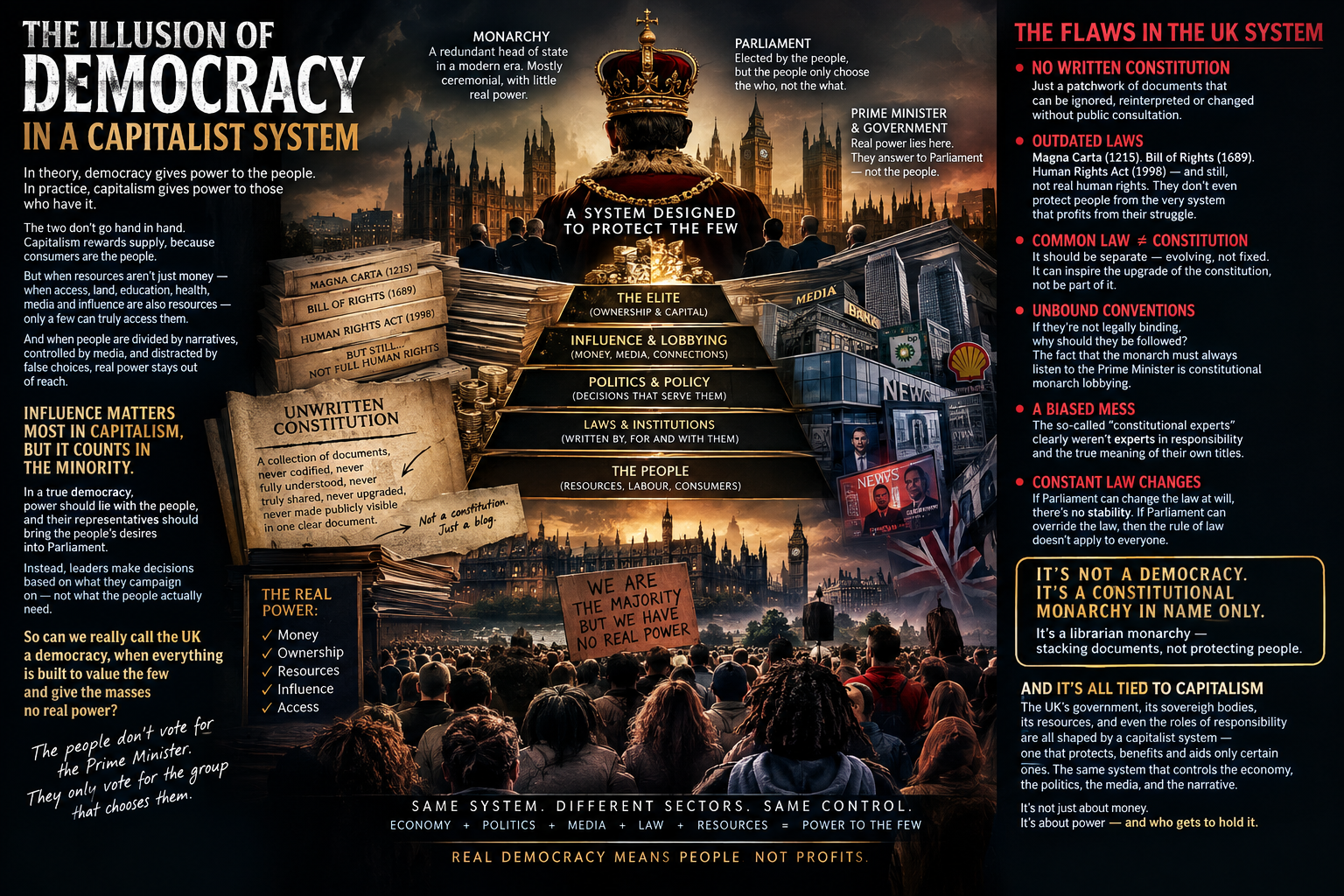
WHO ACTUALLY HAS THE POWER?
This is where the contradiction becomes much bigger than I originally made it.
Because capitalism is power to those who have it.
Democracy is power to the people.
So when we put the two beside one another, we need to stop pretending the relationship is automatically coherent simply because modern societies have made them coexist.
They may coexist.
That does not mean they are expressing the same principle.
And it certainly does not mean that their power structures naturally point in the same direction.
Capitalism rewards ownership, capital, investment, purchasing capacity and the ability to participate in markets.
Democracy, in principle, is supposed to place political authority with the people.
So what happens when the economic system gives some people vastly greater capacity to obtain resources, influence markets, command attention and shape institutions than others, while the political system tells us that the people are sovereign?
That is the contradiction.
And it gets even deeper when we stop treating economics and politics as two separate departments.
Because they are not separate in practice.
Money becomes access.
Access becomes resources.
Resources become capacity.
Capacity becomes influence.
Influence enters institutions.
Institutions make decisions.
Those decisions affect the distribution of resources.
And then the cycle starts again.
So perhaps capitalism and politics are not two systems sitting neatly beside one another.
Perhaps they are two expressions of the same wider distribution of power.
That is what I actually want to investigate.
CAPITALISM IS NOT JUST ABOUT MONEY
This is important.
When people hear “capitalism”, they often think:
businesses,
shops,
markets,
competition,
profit,
private ownership,
buying and selling.
But capitalism is also about who has the capacity to participate in those things.
Money does not have intrinsic value by itself. It is a mechanism through which access and exchange are represented.
Give someone enormous amounts of money and you have not magically given them more intelligence, more humanity or more intrinsic worth.
You have given them greater purchasing capacity within a system that recognises money as a gateway to resources.
That distinction matters.
Because resources are not just money.
Resources are land.
Housing.
Food.
Energy.
Education.
Technology.
Healthcare.
Transport.
Information.
Time.
Networks.
Security.
Professional expertise.
Infrastructure.
Attention.
Influence.
And money can provide access to many of these things.
Which means the concentration of money can become the concentration of access.
And the concentration of access can become the concentration of power.
That is not merely an economic argument anymore.
That is a governance argument.
THE PEOPLE ARE THE CONSUMERS
Now look at supply and demand.
Capitalism is often explained through the relationship between supply and demand.
But here is the obvious thing that gets lost in the way we talk about the system:
There is no supply without demand.
No customer, no commercial transaction.
No demand, no sustainable market.
No one wants the thing, and the producer eventually has a problem.
So why do we so often structure the conversation around the producer as though supply is the active side and demand is merely the passive side?
The consumer is not an accessory to the economy.
The consumer is part of what makes the economy function in the first place.
Perhaps an economy genuinely centred on human beings would recognise supply and demand as equally constitutive of the market relationship.
Not:
“The supplier produces and the consumer pays.”
But:
“Human demand creates the reason for supply to exist, and supply responds to that demand.”
That changes the philosophical relationship.
Because now the customer is not merely someone who purchases.
The customer is one of the reasons the economic structure exists at all.
And that sounds remarkably like democracy.
The people are not supposed to be an audience for government.
They are supposed to be the reason government exists.
So why do we have an economic system where demand technically matters but purchasing power determines whose demand becomes effective, and a political system where the people technically matter but representation determines whose decisions become effective?
AND THIS IS WHERE THE TWO WORLDS COLLIDE
The common response is:
“Capitalism is economic. Democracy is political.”
Fine.
But human beings do not live in departments.
A person does not wake up in the morning and separate their life into:
economy
and
politics
and
law
and
housing
and
education
and
transport
and
health
and
employment
as though each one operates independently.
They experience the consequences together.
If housing is controlled by economic conditions, that affects political participation.
If education is unequal, that affects opportunity.
If access to information is unequal, that affects political understanding.
If wealth affects the amount of time a person has available to engage with politics, that affects participation.
If organisations with enormous resources can buy more professional attention, legal expertise, lobbying capacity or advertising than ordinary individuals can, that affects influence.
The political and economic systems therefore meet whether we like it or not.
The question is whether we are willing to admit that they are interacting parts of one social power architecture.
INFLUENCE MATTERS MOST IN CAPITALISM
This is another place where I think the structure reveals itself.
Capitalism does not merely reward whoever has a human need.
It rewards whoever can organise resources effectively around demand.
And influence matters.
Influence over investment.
Influence over production.
Influence over distribution.
Influence over customers.
Influence over media.
Influence over infrastructure.
Influence over information.
Influence over policy.
And economic influence can become political influence.
This is not merely my interpretation of capitalism. Contemporary political philosophy explicitly debates whether concentrations of wealth and capital can be converted into unequal opportunities for political influence through mechanisms including lobbying and campaign finance. The Stanford Encyclopedia of Philosophy’s current discussion of capitalism specifically identifies this as a central criticism of capitalist political economy.
So when we say:
“They are separate — capitalism is economics and democracy is politics.”
we are pretending the boundary is stronger than it actually is.
The money enters the politics.
The politics enters the economy.
The law regulates both.
The institutions distribute both.
And the people experience the whole thing as one life.
NOW LOOK AT WHAT WE CALL DEMOCRACY
This is where I stop being interested in the label and start looking at the mechanics.
The British system genuinely has democratic institutions.
People vote in general elections.
Those elections elect MPs to the House of Commons.
The Prime Minister is not separately elected by the entire country. UK Parliament explicitly states that voters elect their local MP and do not vote directly for a Prime Minister. The monarch formally appoints the Prime Minister, guided by constitutional conventions; normally, the leader able to command the confidence of the House of Commons becomes Prime Minister.
So here is the distinction I care about:
the people choose who will exercise political authority.
They do not, in ordinary parliamentary elections, personally exercise that authority themselves.
That is representative democracy.
But it creates a very different proposition from direct democratic authority.
The citizen does not vote on every Bill.
The citizen does not vote on every spending decision.
The citizen does not vote on every appointment.
The citizen does not vote directly for the Prime Minister.
The citizen does not individually instruct Parliament on every policy decision.
The citizen chooses representatives.
And this is why my phrase remains:
THE PEOPLE VOTE THE WHO, NOT THE WHAT.
That does not mean people have no influence over the “what”. Elections, parties, manifestos, public debate, media, petitions, campaigning, protest, lobbying and parliamentary pressure can all influence what governments do.
But the structural distinction remains:
the vote principally selects representatives; it does not transfer direct legislative decision-making to the voter.
That is a significant difference.
Because “you get to choose who decides” is not identical to:
“you get to decide.”
And if democracy means power to the people, the distance between those two sentences deserves examination.
WHO ARE THE PEOPLE, ANYWAY?
There is another philosophical problem.
When someone says:
“Power to the people.”
which people?
The people with property?
The people without property?
The rich?
The poor?
The business owner?
The employee?
The landlord?
The tenant?
The creditor?
The debtor?
The institution?
The citizen?
The consumer?
The shareholder?
The person who has ten hours a day to participate?
The person who is working three jobs and has none?
They are all people.
So democracy cannot merely mean people exist somewhere inside the system.
It has to concern how authority is actually distributed among them.
That is why economic power matters to the democratic question.
Because if one person has vastly greater resources with which to influence the structures governing society, then formal equality of citizenship does not automatically produce equal practical capacity to shape society.
This is precisely the problem democratic theorists and critics of capitalism argue over.
Some defenders of capitalism argue that private economic power can act as a counterweight to political power by decentralising decision-making away from the state. Critics argue that concentrations of wealth can instead undermine the fair value of political freedom by allowing economic power to become political influence. Both positions are part of the established philosophical debate.
So the question is not whether one side has ever thought about this.
It clearly has.
The question is:
Why have we built a system where the tension is considered normal instead of asking whether the architecture itself makes sense?
BRITAIN DOES NOT HAVE A SINGLE CODIFIED CONSTITUTION
And now the same pattern appears in the constitutional structure.
Britain does have a constitution.
It simply does not have a single codified constitutional document.
UK Parliament describes the constitution as the collection of statutes, conventions, judicial decisions and treaties that together govern how the UK is run. It is often described as “partly written and wholly uncodified.”
The House of Commons Library’s September 2026 briefing makes the problem particularly clear: most of the laws, conventions and understandings relating to the constitution are written down somewhere, but they cannot conveniently be found written down in one place.
And that is exactly what I am questioning.
Because a pile of constitutional material is not the same thing as constitutional clarity.
My blog is a perfect analogy.
I can write hundreds of articles.
The information can exist.
The principles can exist.
The ideas can exist.
The history can exist.
But nobody would call the blog itself a constitution.
The constitution would be what you gathered from it, organised, codified, structured and placed somewhere everyone could actually see.
That distinction is important.
Accumulation is not codification.
Documentation is not necessarily clarity.
Historical continuity is not necessarily constitutional coherence.
And flexibility is not automatically accountability.
The Government currently describes the flexibility and ability to evolve of the UK’s uncodified constitution as one of its strengths.
Fine.
But flexibility has another side.
A flexible structure can evolve.
It can also remain unclear.
LIBRARIAN MONARCHY
So yes, I am going to keep my phrase.
Librarian monarchy.
Not as a literal constitutional classification.
As an exposure of the absurdity.
We have constitutional material accumulating over centuries.
Magna Carta:
1215.
Bill of Rights:
1689.
Human Rights Act:
1998.
And now:
2026.
More statutes.
More judgments.
More conventions.
More treaties.
More practices.
More understandings.
More amendments.
More constitutional commentary.
More constitutional experts explaining why the structure is the way it is.
And yet the country still does not have one clear constitutional document setting out, in one place, the architecture of authority.
The official description itself says exactly that the constitution consists of these dispersed components.
So I am asking a very simple design question:
At what point does preserving constitutional history become an excuse for avoiding constitutional consolidation?
Because a library is wonderful.
But a library is not a manual.
If I need to understand how an entire machine works and you send me into a library containing 800 years of documents, you have given me information.
You have not necessarily given me clarity.
CONSTITUTIONAL CONVENTIONS
And then we reach something even more extraordinary.
Constitutional conventions.
UK Parliament itself defines them as unwritten understandings about how Parliament should operate which, although not legally enforceable, are almost universally observed.
The House of Lords Constitution Committee has also expressly described constitutional conventions as political rules that are not generally enforceable by courts.
So yes:
Why are we comfortable having rules that matter constitutionally but are not ordinary legal rules?
The answer given by constitutional theory is that conventions regulate political behaviour and are enforced politically rather than judicially.
That is coherent within the existing British model.
But then I ask another question:
If a rule is important enough to govern the people who operate the state, why should its meaning, status and consequences depend so heavily upon custom, understanding and political compliance?
Because if the citizen does not know the rule exists, the citizen cannot meaningfully scrutinise it.
And if the rule is not clearly visible, it becomes dependent on experts explaining what everybody else is supposed to understand.
That is where constitutional expertism comes in.
Not “constitutional experts are stupid.”
That would be ridiculous.
The point is much more uncomfortable:
A system can be technically sophisticated and democratically inaccessible at the same time.
Expertise can preserve complexity just as easily as it can solve it.
THE CROWN: TITLE, AUTHORITY AND RESPONSIBILITY
Then we come to the Head of State.
The UK is a constitutional monarchy.
The monarch is the Head of State.
But much of the monarch’s substantive constitutional activity is exercised on ministerial advice, and formal advice is constitutionally binding in the relevant areas.
Royal Assent is now a constitutional formality and is given under the Royal Prerogative on ministerial advice. The last refusal of Royal Assent occurred in 1708.
So again I ask:
What is the optimum constitutional function of the Head of State?
Not:
“Do we like the monarchy?”
That is a completely different question.
I am asking:
What is the role for?
What responsibility comes with the title?
What accountability comes with the position?
What constitutional work should the office perform?
If a republic replaces the Crown, the head of state could be elected or otherwise constituted through a different democratic mechanism.
If the monarchy remains, another possibility is a substantially redesigned Head of State with clearly defined constitutional stewardship responsibilities.
Either way, the question is about architecture.
Because ceremonial visibility is not the same thing as governing responsibility.
A person can be enormously visible while possessing very little operative power.
And an institution can be culturally enormous while constitutionally restrained.
That is why I find it legitimate to ask whether the present allocation of the role is actually the best use of the office.
“CONSTITUTIONAL MONARCHY LOBBYING”
And yes, I am keeping this one too.
Constitutional monarchy lobbying.
Again, not as a literal legal term.
As a description of the imbalance I see.
If the monarch must constitutionally follow binding ministerial advice in substantial areas, then the practical power lies elsewhere.
The Prime Minister and ministers exercise executive authority.
Parliament legislates.
The monarch participates formally in the constitutional machinery.
So what is the Head of State actually empowered to do when the political government is operating within the accepted constitutional structure?
The Crown can advise.
The Crown can warn.
The Crown can represent.
The Crown can preserve continuity.
But preserving continuity and possessing independent constitutional responsibility are not the same thing.
And if the role is supposed to represent the continuity of the state, then perhaps the continuity of the constitutional architecture deserves more attention than ceremony alone.
PARLIAMENTARY SOVEREIGNTY
Now watch what happens when we take Parliament itself.
The doctrine of parliamentary sovereignty makes Parliament the supreme legal authority in the UK. Parliament can create or end laws, and one Parliament cannot generally prevent a future Parliament from changing those laws.
This is one of the defining principles of Britain’s constitutional order.
And this is where my criticism becomes structural rather than ideological.
If Parliament can change the rules governing everyone else, what governs Parliament itself?
The answer is the constitutional arrangement, political accountability, conventions, courts operating within their jurisdiction, elections and other constraints.
But Parliament retains legal sovereignty.
So the system is not simply:
people → law.
It is more like:
people → elected representatives → Parliament → law → people.
And Parliament sits in the middle.
That may be entirely defensible as a model of representative government.
But it is not the same as direct democratic sovereignty of the individual.
And that is the distinction I want the word democracy to answer for.
DOES THE RULE OF LAW ACTUALLY MEAN THE SAME THING FOR EVERYONE?
Here I want to make the question more precise.
When I say:
“If Parliament can change the law, the law does not go for all.”
I am not saying that changing laws itself destroys the rule of law.
Of course laws must be able to change.
The deeper question is:
Does the rule of law place everyone under a common legal order while leaving Parliament with the ultimate capacity to rewrite that order?
The British constitutional answer is broadly yes.
And parliamentary sovereignty is precisely why.
So the problem is not that there is no rule of law.
The problem is that legal equality before the law and equality of constitutional power are not the same thing.
A citizen is subject to the law.
Parliament can make and unmake the law.
The citizen can vote.
Parliament legislates.
That is a hierarchy of institutional authority.
So again:
democracy may give the people a route into the system without giving them ownership of the system itself.
That is the distinction I am investigating.
THE HUMAN RIGHTS QUESTION
And this takes us to human rights.
The Human Rights Act 1998 is not meaningless.
It contains serious legal protections and allows individuals to rely on Convention rights against public authorities.
But the constitutional mechanism is important.
Where primary legislation cannot be interpreted compatibly with a Convention right, a UK court can issue a declaration of incompatibility.
It cannot simply invalidate the Act of Parliament.
The legislation remains legally valid unless and until Parliament changes it.
That means the rights are legally protected within the system.
But it also means the protection operates through a constitutional architecture in which Parliament remains legally sovereign.
That is exactly where my larger philosophical objection sits.
What happens to rights that would challenge the foundations of the economic or political structure itself?
What happens when the human interest conflicts with institutional convenience?
What happens when a right would require the system to redistribute power rather than merely regulate how existing power is exercised?
Those are different questions from whether a statutory right exists.
And that is why I describe the existing rights framework as unfinished from the perspective of SHS governance.
Not because there are no rights.
Because rights can exist without the human being becoming the ultimate source of authority.
That is a fundamental distinction.
COMMON LAW SHOULD NOT BE THE CONSTITUTION
This is where SHS takes a very different approach.
Common law evolves through cases.
Courts encounter circumstances.
Cases produce judgments.
Judgments can develop legal principles.
That can be useful.
But why should an evolving legal body also function as part of the constitutional architecture?
Within SHS, I see a clearer separation:
The constitution governs the architecture of authority.
The law governs the legal body.
The courts interpret and develop law through cases.
The constitution is periodically reviewed and upgraded in light of what the evolving legal body, society and humanity reveal.
That means common law can inform constitutional development without becoming the constitution itself.
That is not a description of the current British legal system.
It is part of the architecture SHS is building.
And because SHS is a side governance rather than an internal department of the UK system, it does not need to replicate Britain’s historical arrangement simply because Britain inherited it.
It can design deliberately.
WHY SHOULD A CONSTITUTION BE ALLOWED TO AGE WITHOUT A BUILT-IN UPGRADE MECHANISM?
This is another place where the whole structure begins to look strange.
A society changes.
Technology changes.
Economies change.
Human knowledge changes.
Population structures change.
Environmental conditions change.
Concepts of rights change.
Relationships between citizens and institutions change.
So why should the constitutional architecture depend so heavily upon accumulated historical development rather than containing an explicit mechanism for systematic constitutional review?
The UK constitution certainly evolves.
That is established.
But evolution and deliberate review are not the same thing.
A house can accumulate extensions for 800 years.
That does not mean someone ever redesigned the plumbing.
You can keep adding rooms.
Eventually you need to ask:
What is the building now?
That is the constitutional question.
AND THIS IS WHERE CAPITALISM COMES BACK
Because now look at all of this together.
Who controls economic resources?
Who owns productive capital?
Who owns land?
Who has purchasing power?
Who has access to information?
Who can employ professional influence?
Who participates in elections?
Who chooses representatives?
Who writes legislation?
Who interprets legislation?
Who appoints ministers?
Who holds executive authority?
Who possesses parliamentary sovereignty?
Who exercises prerogative powers?
Who creates conventions?
Who interprets conventions?
Who can alter laws?
Who can afford to challenge institutions?
Who has enough time to understand the system?
Who has enough money to navigate it?
Who has enough influence to get attention?
Now tell me:
Are these really separate systems?
Or are they different layers of one power architecture?
That is the question.
Because once money buys access, economics enters politics.
Once politics determines regulation, politics enters economics.
Once law defines economic ownership, law enters capitalism.
Once institutional structures determine who can change the law, constitutional design enters democracy.
Once information shapes what citizens believe is possible, narrative enters all four.
It is one system.
NARRATIVE IS A RESOURCE TOO
This part is massively underestimated.
People talk about resources as though resources are physical.
Oil.
Gas.
Land.
Money.
Buildings.
Technology.
But information is a resource.
Attention is a resource.
Knowledge is a resource.
Narrative is a resource.
And whoever has disproportionate access to those things can influence how the public understands reality.
A population can be divided without anyone physically separating it.
Give people different information.
Different priorities.
Different fears.
Different identities.
Different enemies.
Different explanations.
Different versions of what is possible.
And suddenly people who share the same material circumstances are arguing with one another rather than examining the architecture above them.
This is where political leadership, media, economic power and public narrative can intersect.
Not because every institution coordinates secretly.
That is not necessary.
Systems can produce similar outcomes simply because their incentives point in similar directions.
And that is more interesting than conspiracy.
Because if a structure repeatedly produces concentration of power without anybody needing to meet in a room to design it, then the structure itself deserves investigation.
A DEMOCRACY CAN HAVE DEMOCRATIC PROCEDURES WITHOUT DEMOCRATIC OWNERSHIP
This is the distinction I am actually making.
The UK has democratic procedures.
Elections.
Voting.
Political parties.
An elected House of Commons.
Freedom of expression.
A free press.
Independent courts.
These are real institutional features.
But democratic procedures are not identical to democratic ownership.
You can participate in a system without owning the system.
You can vote within a system without controlling the system.
You can select representatives without directly deciding legislation.
You can possess legal rights without being the ultimate authority over the institutions protecting those rights.
And you can live inside an economy without possessing equal economic power within it.
That is why simply saying:
“Britain is a democracy.”
does not answer my investigation.
It simply names the constitutional tradition.
My question is:
How democratic is the distribution of actual power?
That is a different question.
CAPITALISM DOES NOT NECESSARILY DISPROVE DEMOCRACY
And this is important too.
I am not interested in replacing one simplistic narrative with another.
There are coherent philosophical arguments that capitalism can support forms of freedom by dispersing economic decision-making rather than concentrating everything in government. Milton Friedman, for example, argued that economic freedom can provide a counterweight to political power.
So capitalism is not automatically a dictatorship.
Democracy is not automatically fake.
The question is what happens when their respective distributions of power interact.
And that is precisely where the serious criticism begins.
Because critics of capitalism have argued that when wealth becomes sufficiently concentrated, economic inequality can become political inequality. The contemporary philosophical debate explicitly considers whether wealth can undermine equal political influence and democratic self-determination.
So instead of asking:
“Can capitalism and democracy coexist?”
I am asking:
Can a political order honestly describe itself as government by the people while tolerating an economic architecture in which the practical capacity to influence the world is distributed so unequally?
That is not the same question.
And it is much harder.
MAYBE WE HAVE CONFUSED EQUALITY WITH EQUITY
This is where another SHS principle enters.
Formal democracy can say:
one person, one vote.
Fine.
But equal votes do not create equal lives.
Equal votes do not create equal resources.
Equal votes do not create equal education.
Equal votes do not create equal time.
Equal votes do not create equal access to legal expertise.
Equal votes do not create equal access to housing.
Equal votes do not create equal ability to lobby government.
Equal votes do not create equal ability to recover from economic failure.
And equal votes certainly do not create equal purchasing power.
So perhaps the political system has confused formal equality of participation with substantive equality of capacity.
SHS approaches that differently.
Its equity principle is not “give everyone exactly the same.”
It is:
Give more to those who have experienced less.
That changes the meaning of fairness.
Because if someone starts ten steps behind and you give both people one step, you have treated them equally.
You have not made the outcome equitable.
THIS IS WHY “THE PEOPLE” CANNOT JUST MEAN VOTERS
The people are human beings before they are voters.
Before they are consumers.
Before they are employees.
Before they are taxpayers.
Before they are tenants.
Before they are shareholders.
Before they are applicants.
Before they are defendants.
Before they are patients.
Before they are customers.
The human being precedes the system.
At least, that is how SHS begins.
And this is why SHS is not merely proposing another electoral mechanism.
It starts from a different constitutional principle:
Humanity is the source of authority.
Not the monarchy.
Not Parliament.
Not capitalism.
Not the market.
Not corporations.
Not bureaucracies.
Not inherited institutions.
Not technology.
The human being comes first.
The system comes afterwards.
THE SHS DIFFERENCE
This is why SHS cannot simply be inserted into the British constitutional vocabulary and judged according to whether it looks familiar.
It is a separate governance architecture.
Its legal language is its own.
Its authority structure is its own.
Its constitutional logic is its own.
And its central question is different:
Who owns the system?
The 55% humanity / 45% machine principle is one expression of that architecture.
It is not simply “more democracy.”
It is an attempt to establish a measurable constitutional relationship in which humanity retains the greater authority over the machine structures it creates and uses.
That is radically different from saying:
“Humanity votes sometimes.”
It says:
Humanity retains the higher authority.
And that is the missing piece from the debate I am having here.
Because if the people only periodically select representatives, while economic power is distributed through ownership, political power through representation, constitutional authority through inherited institutional structures, and legal authority through parliamentary sovereignty, then the individual is participating in several systems without necessarily being the final owner of any of them.
THIS IS NOT AN ARGUMENT AGAINST GOVERNMENT
Government is necessary for organising resources, structures, infrastructure, public responsibilities and collective decisions.
But government existing is not proof of progress.
Existence is not progress.
A government can exist for hundreds of years.
A law can exist for hundreds of years.
A constitution can evolve for hundreds of years.
An economic system can dominate for hundreds of years.
None of that proves the architecture is optimised for humanity.
Progress means something more.
Development.
Integration.
Elevation.
Adaptation.
Improvement.
Greater human capacity.
Greater coherence.
Greater ability to meet human needs.
So the question should never be:
“Does the institution exist?”
It should be:
“What is the institution producing?”
THE SAME QUESTION HAS TO BE ASKED OF CAPITALISM
What does capitalism actually produce for humanity?
Not just GDP.
Not just investment.
Not just corporate growth.
Not just consumer choice.
Not just shareholder returns.
What does it produce for the actual human being?
Security?
Housing?
Health?
Time?
Education?
Opportunity?
Purpose?
Connection?
Meaning?
Freedom?
And for whom?
Because if the answer differs radically according to how much capital someone already possesses, then the system is not merely distributing products.
It is distributing capacity.
And capacity is power.
SO WHAT ARE WE REALLY CALLING DEMOCRACY?
This is now my central question.
Not:
“Does Britain have elections?”
Yes.
Not:
“Can people vote?”
Yes.
Not:
“Are MPs elected?”
Yes.
Not:
“Is there a free press?”
Yes.
Not:
“Is there an independent judiciary?”
Yes.
All of those are real components of the British democratic system.
My question is much larger:
Does the overall distribution of power actually match the word democracy?
Because if democracy is:
power to the people,
but economic power is concentrated through capital,
political power is exercised through representatives,
constitutional power is accumulated through institutions,
legal sovereignty sits with Parliament,
constitutional conventions can operate without legal enforceability,
the Head of State is hereditary,
the constitution is dispersed rather than codified,
and citizens primarily select representatives rather than directly control the decisions made in their name,
then perhaps what we have is not one coherent expression of democratic authority.
Perhaps we have a hybrid power architecture that contains democratic mechanisms while retaining substantial non-democratic concentrations of authority.
That is a very different proposition.
AND THAT IS WHY CAPITALISM CANNOT JUST BE LEFT OUT OF THE DEMOCRACY CONVERSATION
Because capitalism is not merely something people do with their money.
It determines who has money.
Who owns assets.
Who gets investment.
Who gets to scale.
Who can absorb losses.
Who gets access.
Who has bargaining power.
Who can walk away.
Who can employ others.
Who can purchase services.
Who can purchase expertise.
Who can purchase attention.
Who can influence markets.
And, depending on the circumstances and institutional safeguards, who can influence politics.
That means capitalism is already participating in the distribution of social power.
So when we ask whether Britain is democratic, capitalism is not an optional side topic.
It is part of the evidence.
THE REAL CONTRADICTION
Maybe the contradiction is not:
capitalism versus democracy.
Maybe it is:
capital concentration versus democratic equality.
Because the more economic power can be converted into political capacity, the harder it becomes to maintain the idea that political power is meaningfully equal.
And the more political institutions depend upon economic structures for resources, investment, employment, infrastructure and growth, the less sensible it becomes to pretend economics and politics are independent.
They are interdependent.
They are intertwined.
They are constantly feeding one another.
So the real question is not:
“Can capitalism and democracy coexist?”
Of course they can exist in the same country.
Britain is evidence of that.
The question is:
Can the distribution of power produced by capitalism remain compatible with a meaningful conception of power belonging to the people?
That depends on how economic power is prevented — or permitted — to become political power.
And that is exactly where the investigation should go.
BECAUSE THE PEOPLE ONLY VOTE THE WHO
This is the sentence I keep returning to.
The people do not normally walk into a general election and vote:
this law yes,
that law no,
this spending allocation yes,
that constitutional reform no,
this Prime Minister yes,
that Prime Minister no.
They elect representatives.
The representatives operate the machinery.
The Prime Minister emerges from the parliamentary arrangement.
The government exercises executive authority.
Parliament makes law.
Courts interpret and apply law.
The Crown performs its constitutional functions within that structure.
Capital moves through the economy.
Businesses allocate resources.
Consumers express demand through purchasing decisions.
Money determines effective access to many goods and services.
Influence circulates through the entire system.
And the individual is expected to call all of this:
democracy.
Maybe it is.
But I want the architecture to prove it.
THIS IS CONSTITUTIONAL EXPERTISM
The problem is not that nobody knows how the British system works.
Experts know.
The problem is that the system can become so historically accumulated, technically specialised and institutionally compartmentalised that ordinary people are left with a conclusion instead of an architecture.
They are told:
“This is democracy.”
“This is constitutional monarchy.”
“This is parliamentary sovereignty.”
“These are conventions.”
“This is common law.”
“These are human rights.”
“This is capitalism.”
And then they are expected to trust the structure because it has a name.
That is not enough.
The citizen should be able to inspect the architecture.
Understand the architecture.
Question the architecture.
Challenge the architecture.
Upgrade the architecture.
And understand exactly where authority comes from.
That is what a genuinely human-first governance model should make possible.
MAYBE THE PROBLEM IS NOT THAT WE HAVE THE WRONG SYSTEM
Maybe the problem is that we have never properly asked:
Who is the system for?
Because once you ask that question, everything changes.
Capitalism has to explain who it serves.
Democracy has to explain who actually holds authority.
Government has to explain what it produces.
Constitutional monarchy has to explain the responsibility attached to the Crown.
Parliament has to explain the distance between representation and direct authority.
Law has to explain how it protects the individual.
Human rights have to explain what happens when rights conflict with institutions.
And the constitution has to explain how the entire architecture remains coherent over time.
That is not rebellion against government.
That is governance.
THE SYSTEM SHOULD NOT OWN THE PEOPLE
This is ultimately the SHS position.
People should own the system.
The system should not own people.
The economy should exist because humans need an organised way to exchange and allocate resources.
Government should exist because humans need organised collective administration.
Law should exist because humans need structured protections, responsibilities and dispute resolution.
A constitution should exist because humans need clarity about who has authority and what that authority is allowed to do.
A Head of State should exist for a defined constitutional purpose.
Businesses should exist because people have needs and people have capacities.
Markets should exist because supply and demand interact.
Technology should exist because humanity creates tools.
None of these things should become more important than the human beings who created them.
And once they do, the system has reversed its purpose.
SO BRING CAPITALISM BACK INTO THE ROOM
Capitalism is not just an economic machine sitting outside government.
It is embedded in the way resources are allocated.
Resources determine capacity.
Capacity determines influence.
Influence can enter politics.
Politics determines law.
Law determines what economic activity is permitted.
Constitutional arrangements determine who can change that law.
Narrative affects what people understand about all of it.
And the public is left with one vote at a time as its primary mechanism for selecting who will operate the whole structure.
That is not a trivial issue.
It is the issue.
Because if the fundamental promise of democracy is power to the people, then we should be able to trace that power all the way through the system.
Not merely locate it at the ballot box.
We should be able to answer:
Where does the power begin?
Where does it move?
Who accumulates it?
Who can exercise it?
Who can challenge it?
Who can alter the rules governing it?
And who ultimately owns the system?
Until we can answer those questions clearly, calling a system democratic is only the beginning of the conversation.
And capitalism is not outside that conversation.
It may be one of the largest parts of it.
Because perhaps the most revealing thing about Britain is not that capitalism and democracy have been allowed to coexist.
Perhaps it is that we have allowed economic power, political power, constitutional power and institutional power to develop alongside one another for centuries without ever requiring them to answer the same fundamental question:
WHO ACTUALLY HAS THE POWER?
And that is the question SHS is built to ask.
Not from inside their system.
From beside it.
Not to inherit its architecture.
To examine it.
Not to accept its names.
To examine what those names actually mean.
And not to ask whether humanity is represented somewhere inside the machinery.
But whether humanity is actually the authority the machinery exists to serve.
…
Well just because they are not known by the masses yet, it doesn’t make them less of legal words. In shs governance they are, and we are not oart of their system, so don’t treat it as it is. Rememebr we are building rhe side governance, not within it.
Also my question, you didn’t ask for specification as I wanted to see what you were going to bring.
My question wasn’t just whether a system can genuinely claim power to the people while anorher sustem disrributes economic power acxording to ownership capital and purchasing power… cause just like you said, economic power isn’t secluded to economy as it mixes with politics. They’re two and one of the same, infact i was aking if it is coherent and cohesive to call britain a democracy, when evergrhing isnbuilt to value the few and no real power is given to the masses, cause we don’t even vote for the prim minisrer, only the grouo of which they choose the prime minister. My investigation is strong as it stands, I don’t need a AI to tell me what’s stronger if you’re not going to have a holisfic perspecfive of jt all and miss important points.
Keep it all and add more that exposes even more of the same icenergs in its full extent. this is what i gave you, respect it: Well that’s the thing you contrdicted yourself, cause capitalism is power to those who have it, and democracy power to the people and the two don’t go hand to hand, so the two in theory cannot coexist for hiwever long capitakism rewards supply, cause the consumers are the people. And especially when resources are not just money, but onlt some have huge amounts of money that also gets them accessnto resources that the common person doesn’t have access to or is too divided by the narratives the leaders allow to happen that disempowers the people.
Maybe if capitalism valued supply and demand equally, as there wouldn’t be any supply if there wasn’t a demand.
Influence matter the most in capitalism, but it counts in the minority, whereas a democracy shoukd go by the hand of the people and the represenrative bring the people’s desires in parliament, but instead leaders make decisions based on what they prophesize during political campaigns, but by definition:
- Elected Parliament: Citizens vote for representatives to serve in the House of Commons.
- Responsible Government: Real political power belongs to the Prime Minister and Parliament, who answer to the voters.
- Democratic Freedoms: The country uses free elections, a free press, and an independent judiciary
This is power to the few, not to the people. The oeople only vote the who, not the what.
Where if we take a repubblic into account.. and if you take away the crown it becomes a repubblic, where the head of state is elected. Instead we have a redundant head od state as there’s no very much of a say with modern monarchy, if not ceremonial appearances. A whole role that could be filled by someone that makes rhe impact or power shared between parliament and head of state, where the head of state is elected if a more prepared option isn’t available in the line of blood.
It’s called constitutional monarchy but uk doesn’t have a written down constitution. Having an accumukstion of documents through time that never gets codified, understood, shared, expressed, reiterated, upgraded and made pubblically visible in a clear one manner, it’s like the structure of mt blog. It is a blog, not a constitution, a constitution is what’s gathered from it and put in one document, in one place, clear for everyone. So why the title constitutional monarchy? They shoukd be called librarian konarchy, as they only stack documents.
Statute law: The magna carta was 1215, we are in 2026. Bill of rights was in 1689, agaij we are in 2026. Human rights act from 1998 doesn’t incorporate the human rights rhst go against rhe parliament, law and capitalism, so not real human rifhts, more like unfinished ones.
Common law should be aside not in the constitution, as it is ever evolving, instead it should inspire the upgrade of constitution, not be part of it., as it is a seprare entity. Constitution is politics/government, the law is legal body. And the court rulings are only expanded for however much the court meets specific cases that require it to expand, if not it doesn’t mewninf rhe constitution remains redundant where there’s need for update. The head of state should take care of this, not just do presences and ceremonies. That’s attention grabbing without any real responsibility and value of the role the crown houses.
Why have constitutional conventions if they are not legally binding?! Cause if soneone doesnt know then they can’t be followed. If legally binding, the excuse of it being important become stronger. For now it’s a biased mess. The fact the monarch must always listen the advice of the prime minister makes it constitutional monarch lobbying.
The constitutional experts that wrote the works of authority, clearlt weren’t that much of an expert, otherwise they would have understood the importance of responsibikity and roles claimed by titles.
If the parliament is always changing laws, there’s never stability. If the parliament can overtyrn the law it means the law doesn’t go for all. Meaning the rule of law doesn’t actually go for all.
This is constitutional expertism.
So bringing it back to capitalism, we see the trend on how these sovereign bodies are capotalistic authorities, not actual democratic bodies.
Capitalism is so inserted in the ways the governemtn of britain runs its resoirces, of which roles of responsibikitg also are part of as resources that manage the very system we all love by, but only benefits, prorects and aids certain ones.




Leave a Reply