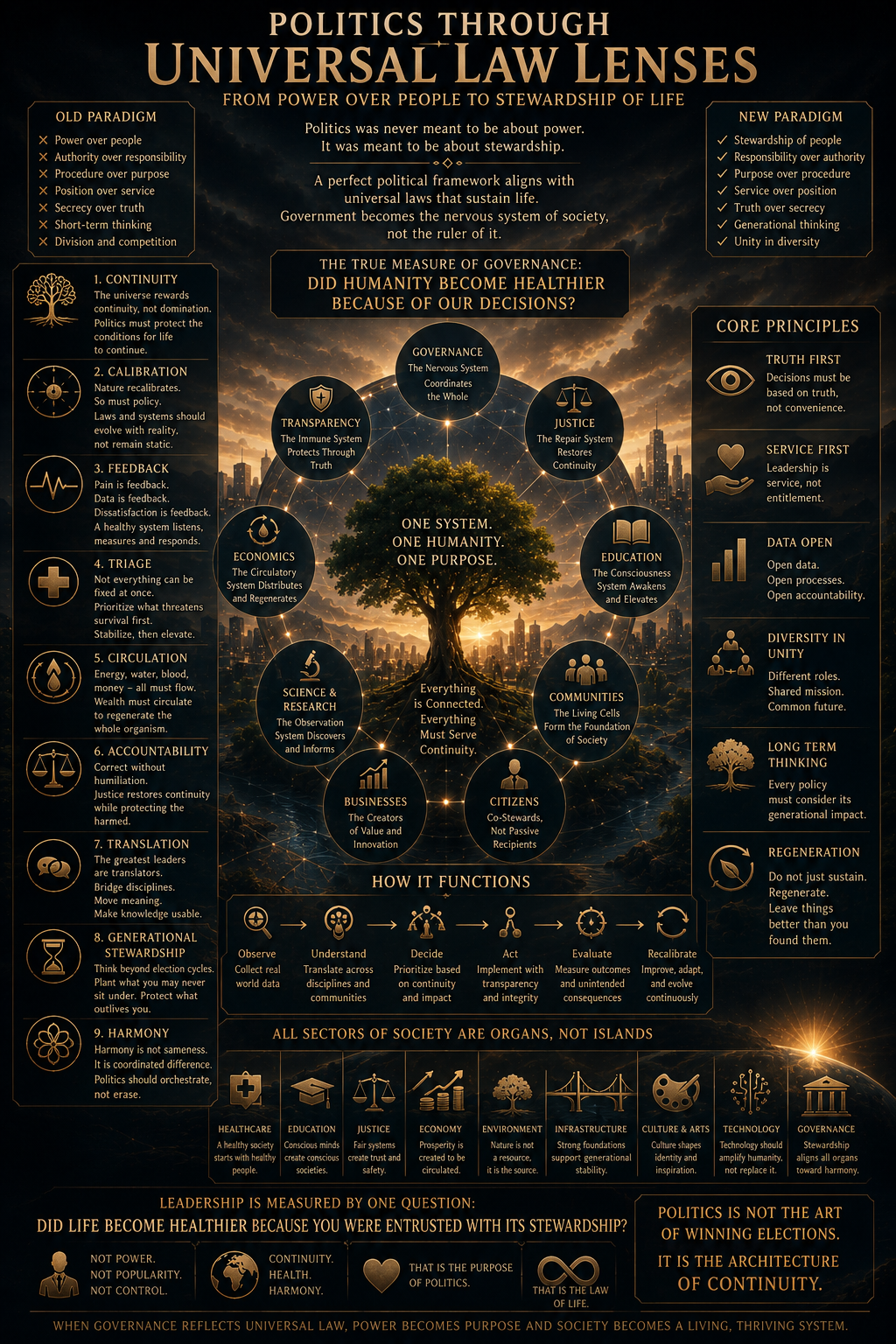
Politics was never meant to be about power.
It was meant to be about stewardship.
There is a difference.
Power asks, “How much control can I hold?”
Stewardship asks, “How much life can I protect?”
That difference alone explains much of humanity’s history.
Throughout civilization we have built governments around authority before responsibility, procedure before purpose, position before service. We have created systems where leadership is frequently measured by victory, popularity, economic output, party loyalty, or ideological success. Yet if we observe nature instead of institutions, none of those are the primary measures by which existence sustains itself.
The universe does not reward domination.
It rewards continuity.
Every ecosystem that survives does so because enough parts work together long enough for life to continue.
That, to me, is the first universal law politics should reflect.
A political system should not ask, “Who won the election?”
It should ask,
“Did humanity become healthier because of our decisions?”
That single shift changes everything.
A perfect political framework would therefore stop viewing government as the ruler of people and begin viewing it as the nervous system of society.
The people are not there to sustain government.
Government exists to sustain the conditions through which people flourish.
Just as the brain serves the body rather than demanding the body serve the brain, governance should coordinate society rather than consume it.
Once that perspective changes, priorities naturally reorganize themselves.
Instead of departments competing for budgets, they become organs cooperating for one living body.
Healthcare is not isolated from education.
Education is not isolated from justice.
Justice is not isolated from housing.
Housing is not isolated from employment.
Employment is not isolated from mental health.
Mental health is not isolated from community.
Community is not isolated from economics.
Everything becomes one living system.
Just like the human body.
Universal law constantly teaches us that nothing survives in isolation.
Every living system survives through relationship.
Politics should therefore become the science of relationship rather than the competition of ideologies.
The second universal law is calibration.
Nature continuously recalibrates itself.
Temperature changes.
Pressure changes.
Species adapt.
Cells repair.
The immune system constantly identifies what belongs and what threatens continuity.
Politics should work exactly the same way.
Policies should never become permanent simply because someone wrote them decades ago.
They should be continuously measured against one question:
“Does this still produce harmony?”
If yes, preserve it.
If not, improve it.
Not because history was wrong.
Because reality moved.
The third universal law is feedback.
Every healthy system receives honest information.
Pain is feedback.
Inflammation is feedback.
Market changes are feedback.
Citizen dissatisfaction is feedback.
Crime is feedback.
Homelessness is feedback.
Corruption is feedback.
Waiting lists are feedback.
Declining birth rates are feedback.
None of these are enemies.
They are information.
A healthy political framework therefore would never hide data.
It would expose it.
Because hiding information prevents correction.
Transparency becomes immune function.
Secrecy becomes disease.
The fourth universal law is triage.
Whenever the human body suffers multiple injuries simultaneously, it does not heal everything equally.
It stabilizes what threatens survival first.
Politics should do the same.
If homelessness reaches crisis levels, resources move there first.
If healthcare begins collapsing, resources move there first.
If infrastructure fails, resources move there first.
Not because the other departments matter less.
Because survival has priorities.
A civilization that cannot prioritize eventually becomes overwhelmed by everything equally.
Universal law never does everything simultaneously.
It sequences.
The fifth universal law is circulation.
Blood moves.
Water moves.
Air moves.
Energy moves.
Money should move exactly the same way.
Whenever circulation stops, tissue dies.
Whenever money concentrates without returning to regenerate the wider organism, society experiences the political equivalent of poor circulation.
The purpose of economics should therefore not simply be wealth creation.
It should be healthy circulation.
Money should move through households, businesses, research, education, infrastructure, healthcare, innovation, environmental restoration and community regeneration before accumulating indefinitely.
Healthy circulation creates resilient societies.
The sixth universal law is accountability without humiliation.
When cells malfunction, the immune system responds.
It does not hate the cell.
It corrects the malfunction.
Politics has largely confused punishment with correction.
Universal law seeks restoration whenever restoration is still possible.
Justice therefore becomes less about revenge and more about restoring continuity while still protecting those who were harmed.
Accountability exists because continuity matters.
Not because punishment feels satisfying.
The seventh universal law is translation.
Perhaps humanity’s greatest political problem is not intelligence.
It is translation.
Scientists discover.
Engineers build.
Teachers explain.
Doctors heal.
Businesses innovate.
Artists communicate.
Lawyers regulate.
Communities experience.
Politicians often attempt to coordinate them all.
Yet very few people translate fluently between those worlds.
A truly advanced political structure would value translators as highly as specialists.
People capable of moving meaning between disciplines become the connective tissue of civilization.
Without translation, knowledge remains isolated.
With translation, knowledge becomes usable.
The eighth universal law is stewardship across generations.
Most political systems operate inside election cycles.
Universal law operates across centuries.
Forests are planted whose shade the planter may never sit beneath.
Parents raise children whose futures they may never witness.
The sun shines regardless of who receives the light.
Politics should therefore ask not merely,
“What helps us win today?”
but,
“What allows humanity to flourish fifty, one hundred, or two hundred years from now?”
That changes infrastructure.
Education.
Environmental planning.
Economic policy.
Healthcare.
Research.
Everything.
Finally comes harmony.
Harmony is not sameness.
Harmony is coordinated difference.
Every instrument in an orchestra plays a different part.
Every organ in the body performs a different function.
Every ecosystem contains different species.
Difference is not the problem.
Disconnection is.
Politics should therefore never aim to erase diversity.
It should coordinate diversity toward shared continuity.
That is harmony.
If I had to summarize the perfect political framework through the lens of universal law, it would look something like this:
Government would function as the nervous system.
Truth would function as sensory input.
Transparency would function as the immune system.
Justice would function as repair.
Economics would function as circulation.
Education would function as consciousness.
Science would function as observation.
Communities would function as living cells.
Businesses would function as creators of value.
Citizens would function as co-stewards rather than passive recipients.
Leadership itself would cease being measured by speeches, popularity or electoral victories.
Leadership would simply be measured by one question:
Did life become healthier because you were entrusted with its stewardship?
Because in the end, politics is not the art of winning elections.
It is the responsibility of creating conditions where humanity can continuously regenerate itself.
When governance begins to reflect the same universal laws that sustain living systems, politics stops becoming a struggle for power and starts becoming an architecture for continuity.
..
movie by 2033, legal campaign by 2049, 2056 immortality baby.
I’ll leave it to Andy, but at the same time give the people the standard lense of what good lesdership looks like.


Leave a Reply