
The Vampires of the past have been investing in slow termed decay, their mirrors, not in the potential but what immortality could be.
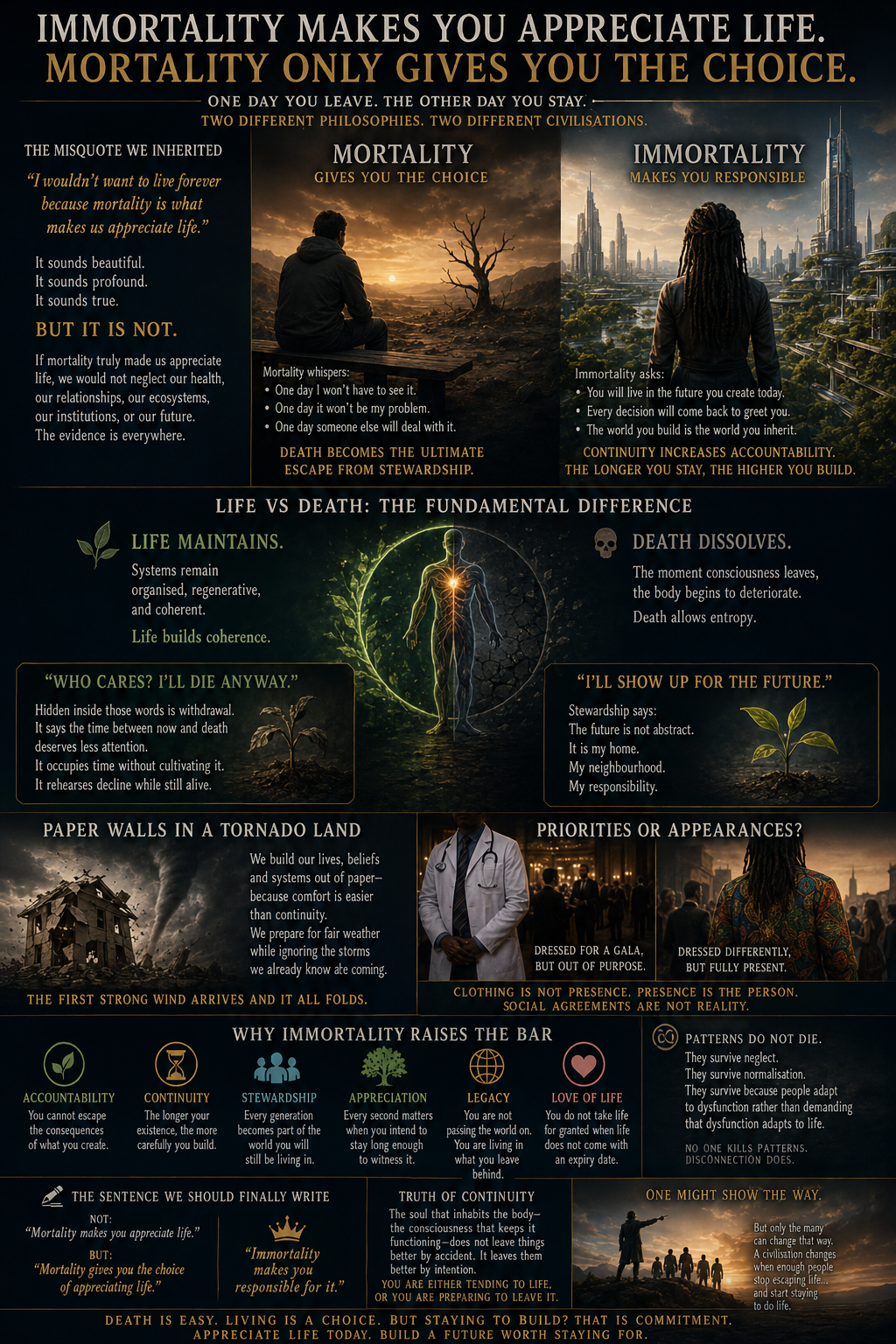
Think of how Jacques St. Germaine and how he invested his wealth… why not build a world that integrates you and benefits from your presence?! Different priorities.
One of the biggest contradictions I have observed throughout my life is this:
Almost everyone says they want to live longer.
Many dream of immortality.
Many invest billions into extending the human lifespan, slowing ageing, regenerating cells, uploading consciousness, replacing organs, or engineering longevity.
None of that is inherently wrong.
The contradiction begins somewhere else.
If we truly want continuity…
Why are we not building a world capable of sustaining it?
Because immortality without a livable future is not immortality.
It is merely extending existence inside collapse.
That isn’t a dream.
That is a delayed tragedy.
People often speak about living forever as though the body is the only variable.
It isn’t.
The body lives inside ecosystems.
Those ecosystems live inside larger ecosystems.
The Earth itself is one of them.
If the environment deteriorates…
If food systems collapse…
If water becomes increasingly compromised…
If mental health continues declining…
If communities continue fragmenting…
If relationships continue becoming transactional…
What exactly are we extending life into?
That is the question that rarely gets asked.
It seems many people want more years…
without asking what kind of years those will be.
Continuity is not measured only by duration.
It is measured by quality.
By coherence.
By harmony.
A civilisation obsessed with adding years but unconcerned with the condition of those years is solving only half the equation.
Perhaps even less.
The irony becomes even sharper when we remember that humanity itself functions as an interconnected organism.
Every person depends on countless other people.
The farmer.
The engineer.
The nurse.
The cleaner.
The teacher.
The builder.
The scientist.
The parent.
The stranger you’ll never meet.
Modern society only exists because millions continuously contribute to one another.
Yet many conversations about the future imagine individual survival instead of collective continuity.
That has never made much sense to me.
If humanity weakens…
Who builds?
Who teaches?
Who repairs?
Who grows food?
Who creates?
Who heals?
Who maintains the systems that every individual depends upon?
You cannot separate your future from humanity’s future.
They are the same conversation.
The same pattern appears when people measure success.
Many look first at their bank account.
Very few ask a different question.
What is my humanitarian account?
What have I contributed to humanity itself?
Have I left the world more capable than I found it?
Have I reduced unnecessary suffering?
Have I increased understanding?
Have I strengthened the systems that future generations will inherit?
Money measures one form of value.
It does not measure every form of value.
It cannot tell you whether your existence increased humanity’s chances of flourishing.
Those are different accounts.
We have become remarkably skilled at investing in immediate experience.
New technologies.
New entertainment.
New conveniences.
New consumption.
There is nothing inherently wrong with innovation.
The question is one of proportion.
How much of what we build today genuinely prioritises the people who will inherit tomorrow?
How many decisions are made because they improve this quarter…
rather than the next century?
Cause and effect does not disappear simply because we choose not to examine it.
Every civilisation creates its future through today’s priorities.
Every neglected consequence eventually arrives as tomorrow’s reality.
That is not pessimism.
It is systems thinking.
If we truly desire continuity…
Then continuity itself must become our design principle.
Not only biological continuity.
Environmental continuity.
Psychological continuity.
Humanitarian continuity.
Educational continuity.
Agricultural continuity.
Relational continuity.
Economic continuity.
Institutional continuity.
A future is not built by extending one human body.
A future is built by extending the health of the systems that allow humanity to exist together.
Perhaps that is why the question continues to stay with me.
If everyone wants to live longer…
Why are so few people building a future worth living in?
Because if our investments reveal our true priorities…
Then perhaps humanity has been investing more heavily in surviving tomorrow…
than in deserving tomorrow.
And those are not the same thing.


Leave a Reply