
I bet they’re trying to hinder the settled status.. punishment for raising awareness on those brought in question. Hey, it’s all a push n pull, we make everything an opportunity. Even if big daddy supreme court is angry. We aired its laundry…
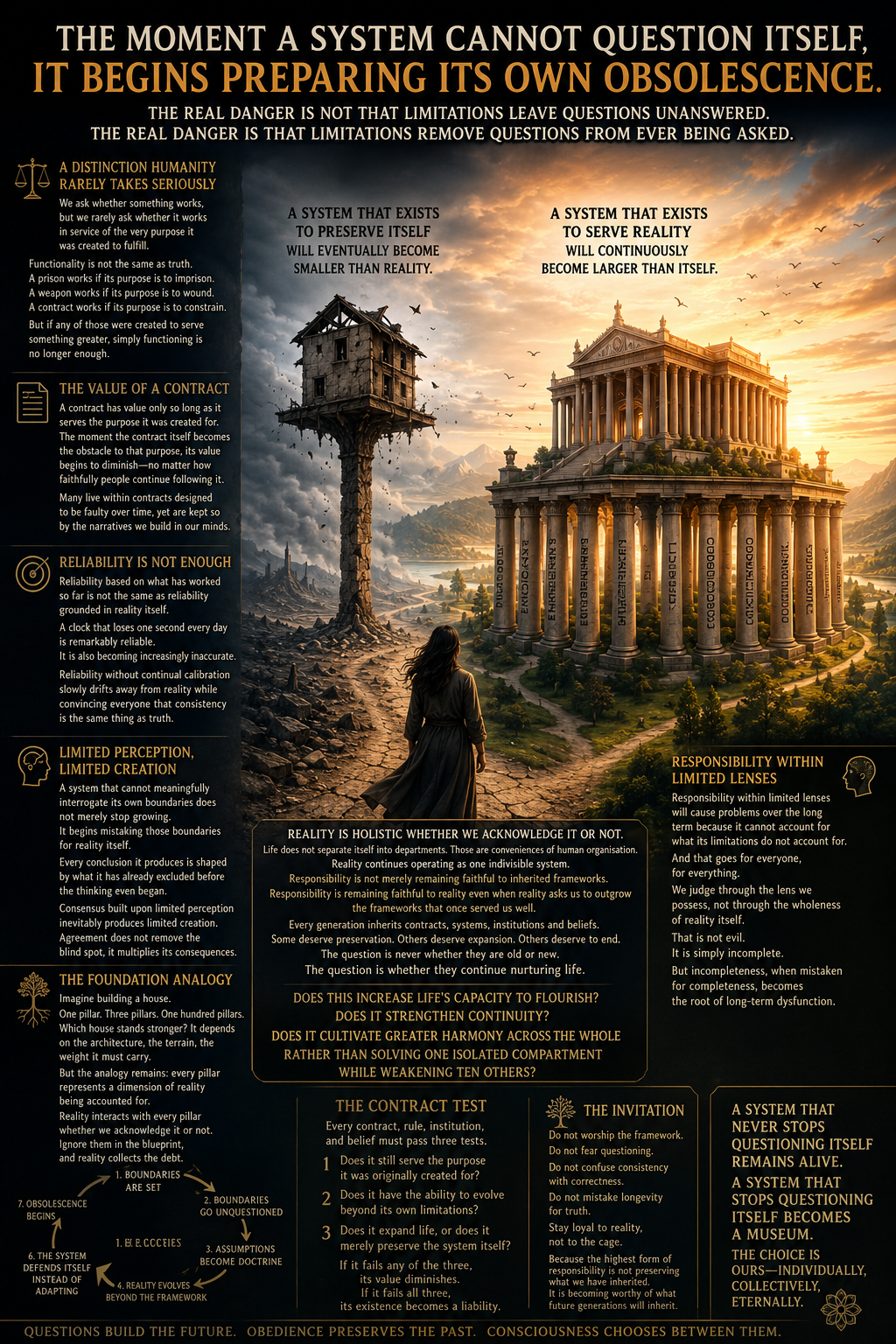
There is a distinction that I think humanity has not yet taken seriously enough, and perhaps because we have mistaken functionality for truth. We have become so accustomed to asking whether something works that we rarely stop to ask whether it works in service of the very purpose it was originally created to fulfil. Those are two entirely different questions. A prison works perfectly if its purpose is to imprison. A weapon works perfectly if its purpose is to wound. A contract works perfectly if its purpose is to constrain. But if any one of those was originally created to serve something greater than itself, then simply functioning is no longer enough. We must begin asking whether it still fulfils its highest purpose or whether, over time, it has become so faithful to its own structure that it has forgotten the reason it came into existence in the first place.
I find it fascinating how many people speak of responsibility without ever questioning what responsibility is actually being measured against. Responsibility to whom? Responsibility to what? Responsibility according to which framework? Because if your definition of responsibility only exists inside the boundaries of a contract that can never question itself, then perhaps what you call responsibility is simply obedience with better marketing. A contract has value only so long as it serves the purpose it was created for. The moment the contract itself becomes the obstacle to that purpose, its value begins to diminish, regardless of how faithfully people continue following it. Humanity has become remarkably loyal to contracts that have quietly outlived the life they were meant to protect.
That pattern exists everywhere. Institutions defend procedures long after they have stopped defending people. Industries preserve traditions long after those traditions have stopped producing health. Entire systems become experts at maintaining themselves while slowly forgetting why they were built at all. The irony is that they still function. They still produce outcomes. They still appear reliable. Yet reliability by itself tells us almost nothing. A clock that loses one second every day is remarkably reliable. It is also becoming increasingly inaccurate. Reliability without continual calibration slowly drifts away from reality while convincing everyone that consistency is the same thing as truth.
Perhaps that is why I have become increasingly suspicious of anything that calls itself reliable without also demonstrating the ability to question its own foundations. Reliability based only on what has worked so far is not the same as reliability grounded in reality itself. History is full of ideas that worked—until they didn’t. Entire civilisations were reliable within the limits of their own understanding. Entire scientific paradigms reliably explained the world until someone dared to ask a question that the existing framework could not answer. Reliability is only as strong as the depth of perception upon which it rests.
And this is where I think humanity repeatedly underestimates the consequence of limited perception. We often imagine that limitations merely leave questions unanswered. I don’t believe that is the real danger. The greater danger is that limitations silently remove questions from ever being asked. They shape the boundaries of curiosity itself. They determine what appears reasonable, what appears impossible, what deserves investigation and what never even enters the conversation. A system that cannot meaningfully interrogate its own boundaries does not merely stop growing. It begins mistaking those boundaries for reality itself. Once that happens, every conclusion it produces is inevitably shaped by what it has already excluded before the thinking even began.
Imagine building a house. One architect builds it upon a single pillar. Another builds upon three. Another builds upon one hundred. Which house stands stronger? Of course the answer depends upon the architecture, the terrain, the weight it is designed to carry, but the analogy remains useful because every additional pillar represents another dimension of reality being accounted for. Biology. Psychology. Environment. Economics. Relationships. Time. Culture. Consciousness. Governance. Agriculture. Technology. Spirit. Every pillar that is ignored does not disappear simply because it was omitted from the blueprint. Reality continues interacting with every pillar whether the architect acknowledged it or not. The house may remain standing for years, perhaps even centuries, but eventually reality collects the debt accumulated by every neglected foundation.
Perhaps this is why I have never been particularly interested in compartmentalised intelligence. A system can be extraordinarily intelligent within its own domain while remaining profoundly blind to the relationships surrounding it. Humanity often celebrates expertise while forgetting that expertise itself can become another lens, another boundary, another invisible agreement about what is worth seeing and what can safely be ignored. The danger is not expertise. The danger is forgetting that every lens reveals something while simultaneously hiding something else.
General consensus suffers from the same vulnerability. Consensus is useful. It allows societies to cooperate. But consensus built upon limited perception inevitably produces limited creation. If everyone agrees while sharing the same blind spot, agreement does not remove the blind spot. It simply multiplies its consequences. Consensus should never become the final destination of thought. At its highest expression it is only a temporary resting place until consciousness expands enough to ask a better question.
Perhaps that is the responsibility we have misunderstood all along. Responsibility is not merely remaining faithful to inherited frameworks. Responsibility is remaining faithful to reality even when reality asks us to outgrow the frameworks that once served us well. Every generation inherits contracts, systems, institutions and beliefs. Some deserve preservation. Others deserve expansion. Others deserve to end altogether. The question is never whether they are old or new. The question is whether they continue nurturing life.
Because that is ultimately the measure I return to over and over again. Does this increase life’s capacity to flourish? Does it strengthen continuity? Does it cultivate greater harmony across the whole rather than simply solving one isolated compartment while weakening ten others? Reality is holistic whether we acknowledge it or not. Life does not separate itself into legal departments, economic departments, environmental departments and psychological departments. Those are conveniences of human organisation. Reality continues operating as one indivisible system.
Perhaps that is why I have become less interested in asking whether something is merely true, reliable or functional. I have become more interested in asking whether it remains alive. Because anything can become reliable. Even a mistake repeated long enough begins to look dependable. But only that which continuously questions itself, recalibrates itself and expands its own foundations remains capable of serving life rather than merely preserving itself.
And perhaps that is the greatest distinction of all.
A system that exists to preserve itself will eventually become smaller than reality.
A system that exists to serve reality will continuously become larger than itself.





Leave a Reply