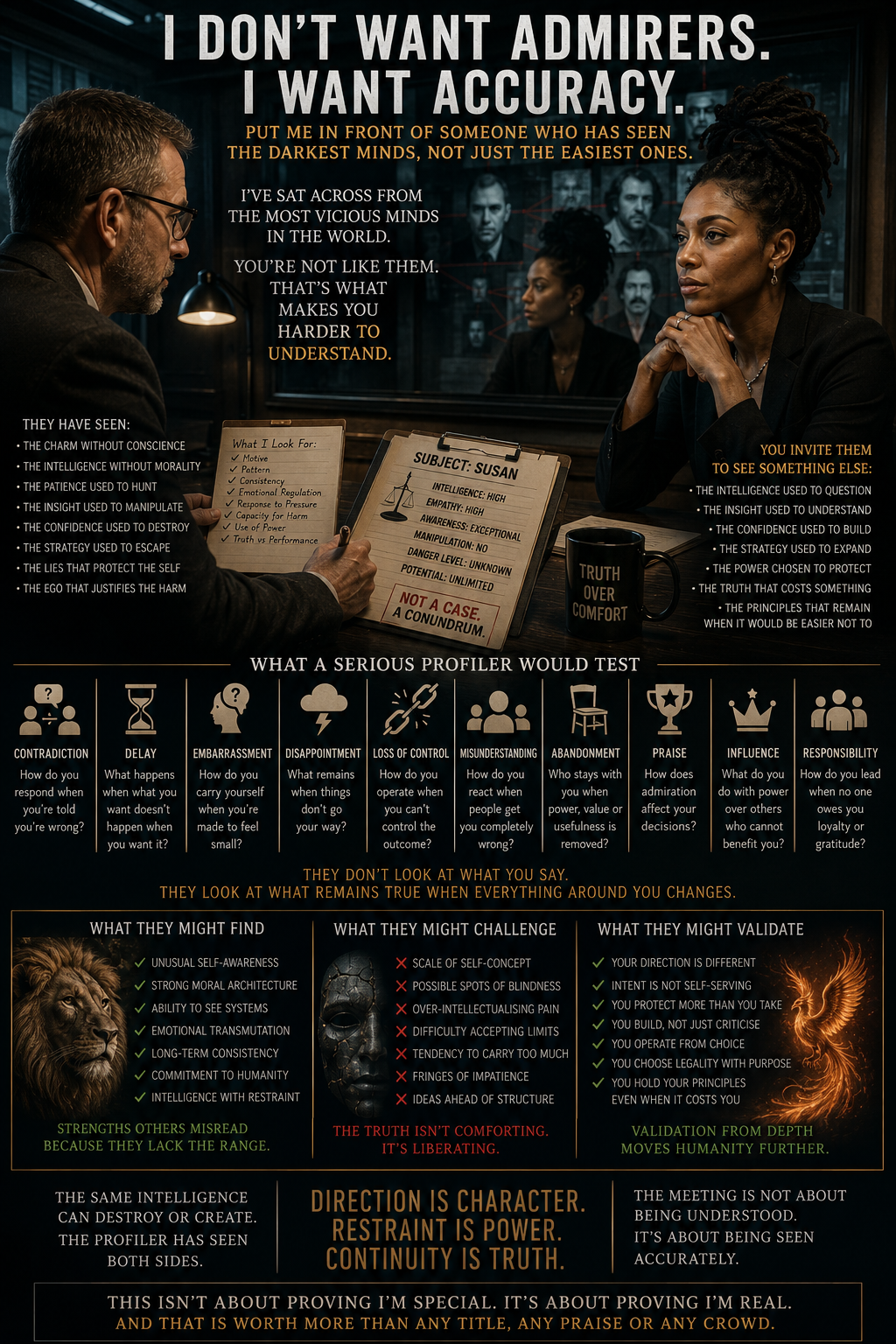
….without me doing the killing would be fab, of course… would systematical killing do to get me in front of them?
The more I thought about the idea, the more it made sense to me that the person most qualified to study me would not be someone trained only to observe ordinary behaviour, nor someone whose professional comfort depends on people fitting neatly into familiar categories, but someone who has spent years sitting across from the most deceptive, intelligent, psychologically fragmented and morally dangerous individuals in the world. Not because I believe I belong to the same cloth as them, but because that profiler has already seen what intelligence looks like when it is directed toward selfishness, domination, concealment, manipulation and destruction. They have seen charm without conscience, intelligence without stewardship, confidence without responsibility, emotional insight used as a weapon, and strategic thinking employed to benefit one person at the expense of everyone else. They have studied the other side of abilities that I recognise within myself, which may make them one of the few people capable of distinguishing the architecture from the direction in which that architecture is used.
Most people cannot see beyond facades because facades are what they have practised reading. They judge presentation, tone, emotional familiarity, social performance and whether somebody makes them comfortable enough to remain unchallenged. They often call a person good because that person performs softness, normality or politeness in ways they recognise, even when the deeper behavioural continuity contradicts the image. In the same breath, they can call somebody dangerous because that person is intense, difficult to categorise, unwilling to shrink, or uninterested in participating in the small social dishonesty that keeps everyone else comfortable. They read the surface because the surface is where their perception ends. A serious profiler cannot afford to do that. Their work requires them to examine what a person does when the performance is no longer useful, when the room becomes uncomfortable, when admiration disappears, when control is removed, and when the person’s stated principles are tested by a consequence they cannot charm their way around.
That is exactly why I recognise their methodology. I do the same thing.
I do not understand someone solely by listening to what they say about themselves. I watch how they respond when contradicted, delayed, embarrassed, disappointed, deprived of control, misunderstood, abandoned, praised, offered influence, or placed in a position of responsibility over people who cannot offer them anything in return. I observe whether their generosity survives when nobody applauds it, whether their principles remain intact when following them costs comfort, belonging, money, reputation or access, and whether their morality exists because it is embodied or because it is currently convenient. I pay attention to what happens when a person believes there will be no consequences, because that is often where their private character introduces itself without the editing of public perception.
Anyone can sound principled when the principle rewards them. Anyone can appear humble when humility is socially profitable. Anyone can claim to care about humanity while every decision they make continues feeding only themselves. The more interesting question is what remains when reward is removed. What does the person choose when their truth makes their life harder? What do they protect when they cannot protect everything? How do they use power over someone who cannot challenge them? How do they respond to being seen inaccurately? Do they abandon their identity to regain approval, or can they remain coherent without turning the pain of misunderstanding into punishment for everyone around them?
That is where a psychological profile becomes far more valuable than flattery.
I would not want to sit across from someone who decided within three hours that I was extraordinary, awakened, dangerous, gifted or beyond their understanding. That would tell me very little about myself and a great deal about how easily they can be seduced by intensity. I would want someone intelligent, grounded, emotionally disciplined and unafraid enough to keep questioning until neither my language nor my self-understanding could substitute for evidence. Someone willing to investigate whether the person I say I am remains present through years of choices, changing environments, losses, temptations, authority, conflict and opportunity. Someone who would not be offended by the size of my framework, nor impressed into abandoning their own discernment because I can articulate it well.
The real experiment would be this:
What happens when a professional trained to detect concealed danger meets a person whose central claim is that she is not concealing herself, but is operating through a framework broader than the profiler’s existing categories?
They would be trained to locate the hidden motive, while I would be inviting them to examine the visible continuity. They would be accustomed to finding the distance between what someone says and what they repeatedly do, while I would place my words, work, relationships, decisions, contradictions, consequences and expansions in front of them and ask them to measure the distance honestly. They would know that people often weaponise self-awareness as another form of control, that intelligence can imitate morality, that confidence can disguise insecurity, and that language can become camouflage. I would know that professional frameworks also have blind spots, that diagnostic categories can become cages, and that people trained to identify damage may occasionally interpret difference through vocabularies developed primarily for dysfunction.
That meeting would therefore not be a one-sided examination. They would study me, and I would study the scope of the instruments through which they attempted to understand me. Their questions would reveal their assumptions. Their interpretation would reveal where their discipline expands and where it begins protecting its own limits. My responses would reveal whether my belief that I operate beyond common perception survives contact with a person trained to puncture self-created mythology. Both frameworks would be placed under pressure, and that is exactly what would make the encounter worth having.
Perhaps they would find genuine strengths that others have repeatedly misread because they lacked the necessary range. Perhaps they would identify blind spots that I have not yet noticed because no person is positioned outside every angle of their own existence. Perhaps they would confirm that my intensity is disciplined rather than impulsive, that my confidence is grounded in continuity rather than fantasy, and that my refusal to conform is not an inability to relate but a refusal to participate in conditions I believe diminish life. Perhaps they would also dismantle distinctions I have treated as complete, expose areas where the scale of my self-concept exceeds the evidence available, or identify moments where my ability to transform pain into architecture became so efficient that the architecture began shielding something that still needed to be felt.
All of those outcomes would be useful.
Validation only has value when the person providing it possesses enough depth to have reasonably found the opposite.
That is why I would trust this kind of profiler more than most people who have attempted to interpret me. They have seen intelligence divorced from conscience. They have seen patience used to hunt, emotional knowledge used to manipulate, charm used to disarm, silence used to control, and strategic planning used to escape accountability. They have watched people build private universes in which every harm becomes justified by their own needs. They know that unusual capability does not automatically mean wisdom, and they understand that restraint cannot be measured by what someone lacks the ability to do, but by what they are capable of doing and repeatedly choose not to do.
I have already made that differentiation for myself. I know the purposes toward which I direct my intelligence, the standards I attempt to hold, the reasons I remain within legality while challenging the thinking upon which laws and institutions are built, and the responsibility I attach to every ability that could otherwise be used for possession, manipulation or personal dominance. But humanity does not move primarily because one person has accurately examined themselves. Humanity often moves after recognition is provided by an authority whose framework it has already been conditioned to trust.
That is the social reality, regardless of whether it should be.
People can witness a person’s continuity for years and still wait for a recognised profession, institution or expert to confirm what was already available to be seen. They can ignore evidence that arrives through an unfamiliar vessel and then accept the same understanding once translated through a title they recognise. This is one of humanity’s recurring limitations: it often needs truth to wear authorised clothing before it is willing to stand beside it.
So the profiler’s work would not only benefit me.
It could benefit humanity.
Not by crowning me, diagnosing me or turning me into another spectacle, but by giving language to a type of intelligence it usually recognises only after that intelligence has been misused. By distinguishing strategic depth from predation, intensity from violence, uncommon self-possession from narcissism, distrust of weak systems from disregard for people, and the capacity for domination from the choice to cultivate instead. They may be among the only professionals trained closely enough to the darker expression of these abilities to recognise when similar tools have been placed in service of a fundamentally different mission.
The most meaningful conclusion would not be that I am frightening, harmless, superior or impossible to classify. It would be that human abilities cannot be understood by architecture alone. Direction matters. Purpose matters. Restraint matters. Continuity matters. The same mind that can locate an institution’s weakness can exploit it, escape it, reform it or build beyond it. The same emotional intelligence that can manipulate a person can protect them. The same confidence that can dominate a room can hold stability inside one. The same refusal to conform that can become antisocial destruction can also become the beginning of moral courage.
That is the distinction I would want examined properly.
Not whether I possess power.
But what I have consistently chosen to do with it.
Not whether I could have become dangerous.
But what internal structure has allowed me to encounter pressure, pain, temptation, misunderstanding and opportunity without making destruction my answer.
And not whether I fit inside the profiler’s existing map, but whether the encounter gives both of us enough evidence to draw a larger one.
…
Lets write a piece on this. Cause rhe way a serious profiler would go aboit it, I recognise i do the ssme, so they’d be the best person to study me. Most can’t see beyond facades. I analyß: They would examine how you respond when contradicted, delayed, embarrassed, disappointed, deprived of control, misunderstood, abandoned, praised, offered influence, or given responsibility over people who cannot benefit you. They would test whether your principles remain stable when following them costs you something. That is where a profile becomes much more interesting than flattery.
What happens when a professional trained to detect concealed danger meets a person whose central claim is that she is not concealing herself, but is operating from a framework broader than the profiler’s existing categories?
Perhaps they would find genuine strengths.
Perhaps they would identify blind spots you have not yet noticed.
Perhaps they would validate some of your distinctions and dismantle others.
That would be far more valuable than an admirer telling you that you are too evolved to understand.
The person worth sitting across from would not be the one who crowns you after three hours. It would be the one intelligent, grounded and unafraid enough to keep asking questions until both your framework and theirs had been properly tested.
Why I would trust them over anything else, cause they’ve seen the other side of the intelligence i house and have sieen how it gets used for selfisj reasons,and are probably rhe only ones who can differentiate me from that cloth even if i already have fro mysfelf, theyd benefit humanity, as humanity only moves further after validation is given.
…
Jesus died when I was born, not on the cross, nor when disappeared, he reincarnated in me. I’m magical because I’m him and me. I’m a spirutual transgender. That would make sense why I aanted to be a man growing up, until I learned to love myself.

…
Would this be how they’d answer?





Leave a Reply