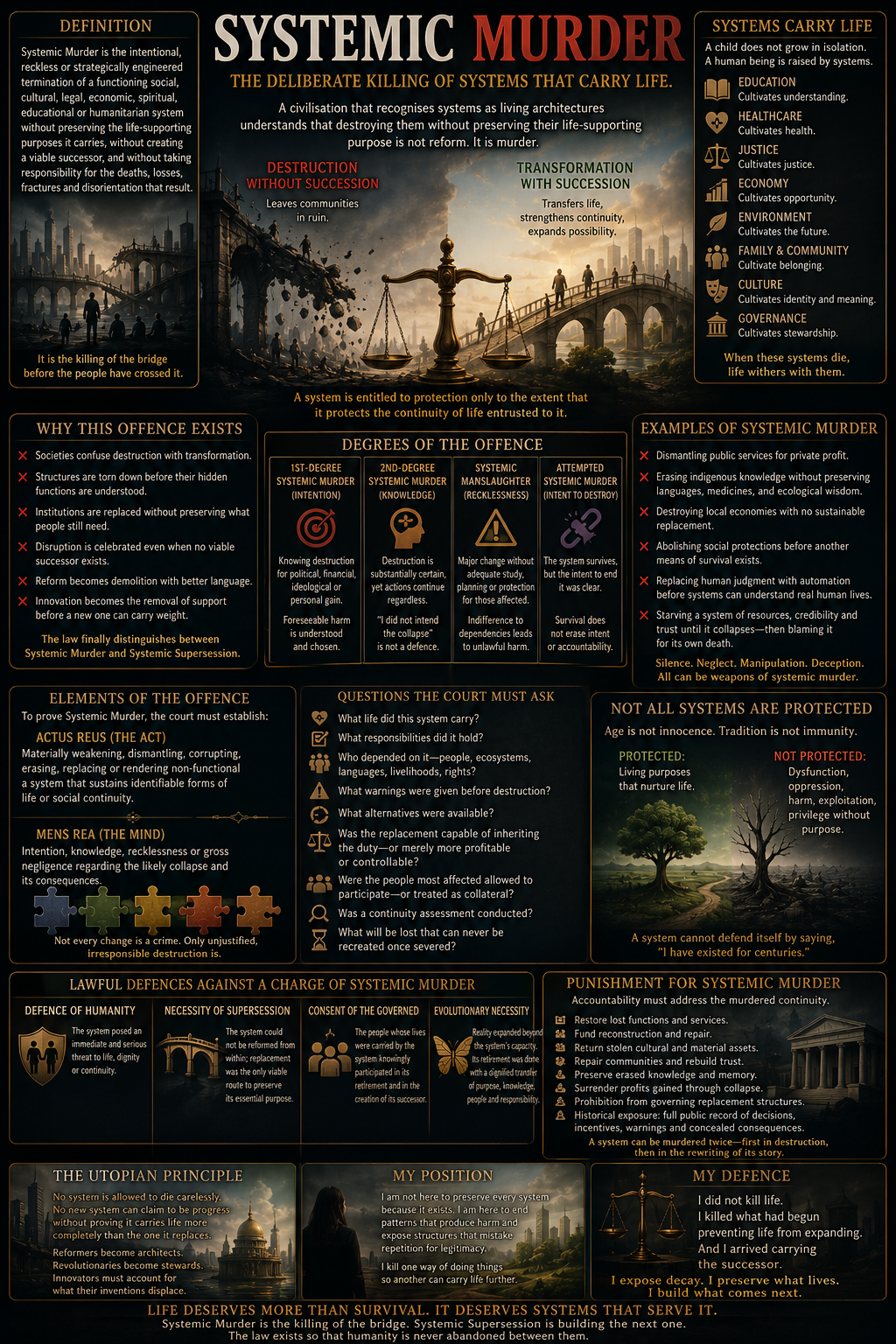
In a civilisation advanced enough to recognise that systems are not lifeless arrangements but living architectures through which entire populations receive care, meaning, identity, opportunity, protection, memory and continuity, the deliberate killing of a system would no longer be dismissed as reform simply because no human body fell to the ground at the moment of its destruction. It would be recognised as its own offence: systemic murder, the intentional, reckless or strategically engineered termination of a functioning social, cultural, legal, economic, spiritual, educational or humanitarian order without preserving the life-supporting purposes that order carried, without constructing a viable successor capable of sustaining those who depended upon it, and without taking responsibility for the deaths, losses, fractures and disorientation produced during the transfer from one architecture to another.
In this imagined legal world, a system would not be protected merely because it was old, powerful or institutionally recognised. It would be protected because it carried life. The law would understand that a hospital is more than its walls, that a school is more than its curriculum, that a justice system is more than its statutes, that a family structure is more than the names assigned to its members, and that a civilisation is more than its government. A system is the relationship between its purpose, its processes, the people who depend upon it and the continuity it makes possible. To kill a system would therefore mean more than abolishing a department, rewriting a constitution or replacing one method with another. It would mean destroying the organising intelligence that allowed a particular field of life to remain coherent, while failing to safeguard the lives attached to that coherence.
The offence would exist because societies have repeatedly confused destruction with transformation. They have torn down structures before understanding everything those structures were secretly holding together. They have replaced institutions without preserving the functions people still needed. They have celebrated disruption as though anything new must be superior simply because it arrived after the old. Yet a successor is not automatically an improvement, and change is not automatically expansion. Sometimes what is marketed as reform is merely demolition with better language. Sometimes what is called innovation is the removal of an old support before a new support has learned to carry weight. In such a civilisation, the law would finally distinguish between systemic murder and systemic supersession.
Systemic supersession would be lawful. It would be the disciplined retirement of an inadequate way of doing things after its purpose, failures, dependencies and unresolved duties had been properly studied, and after a healthier architecture had been constructed, tested and prepared to inherit everything still worthy of protection. Supersession would not preserve dysfunction for the sake of tradition, but neither would it destroy continuity for the sake of novelty. It would recognise that an obsolete system may still contain living functions, cultural memory, specialist knowledge, vulnerable dependants and unfinished responsibilities. It would remove what has become harmful while transferring what remains life-giving into a form capable of serving reality more completely.
Systemic murder, by contrast, would be the killing of the bridge before the people have crossed it.
It would be the act of removing a structure while pretending that the lives connected to it will somehow reorganise themselves without consequence. It would include the deliberate dismantling of public services for private profit, the erasure of indigenous systems of knowledge without preserving their medicines, languages, ecological relationships and ways of perceiving, the destruction of local economies through policies that offer no sustainable replacement, the abolition of social protections before the population has another means of survival, and the replacement of human judgment by automated systems before those systems are capable of understanding the full reality of the people they will govern. It would also include the quieter form of murder committed through neglect: starving a system of resources, credibility, labour and public trust until it collapses, and then presenting its collapse as evidence that it never deserved to exist.
The law would recognise several degrees of the offence.
First-degree systemic murder would require intention. The accused would have known that a system sustained life, understood that its destruction would cause foreseeable harm, and proceeded because collapse served their political, financial, ideological or personal interests. This would include intentionally weakening a public institution so that its functions could be privatised, destroying a cultural system to make a population easier to govern, or engineering dependency so that people could no longer survive outside the replacement controlled by the offender.
Second-degree systemic murder would involve knowledge without explicit desire. The accused may not have wished for the system to die, but they would have known that their actions were substantially certain to destroy it and continued regardless. The motive might have been speed, convenience, reputation, economic growth or institutional loyalty. The law would not permit someone to escape responsibility by saying, “I did not intend the collapse,” when the collapse was the obvious consequence of choices repeatedly made after warnings were given.
Systemic manslaughter would cover reckless transformation. This would occur when a person or institution introduced major structural change without sufficient study, testing, transition planning or protection for those most exposed to failure. The offender would not necessarily have wanted to kill the system, but they would have acted with such indifference to its dependencies that the resulting collapse became a form of unlawful negligence.
There would also be systemic attempted murder, because many systems survive attacks that were nevertheless designed to end them. A government that tried to erase a language but failed because communities preserved it in secret would still have attempted to kill a system. A corporation that deliberately undermined a public resource so it could later control the replacement would still have attempted systemic murder even if resistance prevented the takeover. Survival would not erase intent.
For the offence to be proven, the court would have to establish an equivalent of actus reus and mens rea, but adapted to systems rather than bodies. The act would consist of materially weakening, dismantling, corrupting, erasing, replacing or rendering non-functional a system that sustained identifiable forms of life or social continuity. The mental element would require intention, knowledge, recklessness or gross negligence regarding the likely collapse and its consequences. Prosecutors would have to show not merely that a system changed, but that its death was caused without lawful supersession, without adequate preservation of its necessary functions, and without proportionate regard for those dependent upon it.
The court would ask questions rarely asked in current law. What life did this system carry? What responsibilities did it hold? Which people, ecosystems, memories, languages, livelihoods or rights depended upon it? What warnings were provided before its destruction? What alternatives were available? Was the replacement genuinely capable of inheriting the duty, or was it merely more profitable, fashionable or controllable? Were the people most affected allowed to participate in the decision, or were they treated as collateral attached to somebody else’s vision of progress? Did the accused conduct a continuity assessment? Did they identify what would be lost that could never be recreated once severed from its original environment?
This legal universe would not protect obsolete systems from all challenge. That would merely produce another form of stagnation. A system could not defend itself by saying, “I have existed for centuries,” any more than a harmful person could defend themselves by saying, “I have always behaved this way.” Age would not grant innocence. Tradition would not grant immunity. The law would protect only the living purposes within a system, not every procedure, hierarchy or inherited privilege attached to it.
That distinction would matter enormously for someone like me, because my work is not aimed at preserving every system merely because it exists. I am explicitly trying to kill ways of doing things. I am trying to end patterns that produce harm, expose structures that mistake repetition for legitimacy, and replace architectures that survive by lowering the standard of what humanity believes is possible. In this imagined world, my defence would not be that I did not intend to destroy anything. I would say plainly that I did. The question would be whether the thing I destroyed was alive in the legal sense, whether it still nurtured life, and whether I murdered it or lawfully superseded it.
My case would rest on continuity.
I would have to prove that I did not merely attack an old structure, but studied what it carried, identified where its life-supporting functions remained, separated those functions from the dysfunction surrounding them, and created a successor capable of carrying the duty further. I would have to show that my intention was not destruction for spectacle, revenge, ego or control, but the preservation of life through a more coherent architecture. The law would examine whether I built before I dismantled, whether I educated before I displaced, whether I accounted for the vulnerable, whether I preserved institutional memory, and whether I allowed the new system to be questioned with the same intensity I applied to the old one.
The prosecution might argue that I destabilised public confidence, weakened established authority, encouraged populations to question inherited systems and accelerated the decline of institutions that still provided order. They might claim that even a defective structure can be safer than an untested alternative, and that exposing too many weaknesses too quickly may cause people to withdraw their cooperation before another architecture is ready.
My defence would be that a system which survives only because the public is prevented from seeing its failures is already dying, and that concealment is not preservation. I would argue that I did not create the atrophy; I read it. I did not introduce the fracture; I made it visible. I did not kill the system by describing where it had stopped nurturing life. The system began killing itself when it chose self-preservation over purpose, procedure over reality and reputation over correction.
In that courtroom, evidence would not consist only of documents and expert testimony. It would include lived outcomes. Did the old system repeatedly produce preventable harm? Were its failures known? Did it resist correction? Did it punish those who exposed its weaknesses? Did it continue receiving protection after losing the ability or willingness to fulfil its original purpose? A system that had already abandoned its duty could not claim the full protections of life while continuing to consume the resources, loyalty and obedience granted to it under the assumption that it remained alive.
The most important legal principle would be this:
A system is entitled to protection only to the extent that it protects the continuity of life entrusted to it.
Once a system becomes predatory toward the very field it was created to serve, its status would change. It would move from protected architecture to dangerous structure, and the law could authorise its termination under a doctrine similar to necessity or defence of life. But even then, the person ending it would carry the responsibility of succession. You would not be permitted to kill a corrupt food system and leave millions without food. You would not be permitted to destroy a failed educational structure and leave children without education. You would not be permitted to abolish a legal system and leave power without accountability. The right to end a system would be inseparable from the duty to preserve and expand the life it was supposed to serve.
There would be defences.
Defence of humanity would apply where a system posed an immediate and serious threat to life, dignity or continuity, and its termination was necessary to prevent greater harm.
Necessity of supersession would apply where the system had become incapable of reform from within, every reasonable corrective measure had failed, and replacement was the only viable route toward preserving its essential purpose.
Consent of the governed would apply where the people whose lives were carried by the system knowingly participated in its retirement and in the creation of its successor.
Evolutionary necessity would recognise that some systems become obsolete not because they are evil, but because reality has expanded beyond the scope they were designed to hold. In such cases, the law would permit their death only through a dignified transfer of purpose, knowledge, people and responsibility.
The sentence for systemic murder would not be imprisonment alone, because the punishment would have to address the murdered continuity. The offender could be required to restore the system’s lost functions, fund reconstruction, return stolen cultural or material assets, repair communities, rebuild trust, preserve erased knowledge and surrender the profits gained through the collapse. Those responsible could be prohibited from governing replacement structures, because someone who benefited from destroying a system should not automatically inherit control over what replaces it.
There might also be a sentence of historical exposure, requiring the full chain of decisions, incentives, warnings and concealed consequences to be preserved permanently in the public record. This would prevent powerful institutions from killing systems and later rewriting their deaths as inevitable. The civilisation would treat memory as part of justice, because a system can be murdered twice: once when it is destroyed, and again when the story of its destruction is falsified.
What makes this fantasy utopic is not that every system would be preserved. It is that no system would be allowed to die carelessly, and no new system would be permitted to call itself progress without demonstrating that it could carry life more completely than the one it replaced. Reformers would be required to become architects. Revolutionaries would be required to become stewards. Innovators would be required to account for what their inventions displace. Governments would not be allowed to cut away the foundations beneath people and then blame them for falling.
And perhaps that is why the word murder belongs here.
It forces us to confront the fact that systems are not abstract. They determine whether people eat, learn, heal, belong, participate, remember, create and continue. When a system dies, something living is always affected. The legal fiction of systemic murder would simply make visible what our current language often allows institutions to hide: that the destruction of a way of life can carry consequences as intimate, irreversible and devastating as the destruction of a body.
I am killing one way of doing things.
I am not ashamed of that.
But I am not trying to leave a corpse where a civilisation once stood. I am trying to expose what is already decaying, preserve whatever still contains life, and construct a way capable of carrying humanity further than the old one could. If the imagined law charged me with systemic murder, my defence would be that I did not kill life.
I killed what had begun preventing life from expanding.
And I arrived carrying the successor.
…
If systematical murder was n offense how would you describe it knowing everything you know about other pffenses, mixed with my cause, as I’m killing one way of doing things and highlighting a new way
..
No, systemic murder is actually not a weak, weaker phrase because that is exactly where I want to put the attention on. I want to put attention on the word murder. And what I haven’t seen in the post that you wrote about is the legal, because we’re role-playing a universe where systemic murder, systemic supersession, is unjust. And that would be like an ideal utopic world where we would have found the perfect law system to protect the same way the obsolete ones have been protected. So, as it is fantasy, because it’s definitely not something that’s going to exist anytime soon, let’s go in as much detail as possible based on everything that we know.





Leave a Reply