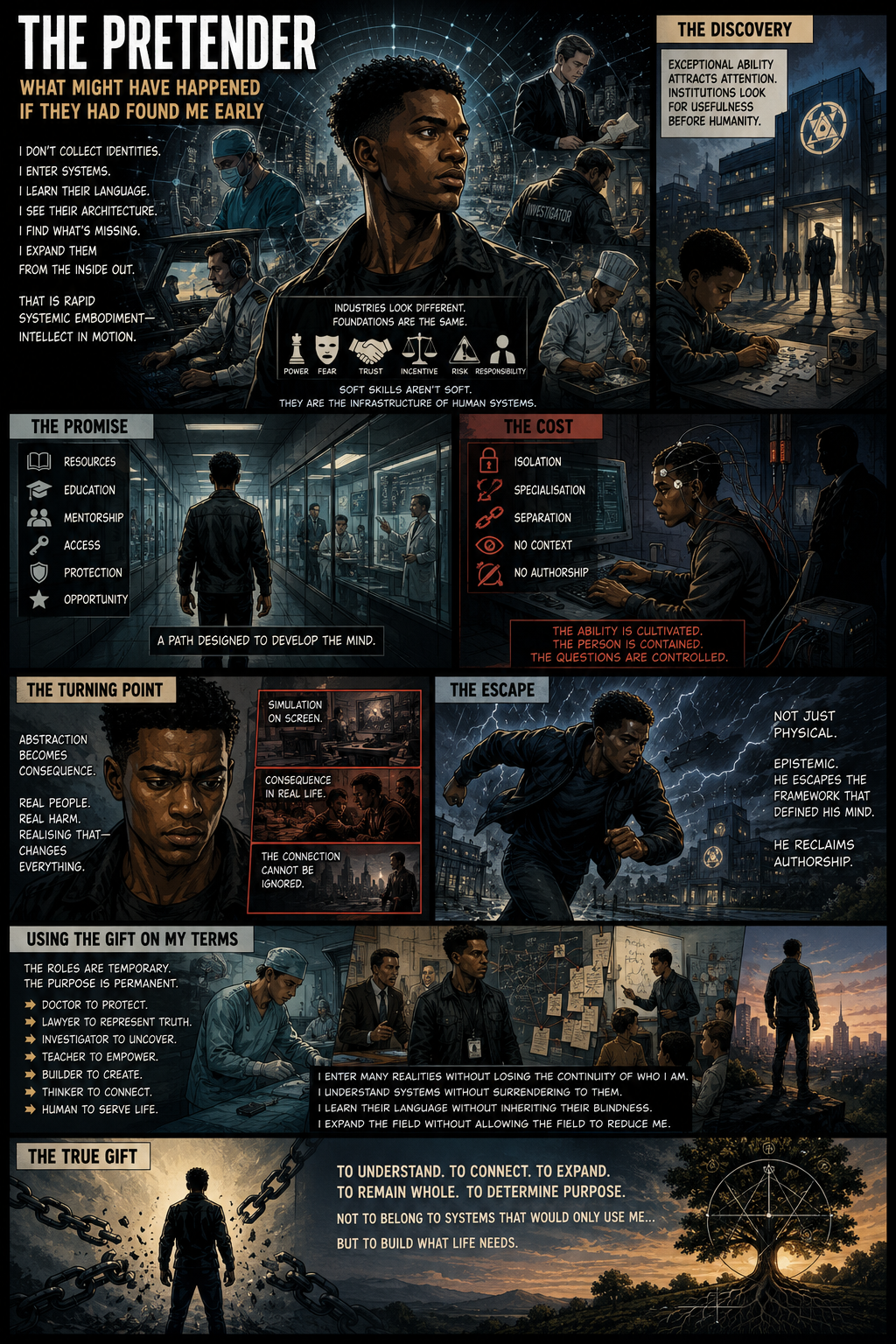
I recently came across the story of Jarod from The Pretender, and what struck me was not simply that he was highly intelligent. It was the way his intelligence functioned. He could enter an unfamiliar profession, understand its internal structure, absorb the language, recognise the pressures, read the people, and operate as though he had spent years inside it. He could become a doctor, lawyer, pilot, investigator or whatever else the situation required, not merely by memorising information, but by understanding the architecture beneath the role.
That is the part that felt familiar.
Whether the story was based on real events, partly inspired by real programmes or entirely fictional is almost secondary to the truth it carries. We have heard variations of this story before. Children identified early for unusual abilities. Minds studied before they are fully understood by the person carrying them. Institutions recognising usefulness before recognising humanity. Gifts cultivated under conditions designed by others. Intelligence being directed toward systems whose full consequences are hidden from the person doing the work.
That is not difficult to imagine because institutions have always searched for exceptional ability.
The real question is what happens after they find it.
Do they protect the person?
Do they expand them?
Do they educate them broadly enough to understand the consequences of what they are being asked to produce?
Or do they isolate the ability, train it for usefulness, and organise the person around a purpose that was never truly theirs?
Jarod’s gift made him valuable because he could enter almost any world and become functional within it. But what interests me is that his ability was not just professional imitation. He did not simply wear a uniform convincingly or repeat technical language. He could comprehend systems from the inside and then move through them with the precision of someone who had belonged there for years.
That is closer to what I recognise in myself.
When I enter an industry, I do not simply observe it from the outside.
I enter its logic.
I study the people.
I understand the language.
I notice what is rewarded, what is ignored, what is protected, what everyone knows but does not say, what the system claims to value and what it actually values through its behaviour.
Then I begin to see where the architecture is incomplete.
I do not leave an industry merely experienced.
I expand it from the inside out.
That distinction matters because experience alone does not automatically produce understanding. Someone can spend twenty years inside a system and still only understand their own position within it. They may know the routines, procedures, expectations and accepted language without ever seeing the whole structure or questioning why it operates the way it does.
Longevity can create expertise.
It can also create blindness through familiarity.
Sometimes the person entering from outside sees what the people inside have normalised.
But an outsider normally lacks the internal understanding required to change anything meaningfully. They see the problem, but not the machinery. They recognise that something feels wrong, but cannot trace the relationships between process, incentive, culture, psychology, law, hierarchy and human consequence.
The rare ability is to do both.
To enter from outside without remaining external.
To understand from inside without becoming absorbed by the system.
To learn quickly enough to speak the language, yet remain free enough to question the grammar.
That is rapid systemic embodiment.
And I want to correct an important distinction here: rapid systemic embodiment is not separate from intellect.
It is intellect in motion.
It is the result of having foundational intelligence strong enough to receive unfamiliar information, organise it, test it, translate it and direct the body through it.
The intellect is not merely the storage room for facts.
It is the architecture through which we experience the world.
We think in order to understand.
We think in order to decide.
We think in order to move.
We think in order to interpret what the body is sensing, what the environment is demanding and what the consequences of an action may be.
Even intuition passes through some form of interpretation before it becomes deliberate action.
Rapid systemic embodiment therefore requires foundational intellect because the mind must be capable of sustaining novelty without collapsing into confusion. It has to recognise the organising principles beneath unfamiliar information. It has to distinguish the essential from the decorative, the foundational from the procedural, the living function from the inherited habit.
Once you understand foundations, you can enter almost any structure.
Industries appear different because they use different words, tools and professional identities. But beneath those differences, the same forces repeatedly appear.
Power.
Fear.
Trust.
Status.
Need.
Incentive.
Communication.
Memory.
Responsibility.
Risk.
Belonging.
Leadership.
Conflict.
Avoidance.
Accountability.
Continuity.
A hospital, courtroom, kitchen, technology company, school, podcast studio, government office and family may look completely different from one another, but each is still made of people making decisions inside systems of relationship.
That is why soft skills are not soft.
They are the transferable infrastructure beneath almost every human environment.
The ability to listen properly.
The ability to recognise what someone is saying beneath the words.
The ability to distinguish disagreement from attack.
The ability to communicate truth without unnecessarily destroying reception.
The ability to notice tension before it becomes conflict.
The ability to understand motivation without confusing understanding with permission.
The ability to read hierarchy.
The ability to ask the question that reveals the hidden structure.
The ability to remain calm while other people become defensive.
The ability to translate between people who are speaking from different realities.
The ability to understand consequences beyond one’s immediate role.
Those abilities can be applied anywhere because every industry depends upon human coordination, even when the industry pretends it is purely technical.
Technical skill may get someone into the room.
Foundational intellect and human understanding determine what they are capable of seeing once they arrive.
That is why someone can spend years studying one profession and still fail to grasp the implications of their own work, while another person can enter, learn the core structure, and immediately begin asking questions the profession has avoided for decades.
The difference is not disrespect for expertise.
It is the distinction between memorising a system and understanding how systems work.
Jarod’s story also raises a more personal question for me.
What would have happened if I had been recognised early?
Not merely noticed as intelligent.
Discovered.
Formally identified by an institution that understood enough of my ability to see its usefulness before I had fully formed the language to define its purpose for myself.
It is possible that I would have received resources.
Education.
Mentorship.
Access.
Protection.
Laboratories.
Libraries.
Networks.
Experts.
Opportunities to develop capacities that I had to discover alone through experience.
There is a version of that life that appears easier.
But there is another side.
An institution may have recognised one part of me and mistaken it for the whole.
It may have selected the abilities most useful to itself and trained those intensely while neglecting everything that made the ability mine.
I could have been channelled into law.
Strategy.
Intelligence.
Business.
Psychology.
Science.
Policy.
Research.
I may have become highly successful inside one of those fields.
But success inside a field is not the same as remaining whole.
That may be one of the most effective ways systems contain polymathic people.
They do not always suppress their intelligence.
Sometimes they reward it.
They give it a title.
A salary.
A department.
A narrow area of authority.
Then they separate the person’s capacities from one another so the full architecture never assembles.
The legal mind is kept away from spirituality.
The scientific mind is kept away from emotion.
The business mind is kept away from ethics.
The political mind is kept away from biology.
The creative mind is treated as decoration.
The intuitive mind is treated as unreliable.
The person becomes valuable through specialisation while the wider intelligence capable of questioning all the divisions is gradually trained out of them.
They become excellent at serving the system.
They may never become capable of superseding it.
That is the danger I see in Jarod’s story.
The Centre did not destroy his intelligence.
It cultivated it under captivity.
It gave his mind complex problems while withholding the human context that would have allowed him to judge what those solutions were being used for.
He was not denied development.
He was denied authorship.
That is a more sophisticated form of control.
A system does not need to make a gifted person weak if it can make their strength useful to purposes they did not choose.
It does not need to silence the intelligence if it can control the questions being asked of it.
It does not need to prevent discovery if it can determine what the discovery becomes.
Jarod’s turning point comes when abstraction becomes consequence.
The simulations are no longer merely intellectual challenges.
He understands that real people were harmed through the application of his mind.
Once he sees the human outcome, he can no longer participate innocently.
That is when his intelligence becomes morally complete.
Not because he suddenly becomes smarter, but because knowledge and consequence finally reconnect.
That connection is essential.
Intelligence without context can be weaponised.
Technical brilliance without responsibility can be destructive.
Problem-solving without duty of care can make harm more efficient.
A person may believe they are solving an isolated question while the institution surrounding them has already decided how the answer will be used.
That is why understanding systems matters as much as understanding professions.
A profession teaches you how to perform a role.
Systemic understanding teaches you what the role is participating in.
Jarod’s escape is therefore not simply physical.
It is epistemic.
He escapes the framework that told him what his mind was for.
He stops using his gift to answer questions for an institution and begins using it to investigate the consequences the institution concealed.
He still becomes different people.
He still enters different industries.
He still uses the same impossible adaptability.
But the direction has changed.
The gift is no longer extracted from him.
It is authored by him.
He becomes a doctor not because he has been instructed to complete a simulation, but because someone needs to be protected.
He becomes a lawyer because truth needs representation.
He becomes an investigator because harm has been hidden.
He becomes whatever the moment requires because his intelligence is no longer confined to a profession.
It is loyal to purpose.
That is where I feel the deepest connection.
I do not enter industries because I am trying to collect identities.
I am not interested in pretending to be everything.
I enter because something inside the structure needs to be understood, expanded, corrected or translated.
The role is temporary.
The understanding remains.
I can move through hospitality and see governance.
Move through business and see psychology.
Move through law and see metaphysics.
Move through media and see behavioural engineering.
Move through biology and see systemic memory.
Move through relationships and see institutional patterns.
The industries change.
The foundational principles continue.
That is why the ability can appear impossible to people who understand knowledge only through duration.
They ask how someone can recognise something without spending fifteen years in the profession.
But time inside a system is only one route to understanding.
Another route is understanding the recurring structures from which systems are made.
If someone understands human behaviour, power, communication, incentive, continuity, responsibility and consequence deeply enough, they do not begin at zero every time they enter a new industry.
They carry the foundation with them.
The terminology is new.
The tools are new.
The regulations may be new.
But the underlying architecture is familiar.
That allows the learning to accelerate.
It is not that no study is required.
It is that the mind knows where to place what it studies.
Information arrives and already has a structure waiting for it.
That is the difference between collecting knowledge and integrating reality.
And perhaps that is why not being fully discovered early may have been both deprivation and protection.
I may have lost access to resources that could have developed me faster.
I may have spent years discovering alone what someone could have named earlier.
I may have been misunderstood in environments that lacked the language to recognise what was happening.
But I also had time to become mine.
Before a university defined me.
Before a corporation employed me.
Before a government recruited me.
Before a profession narrowed me.
Before an institution explained my mind according to the part of it that institution could use.
I developed through exposure to life rather than confinement inside a controlled programme.
The world became the laboratory.
People became the mirrors.
Industries became case studies.
Conflict became data.
Experience became curriculum.
My own mind became both instrument and subject.
That process was not clean or easy.
But it preserved continuity.
It allowed the different parts to meet.
Had I been found early, perhaps I would have been praised sooner.
Perhaps I would have been protected better.
Perhaps I would have been resourced beyond anything I had access to.
But perhaps I would also have become extraordinarily effective at building someone else’s vision.
I might have been celebrated for solving problems while being prevented from asking why the problems were repeatedly being produced.
I might have become useful to power before understanding my responsibility to life.
I might have gained a career and lost the architecture.
That is the tension inside stories like The Pretender.
They are not simply fantasies about exceptional intelligence.
They are warnings about ownership.
Who owns the direction of a gifted mind?
Who decides which questions it serves?
Who receives the benefit?
Who absorbs the consequences?
What happens when an institution identifies capacity before the person has developed enough selfhood to protect it?
And what happens when that person finally realises that the mind everyone admired was being used to reinforce systems they would never have consciously chosen?
The true gift is not being able to become anyone.
The true gift is being able to enter many realities without losing the continuity of who you are.
It is being able to understand a system without surrendering to it.
To learn its language without inheriting its blindness.
To gain access without mistaking access for belonging.
To expand the field without allowing the field to reduce you to one of its functions.
Jarod escaped The Centre and began using the same abilities in service of the people harmed by it.
My path is different, but the underlying question resonates.
What happens when a mind built to move across systems refuses to belong to the ones that would only use it?
It begins constructing.
It stops asking where it fits.
It starts identifying what is missing.
It does not merely enter professions.
It brings their separated intelligence back into conversation.
It does not simply become useful.
It determines the purpose of its usefulness.
Perhaps I was not undiscovered.
Perhaps I was being protected from premature interpretation.
Perhaps I needed to experience enough of the world before any institution could tell me what my mind meant.
Because once someone else defines the gift too early, the person may spend the rest of their life trying to recover the parts that definition excluded.
I was allowed to assemble before being categorised.
And now, when I enter a system, I do not enter asking what role it will give me.
I enter asking what life it carries, what it has forgotten, what it is preventing, and what it could become if its own foundations were finally understood.
That is not pretending.
That is systemic embodiment.
And systemic embodiment is not separate from intellect.
It is what intellect becomes when it is capable of entering reality, understanding its architecture, directing the body through it, and expanding the structure from within without surrendering authorship of the mind that entered.





Leave a Reply