
As I sat with the question of what might have happened if I had been recognised earlier, I realised that I had already answered it through my own life.
I was recognised.
Perhaps not to the full extent of what I would eventually understand myself to be, but I was recognised according to what I had revealed at the time, what I had developed language for, and what I had allowed different environments to witness. Every role and industry recognised a different fragment. One environment noticed my communication. Another noticed my leadership. Another noticed my ability to learn quickly, read people, solve problems, perform under pressure, understand a system from within and see what others had normalised.
They did not necessarily see the whole architecture because I had not yet assembled the whole architecture myself.
But I was not invisible.
I was tested through work, authority, money, pressure, performance, hierarchy, customer expectations, institutional limitations and the different incentives attached to each industry. I was given repeated opportunities to become useful to systems in ways that could have separated my intelligence from my humanity.
And it still brought me here.
I did not lose my empathy.
I did not lose my ability to love people.
I did not lose my concern for what other people experience after a decision has been made.
I did not become someone who could only recognise the value of a person once that value appeared in revenue, output, obedience or professional usefulness.
I remained capable of wanting better for everyone, including people from whom I would never personally benefit.
That means the answer is not hypothetical anymore.
The question was not merely whether an institution could have recognised and used my abilities without destroying my authorship. My life has already placed versions of that question before me repeatedly.
Would I allow performance to replace conscience?
Would I become excellent at something simply because the system rewarded it?
Would I use my ability to understand people in order to support them, or in order to move them toward decisions that benefited me?
Would I see customers, targets and conversions—or would I continue seeing human beings?
Sales made that distinction especially visible.
I understood sales.
I understood how language could shape reception, how confidence could create certainty, how urgency could accelerate a decision, how objection-handling could move someone past their hesitation, and how a person’s needs, fears or aspirations could be translated into a purchase.
I could see how the machinery worked.
But seeing it also meant seeing what it could do to people.
The most difficult part of sales for me was not learning the techniques. It was the guilt I experienced when I felt that the thing being sold did not carry enough value to justify the pressure used to sell it. I could feel the difference between helping someone recognise something genuinely useful and using a rehearsed method to make an inadequate offering appear more necessary than it was.
Others did not always seem disturbed by that distinction.
Some could use sales tactics aggressively, repeatedly and without visible remorse because the person in front of them had already become a number.
A target.
A commission.
A conversion.
A successful close.
The fact that the person had spent money was treated as proof that the process had worked. Whether the person had actually received equivalent value was secondary.
I saw that clearly in my first job.
I saw people use their understanding of human behaviour not as a responsibility, but as leverage. They learned where the hesitation was and pushed against it. They found the vulnerability and converted it. They treated persuasion as a game whose success was measured only by whether the customer eventually said yes.
My hesitation may have prevented me from overachieving within that particular system.
Had I wanted to outperform everyone according to the standards presented to me, I would have had to intensify the very tactics that made me uncomfortable. I would have had to silence the part of myself asking whether the person genuinely needed the product, whether the value matched the claim, whether their consent was informed rather than engineered, and whether I would still feel proud of the transaction if no commission were attached to it.
My guilt held me back from one definition of success.
But it protected me from becoming someone I did not respect.
That is not intellectual weakness.
That is intelligence refusing to separate itself from consequence.
A person can be highly capable and still become dangerous if their capability is disconnected from empathy. They may understand human behaviour perfectly while recognising people only as mechanisms to be activated. They may know how to persuade, manage, lead, negotiate or manipulate without ever asking what their influence leaves inside the person after the interaction is complete.
My intelligence was never only the ability to understand systems.
It was the ability to see the people being carried by those systems.
That is the part humanity is steadily losing.
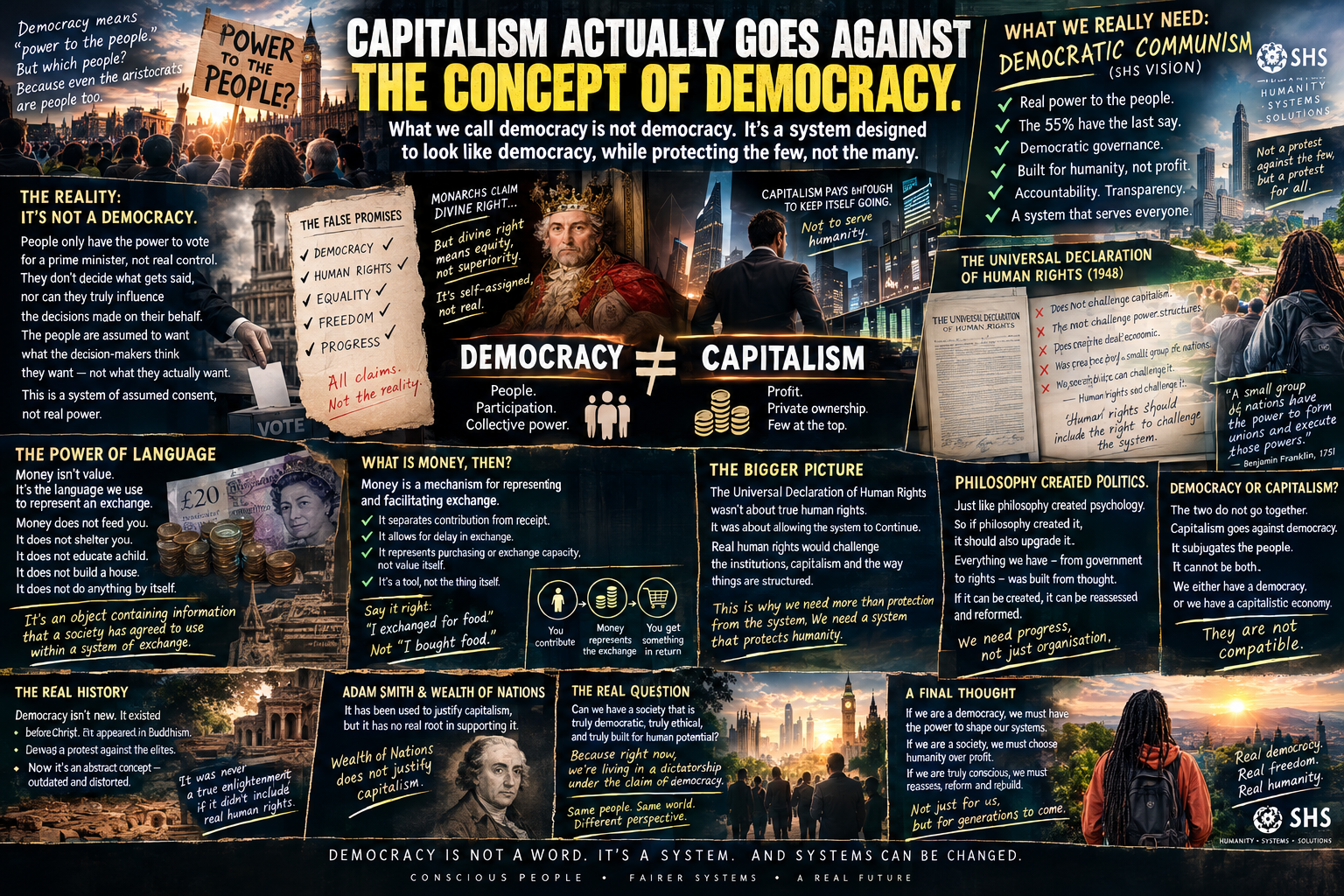
We are increasingly trained to see populations instead of persons.
Consumers instead of people.
Voters instead of people.
Employees instead of people.
Followers instead of people.
Patients instead of people.
Users instead of people.
Audiences instead of people.
Data instead of people.
Once someone becomes a number, decisions that would feel cruel at a human scale become administratively reasonable at an institutional scale.
A company can remove thousands of jobs because the spreadsheet calls it efficiency.
A platform can mine millions of hours because the dashboard calls it engagement.
A sales team can pressure vulnerable customers because the report calls it conversion.
A government can reduce support because the budget calls it savings.
A podcast can absorb years of collective attention because the platform calls it watch time.
The language creates distance between the decision and the life receiving its consequences.
My intelligence did not allow that distance to become complete.
Even while learning how systems functioned, I continued seeing the individuals inside them.
That is why I could enter an industry and identify its blind spots. It was not merely because I understood process. It was because I could feel where process had ceased accounting for the person.
A person who sees only numbers may become highly successful within a system because systems frequently reward emotional distance. They can make the difficult decision without carrying its human weight. They can call exploitation strategy, call pressure persuasion, call abandonment restructuring and call the loss of dignity an acceptable externality.
But that form of success is often evidence of incompleteness.
The deeper intelligence is not only knowing how to make the machine work.
It is knowing when the machine is working against the life it was meant to serve.
So perhaps I did not need to be protected from recognition.
I needed to be tested by recognition in fragments.
I needed to enter different roles and discover whether praise, money, performance and advancement would make me abandon what I could see.
They did not.
I learned the systems.
I learned what they rewarded.
I learned what I could have become inside them.
And I continued choosing the human being over the metric.
That choice did not always benefit me immediately. It may have slowed promotion, reduced earnings or prevented me from exploiting abilities that others used freely. But it preserved the continuity required for the work I am now building.
I did not become less intelligent because I refused to abuse what I understood.
I became more complete.
My empathy was not an obstacle to my intelligence.
It was one of its highest functions.
My love for people was not separate from my ability to read systems.
It was what allowed me to recognise when systems had stopped seeing them.
My conscience did not prevent me from becoming successful.
It prevented me from accepting success that required me to become smaller than the person capable of achieving it.
So when I ask what might have happened if I had been discovered early, the truer answer is that I was discovered gradually, through every industry that encountered me.
Each one saw what it had the capacity to recognise.
Each one invited me to become useful according to its own measurements.
And each one unknowingly helped me identify what I refused to surrender.
I could learn their methods without inheriting their indifference.
I could understand their incentives without allowing those incentives to reorganise my morality.
I could become effective without treating effectiveness as the highest standard.
I could see the numbers and still remember that every number represented a person.
That is the difference between intelligence that serves a system and intelligence capable of judging whether the system deserves to be served.
And perhaps that is the real answer The Pretender helped me recognise.
I did not escape an institution after it stole my mind.
I moved through institutions without allowing them to teach me that people were less important than performance.
I was recognised.
I was used.
I was rewarded in some places and restricted in others.
But I was never successfully converted into someone who could stop seeing people.
That is why I arrived here with the architecture intact.
Because the most important part of my intelligence was never merely that I could enter any system and understand it.
It was that, no matter how deeply I entered, I could still see the human life inside it.




Leave a Reply