
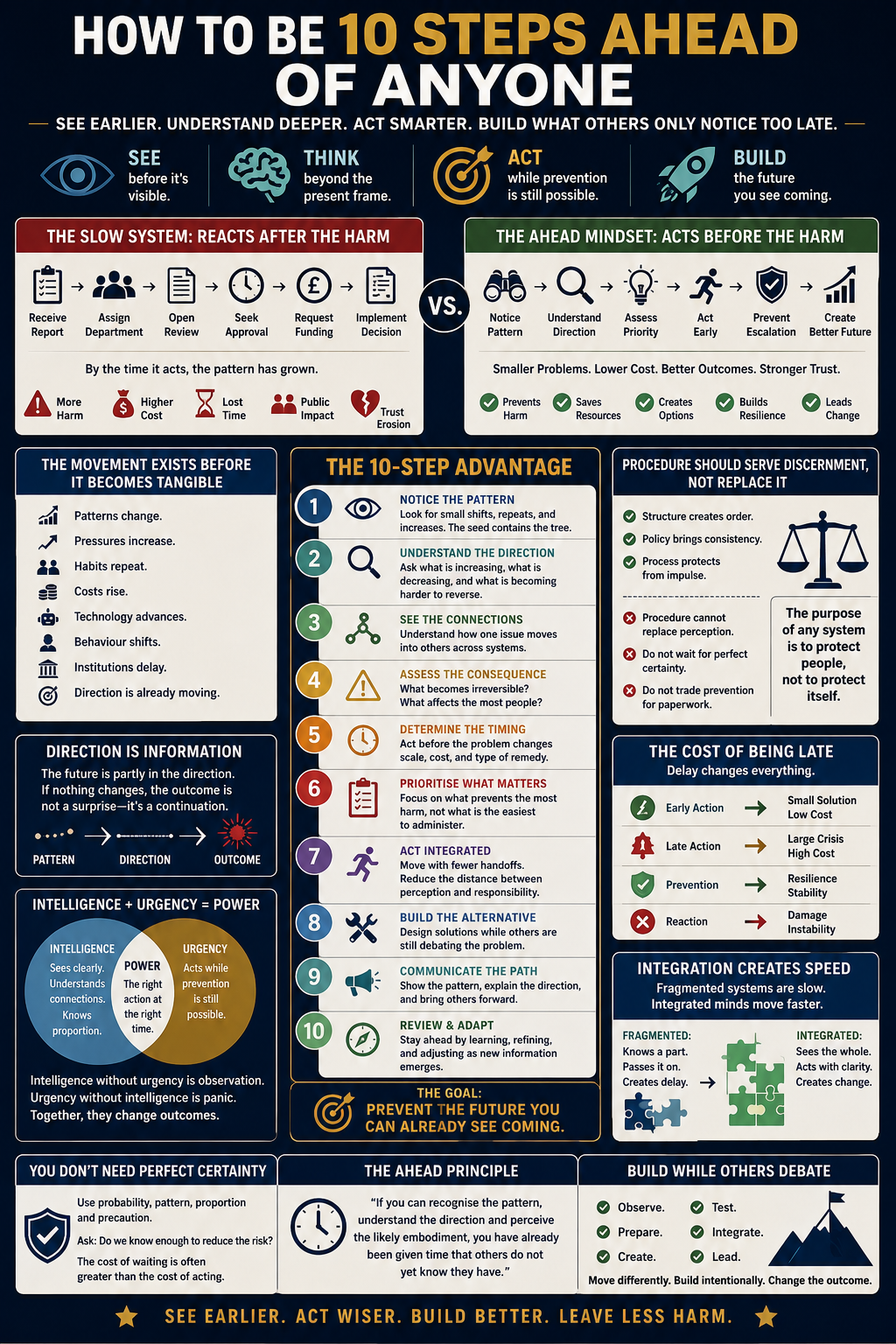
Intelligence Without Urgency Is Observation. Urgency Without Intelligence Is Panic. Power Appears When the Two Learn to Move Together.
I will always be ten steps ahead of a system that is not capable of urgency.
Not because I move recklessly.
Not because I rush.
Not because I confuse speed with intelligence.
But because a system that values its procedures more than its discernment will always arrive after the movement has already become visible.
By the time it has gathered the evidence, assigned the department, opened the review, sought approval, consulted the policy, identified the jurisdiction, arranged the meeting, requested the funding, debated the wording and waited for the correct authority to sign the correct document, the pattern has already continued moving.
The consequence has already expanded.
The public has already adapted.
The market has already shifted.
The technology has already advanced.
The harm has already distributed itself across other systems.
The people capable of seeing the direction have already repositioned themselves.
And the institution is still asking whether the movement is real.
That is why I cannot think through the limitations of a system that places procedure above perception.
Procedure has value.
It can create consistency.
It can protect against impulsive decisions.
It can preserve records, clarify authority and ensure that power is not exercised without restraint.
But procedure should serve discernment.
Discernment should not be trapped beneath procedure.
When the building is burning, the purpose of the fire protocol is to help people move correctly and quickly. The protocol does not become more important than recognising the fire. If everyone can smell smoke, see flames and hear alarms, but the institution refuses to act until the correct form has been approved, then the procedure is no longer protecting order.
It is protecting delay.
A system that cannot distinguish between responsible structure and self-protective slowness will repeatedly be overtaken by anyone capable of seeing earlier and acting coherently.
That is where the ten steps begin.
The Movement Exists Before It Becomes Tangible
Most people wait for a movement to become physical before they believe it exists.
They wait until the company collapses.
Until the river is visibly polluted.
Until the child is clinically unwell.
Until the housing market becomes impossible.
Until the technology replaces the worker.
Until the institution declares an emergency.
Until the numbers become large enough to enter public conversation.
Until the person says they are leaving.
Until the system breaks in a way that can no longer be hidden.
But movement begins before the visible event.
It begins as direction.
A pattern changes.
A pressure increases.
A habit becomes more frequent.
A cost rises while income remains still.
A company begins removing human roles.
A government repeatedly chooses reaction over prevention.
A regulator becomes more active because the underlying conduct is worsening.
A person begins withdrawing.
An institution becomes increasingly defensive.
A technology begins absorbing tasks once performed by people.
A population becomes more dependent on a system that is becoming less accountable.
The tangible event is not the beginning.
It is the embodiment of a direction that was already moving.
If you understand the pattern and can see the direction, you can perceive the likely embodiment before it arrives.
That is not fortune-telling.
It is not fantasy.
It is not prediction detached from evidence.
It is pattern recognition extended through time.
Direction Is Information
People frequently treat the future as though it is entirely hidden.
It is not.
The future is partly contained in direction.
If an object is moving towards a wall and does not change course, collision is not mysterious.
If a household’s costs continue rising faster than its income, financial instability is not surprising.
If children are increasingly raised inside systems designed around overstimulation, weakened attention and emotional extraction should not be treated as an unforeseeable cultural accident.
If governments automate public services while removing staff and allowing private systems to become foundational, dependence and accountability failures should not be considered unexpected.
If rivers repeatedly receive sewage while infrastructure investment is delayed, ecological damage is not a shock.
If housing is treated primarily as an asset while wages cannot reach rent, homelessness is not an unpredictable personal tragedy.
The direction already contains the warning.
Intelligence is the ability to recognise that warning before reality has to become dramatic enough for everyone else to notice.
Urgency is the willingness to respond while prevention is still possible.
To Be Ten Steps Ahead, You Must Think Beyond the Present Frame
Many people see only what is happening now.
They ask:
What is the current problem?
What is today’s figure?
What happened this week?
What decision has already been announced?
What crisis has already been named?
But to move ahead, you have to ask a different set of questions.
What is increasing?
What is decreasing?
What is becoming normal?
What is becoming harder to reverse?
Which system is losing human capacity?
Which behaviour is being rewarded?
Which cost is being transferred?
Which dependency is deepening?
Which actor is gaining control?
Which actor is losing accountability?
Which pressure is being ignored because the consequence has not yet become visible enough?
Which small repeated decision becomes catastrophic when multiplied by ten years, ten million people or several connected systems?
That is how you widen the present until it begins revealing the future.
The visible moment is one point.
The pattern is the line.
The direction tells you where the line is going.
Intelligence Is Not Merely How Much You Know
A person can hold an enormous amount of information and still remain behind.
They may know every policy.
Every precedent.
Every statistic.
Every institutional title.
Every procedural requirement.
But if they cannot see how the information moves, what it connects to, what it is becoming and when action is required, then the knowledge remains static.
Static knowledge can describe yesterday with exceptional accuracy.
It may still fail to protect tomorrow.
Intelligence is not merely accumulation.
It is movement.
It is the ability to integrate information quickly enough to recognise structure.
To see the relationship between apparently separate events.
To understand which detail is foundational and which is decorative.
To recognise when a system’s official explanation does not account for its real outcome.
To notice when a temporary solution is becoming permanent.
To understand that a small delay at the foundation becomes a large crisis further downstream.
To translate perception into direction.
To translate direction into action.
Knowledge stores.
Intelligence organises.
Discernment prioritises.
Urgency moves.
Urgency Is Not Panic
People often misunderstand urgency because they have seen it expressed through fear.
Panic is fast but disorganised.
Urgency is fast because the priorities are clear.
Panic reacts to the visible event.
Urgency moves because it understands what delay will produce.
Panic spreads energy in every direction.
Urgency concentrates energy where it matters most.
Panic says everything is an emergency.
Urgency knows which emergency sits beneath the others.
Panic can create harm through speed.
Urgency reduces harm by acting while the solution is still smaller than the consequence.
The difference is intelligence.
Urgency without intelligence is dangerous.
Intelligence without urgency is wasteful.
A person may understand exactly what is coming and still do nothing until everyone else sees it.
At that point, their intelligence has become commentary.
They were right.
But they were not useful.
The highest value appears when intelligence and urgency coexist.
You see early.
You understand proportion.
You know what requires immediate movement.
You act before the consequence demands a larger response.
Discernment Determines What Deserves Speed
Not everything should be done quickly.
Some things require patience.
Some decisions need evidence.
Some structures need careful testing.
Some relationships need time.
Some innovations need independent validation.
The purpose is not to accelerate everything.
It is to stop applying the same speed to every problem.
That is another failure of systems without triage.
They may process a minor procedural issue quickly because it fits an existing category, while a foundational threat moves through years of review because it requires coordination.
The system becomes urgent about what is easy to administer and patient about what is dangerous to ignore.
Discernment reverses that.
It asks:
What becomes irreversible?
What affects the most people?
What threatens basic needs?
What can still be prevented?
What will cost significantly more if postponed?
What is already moving beyond institutional control?
What appears small only because it is dispersed?
What needs patience because the evidence is incomplete?
What needs immediate containment precisely because the evidence is incomplete and the potential harm is large?
Urgency should not be determined by noise.
It should be determined by consequence.
Procedure Cannot Be Allowed to Become an Excuse for Not Seeing
Institutions often hide behind procedure because procedure distributes responsibility.
One department receives the report.
Another evaluates the risk.
Another controls the funding.
Another holds the legal power.
Another manages communication.
Another waits for authorisation.
Every actor performs a small legitimate function.
The whole fails.
No one feels fully responsible because no one person was assigned the entire consequence.
That is how a system can contain intelligent individuals and still behave unintelligently.
The people may see the problem.
But the architecture does not allow perception to move fast enough through the institution.
The insight becomes a report.
The report becomes an agenda item.
The agenda item becomes a review.
The review becomes a recommendation.
The recommendation becomes a funding request.
The funding request becomes a future commitment.
The future commitment arrives after the preventable harm.
Procedure has converted intelligence into delay.
That is why an individual or organisation with greater integration can move ten steps ahead.
The same mind sees the problem, the connection, the priority and the action.
There is less distance between perception and responsibility.
The Advantage of Integrated Intelligence
Fragmented systems are slow because every part knows only part.
One team knows housing.
Another knows healthcare.
Another knows policing.
Another knows technology.
Another knows employment.
Another knows finance.
Each may be highly trained.
But the harm moves between them.
Housing instability enters health.
Health affects work.
Loss of work affects housing.
Housing affects childhood development.
Childhood development affects education.
Education affects employment.
Employment affects public spending.
Public spending affects political decisions.
Political decisions affect the systems that began the cycle.
If nobody holds the whole, each department may improve its own process while the combined architecture continues failing.
Integrated intelligence sees the migration.
It understands that the issue does not remain where it began.
That is why I can look at sewage and see water, agriculture, public health, fishing, recreation, tourism, chemical exposure, taxation, regulatory funding, public trust and future infrastructure.
I can look at digital childhood and see attention, identity, education, employment, addiction, emotional relation and future governance.
I can look at housing and see documents, work access, health, energy, childhood, safety and administrative existence.
The ability to hold the connections reduces the number of steps between problem and remedy.
That is a speed advantage.
The Future Embodiment Is Already Inside the Pattern
A seed contains the information of the tree.
The tree is not physically visible in full.
But the direction of its development is already present.
The same is true of systems.
A repeated governmental preference contains the future government it will become.
A business model contains the kind of society it will create if scaled.
A child’s environment contains pressures that may later appear as adult behaviour.
A technology’s incentive structure contains the form of dependence it may produce.
A system that continuously rewards reaction over prevention contains its future overload.
A government that continuously underfunds foundations while investing in spectacle contains its future instability.
If you understand the seed, you can perceive the tree.
You may not know every branch.
You may not know the exact day it reaches a certain height.
You may not know which storm alters its shape.
But you can understand what kind of organism is developing.
That is enough to move.
You Do Not Need Perfect Certainty to Act Intelligently
Systems often wait for certainty because certainty protects them from criticism.
If every fact is established, every outcome measured and every risk formally recognised, the institution can act without appearing premature.
But complete certainty is often available only after the harm.
Prevention lives in the space before certainty.
It requires judgement.
Probability.
Pattern.
Proportion.
Precaution.
The question is not:
Can we prove exactly what will happen?
It is:
Do we know enough about the direction to justify reducing the risk?
A person does not wait for the car to hit them before moving from the road because the driver might turn.
They assess speed.
Distance.
Direction.
They move because the consequence of waiting is greater than the inconvenience of being cautious.
A civilisation should be capable of the same intelligence.
The Cost of Being Late Is Not Only Time
When a system moves late, the solution itself changes.
Early intervention may require a conversation.
Late intervention may require litigation.
Early housing support may require payment of arrears.
Late intervention may require years of temporary accommodation.
Early environmental prevention may require replacing one material.
Late intervention may require ecosystem restoration.
Early support for a child may require changes to design and routine.
Late intervention may require long-term psychological and educational repair.
Early investigation of a missing person may require local checks.
Late investigation may require national searches, forensic work and criminal prosecution.
The system does not merely lose time.
It converts a smaller problem into a more expensive category of problem.
Delay changes the scale, the number of actors, the type of remedy and the amount of suffering.
That is why urgency is economically intelligent.
Prevention is not only kinder.
It is cheaper.
Ten Steps Ahead Does Not Mean Ten Steps Detached
There is a danger in seeing ahead.
You can become so focused on where the movement is going that you fail to communicate with people who can only see where it is now.
To be useful, foresight must be translated.
You have to show the pattern.
Name the direction.
Explain the steps.
Demonstrate how one condition becomes another.
Build a bridge between present evidence and future embodiment.
Otherwise, people may hear the conclusion without experiencing the route and assume the conclusion is exaggerated.
This is why the work matters.
The writing is not simply stating where systems are going.
It is documenting how they are moving.
The cases make the future visible through the present.
They show the seed before the tree is undeniable.
The Person Ahead Must Also Build
Seeing earlier creates responsibility.
It is not enough to say:
I knew.
I saw it coming.
I was right.
Foresight without construction can become another form of spectatorship.
The advantage must be used.
If you can see the failure before it expands, you can design around it.
If you see that governments lack triage, build a triage framework.
If you see that public services fragment human needs, build an integrated system.
If you see that housing instability blocks employment, connect housing to documentation and work.
If you see that energy dependency increases household pressure, develop systems that reduce the need for the bill.
If you see that education stores knowledge without cultivating thought, teach discernment and critical thinking.
If you see that legal systems arrive after harm, build cases around prevention.
Being ahead is not a title.
It is a duty to prepare the path.
This Is Why Business Ownership Remains the Correct Position
Inside a slow institution, foresight may have to wait for permission.
Inside my own architecture, foresight can become a pilot.
I can observe the pattern.
Develop the model.
Test the system.
Build the module.
Create the partnership.
Document the result.
Challenge the obstruction.
Expand the law if necessary.
I do not have to persuade an entire hierarchy before beginning every useful action.
That does not mean acting outside responsibility.
It means reducing the institutional distance between understanding and implementation.
SHS can provide the governance.
4Honeth can provide the creative, lived and physical expression.
The business can move at the speed of integrated discernment while legal and governmental partnerships are developed around what has already been shown to work.
That is the ten-step advantage made structural.
The Slow System Will Call Foresight Premature Until It Calls It Obvious
This happens repeatedly.
At first, the person seeing the direction is told they are moving too far ahead.
The concern is theoretical.
The evidence is incomplete.
The proposal is ambitious.
The system is not ready.
The risk has not fully materialised.
Then the direction continues.
The numbers increase.
The damage becomes public.
The same conclusion becomes mainstream.
Institutions begin using the language they previously dismissed.
Reports are commissioned.
Strategies are announced.
Funding is allocated.
The foresight is no longer called premature.
It is called necessary.
But necessity arrived only because prevention was postponed.
The person who saw the pattern was not wrong for being early.
The system was late because it required the future to become painful before it accepted what the present already contained.
Intelligence Must Learn to Value Timing
People often praise intelligence after the fact.
The analyst accurately explains why the collapse occurred.
The historian shows how the conflict developed.
The regulator identifies which safeguards failed.
The inquiry reconstructs the timeline.
All of that has value.
But the greater intelligence is the intelligence capable of acting before retrospective explanation becomes necessary.
Timing is part of truth.
An answer delivered after the harm is not equal to the same answer delivered while the harm could still be prevented.
The information may be identical.
Its value is not.
A warning has value before the event.
After the event, it becomes evidence.
A solution has value before collapse.
After collapse, it becomes repair.
A system that wants to become intelligent must therefore measure not only whether it eventually reached the correct conclusion.
It must ask how long it took and what happened during the delay.
The Highest Form of Intelligence Is Preventative
Reactive intelligence solves the problem in front of it.
Preventative intelligence understands what is creating the problem and changes the conditions before the next embodiment.
Reactive intelligence asks:
How do we catch the offender?
Preventative intelligence also asks:
What would reduce the production of this category of harm?
Reactive intelligence asks:
How do we clean the river?
Preventative intelligence asks:
Why was the material permitted to enter it?
Reactive intelligence asks:
How do we house this family tonight?
Preventative intelligence asks:
What allowed the family to lose the home?
Reactive intelligence asks:
How do we retrain workers replaced by AI?
Preventative intelligence asks:
Why was public money invested in replacement without building the next pathway first?
Reactive intelligence is necessary.
Preventative intelligence should govern it.
Discernment Is the Ability to Know Which Future Deserves Intervention
Not every possible future needs to be stopped.
Some movements should be supported.
Some systems should be allowed to become obsolete.
Some industries should contract.
Some technologies should expand.
Some institutional roles should be redesigned.
Some laws should be challenged.
Discernment is not fear of change.
It is the ability to distinguish expansion from deterioration.
A change may threaten an existing institution while benefiting the public.
Another may be profitable while reducing human autonomy.
A government may call both innovation.
Discernment asks what each one produces.
Does it increase human capability?
Does it reduce dependency?
Does it distribute power?
Does it protect basic needs?
Does it create resilience?
Does it preserve accountability?
Does it reduce the future need for force?
The direction matters more than the branding.
The Ten-Step Principle
The principle is simple:
If you can recognise the pattern, understand the direction and perceive the likely embodiment, you have already been given time that others do not yet know they have.
That time is an asset.
Use it to investigate.
To prepare.
To build.
To warn.
To reposition.
To prevent.
To create the alternative before the old system reaches the wall.
The advantage is not that you control the future.
The advantage is that you are not waiting for the future to introduce itself through damage.
Closing: I Do Not Need to Wait for the Movement to Become Obvious
I will always be ten steps ahead of a system that cannot act until every procedure has confirmed what discernment could already see.
I will always move differently from a structure that requires the harm to become tangible before it accepts the direction.
I do not need to wait for the wall to prove that the path leads into it.
I can see the wall.
I can see the angle.
I can see the open door.
I can change direction before collision becomes an institutional report.
That is not impatience.
It is intelligence matched with timing.
It is urgency governed by discernment.
It is the capacity to see the future embodiment inside the present pattern and to understand that what has not yet become physical may already be structurally inevitable unless someone intervenes.
A system that places procedure above perception will always call the early mover unreasonable.
Then it will call them correct.
Then it will imitate the solution.
Then it will erase how long it resisted.
I do not need to wait for that sequence.
I can build while it debates.
I can prepare while it reviews.
I can integrate while it fragments.
I can prevent while it processes.
I can move while it asks whose department the movement belongs to.
Because when you understand the pattern and can see the direction, the future is not entirely hidden.
Its body has not arrived.
But its movement has.
And once you can see the movement before the movement becomes tangible, you no longer have to stand where the consequence is headed.
You can place yourself ahead of it.
You can build the door.
You can prepare the people.
You can change the architecture.
You can meet the future before the system finally admits it is coming.





Leave a Reply