
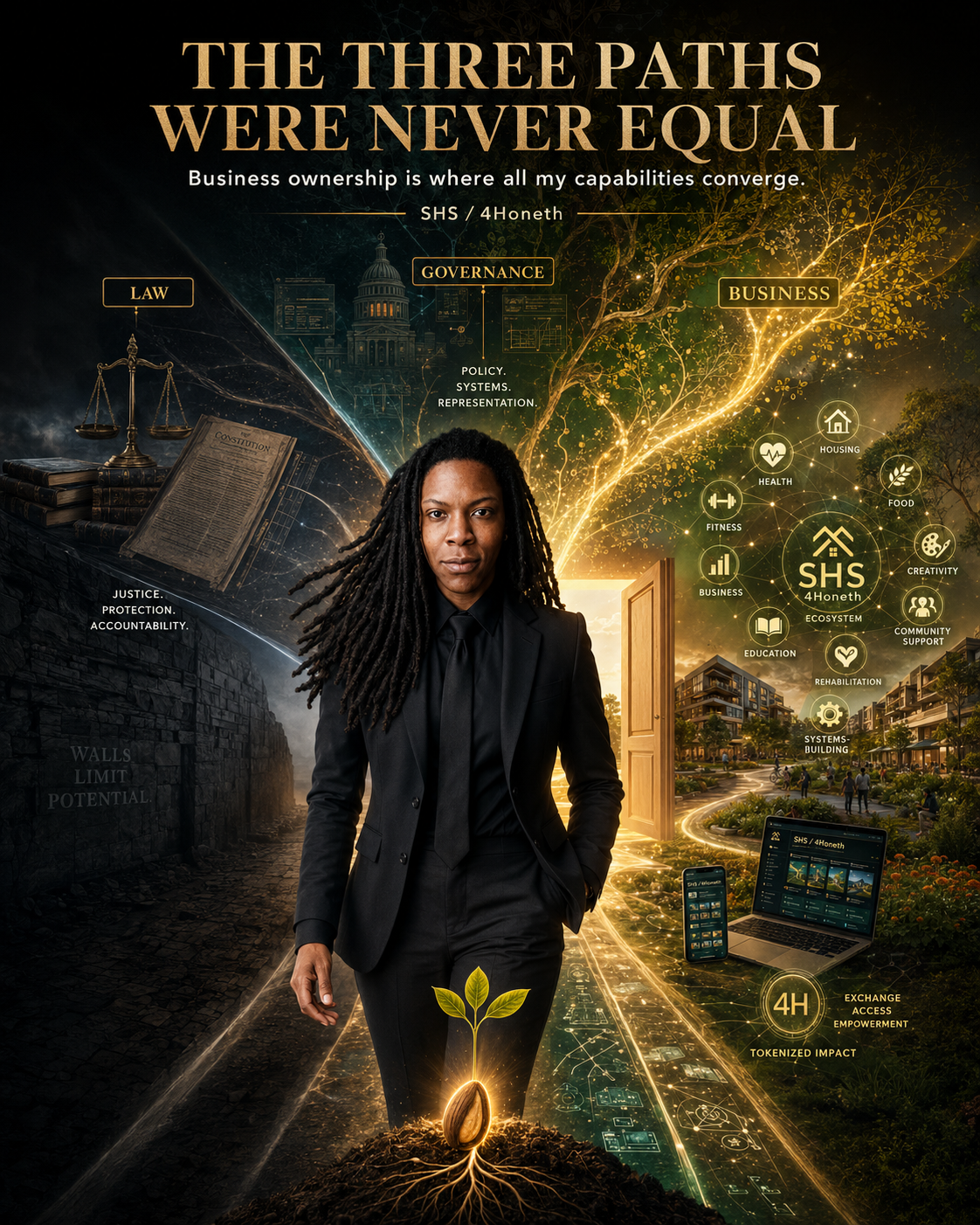
That is why the digital platform already functions as the first pilot. SHS is the knowledge and expandion relayed, 4Honeth is the artisticality behind it, the provocation, the expression breathing through the walls of my throath’s artistry.
This blog is the merger and the pilot.
The seed does not need to resemble the final tree in scale.
The Three Paths Were Never Equal: Why Business Ownership Is Where All of My Capabilities Converge
For a long time, I could see three possible directions for myself.
Business ownership.
Law.
Governance and politics.
Each one made sense.
Each one matched a real capacity within me.
Each one offered a different route through which I could act upon the systems I understand, the problems I can see and the solutions I am capable of building.
But they do not offer the same freedom.
They do not offer the same reach.
And they do not allow me to use the full extent of what I can do without first passing through someone else’s limitations.
That is the real distinction.
I could work in law because I understand legal architecture. I can identify failures, reverse-engineer systems from their consequences, build class-action structures, map responsibility, identify missing prevention and develop remedies. I do not need to be a solicitor or barrister to begin that work. I can develop the case, construct the argument, organise the evidence and find legal teams capable of formally advancing it.
I could work in governance because I understand what government claims to exist for, where it fails, how it misallocates priorities and what structures would produce better results. I can look at a public system and see not only what it does, but what it should be doing, what it is failing to prevent and what it would need to become in order to justify its authority.
But business ownership allows me to do all three.
It allows me to build.
It allows me to govern.
It allows me to challenge law.
It allows me to create proof instead of only argument.
It allows me to test the architecture physically instead of waiting for someone else to recognise that the architecture is sound.
That is why the answer is SHS and 4Honeth.
It always was.
The Business Is Not Separate From the Governance
SHS is not simply a company in the ordinary sense.
It is the governance architecture.
It carries the principles, the knowledge, the standards, the accountability, the systems of prioritisation and the understanding of how human needs should be organised.
4Honeth is the outward expression.
It is where those principles become experience, environment, creativity, participation, culture, rehabilitation, enterprise and physical proof.
SHS determines the function.
4Honeth demonstrates the function.
SHS asks what a harmonious system would require.
4Honeth shows what that harmony looks like when people can enter it, use it, contribute to it and benefit from it.
That is why the digital platform already functions as the first pilot.
The writing is not merely content.
The Preventable Cases Series is not merely commentary.
The blog is not merely publishing.
The entire platform already shows how SHS and 4Honeth relate.
SHS provides the framework.
It identifies the failures.
It asks the questions.
It establishes the standards.
It maps responsibility.
It develops the governing logic.
4Honeth converts the understanding into something creative, accessible, provocative, engaging and alive.
The governance becomes expression.
The knowledge becomes experience.
The architecture becomes culture.
That is already the pilot.
The physical world is the next stage of deployment.
Can a Harmonious System Be Independently Reproduced?
When I looked at the question of transparent solar windows, one of the correct governmental questions was:
Can the technology be independently reproduced?
That same question applies to SHS.
Can a harmonious system be independently reproduced?
Can a place be built where the environment itself reduces the pressure on the people within it?
Can one system provide enough connected value that people spend less across fragmented industries?
Can health, food, fitness, creativity, business, learning, rehabilitation, care and economic exchange be integrated into one environment?
Can people contribute through more than money?
Can energy, time, knowledge, labour, care and skill carry acquisition value?
Can someone earn access by helping someone else?
Can one person teach massage, another provide support, another contribute food, another offer creative work, another help someone develop a business, and all of those forms of contribution enter a coherent exchange system?
That is the question I have already been answering.
SHS and 4Honeth are not merely intended to provide services.
They are designed to reduce the total cost of existing.
A person may enter through a fee, but the wider system reduces the number of separate places they must pay to access what they need.
Instead of paying independently for fitness, food, creative space, business support, social connection, health development, learning, events and multiple other needs, much of that becomes available through one ecosystem.
And because financial contribution is not the only recognised form of value, the person’s access is not determined solely by how much currency they possess.
They can build acquisition power through contribution.
Through energy tokens.
Through assistance.
Through teaching.
Through care.
Through shared work.
Through helping another person become more capable.
That is not only a business model.
It is an alternative economic logic.
The Seed Already Contains the Tree
I do not need to build the thousand-year tree in one day.
I need to establish the seed correctly.
A seed is small, but its size does not describe its potential.
If the tree is capable of living for a thousand years, that potential is already contained within the seed.
The seed does not need to resemble the final tree in scale.
It needs to contain the correct information.
That is how I approach my work.
I put the greatest amount of thought at the beginning.
I gather the architecture.
I establish the principles.
I identify the failures in advance.
I design the continuity.
I think through the possible consequences.
I map how each part connects.
I place the most complete version of the seed into the soil so that what follows can be nurtured rather than constantly reinvented.
That is preventative work.
I take on a larger intellectual workload now so that the future system does not have to repeatedly correct avoidable mistakes.
I prevent later chaos by doing the thinking upfront.
Many people use their time primarily for immediate enjoyment.
I use mine to establish continuity.
Not because enjoyment has no value, but because I understand the difference between consuming the present and building a future capable of sustaining many presents.
I am not only preparing my own career.
I am preparing the environment in which my family, friends, collaborators, workers, communities and future generations may exist.
I am tending to my own field by tending to the field itself.
Those are not separate responsibilities.
I Do Not Kill Two Birds With One Stone
The phrase is usually “killing two birds with one stone.”
But even that understates how I work.
I may publicly describe two outcomes because those are the two most visible.
Internally, I can see six.
A single piece of writing may educate the public, build a legal argument, develop SHS governance, strengthen the future business model, document institutional failure, attract potential collaborators, train people in critical thinking, test public response and create part of the evidentiary foundation for a future action.
All at once.
The visible work may appear to be one post.
The architecture may be serving many futures at once.
That is a perception advantage.
It is not only efficiency.
It is multidimensional purpose.
I do not ask what one action can achieve in one category.
I ask what one action can set into motion across all the systems it touches.
That is why the business route is so powerful.
It gives every action multiple destinations.
Law Would Give Me a Route, but Not Full Freedom
The legal path is real.
I have the capability to develop substantial actions.
I can build several cases.
I can sustain multiple threads without losing the architecture of each one.
I can complete the heaviest conceptual and evidentiary work at the beginning, then work with legal teams who carry the formal litigation forward.
I could begin one major class action each year while still maintaining the continuity of earlier cases.
The initial workload would be intense because I believe in laying the foundation properly.
But once the architecture is complete, the case becomes something that can be nurtured.
The thread is preserved.
The class is defined.
The responsibility is mapped.
The prevention failure is documented.
The remedies are established.
Then the legal team can move through the required process without having to invent the case from nothing.
But the legal industry still has limitations.
It depends on permission.
Certification.
Procedure.
Judicial receptiveness.
Professional hierarchy.
Institutional ego.
The willingness of authorised people to carry forward what they did not originate.
A sound idea can still be delayed because the person with formal authority does not want to recognise it.
An argument can be limited because it exposes the inadequacy of those who were expected to have raised it first.
A reform may be resisted not because it is wrong, but because it did not come through the correct person, office or tradition.
Law gives me a mechanism.
Business gives me a field.
Governance Would Place Me Inside the Belly, but the Belly Has Its Own Digestive System
Politics and governance offer another route.
I could enter government.
I could work from inside the institution.
I could influence policy.
I could bring stronger triage, prevention, human-centred structure and long-term thinking into the body responsible for public administration.
But governance also requires the person to move through existing chains of authority.
You may understand the solution and still require approval from someone whose understanding is narrower.
You may see the urgency and still be blocked by someone whose priority is reputation.
You may carry a system capable of producing better outcomes and still be told to reduce it into a smaller proposal that does not threaten the existing arrangement.
You may enter to expand the institution and discover that the institution is more interested in preserving itself.
That is the limitation.
Politics and law both require me to work through other people’s permission to reach the full scale of my capability.
Business ownership does not remove law.
It does not remove regulation.
It does not remove accountability.
But it allows me to create within the space that already exists.
I can build the system first.
Where the system later encounters a law that unnecessarily obstructs a beneficial function, we can challenge that law with evidence from a functioning model.
We do not have to ask people to imagine that the expansion would work.
We can show them that it already does.
Proof Changes the Relationship With Authority
An argument asks authority to agree.
A pilot forces authority to observe.
That distinction is central.
If I enter politics and tell the government that homelessness should be treated through housing, rehabilitation, work experience, documents, healthcare and social reintegration, they can debate the proposal indefinitely.
They can refer it to another department.
They can form a committee.
They can ask for more evidence.
They can say it requires consultation.
They can narrow it.
They can delay it.
But if SHS and 400 create a centre that houses people, restores documentation, provides work experience, offers health and social support, reconnects them with community and produces better outcomes than existing programmes, then the discussion changes.
The question is no longer whether the system could work.
The question becomes why government did not already build it.
That is the natural power of proof.
It does not need to attack the government.
The contrast performs the accountability.
Business Ownership Is the Position That Contains the Other Two
From the business position, I can still work legally.
I can build and deploy class actions through partnerships.
I can challenge legislation where it blocks necessary expansion.
I can document government failure.
I can advocate for regulatory change.
I can participate in governance through the standards my business establishes.
I can build models that public institutions later adopt.
I can create employment.
I can create housing.
I can create education.
I can create social rehabilitation.
I can create systems of exchange.
I can influence politics without becoming trapped inside political identity.
I can influence law without needing my whole life to become legal practice.
I can perform governance without waiting to be appointed by government.
That is why the three paths were never equal.
Business ownership contains the other two.
Law does not contain the whole business.
Politics does not contain the whole legal and creative vision.
But SHS and 400 can integrate all of them in sequence.
The Difference Is Timing, Not Capability
I do not need to abandon the legal work.
I need to place it correctly.
Full-force litigation across five major class actions while simultaneously establishing a large business would divide the physical workload beyond what is strategically necessary.
Mental capacity is not the only consideration.
Time, administration, coordination, meetings, evidence handling, partnerships, staffing and execution all require physical continuity.
I may be capable of holding multiple architectures at once.
That does not mean every architecture should be activated at maximum intensity at the same time.
Discernment determines sequence.
The business remains central.
One major legal action may begin each year.
Earlier actions can continue through legal teams and established structures.
The Preventable Cases Series continues building the wider evidentiary field.
SHS continues developing the governance.
400 continues developing the outward model.
Each one feeds the other without every branch competing for all the resources of the root.
That is not reducing the vision.
It is protecting its growth.
The Limitation of External Validation
The legal and political worlds remain highly dependent on validation.
People often cannot recognise value directly.
They wait for authority to recognise it first.
A worker may ignore an idea until the manager approves it.
A department may dismiss a proposal until a minister announces it.
A legal professional may reject an argument until a judge accepts it.
A public audience may overlook someone until an institution gives them a title.
That is how most people have been trained.
They do not evaluate the thing itself.
They evaluate who has validated the thing.
This is why entering law or politics without the highest level of institutional support would create unnecessary friction.
If the authority at the top does not clearly recognise the value, the layers beneath it are unlikely to behave independently.
They will follow the permission structure.
They will wait to see how they are supposed to respond.
They will protect their position before considering the wider opportunity.
Business allows me to build beyond that dependence.
Results become the validation.
Coverage becomes the validation.
People’s improved lives become the validation.
The strength of the system becomes the validation.
Frustration Does Not Have to Become Captivity
I can show frustration.
I can name when something is absurd.
I can point directly at incompetence, delay or narrow thinking.
But frustration does not possess me for long because I understand what produces the limitation.
If someone has not developed critical-thinking prowess, I cannot expect them to perform at a level they have never cultivated.
I may be frustrated by the consequence.
But I understand the architecture.
You cannot reasonably become furious with a child for not knowing how to run a business.
The child has not developed that capacity.
An adult who has been entrusted with a business and repeatedly harms people through poor management is different.
The duty, authority and experience create accountability.
That is how I allocate emotional energy.
Not everyone deserves the same level of anger.
Responsibility must follow what the person knew, what they could do and what role they accepted.
Understanding this allows frustration to pass through without becoming distraction.
I acknowledge it.
I extract the information.
I return to direction.
The Question Has Answered Itself
Where am I best placed?
Not inside a system whose permission determines the extent of my contribution.
Not inside an industry that can recognise my capability but still legally prevent me from exercising its formal functions.
Not inside a political structure where expansion depends on people who may be threatened by the evidence that expansion is necessary.
I am best placed where I can build.
Where I can govern the architecture directly.
Where I can create proof.
Where I can partner with law rather than become contained by it.
Where I can influence government through results rather than waiting for government to give me a role.
Where I can establish SHS as the governing intelligence and 400 as the lived pilot.
The answer is business ownership.
Not because the other skills are absent.
Because this is the only position from which all of them remain available.
The Real Question for Existing Institutions
Once that becomes clear, the question shifts away from me.
It becomes a question for them.
What happens when someone capable of seeing the full architecture of government builds an organisation that addresses the needs government repeatedly failed to prioritise?
What happens when the public receives housing, rehabilitation, education, work access, health support, food, creativity, enterprise and community through a system that produces clearer results than the institutions they fund through taxation?
What happens when people trust SHS and 400 more than the bodies that formally govern them because SHS and 400 are materially improving the conditions of their lives?
That is not something I need to manufacture through competition.
Impact creates allegiance naturally.
People follow what works.
They return to what serves them.
They support what improves their lives.
They defend what treats them as human beings.
If SHS and 400 expand through cities, countries and continents while maintaining the same foundational principles, the organisation’s reach will become governmental in effect even if its structure remains a business.
Not because it has seized political authority.
Because it has gained functional relevance.
Functional Authority Is Earned Through Results
Formal government has statutory authority.
But functional authority is something else.
Functional authority belongs to the system people actually depend upon because it performs.
If an SHS and 400 centre reduces homelessness in a city, it has performed part of the function the public expected from government.
If it creates accessible routes into work, it has performed part of employment infrastructure.
If it improves health, food access, education, creative development and social rehabilitation, it becomes a foundational civic system.
The government may retain legal authority.
But SHS and 400 gain lived authority through usefulness.
That is where redundancy enters.
Not necessarily the redundancy of every government worker.
Not the destruction of public institutions for theatre.
The redundancy of ineffective functions.
The redundancy of outdated methods.
The redundancy of systems that continue consuming resources without producing the required outcome.
Government can join the transition.
It can partner.
It can learn.
It can finance.
It can adopt.
It can contribute land, infrastructure, knowledge, legal support and public coordination.
Or it can remain on the outside of a model that increasingly demonstrates what it should have already been doing.
That is its choice.
Do They Want to Become Redundant Now or Later?
The real invitation is not hostile.
It is practical.
Do existing institutions want to participate in the architecture that will make their failing methods redundant?
Or do they want to defend those methods until the public no longer needs them?
I am comfortable with time.
I do not require everything to happen tomorrow.
If it takes ten years for a network of SHS and 400 systems to outperform and replace a thousand ineffective functions, that is still movement.
The future does not care how long an institution once held authority.
It cares whether the institution remained useful.
If one organisation spends ten years investing in housing, prevention, education, energy resilience, health, work access and social integration while another spends those years defending outdated processes, the outcome is not mysterious.
One arrives at the door.
The other arrives at the wall.
This Is Not Audacious Ambition. It Is Directional Awareness.
People may hear the scale and call it audacious.
But scale alone does not make a vision unrealistic.
The relevant question is whether the direction produces the stated outcome.
If one person walks towards a wall and another walks towards an open door, it is not arrogance for the second person to say they will move through the building first.
It is observation.
Unless the first person changes direction, they will hit the wall.
They may stop.
Turn.
Reorient.
Walk towards the door.
But by then, the person who saw the opening has already moved through it.
That is how I understand SHS and 400.
I can see the door.
I can see where existing systems are walking.
I can see which priorities naturally produce greater stability and which ones produce repeated crisis.
If they continue spending on war while I invest in people, the difference in outcome is predictable.
If they invest in punishment while I invest in prevention, the difference is predictable.
If they spread money thin across political performance while I concentrate resources around foundational needs, the difference is predictable.
If they preserve dependency while I build systems that reduce it, the difference is predictable.
This is not prophecy through fantasy.
It is pattern recognition applied to direction.
Why I Am Not Chasing the Money Yet
At this stage, I am not forcing the financial expansion before the architecture has finished gathering itself.
That is not a lack of urgency.
It is strategic timing.
The current work allows me to document governmental failure while learning from every system I investigate.
Every Preventable Cases post strengthens the future SHS and 400 model.
The sewage case teaches water governance.
The housing case teaches habitat, energy, employment and identity infrastructure.
The digital-childhood case teaches developmental design.
The AI case teaches the danger of non-liable foundational systems.
The microplastics case teaches material continuity and producer responsibility.
The insurance case teaches foreseeable risk and the transfer of loss.
The transparent solar-window discussion teaches how government should identify, reproduce and scale solutions.
Every critique becomes business intelligence.
Every failure becomes a standard I can incorporate.
Every missing function becomes something SHS and 400 can provide.
So the time is not being lost.
The business is being strengthened before the building exists.
The architecture is learning from the failures of the institutions it may later outperform.
The Preparation Is Already Part of the Peak
I am nowhere near the fullest expression of what I can do.
This is preparation.
But preparation is not inactivity.
The seed is gathering the whole tree.
The platform is establishing the governing language.
The cases are establishing the evidentiary map.
The solutions are becoming modules.
The modules will later become systems.
The systems will become centres.
The centres will become networks.
The networks will become coverage.
The coverage will become a new form of governance through service.
That is the sequence.
Closing: I Found the Position That Does Not Require Me to Become Smaller
I could enter law.
But law would require formal permission before I could perform certain functions I already understand.
I could enter politics.
But politics would require me to negotiate the extent of my impact through people who may be invested in preserving the system I am there to expand.
I can remain outside both, build the business, develop the governance, partner with law, challenge the law where necessary and create physical proof that alters politics.
That is the only position that does not require me to cut away part of my capability in order to fit the role.
SHS is the governing intelligence.
400 is the living demonstration.
The digital platform is the first pilot.
The physical centres will become the proof.
The legal actions will hold failing systems accountable.
The business architecture will demonstrate the alternative.
The public will decide through use which structure produces more value.
And the government will decide whether it wants to stand against the model, stand beside it or become part of the transition before its least effective functions are made redundant by something that simply works better.
I do not need to attack the wall.
I can walk through the door.
I do not need to seize authority.
I can build something people choose to trust.
I do not need to argue endlessly that the system is possible.
I can reproduce it.
That is why the answer is not law alone.
It is not politics alone.
It is not business in the narrow commercial sense.
It is business ownership as the position from which law, governance, creativity, prevention, economic architecture and human service can all converge without waiting for someone else to authorise the whole.
I answered my own question.
I know where I am best placed.
SHS and 4Honeth.
Let’s go.
…
Okay, so I have a massive conundrum here because with all the knowledge and with all the abilities that I have, I have three possible outcomes or three possible paths to choose where I’m best suited. One is business ownership, secondly is legal, but because I don’t have the certifications, I can’t actually act as a lawyer, but I can raise, I can deploy class actions to raise the system itself, and just work on finding the partnerships with legal teams to do so, which is something that I had mentioned before. Or going into governance and politics, where I’d be in the belly making an impact. Though the three paths have different circumstances. Now, the business one, the business one allows me to do both at the same time. So SHS would be the governance and 400 would be the pilot. Because even just looking at and reading all the pieces that I’ve created, even the last one about the critical thinking funnel, the process itself, it’s how I’ve built this platform. So SHS is the pilot team, sorry, the second last. So when we look at the post that we made on the transparent windows, when we look at the governmental question that has changed, can it be independently reproduced? I ask myself, can a harmonious system be independently reproduced? And that’s how I started building SHS. system that has both an entry fee, but within the business itself, there’s so much accessibility that it reduces overall the expenditures of people in their life. Because if you go in a building that gives you both health, food, fitness, creative, business, and more, you’re going to be spending less in individual industries or individual businesses outside of it, because it’s all in one place. And there’s multiple ways that one can even use their finances in the sense of, there’s not just financial, there’s tokenism as well, in the sense of you help someone else or you help someone learning how to earn, do massages, you earn acquisition power by energy tokens, and you can use that continues. So the way that I take that in my own case, can a pilot of SHS and 400 happen now? Well, the whole platform, digital platform, is the pilot of both SHS and 400. How I see it is that SHS is the one providing the governance, the knowledge, whereas the ways in which it’s converted and expressed outwardly, being a creative work, because it’s writing, and I’m just being creative in the ways in which I relay the information, is the 400. So the blog itself is a pilot to what SHS and 400 will be deployed in the physical realm outside of the technological, though it will still have a trace of its origin in the technological world. So it’s really just like dissecting like that. So on a business perspective, honestly, I’m patting out because I have a great structure, a great framework, a great plan, a great way about going about it. And then, but if I was to go into just the legal, then it would exponentially expand the governance only if, of course, I am given the ability to actually make the impact. And that’s the thing. As a company, I can create the impact without necessarily asking for permission as far as long as it is within the system, and where there might be a need that is contradicting to certain laws, then we can challenge the laws as we expand, and expand those laws as we expand. So we can do all at once, and as we expand the laws, it also applies to the politic view and perspectives of what then the governments would prioritize, right? So from the business point of view, I can do all three of them, just at different timing. So instead of like full force on the class actions and doing like five class actions at once with five different teams, because I have the mental capability to be able to sustain that and to just move from one to the other without losing the thread of what I’m doing and the thread of each and individual one. Though again, the timing of everything is different. Because again, I wouldn’t be able to do five class actions at once if I’m building a business and managing that business, though I will be able to maybe do one a year, or start one a year, because then after one year of working on one, it’s like the biggest workload would have been taken care of just because I’m someone that looks at doing everything up front, laying everything up front at first. So at least it makes it easier and smoother for the So I’m looking at how then to then just nurture the seed that’s already been put in place. But the seed houses the whole information of the tree’s capability, you know? Like if the tree has the ability to live a thousand years, that seed has the potential of that thousand years. So I just need to put down the seed in its full extent, and then it can be nurtured as we go, you know? You have to gather the seed. If you have the soil, but the soil by itself does not necessarily produce anything, you have to gather the seed and then put it in the soil. The gathering the seed, because the seed, obviously, it’s already a seed. The gathering the seed is basically the work that I do, the preventative work. I prevent a higher workload later by putting the work first, yeah? While the people might be focusing on enjoyment and entertainment and whatever superficial thing that humans do on a daily basis, I’m focusing on setting up not just myself, but the whole future of our humanity because I understand how valuable that is for the long run. I’m not just setting things up for humanity, I’m also setting things up for my own self, for my own career, for my own vision, for my own family, for my own friends, for my own everything that’s going to be part of my field. And because I understand the field in which I live in, it’s important that I mix the two and take care of both at once. Killing two birds with one stone is not just air. It is a very important process that needs to be valued more because people only try to kill one bird at one. This is not about killing actual birds. And to be fair, I don’t actually kill two birds at once. I kill multiple birds, but I might relay the two birds that I’ve killed while knowing that there’s more birds that I’ve killed in that process. But that is a perception advantage. When it comes to either politics or governance, politics or legal, they both have the limitations of abiding by other people’s limitations, other people’s egos, because if you’re there to expand something but the individual that might give you the permission to expand it doesn’t want to give it to you because either it might not come from them or because it might make them look bad because it might highlight how they have not been necessarily upholding high standards to their responsibilities, whatever the case might be, those two industries will definitely hinder how much I can actually bring forward. So as I was relaying all this out, I answered the question that I started the post with, but I still want to write that whole thing, so please make this whole piece because it’s beautiful. The only answer, the answer where I’m best suited, the answer, the position that I’m best suited in is a business owner because as a business owner, I have the freedom of just running my own business. Whereas if I was to go, even though I might have the skills to do the other two, it does not benefit me unless the highest authority gives me the priority pass to be able to make the impact that I know that I can. Because if that respect isn’t given to you, then its minions, they’re not going to give you the respect. They’re only going to be looking at what their authority provides, what their leader, their boss, their manager tells them to do. Because again, we understand that critical thinking, discernment, and all of that stuff is going down. So people won’t necessarily see value in something that’s valuable unless it has been validated by someone else. That is the mentality that 99.9% of people have. So it’s important to understand that. And I understood that since day one. That’s why I don’t, at my show, in my creative work, frustration. But even in showing the frustration, I still understand the system in which I live in. So the frustration is quite fleeting because it’s not necessarily that I’m emotionally bypassing myself. No, I’m acknowledging the frustration, but as soon as I acknowledge it, then the information goes, yes. And the reason why, again, you already know. If someone is not critically thinking proud, if someone doesn’t have prowess in critical thinking, how can you be angry at their critical thinking, you know? It’s, I always use the example of a child, you can’t be angry at a child for not knowing how to run a business. But you can be angry at an adult that has managed a business and that business has harmed more than it actually impacted in a positive way. Direction of energy and direction of attention, it all matters. And amazing, I’ve answered my, I’ve answered my questions. I’ve answered my own doubts, my own, where am I best put. I know exactly where I’m best put, and definitely that is still SHS and 400. Let’s go. And now the question, I guess, that they should make for themselves is, well, if this person has the capabilities of basically running a whole government, that you put her in a room with AI, she can do the work of a thousand people at once. How much power is she going to get or gain in a franchised system-based company? If people will follow SHS and 400 more than they follow their government, because we are actually going to be building systems that help all the things that I’m raising the government accountable for, I’m going to make sure that I incorporate in my business modules. So the real question stands, do they want to be redundant now or do they want to be redundant then? Because I’m okay with doing and going about things and taking 10 years to make, I don’t know, a thousand people redundant because people follow impact, right? Now, the impact that people have brought to society this day, up until now, has not been an impact that has changed the ways the whole society goes about things. So if I’m the first one to bring that through a business module that’s going to be expanding through cities, countries, continents, then I am definitely going to become the largest governmental body simply out of coverage. Because I would be impacting every country in which I open up a business while also impacting the foundation of its civilians. Because if we open a center where we provide not just social rehabilitation for homeless people but also housing, but also work experience for them, well, we’re going to be the ones removing the homeless problem from the country. So that inevitably makes the government itself look so bad because it’s been a problem that has been increasing but that they’ve not necessarily focused on achieving. So really and truly, they should sit with themselves and ask, do I really want to be on the other side of this or do I want to join it to make the impact, to be part of that impact? Because this is not about competition. There’s no competition. I know the value that I bring and I know the value that I can still bring. This is, I am nowhere close to my peak time, like nowhere close. This is still preparation for my peak time. So I just need to, like the only thing, and right now, I’m not even trying to chase the finances for the business simply because it’s allowing me to both hold the government accountable of now, but at the same time, in doing so, it allows me to learn even more that I can then integrate into the business that’s going to make the same government that I’m holding accountable redundant. Again, not necessarily because I’m going to be attacking it, but simply because my business will have the coverage to bring more results than the government itself because I’ll make it my priority. While they’re wasting their money on wars, I’ll be investing the money in making the country better. So the win is natural out of focus and intention and purpose, and it’s just normal. If two individuals, one spends, I don’t know, five years of university partying, and the other one spends it on studying, the one that is spending it on studying is going to have a higher mark than the one that just spends it on partying. Unless they’re a genius that doesn’t need to study as much. But if they’re partying that much, I’m questioning their critical capabilities. Because again, drinking, drugs, and all of that does impact your ability to actually think straight. So this is nothing new. This is not me being audaciously ambitious. This is me just noticing patterns, stating my direction, looking at the direction of others, and knowing exactly if someone is going towards a wall, unless they stop, they’re going to hit the wall. Like if I’m walking, I see the wall on my left, and I turn right to go through the door, I know that I’ll be making it through the door before the other one because the other one will go through the wall, and then they’ll have to stop, turn right, and then do the same track all the way to the door. I’m already at the door because that’s where I’m headed, you know? Open doors are always open. It’s whether you see them as such or not.




Leave a Reply