I Did Not Study Law. I Studied What It Claims to Protect.
I did not begin by learning every law.
I began by asking what law claims to be for.
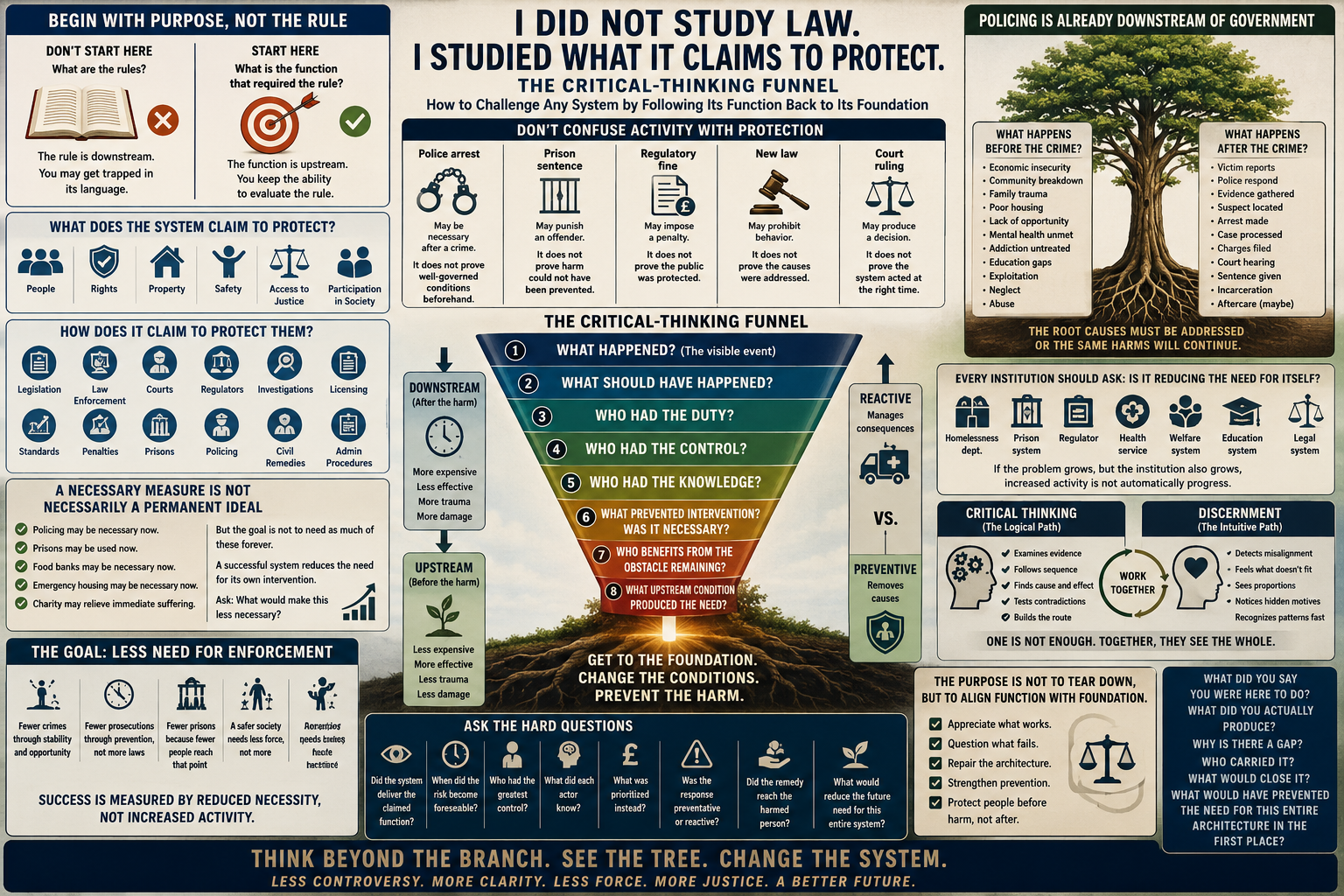
That distinction explains much of how I think, how I investigate institutions and how I develop the Preventable Cases Series. I do not need to begin inside every statute, regulation, department or professional category before I can recognise that something is not functioning. I begin with the claimed purpose, compare it with the result, and then work backwards through the architecture that produced the discrepancy.
The questioning begins simply.
There is a legal system.
Okay.
What does the legal system claim to protect?
People.
Their lives.
Their rights.
Their property.
Their safety.
Their access to justice.
Their ability to participate in society without being subjected to arbitrary harm.
Okay, great.
How does it claim to protect them?
Through legislation.
Law enforcement.
Courts.
Regulators.
Public authorities.
Investigations.
Licensing.
Standards.
Penalties.
Prisons.
Policing.
Civil remedies.
Administrative procedures.
Okay, cool.
Now we have to ask the question that institutions often avoid:
Are all of those mechanisms evidence that the system is successfully protecting people, or are some of them evidence that the system repeatedly failed to protect people earlier?
That question changes everything.
A police arrest may be necessary after a crime.
But it does not prove that the conditions preceding the crime were well governed.
A prison sentence may punish an offender.
But it does not tell us whether the harm could have been prevented.
A regulator may impose a fine.
But the fine does not automatically prove that the public was protected.
A new law may prohibit a behaviour.
But the existence of the law does not tell us whether the conditions producing the behaviour were ever addressed.
A court case may produce a ruling.
But the presence of a ruling does not mean the system acted at the right time.
The institution may be very active at the end of the harm while remaining almost absent at the beginning.
That is where the critical-thinking funnel enters.
Do Not Begin by Asking What the Rule Is
Most people approach an institution by asking:
What are the rules?
I begin with another question:
What was the function that required the rule?
That is a different direction of thought.
The rule is downstream.
The function is upstream.
If I begin with the rule, I may become trapped inside its language. I may start assuming that the existence of the rule proves the legitimacy of the architecture around it. I may become so focused on whether the procedure was followed that I stop asking whether the procedure protects what it claims to protect.
But when I begin with function, I retain the ability to evaluate the rule.
I can ask:
Why was this law created?
Which harm was it supposed to prevent?
Did it prevent that harm?
Did it merely respond after the harm?
Did it create a new obstruction?
Did it protect the public, or did it protect the institution from responsibility?
Did it improve the foundation, or did it create another layer of administration above a failing foundation?
Did it reduce the future need for itself?
That final question is especially important.
A successful preventative system should gradually reduce the volume of crisis intervention required.
A successful healthcare system should reduce avoidable illness.
A successful housing system should reduce homelessness.
A successful education system should reduce ignorance and dependency.
A successful justice system should reduce preventable harm.
A successful police system should not judge its long-term value only by the number of arrests it makes.
The theoretical goal should be that less policing becomes necessary because fewer conditions are producing violence, exploitation, theft, desperation and public instability.
But institutions rarely measure success through reduced necessity.
They often measure success through increased activity.
More investigations.
More prosecutions.
More arrests.
More cases processed.
More fines.
More officers.
More prisons.
More budgets.
The system becomes larger without necessarily making the harm smaller.
A Necessary Measure Is Not Necessarily a Permanent Ideal
One of the most important distinctions people must learn is that something can be necessary now without being desirable forever.
Policing may be necessary now.
That does not mean society should aspire to require the same quantity and intensity of policing indefinitely.
Prisons may be used now.
That does not mean the highest achievement of civilisation is maintaining full prisons.
Emergency accommodation may be necessary now.
That does not mean temporary housing should become a permanent industry.
Food banks may be necessary now.
That does not mean a society should celebrate how many food parcels it distributes without asking why so many people need them.
Charities may relieve immediate suffering.
That does not mean the conditions creating the suffering should be preserved so that charity can continue displaying its generosity.
A measure can be valuable in response to the present while still representing evidence that the deeper system has not yet healed.
The mistake is turning emergency architecture into identity.
The institution begins to believe that because it performs a necessary function today, the need for that function must be defended tomorrow.
But a prevention-led system asks:
What would make this intervention less necessary?
What would reduce the number of people requiring it?
What lies beneath the behaviour being managed?
What would happen if we invested more heavily before the crisis?
How much of the current institution exists because earlier systems were allowed to fail?
That is not an attack on the people working inside the institution.
It is an evaluation of whether the institution is reducing the conditions that justify its existence.
The Policing Example
Take policing.
What is policing supposed to protect?
People.
Their safety.
Their bodies.
Their homes.
Their freedom.
Their ability to move through society without being harmed.
How does policing usually become involved?
Often, after something has already happened.
A person has been assaulted.
Someone has disappeared.
A home has been broken into.
A person has been harassed.
A child has been harmed.
Property has been stolen.
Someone has been raped.
A duty of care has been breached.
A threat has escalated.
At that point, law enforcement may take a statement, gather evidence, locate a suspect, preserve records, issue warnings, make an arrest or refer the case for prosecution.
Those actions may be necessary.
But they are still downstream.
The person has already carried fear.
The harm has already occurred.
The evidence may already be disappearing.
The offender may already have moved.
The victim may already have been forced to repeat the story several times.
The case may already require significantly more time, money, personnel and legal administration than an earlier intervention would have required.
This is where the system must be challenged on timing.
When someone reports that a person is unexpectedly missing and provides credible reasons why the absence is out of character or dangerous, the response should be based on risk, not a mechanical waiting period.
The relevant questions should be:
What is unusual about this disappearance?
Is the person vulnerable?
Was there a threat?
Is there evidence of coercion?
Is the person normally reachable?
Was there a sudden behavioural change?
Are there health concerns?
Is there a known offender?
Is delay likely to increase danger?
The system should not require the family to wait until uncertainty becomes tragedy before treating the concern as legitimate.
Where an institution delays despite credible warning signs, and the delay allows the danger to grow, the question should not only be whether the eventual offender is liable.
The structure of the response should also be examined.
Did the system increase the harm by refusing to act at the moment intervention was most useful?
Did it create a larger criminal investigation by avoiding a smaller preventative response?
Did it spend more taxpayer money because it waited?
Did an internal policy substitute elapsed time for judgement?
Did the institution protect itself procedurally while the person remained unprotected physically?
That is how the funnel works.
We begin with one police interaction.
Then we move upward into operational policy.
Then institutional training.
Then resourcing.
Then legal duties.
Then governmental priorities.
Then the underlying social conditions producing the risk.
Policing Is Already Downstream of Government
Even that is not the beginning.
Policing is already a later-stage response.
Before theft, what happened to economic security?
Before street violence, what happened to community stability?
Before exploitation, what happened to protection and education?
Before repeated offending, what happened to early intervention?
Before substance dependency became criminalised behaviour, what happened to healthcare, trauma support and developmental care?
Before a person became desperate enough to commit survival-driven harm, what happened to housing, food, employment and social assistance?
Not every crime is caused by poverty.
Not every offender lacks basic needs.
Some people harm others despite having stability and opportunity.
Responsibility for deliberate wrongdoing remains.
But the existence of personal responsibility does not erase the existence of structural influence.
A system can hold an individual responsible and still ask what increased the probability of the harm.
That is the wider thinking institutions frequently avoid because it forces responsibility beyond the nearest visible actor.
The offender may be responsible for the act.
The government may still be responsible for the conditions it knew were increasing the likelihood of that category of harm.
The police may be responsible for the response.
The department may be responsible for the policy.
The legislature may be responsible for the legal framework.
The Treasury may be responsible for resource allocation.
The housing system may be responsible for instability.
The education system may be responsible for developmental neglect.
The healthcare system may be responsible for untreated conditions.
Responsibility does not always belong to one actor.
It can exist across the whole chain without becoming meaningless.
The Funnel Moves From Event to Architecture
The critical-thinking funnel can be used on almost anything.
You begin with what happened.
Then you ask what should have happened.
Then you ask who had the duty.
Then who had the control.
Then who had the knowledge.
Then who had the resources.
Then what prevented intervention.
Then whether that obstacle was necessary.
Then who benefited from the obstacle remaining.
Then what upstream condition produced the need for the intervention in the first place.
The questions may look like this:
1. What is the visible event?
A person is missing.
A river is polluted.
A family is homeless.
A child is addicted to a platform.
A patient deteriorates while waiting for treatment.
A worker loses access to employment through automation.
A household cannot afford energy.
2. What was the system supposed to prevent or provide?
Safety.
Clean water.
Shelter.
Childhood protection.
Healthcare.
Accessible work.
Heat and electricity.
3. Did the system deliver the claimed function?
Not whether it processed the complaint.
Not whether it opened a case.
Not whether it sent an automated letter.
Did it deliver the function?
4. When did the risk become foreseeable?
At the point of injury?
Or years earlier?
Was there a report?
A pattern?
Research?
Previous incidents?
Internal knowledge?
A public warning?
5. Who had the greatest control?
The citizen?
The company?
The regulator?
The government department?
The legislature?
The contractor?
The owner?
6. What did each actor know?
Did the company possess internal evidence?
Did the regulator receive complaints?
Did the government commission research?
Did employees raise concerns?
Did the public repeatedly report the same failure?
7. What was prioritised instead?
Profit?
Political convenience?
Institutional reputation?
Administrative simplicity?
Short-term savings?
A lower-priority public project?
Avoidance of conflict?
8. Was the response preventative or reactive?
Did it stop the harm?
Or did it arrive after the scale made action unavoidable?
9. Did the remedy reach the harmed person?
Was there actual restoration?
Or only a fine, announcement, review or institutional promise?
10. What would reduce the future need for the entire response system?
This is the question most institutions do not ask deeply enough.
Because it threatens the permanence of the architecture built around failure.
The Goal Should Be Less Need for Enforcement
A healthy legal system should not aspire to the greatest amount of enforcement possible.
It should aspire to the smallest amount necessary within the safest and most coherent society possible.
That does not mean weakening protection.
It means strengthening prevention.
A society requiring fewer police because people are housed, supported, educated, emotionally developed, meaningfully employed and protected early is not less safe.
It may be safer.
A society requiring fewer prosecutions because harmful systems are stopped before they produce thousands of victims is not soft on accountability.
It is more intelligent about accountability.
A society requiring fewer prisons because fewer people reach the point of serious offending is not refusing justice.
It is preventing the need for its harshest form.
But systems frequently treat the response institution as the solution.
They ask how many police officers are needed.
How many prison places.
How many judges.
How many caseworkers.
How many emergency beds.
How many crisis teams.
Those questions may be necessary.
But they should be followed by:
Why is the demand increasing?
What is feeding it?
Which earlier system is transferring its failure here?
How much would be saved if that earlier failure were repaired?
Otherwise, government continues financing the consequences of its own lack of triage.
Every Institution Should Be Asked Whether It Is Reducing the Need for Itself
This is a powerful test.
Is the homelessness department reducing homelessness?
Is the prison system reducing future crime?
Is the regulator reducing the behaviours requiring enforcement?
Is the health service reducing preventable disease?
Is the welfare system creating viable routes towards stability?
Is the education system reducing dependency on external authority?
Is the legal system reducing the volume of foreseeable harm?
If the institution grows every year while the problem also grows, increased institutional activity should not automatically be described as progress.
The institution may be working hard.
Its employees may be exhausted.
Its budget may be increasing.
Its reports may be longer.
Its data may be more sophisticated.
But the function may still be failing.
Busyness is not prevention.
Processing is not resolution.
Expansion is not proof of success.
This Method Is Not Limited to Law
The funnel can be applied to governments, businesses, schools, relationships, religions, technologies and individual behaviour.
A company says it values its employees.
Okay.
How?
Through pay?
Safety?
Progression?
Workload?
Accountability?
What happens when an employee reports harm?
Does the company protect the person or its reputation?
A school says it educates children.
Okay.
Does it teach them how to think?
How to regulate emotion?
How to understand power?
How to recognise manipulation?
How to participate in society?
Or does it mainly prepare them to reproduce information under examination conditions?
A government says it serves the public.
Okay.
Where does the money go?
Which needs are treated as foundational?
What does the public receive?
What becomes more stable because the government exists?
What would happen differently if the institution did not exist?
A relationship claims to be loving.
Okay.
Does the behaviour protect the other person?
Does it create safety?
Does it expand understanding?
Does it produce repair after harm?
Or does the language of love conceal patterns that repeatedly damage the relationship?
The funnel does not allow a title to substitute for function.
It does not allow “government,” “school,” “law,” “family,” “care,” “justice” or “protection” to prove themselves merely by being named.
It asks them to produce evidence through outcome.
Critical Thinking and Discernment Are Two Sides of the Same Capacity
Critical thinking and discernment are often spoken about as though they belong to separate worlds.
They do not.
Critical thinking is the logical movement.
Discernment is the intuitive movement.
Critical thinking examines sequence, evidence, contradiction, cause, category and consequence.
Discernment detects proportion, coherence, hidden motive, misalignment and what does not feel structurally complete even before every piece has been formally named.
One asks:
Does this argument make sense?
The other asks:
Does this architecture feel true to what it claims to be?
One follows the visible evidence.
The other detects where evidence may be missing.
One breaks the system into parts.
The other senses the relationship between the parts.
They are friends.
They should work together.
Logic without discernment can become technically accurate but humanly blind.
A person may follow every rule and still fail to recognise that the result is wrong.
Discernment without logic can become intuition without structure.
A person may sense that something is wrong but remain unable to demonstrate why, trace the cause or construct a remedy.
Together, they form fuller intelligence.
Discernment opens the question.
Critical thinking builds the route.
Discernment notices the gap.
Critical thinking names the gap.
Discernment recognises the whole.
Critical thinking shows how the whole was assembled.
Intuition Is Not the Enemy of Reason
People often treat intuition as if it were irrational.
But intuition is frequently rapid integration.
It is the mind recognising a pattern before conscious language has caught up.
You notice that something does not fit.
You cannot immediately explain every reason.
Then you investigate.
You gather information.
You compare.
You find that the intuition was responding to contradictions, missing links, changes in behaviour, timing or consequence that the conscious mind had not yet organised.
The answer is not to obey every intuition blindly.
The answer is to investigate it.
Intuition can generate the hypothesis.
Critical thinking can test it.
Discernment can continue evaluating whether the explanation remains coherent as the scope expands.
This is how people rebuild trust in their own intelligence.
Not by choosing between feeling and thought.
By refining the relationship between them.
The More You See, the More Intuition Has to Work With
Intuition does not develop in emptiness.
It grows through observation.
Experience.
Pattern recognition.
Memory.
Curiosity.
Reflection.
Correction.
The more you investigate systems, the more reference points you carry.
The more reference points you carry, the faster you recognise familiar architecture.
You begin to see when responsibility is being fragmented.
When an institution is protecting procedure over purpose.
When a company is transferring cost.
When a government is announcing a future solution to avoid accounting for past delay.
When a regulator is presenting punishment as though it were civilian redress.
When a person is using complexity to make a simple failure feel inaccessible.
The intuition becomes faster because the internal library becomes larger.
That does not make the conclusion infallible.
It makes the initial perception more informed.
You see more because you have trained yourself to look beyond the object.
Most People Are Taught to Accept the Category Before Examining the Function
People are told:
That is the police.
That is the law.
That is the government.
That is education.
That is healthcare.
That is the market.
That is just how the system works.
The category arrives with inherited authority.
Most people then think inside it.
They ask how to access the system.
How to comply.
How to qualify.
How to complain correctly.
How to appeal.
How to prove that they belong within the recognised category of harm.
They do not ask whether the category itself is too narrow.
Whether the threshold is too late.
Whether the institution is processing the consequence of another institution’s failure.
Whether the remedy is designed around public restoration or administrative closure.
The funnel reverses that conditioning.
It says:
Do not let the institution define the entire question before you have examined the function.
The System May Be Protecting Its Own Need to Exist
This is one of the most provocative stages of the funnel.
Does the institution benefit from the continuation of the problem it claims to oppose?
A criminal system receives more cases when prevention fails.
A regulatory body expands when corporate harm increases.
A homelessness sector grows when housing remains unstable.
A charitable industry grows when public systems fail to provide.
A private security industry grows when fear increases.
A digital-safety industry grows after platforms are permitted to create new harms.
This does not mean every worker consciously wants the problem to continue.
It means the structure may be economically sustained by the problem.
The institution can contain kind, committed and exhausted people while still possessing incentives that do not fully align with eliminating its own demand.
That is why goodwill is not enough.
The architecture must be examined.
Who gains budget when the problem grows?
Who loses status if the problem disappears?
Which careers depend on managing consequences?
Which companies profit from repair?
Which politicians gain visibility from reacting?
Who receives less money when prevention succeeds?
Once those questions are asked, we can understand why prevention is so often praised rhetorically and underfunded materially.
Prevention Should Be the Largest Department
If government truly wanted fewer victims, fewer offenders, fewer homeless households, fewer sick people, fewer polluted rivers and fewer children carrying preventable developmental harm, prevention would not be a small programme sitting beside massive reactive systems.
It would be the organising principle.
Housing would be crime prevention.
Education would be health prevention.
Food security would be health prevention.
Childhood development would be future justice prevention.
Accessible mental healthcare would be violence prevention.
Employment access would be housing prevention.
Clean infrastructure would be public-health prevention.
Energy resilience would be poverty prevention.
The departments would still exist.
But they would understand themselves as one connected prevention architecture.
That is what triage should produce.
How Anyone Can Use the Funnel
When you encounter a law, institution, policy, company or relationship, ask:
What does it claim to do?
Then:
Who or what is it supposed to protect?
Then:
What mechanisms has it created?
Then:
Do those mechanisms prevent the harm, or merely manage it afterward?
Then:
Are those mechanisms reducing the need for themselves?
Then:
What conditions keep producing the problem?
Then:
Who controls those conditions?
Then:
Who benefits from the current arrangement?
Then:
Who pays when it fails?
Then:
What would a preventative version look like?
Then:
Why has that version not been prioritised?
Then:
What is the simplest intervention with the widest benefit?
Then:
What happens if nothing changes?
That is how a person moves from complaint to architecture.
From reaction to analysis.
From intuition to evidence.
From evidence to remedy.
The Purpose Is Not to Tear Everything Down
Questioning a system does not mean every part of it has no value.
A police officer may save a life.
A lawyer may secure justice.
A regulator may stop a dangerous company.
A teacher may transform a child.
A social worker may hold a family together.
A judge may produce an important remedy.
The issue is not whether valuable people and functions exist.
The issue is whether their effort is being placed inside an architecture that keeps reproducing the need for emergency intervention.
I can appreciate the necessity of a function while still asking why society requires so much of it.
I can respect a police officer while wanting fewer conditions that require policing.
I can respect a lawyer while wanting fewer people forced into years of litigation.
I can value a food bank while wanting food banks to become less necessary.
I can value a homelessness worker while wanting their work to result in the disappearance of mass homelessness.
Critical thinking does not demand cynical destruction.
It demands functional honesty.
Closing: Follow the Function Until the Contradiction Reveals Itself
I did not study law.
I studied what law claims to protect.
Then I followed the claim.
You protect people?
How?
Through enforcement?
Why is enforcement needed?
What happened before it?
Who could have intervened?
Why did they not?
What conditions produced the harm?
Who controls those conditions?
Who profits from the existing response?
Why is prevention smaller than punishment?
Why does the system arrive after the person has been harmed and call that protection?
Why does it measure the quantity of cases processed rather than the quantity of cases made unnecessary?
That is the funnel.
You keep asking until the institution can no longer hide behind its title.
Until the procedure is brought back into contact with the purpose.
Until activity is separated from effectiveness.
Until the necessary response is distinguished from the permanent ideal.
Until the person at the bottom of the system is connected to the decision made at the top.
Until intuition becomes structured.
Until logic becomes human.
Until discernment and critical thinking recognise each other as two expressions of the same intelligence.
Because the purpose of critical thinking is not merely to become better at arguing.
It is to become harder to govern through contradiction.
It is to become less dependent on authority to tell you whether what you can already see is real.
It is to look at every institution and ask:
What did you say you were here to do?
What did you actually produce?
Why is there a gap?
Who carried it?
What would close it?
And what would have prevented the need for this entire architecture in the first place?
Once people learn to think like that, they no longer see a police case as only a police case.
A housing failure as only housing.
A polluted river as only water.
A missing person as only an investigation.
A law as only a law.
They see the chain.
They see the order.
They see the missing intervention.
They see the whole tree beyond the branch placed in front of them.
And perhaps that is the greatest protection any legal or educational system could ever give a population:
Not merely rules.
Not merely enforcement.
But the ability to understand what the rules are for, recognise when they fail and think clearly enough to build something that requires less force because it creates less preventable harm.


Leave a Reply